Archives par mot-clé : Wrong Prediction(s)?

Icy Silence From Climate Doomers As Controversial Study Warns Of Possible Ice Age

by S. Kent, Nov 13, 2025 in ClimateChangeDispatch 


A controversial study warns a collapsing Atlantic current could trigger a new ice age in the EU and US.

Frozen EU USA
Forget threats of “global boiling.” A possible new ice age and attendant sea level changes could be ushered in as a result of shifts in a key Atlantic current, climate scientists set out in a controversial new study as reported by multiple outlets. [emphasis, links added]

The forecast appears in the journal Communications Earth & Environment and, at face value, runs counter to the incessant cries of “global boiling” that dominate the climate debate.

The apocalyptic predictions came as a result of a collaboration between researchers at the Institute of Oceanology of the Chinese Academy of Sciences (IOCAS) and the University of California, San Diego.

They have been published just a matter of weeks after one-time climate doomer Bill Gates publicly downplayed the impact of temperature fluctuations on the planet and urged humanity to instead focus on other threats to our future.

The NY Post makes clear what is at stake per the new findings in a story headlined: “Climate scientists’ controversial claim Gulf Stream could be near collapse — predicting a new ice age”

“But you said the ice was going to disappear in 10 years!”

by Gavin, Sep é&, 2025 in RealClimate


Almost two decades ago, some scientists predicted that Arctic summer sea ice would ‘soon’ disappear. These predictions were mentioned by Al Gore and got a lot of press. However, they did not gain wide acceptance in the scientific community, and were swiftly disproven. Unsurprisingly, this still comes up a lot. Time for a deeper dive into what happened and why…

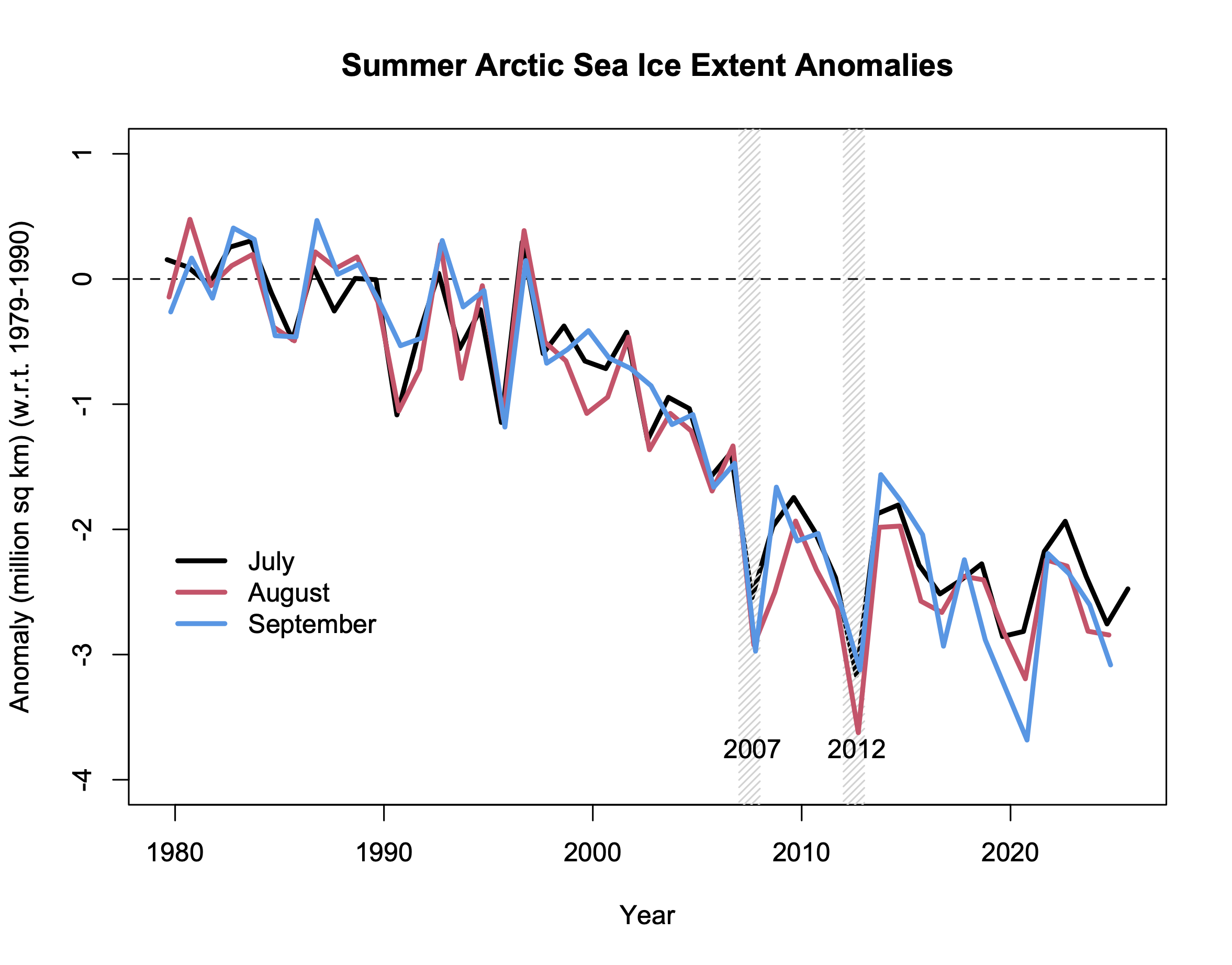
It is unsurprising that climate contrarians bring up past ‘failed predictions’ to bolster their case that nothing need be done about climate change. [It is equally unsurprising that they don’t bother to mention the predictions that were skillful, but let’s not dwell on that!]. For a long time, their favorite supposed ‘failed prediction’ was that there was a consensus about the imminence of a new ice age in the 1970s (a topic we have covered many times), but more recently it has turned to the supposed prediction of Al Gore that “Arctic summer sea ice would disappear” in a short number of years. This has everything – the ‘But Al Gore!’ knee-jerk, a conflation of Al Gore with the scientific community, it’s sounds suitably apocalyptic and, of course, Arctic summer sea ice has not disappeared (it’s only down 40% or so):

Arctic summer sea ice extent anomalies from NSIDC, with the exceptional years of 2007 and 2012 highlighted (data through July 2025).

What did Al Gore actually say?

If we go back to Dec 2007, in the immediate aftermath of the shocking decrease in sea ice that summer, Gore gave his acceptance speech for the Nobel Peace Prize he’d received jointly with the IPCC. In it he said:

Last September 21, as the Northern Hemisphere tilted away from the sun, scientists reported with unprecedented distress that the North Polar ice cap is “falling off a cliff.” One study estimated that it could be completely gone during summer in less than 22 years. Another new study, to be presented by U.S. Navy researchers later this week, warns it could happen in as little as 7 years.

What was he reporting on?

Lomborg: Environmental Doomsday Predictions Collapse As World Becomes Richer And Greener

by B. Lomborg, Sep 16, 2025 in ClimateChangeDispatch 


Fearmongering climate change forecasts keep falling apart.

Climate protest
Over the past half-century, environmentalists have predicted countless calamities. Their extreme predictions were typically wrong, their draconian countermeasures turned out to be mostly misguided, and we should be grateful we didn’t follow their harmful advice. [emphasis, links added]

We need to keep this history in mind as we are inundated with stories of climate Armageddon.

This summer, headlines about the Great Barrier Reef painted a dire picture of climate-driven devastation, with environmental journalists claiming the reef was on the brink of collapse.

In reality, data shows the reef has its fourth-highest coral cover since records began in 1986, revealing these alarmist narratives to be vastly misleading.

Truth and Scares

Sensible, life-improving environmental policies over recent decades were rarely sold with fearmongering. Rich countries have dramatically reduced air and water pollution through technological advances and then through regulation.

Poorer countries are starting to do the same thing, as they emerge from poverty and can afford to be more environmentally concerned. Forests have expanded globally, with this growth clear in rich countries and increasingly across the world.

This isn’t the scary future environmentalists promised us.

A recent peer-reviewed study counts almost a hundred environmental doomsday predictions that environmentalists have made over the past half-century.

Two-thirds of them predicted doom before August 2025, and all of these have turned out to be false.

NYT Falsely Blames Climate Change For Hurricane Erin Despite No Evidence

by L. Lueken, Aug 28, 2025 in ClimateChangeDispatch


Rapid intensification of Hurricane Erin isn’t unusual, and attribution studies don’t prove climate change caused it.

The New York Times (NYT) published an article titled “How Climate Change Affects Hurricanes Like Erin,” in which they rely on rapid attribution analysis to claim that climate change is making rapidly intensifying hurricanes more likely, implying that the storm was worsened by global warming. This is false. [emphasis, links added]

Attribution studies are generally not based on solid scientific evidence and, therefore, not provable. Plus, there is a lack of evidence to support the notion that rapid intensification is becoming more common.

At the outset, the NYT claimed that hurricane Erin’s effects, such as they are, “are made worse by global warming,” even though the storm stayed offshore. The storm intensified quickly from a Category 1 to a Category 5 hurricane, and NYT claims that “[a]s the planet warms, scientists say that rapidly intensifying hurricanes are becoming ever more likely.”

First, it is important to note that just because a storm is among the most rapidly intensifying on record, it does not mean that there were not similar storms that went unrecorded.

As mentioned in a previous Climate Realism post about hurricane Erin, hurricane measurement technology is far advanced today than it was even a few decades ago.

Before the widespread use of Hurricane Hunter flights starting in the 70s where offshore storms were first closely monitored and directly measured throughout their lifespan, other rapidly intensifying storms would not have made the record.

So there is uncertainty about the record there.

Beyond that, attribution researchers and the NYT would like to blame hurricane intensification all on warm sea surface temperatures, but rapid intensification occurs in response to a variety of factors lining up just right.

Similar claims were made two years ago concerning Hurricane Otis. That storm also intensified rapidly over a single day, turning into a Category 5 before hitting the west coast of Mexico.

Otis did not intensify under expected conditions; thunderstorm bursts that forecasters were unable to predict are now believed to have been responsible for its rapid intensification.

Just as some scientists say more intense storms are more likely with warming, other scientists say that they will become less likely to form or less likely to strike land.

The NYT neglected to mention these perspectives, focusing its story on the scarier opinions that support the narrative that climate change is responsible for worsening extreme weather events.

In fact, as Climate at A Glance: Hurricanes details, there is no data suggesting hurricanes are becoming more frequent or more intense.

Media Championed Study Overstating Climate Damages, Went Radio Silent As Major Flaws Emerged

by K. Killough, Aug 20, 2025 in ClimateChangeDispatch


Typhoon flooding aftermath
When a study published last year in the peer-reviewed journal Nature found that climate change would cost the globe $38 trillion per year by 2050 — ultimately reducing GDP by 19% over the next 24 years — many media outlets were quick to jump on it. [emphasis, links added]

“Climate change will make you poorer,” CNN warned. The Guardian reported on the study under the headline, “Climate crisis: average world incomes to diminish by nearly a fifth by 2050.”

Reuters and Forbes also carried articles on the study, and the Associated Press reported that “New study calculates climate change’s economic bite will hit about $38 trillion a year by 2049.”

According to the activist publication Carbon Brief, only one other study received more mentions in the media in 2024.

However, the study — referred to as “the Potsdam study” — has since been found to have serious flaws.

When these are corrected, according to the researchers who uncovered the problems, it reduces the study’s estimate of climate “damages” through 2100 by two-thirds. This means the estimates aren’t statistically different from zero.

The study has been cited by organizations influencing policy across the globe, including the World Bank, the Organization for Economic Co-operation and Development, and the U.S. Congressional Budget Office. Sen. Sheldon Whitehouse, D-R.I., cited the study last yearand again in July — both times entering the study into the Congressional Record.

While The Washington Post reported on the errors, none of the other outlets have so far revisited the story.

Flaws called “devastating” to the paper’s conclusions


Scientists Warn About Scientists’ Warnings

by W. Eschenbach, Aug 19 2025, in WUWT


Only a journalist truly committed to the ancient art of panic-clickbait could squeeze all the world’s existential dread into a headline like, “A Giant, Destructive Volcanic Eruption Is Set to Shake the World in the Coming Months, Bringing About the End of Mankind, Scientists Warn.” They’ve accompanied it with the following graphic, in case you weren’t adequately terrified.

The dead giveaway? “Scientists Warn.” Whenever you see those two words sandwiched together above the fold, you know you’re about to step into a wonderland of wild extrapolation, qualified maybes, and models run so far into the future they boomerang back with “robots take over” as the y-axis.

They start out as follows:

The German “Summer From Hell” That Never Came…Earlier Wild Forecasts Backfire

by P. Gosselin, July 29, 2025 in NoTricksZone 


Already as early as May 2025 predictions of a hellish record-breaking hot summer with possibly thousands of heat deaths were forecast – much of it based on the unusually dry and warm spring that had gripped much of Central Europe at the time. 

Hat-tip: Frank Bosse at Klimanachrichten

The online Frankfurter Rundschau printed a weather column by meteorologist Dominick Jung just over 2 weeks ago, on July 13, warning of a “looming, huge heat dome” for the rest of the summer over Central Europe.

German TWC meteorologist Jan Schenk had already made a prediction in Focus magazine on June 10, 2025: “According to this, we can expect extreme heat and drought in Germany, especially in July and August.”

Then came reality.

Just recently, even the climate-alarmism purveyor Der Spiegel had to concede that “it feels more like autumn.”

Plenty of rain has been falling, along with snow high in the Alps.

So what was behind all the ridiculous hellish-summer forecasts? Veteran Swiss meteorologist Jörg Kachelmann in an interview with the online Bild called all the constant exaggerations and distortion: “Symbols of an education problem with us.”

At the end of June, 2025, after having made ridiculous made predictions a year earlier in 2024, biologist Mark Benecke lectured again on climate and weather to an auditorium, showing such weather model maps:

Predictive? Study Finds IPCC Climate Models Overstate Warming Up To 4.5°F

by K. Richard, May 28, 2025 in ClimateChangeDispatch


A new evidence-based study provides compelling evidence that for decades, the IPCC has been engaged in “advocacy research,” or the “antiscientific practice of undertaking research designed to support a given hypothesis.” [emphasis, links added]

The IPCC favored climate model parameters used to support the narrative that climate change is primarily caused by humans burning fossil fuels (referred to as the Anthro models in the study).

[It is] so fraught with errors that even a stripped-down benchmark model that merely projects future temperatures will not deviate from the historical average, overwhelmingly outperforming the IPCC’s modeling.

“The IPCC’s models of anthropogenic climate change lack predictive validity. The IPCC models’ forecast errors were greater for most estimation samples – often many times greater – than those from a benchmark model that simply predicts that future years’ temperatures will be the same as the historical median.

The IPCC’s Anthro models, which hypothesize that (primarily) CO2 will foment dangerous global warming over the coming decades, woefully overestimated the warming from 1970-2019 by anywhere from 1.8°C [3.2°F] to 2.5°C [4.5°F].

“The errors of forecasts from the anthropogenic models for the era of concern over man-made global warming, starting in 1970, were 1.8°C (AVL), 1.7°C (AVSL), 2.3°C (AVR), and 2.5°C (AVSR) warmer than the measured temperatures.”

Over the 2000 to 2019 period, the Anthro models’ forecast errors were a staggering 16 times greater than the simple benchmark model’s errors.

“…forecasts for the years 2000 to 2019 from models estimated with 50 observations of historical data (1850 to 1899) have MdAEs [median absolute errors] of around 17°C or 1,600 percent greater than the 1°C MdAE of forecasts from the naïve benchmark model.”

In contrast, the authors found the models that centered on Total Solar Irradiance (TSI) as a climate change factor did indeed have predictive validity, and their error ranges were much smaller.

Considering the magnitude of the error in using CO2 emissions as a basis for climate forecasts, the authors conclude the Anthro models’ unreliability “would appear to void policy relevance.”

CNN Lies in its AMOC Collapse Story: Another Flip-Flop in a Long Line of Alarmist Claims

by A. Watts, May 23, 2025 in ClimateRealism


A recent CNN article by Laura Paddison, titled “A crucial system of ocean currents is slowing. It’s already supercharging sea level rise in the US, references new research on the Atlantic Meridional Overturning Circulation (AMOC) to claim the current is slowing down leading to rising seas and costly, deadly coastal flooding. This false claim is based solely on a single, as yet unpublished and unverified, study which used a single climate model’s projections. Evidence, such as other studies and historical reporting on AMOC trends demonstrate that there is no consensus on the status of the AMOC. Rather, scientists’ predictions and the media’s reporting on the AMOC have been flip-flopping for nearly two decades—unable to decide whether AMOC is speeding up, slowing down, or staying steady.

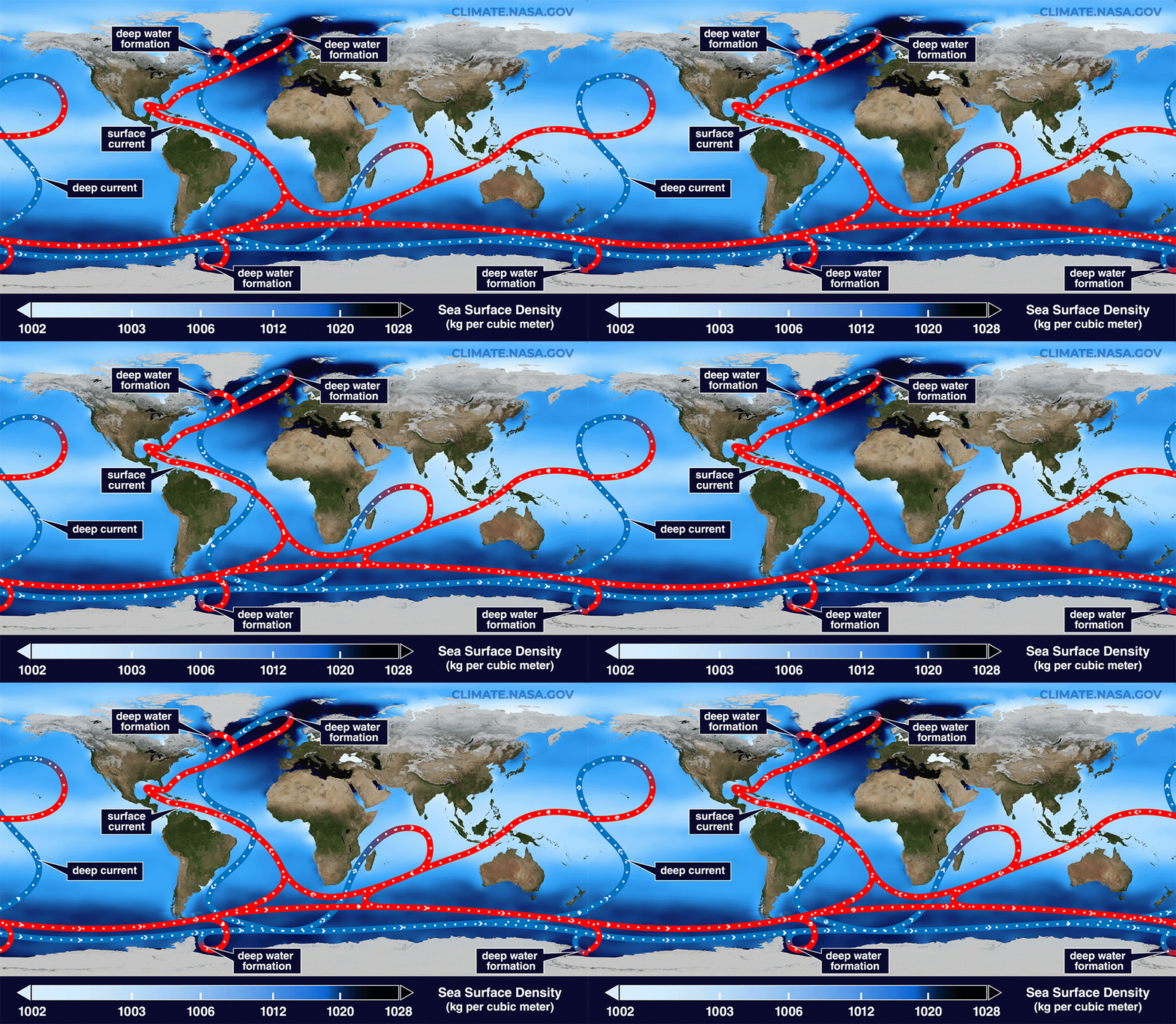
Figure1. A simplified illustration of the global “conveyor belt” of ocean currents that transport heat around Earth. Red shows surface currents, and blue shows deep currents. Deep water forms where the sea surface is the densest. The background color shows sea-surface density. The AMOC is the currents in the Atlantic Ocean off the east coast of the US. Source: NASA/Goddard Space Flight Center Scientific Visualization Studio.

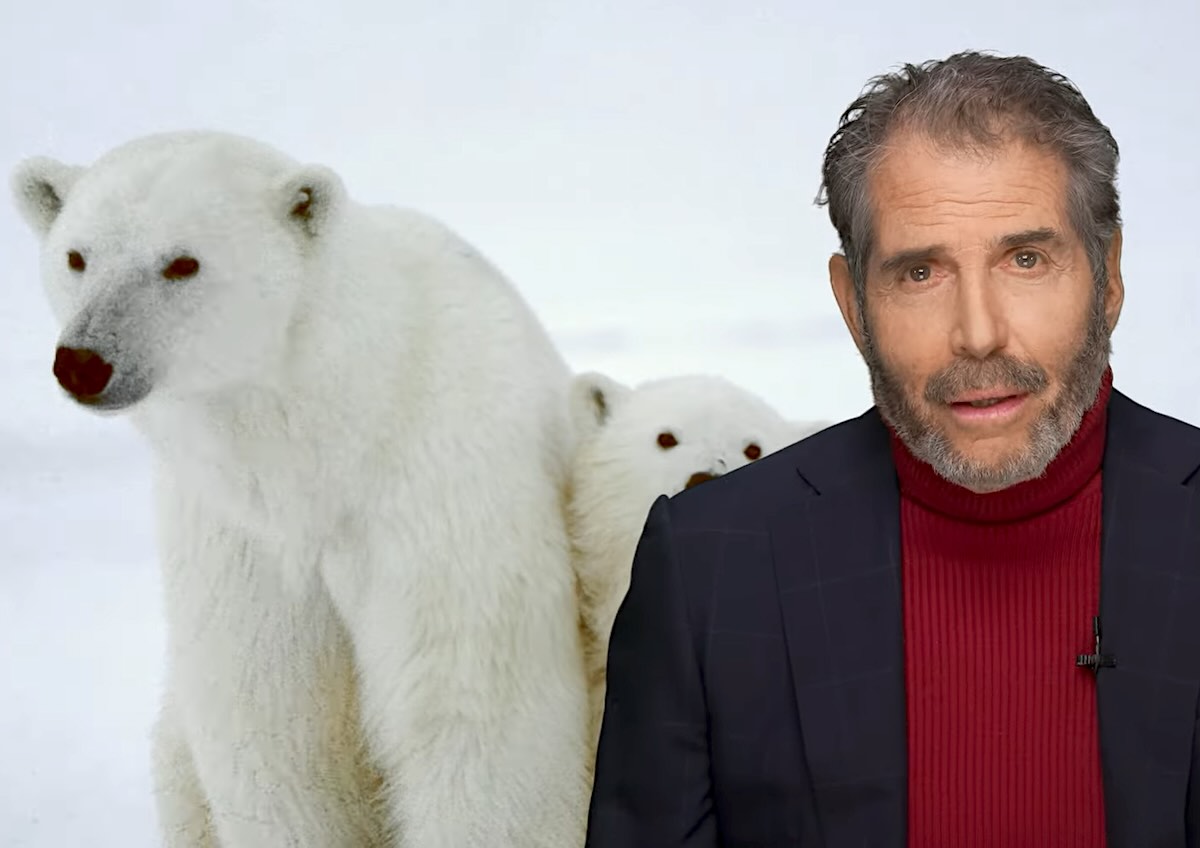
Climate Change Myths Part 1: Polar Bears, Arctic Ice, And Food Shortages

by J. Stossel, Apr 16, 2025 in ClimateChangeDispatch 


stossel climate myths
Climate zealots tell us the end is near. It’s the era of “global BOILING!” says the UN secretary-general.

Climate alarmists say the Arctic will soon be ice-free and cities underwater!

But what do the facts say?

The facts say that the climate change fanatics’ catastrophic claims are wrong.

In this video and the next, we’ll debunk 7 myths about climate change.

Climate Doomsday Predictions That Flopped Spectacularly

by A. Stiles, Mar 7, 2025 in ClimateChangeDispatch


10 catastrophic climate forecasts that failed.

It’s been almost six years since the delinquent child activist Greta Thunberg promoted a so-called scientist’s warning that “climate change will wipe out all of humanity unless we stop using fossil fuels” by 2023. [emphasis, links added]

The scientist in question, Harvard University professor James Anderson, also predicted “there will be no floating ice remaining” in the Arctic Ocean by 2022 absent a “Marshall Plan-style endeavor in which all of the world takes extreme measures to to transition off of fossil fuels completely within the next five years.”

That didn’t happen, but climate activists are still warning that the Arctic could be ice-free at some point between 2035 and 2067.

Not surprisingly, there is a long history—dating back to the 1970s—of so-called climate scientists and government bureaucrats making catastrophic predictions about the environment that never materialized.

Here are 10 of the most egregious examples. Enjoy!

1) In 1970, S. Dillon Ripley, a wildlife conservationist who served as secretary of the Smithsonian Institute, warned that 75 percent to 80 percent of species would be extinct by 1995.Wrong.

2) In 1970, Kenneth Watt, an ecologist and professor at the University of California, Davis, warned that “there won’t be any more crude oil,” that “none of our land will be usable” for agriculture, and the world would be 11 degrees colder by the year 2000. False.

3) In 1970, biologist Paul Ehrlich at Stanford University warned that by the end of the decade up to 200 million people would die each year from starvation due to overpopulation, life expectancy would plummet to 42 years, and all ocean life would perish. Extremely false.

4) In 1970, Peter Gunter, a professor at North Texas State University, predicted that “world population will outrun food supplies” and “the entire world, with the exception of Western Europe, North America, and Australia, will be in famine” by the year 2000. Didn’t happen.

5) In 1971, Dr. S. I. Rasool, an atmospheric scientist at NASA, predicted the coming of a “new ice age” within 50 years. Incorrect.

6) In 1975, Ehrlich, the Stanford biologist, warned that 90 percent of tropical rainforests and 50 percent of species would disappear within 30 years. Erroneous. 

7) In 1988, Hussein Shihab, environmental affairs director of the Maldives, warned that his island nation would be completely underwater within 30 years, which wouldn’t even matter because experts also predicted the Maldives would run out of drinking water by 1992. False.

8) In 2004, a Pentagon analysis warned of global anarchy due to climate change. Major European cities would be underwater by 2020, at which point Britain would suffer from a “Siberian” climate. Extremely false.

9) In 2008, Bob Woodruff of ABC News hosted a two-hour climate change special warning that New York City could be underwater by 2015, among other apocalyptic predictions. Didn’t happen.

10) In 2009, former vice president and climate activist Al Gore predicted the Arctic Ocean would have no ice by 2014, which is the same thing Greta Thunberg said would happen by 2022. Nope

No, BBC, Atlantic Hurricane Season Did Not Break Records

by P. Homewood, Dec 1, 2024 in NotaLotofPeopleKnowThat


The 2024 Atlantic hurricane season is coming to an end and it has been an active one overall.

There have been 18 named tropical storms, with 11 of those reaching hurricane strength and five becoming major hurricanes – category three and above.

An average season would bring 14 storms, seven hurricanes and three major hurricanes.

Some records have been equalled or broken but the active weather was not spread evenly across the season. In fact the middle of the season, normally the peak, was very quiet.

https://www.bbc.co.uk/weather/articles/cp87g4p73kxo

.

Despite claims of “records broken”, the BBC makes no mention of what these might be!

Unsurprising, because no records were broken, unless you count Beryl which was claimed to be the earliest Cat 5 on record, which has no significance whatsoever.

Instead, although above average, the number of hurricanes and major ones were not exceptional at all.

Prophets Of Doom: Why A New 2024 Climate Report Is Fueled By Fear, Not Facts

by Dr M. Wielicki, Oct , 2024 in ClimateChange Dispatch 


The recent article published in BioScience, “The 2024 state of the climate report: Perilous times on planet Earth,” is a parade of exaggerated claims and half-truths, a propaganda piece designed to scare the public into adopting misguided policies while turning a blind eye to the real drivers of human progress. [emphasis, links added]

While it projects an image of scientific rigor, a closer look reveals that most of these dire warnings don’t even align with the IPCC‘s latest report, particularly when scrutinizing the IPCC AR6’s scientific foundations.

Math Confirms Foolishness of Climate Alarmism

by G. Wrightstone, Aug 11, 2024 in WUWT


The science of climate change often is presented in complicated language that speaks of computer models and the theoretical inputs and outputs thereof and concludes that the globe is on the verge of “boiling.” Well, leave it to three physicists — steeped in calculus and such arcane matters as the behavior of molecules and the nuclear charge of atoms — to simplify the analysis and arrive at a much less alarming determination.

Straightforward calculations … show that eliminating U.S. CO2 emissions by the year 2050 would avoid a temperature increase of 0.0084 degrees Celsius,” states a brief paper authored by Drs. Richard Lindzen, Massachusetts Institute of Technology; William Happer, Princeton University; and William A. van Wijngaarden, York University, Toronto. On the Fahrenheit scale, the value of averted warming is 0.015 degrees.

In short, the amount of warming averted by eliminating CO2 emissions in the United States would be too small to measure. The paper bolsters the position of those who argue that a changing climate is the product of natural forces, that human-induced carbon dioxide emissions can have only a minuscule effect on global temperature, and that CO2 is a valuable plant food and not a pollutant.

Rather than using theoretical assumptions about various factors that are fed into computers, the paper’s calculation relies almost exclusively on “observable data” that are widely accepted and publicly available, says Dr. Happer.

“This is something anybody with a calculator can figure out,” said the scientist, who may be best known for his contribution to a laser-based technology for destroying incoming ballistic missiles as part of the so-called Star Wars program of the 1980s. Continuer la lecture de Math Confirms Foolishness of Climate Alarmism

Peer reviewed skepticism

by D. Wojick, July 9, 2024 in WUWT


A fine skeptical journal article waded through green pal review. Wonder of wonders!

The journal is the American Journal of Economics and Sociology. The article title is perfectly clear: “Carbon dioxide and a warming climate are not problems”.

See https://onlinelibrary.wiley.com/doi/10.1111/ajes.12579

But it is an “Early View Online Version of Record before inclusion in an issue” so get it before it gets too hot for the Journal. I understand it is very popular so the green screams are deafening.

Alas it is paywalled but the lengthy free Abstract is as clear as the title. Here is the conclusion:

“Observations show no increase in damage or any danger to humanity today due to extreme weather or global warming (Crok & May,  2023, pp. 140–161; Scafetta,  2024). Climate change mitigation, according to AR6, means curtailing the use of fossil fuels, even though fossil fuels are still abundant and inexpensive. Since the current climate is arguably better than the pre-industrial climate and we have observed no increase in extreme weather or climate mortality, we conclude that we can plan to adapt to any future changes. Until a danger is identified, there is no need to eliminate fossil fuel use.”

The authors are Andy May and Marcel Crok and as the first parenthetical reference above indicates they are building on prior work. Their 53 References are not paywalled and quite interesting. Continuer la lecture de Peer reviewed skepticism

Surveys Show Vast Bulk of Antarctica Is Stable or Growing

by  H.S. Sterling, June. 16, 2024 in WUWT


We hear a lot in the mainstream media about massive ice loss in Antarctica and how it may radically increase sea level rise. The West Antarctic ice sheet and ice on the Antarctic peninsula are in decline, with some massive glaciers threatening to break off; however, conditions there are not the same as for the vast bulk of the continent. First, the subsurface geothermal/volcanic activity that is driving much of the melting in West Antarctica is not affecting the vast bulk of the continent. And the shifting ocean oscillations, which affect the continent’s climate as a whole, have a much greater, more direct impact on the Antarctic peninsula, the northern-most part of the continent, a relatively narrow spit of land surrounded by oceans and beset be clashing currents.

The conditions of the sea ice around Antarctica don’t matter in the sea level equation. Sea ice changes dramatically each season, waxing and waning with the seasons and the currents. For the limited period for which we have consistent measurements, Antarctica’s sea ice has set new records for extent and for low levels during the most recent period of climate change. Neither, however, impact sea levels since floating ice doesn’t displace water.

NASA reported in 2015 that because East Antarctica, which makes up the bulk of the continent, was adding ice and snow, Antarctica as whole may, in fact, be gaining ice on net, implying it could be modestly taking away from sea level rise rather than adding to it. At least from 1992 to 2015, when the report was published.

No, CNN, Climate Change Is Not Driving Doomsday Glacier’s Decline

by S. Burnett, Mar 5, 2024 in ClimateChangeDispatch


A CNN story implies that supposed human-caused climate change is causing the Thwaites Glacier to melt, causing sea level rise. This is false.

Data show that Antarctica has not been warming. Also, the study CNN cited itself shows the glacier has declined dramatically and recovered repeatedly in the past, all without human contribution, suggesting the present decline is part of a natural cycle. [emphasis, links added]

At approximately the size of Florida, the Thwaites Glacier is the broadest glacier on Earth. The Thwaites Glacier is often referred to as the “Doomsday Glacier,” based on the belief that a complete collapse would cause as much as two feet of sea level rise over time.

The CNN story, “The ‘Doomsday Glacier’ is rapidly melting. Scientists now have evidence for when it started and why,” discusses a new study published in the journal Proceedings of the National Academy of Sciences, which determined when the present decline began.

“By analyzing marine sediment cores extracted from beneath the ocean floor, researchers found the glacier began to significantly retreat in the 1940s, likely kicked off by a very strong El Niño event — a natural climate fluctuation which tends to have a warming impact,” reports CNN.

“Since then, the glacier has been unable to recover, which may reflect the increasing impact of human-caused global warming, according to the report.”

Although the commencement of … Thwaites’ decline may now have been determined, any prognostications about future trends for the glacier are pure speculation, unsupported by historical evidence or data about present Antarctic trend.

The underlying reports determined that the Thwaites glacier’s decline commenced in the 1940s probably prompted by a powerful El Nino event that warmed the abutting waters.

….

EXCLUSIVE: A Third of U.K. Met Office Temperature Stations May Be Wrong by Up to 5°C, FOI Reveals

by C. Morrison, March 1, 2024 in TheDailySceptic


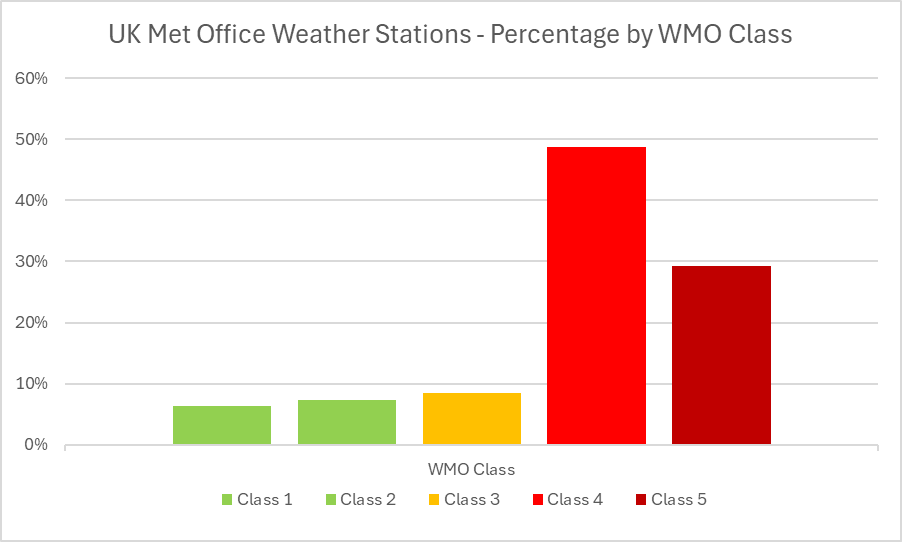
Nearly one in three (29.2%) U.K. Met Office temperature measuring stations have an internationally-defined margin of error of up to 5°C. Another 48.7% of the total 380 stations could produce errors up to 2°C, meaning nearly eight out of ten stations (77.9%) are producing ‘junk’ or ‘near junk’ readings of surface air temperatures. Arguably, on no scientific basis should these figures be used for the Met Office’s constant promotion of the collectivist Net Zero project. Nevertheless, the state-funded operation frequently uses them to report and often catastrophic rises in temperature of as little as 0.01°C.

Under a freedom of information request, the Daily Sceptic has obtained a full list of the Met Office’s U.K. weather stations, along with an individual class rating defined by the World Meteorological Office. These CIMO ratings range from pristine class 1 and near pristine class 2, to an ‘anything goes’ or ‘junk’ class 5. The CIMO ratings penalise sites that are near any artificial heat sources such as buildings and concrete surfaces. According to the WMO, a class 5 site is one where nearby obstacles “create an inappropriate environment  for a meteorological measurement that is intended to be representative of a wide area”. Even the Met Office refers to sites next to buildings and vegetation as “undesirable”. It seems class 5 sites can be placed anywhere, and they come with a WMO warning of “additional estimated uncertainties added by siting up to 5°C”; class 4 notes “uncertainties” up to 2°C, while class 3 states 1°C. Only 13.7%, or 52 of the Met Office’s temperature and humidity stations come with no such ‘uncertainty’ warnings attached.

The above graph shows the percentage totals of each class. Class 1 and 2, identified in green, account for just 6.3% and 7.4% of the total respectively. Class 3 identified as orange comes in at 8.4%. The graph shows the huge majorities enjoyed by the darkening shades of red showing classes 4 and 5. It is possible that the margins of error identified for classes 3, 4 and 5 could be a minus amount – if for instance the measuring device was sited in a frost hollow – but the vast majority are certain to be pushed upwards by heat corruptions.


UK Met Office Fails to Retract False Claim of “More Intense” Storms Due to Climate Change

by C. Morrison, Feb 23, 2023 in WUWT


The Met Office is refusing to retract a claim made by a senior meteorologist on BBC Radio 5 Live that storms in the U.K. are becoming “more intense” due to climate change. This is despite admitting in Freedom of Information (FOI) documents that it had no evidence to back up the claim. The Global Warming Policy Foundation (GWPF) noted the “false” claim seriously misled the public and demanded a retraction. The Daily Sceptic covered the story last Thursday and has since contacted the Met Office on three occasions seeking a response. “False information of this kind does much to induce climate anxiety in the population and I am sure you would agree such errors should be corrected by any reputable organisation,” it was noted. No reply was received – no retraction has been forthcoming.

The storm claim was made by Met Office spokesman Clare Nasir on January 22nd and led to an FOI request for an explanation by the investigative journalist Paul Homewood. The Met Office replied that it was unable to answer the request due to the fact that the information “is not held”. Interestingly, the Met Office’s own 2022 climate report noted that the last two decades have seen fewer occurrences of maximum wind speeds in the 40, 50, 60 knot bands than previous decades. The Daily Sceptic report went viral on social media with almost 3,000 retweets on X, while GWPF’s demand for retraction was covered by the Scottish Daily Express.

The lack of action by the state-funded Met Office is very interesting. Extreme weather is now the major go-to explanation for the opinion that humans largely control the climate, despite a general lack of scientific evidence. Backing away from this ‘settled’ narrative risks damaging a potent tool nudging populations across the world towards the collectivist Net Zero political project. Mainstream media usually take care to fudge their reporting of any direct link, using phrases such as ‘scientists say’ and sprinkling words ‘could’ and ‘might’ in the copy. The mistake Nasir made was to forget this basic requirement of broadcast fearmongering.

There appears to be an arrogance around the Met Office, an arrogance it shares with many other organisations and scientists promoting Net Zero …

….

Wrong Again: 50 Years of Failed Eco-pocalyptic Predictions

by M. Ebell & S.J. Milloy, 18 Sep 2019 in CompetitiveEnterpriseInstitute


Thanks go to Tony Heller, who first collected many of these news clips and posted them on RealClimateScience

SUMMARY

Modern doomsayers have been predicting climate and environmental disaster since the 1960s. They continue to do so today.

None of the apocalyptic predictions with due dates as of today have come true.

What follows is a collection of notably wild predictions from notable people in government and science.

More than merely spotlighting the failed predictions, this collection shows that the makers of failed apocalyptic predictions often are individuals holding respected positions in government and science.

While such predictions have been and continue to be enthusiastically reported by a media eager for sensational headlines, the failures are typically not revisited.

Can we trust projections of AMOC weakening based on climate models that cannot reproduce the past?

by G.D. McCarthy & L. Caesar, Nov 2023 in PhilosophicalTransactions


The Atlantic Meridional Overturning Circulation (AMOC), a crucial element of the Earth’s climate system, is projected to weaken over the course of the twenty-first century which could have far reaching consequences for the occurrence of extreme weather events, regional sea level rise, monsoon regions and the marine ecosystem. The latest IPCC report puts the likelihood of such a weakening as ‘very likely’. As our confidence in future climate projections depends largely on the ability to model the past climate, we take an in-depth look at the difference in the twentieth century evolution of the AMOC based on observational data (including direct observations and various proxy data) and model data from climate model ensembles. We show that both the magnitude of the trend in the AMOC over different time periods and often even the sign of the trend differs between observations and climate model ensemble mean, with the magnitude of the trend difference becoming even greater when looking at the CMIP6 ensemble compared to CMIP5. We discuss possible reasons for this observation-model discrepancy and question what it means to have higher confidence in future projections than historical reproductions.

This article is part of a discussion meeting issue ’Atlantic overturning: new observations and challenges’.

Climate Expert: ‘Decidedly Unscientific Justifications’ Used To Keep Worst-Case Scenario Alive

by R. Pielke Jr, Oct 23, 2023 in ClimateChangeDispatch


Physicist Richard Feynman once described a key difference between religion and science as follows: “Religion is a culture of faith; science is a culture of doubt.” Scientific reasoning and provisional truths that result are based on evidence, not simply belief.

As the debate has grown over the continued misuse of outdated climate scenarios in research and policy, I’ve noted a tendency for defenders of RCP8.5 to rely on decidedly unscientific justifications for its continued misuse. [emphasis, links added]

Among defenders of the indefensible are leading scientists and even the Intergovernmental Panel on Climate Change (IPCC).

For instance, the recent IPCC AR6 report acknowledged our recent work on scenario plausibility but reasserted the value of RCP8.5:

Another Tipping Point Cancelled—Claims Of Runaway Greenland Ice Melt Overblown

by  Klimanachrichten, Oct 23,2023 in ClimateChangeDispatch


We have carefully read the definition of a “tipping point” as conveyed by the Potsdam Institute (PIK):

“It’s like a pencil that you push further and further over the edge of a table with your finger. First nothing happens – then it falls.” That’s what the PIK website says.

Nothing can bring the pencil back to the table except a failure of gravity, which is not conceivable. [emphasis, links added]

Then PIK lists various “elements” that are supposed to exhibit such behavior. To the Greenland Ice Sheet (GrIS), one finds:

There are indications that the tipping point, which leads to an almost complete loss of ice in the long term (about 10,000 years), could probably be reached at a global warming of just under 1.5°C (possible from 0.8°C global warming, at the latest at 3°C).“

Now there’s a paper on the subject that has appeared in “Nature“, which paints a different picture. It finds that even after a possibly “critical warming threshold” has been crossed, “the pencil does not fall down”:

We find several stable intermediate ice-sheet configurations … that return to the present-day state if the climate returns to present-day conditions.”

In addition, models often determine the warming in Greenland (the root of the evil) using the mean global warming rate and then apply an “Arctic amplification” factor to each warming to determine the temperature swing in Greenland.

The paper states:

Recently, it has been shown that the Arctic warms four times faster than the global average and thus substantially exceeds previous estimates and projections from climate models.

Arctic amplification of this magnitude would reduce the safe space for the GrIS substantially. However, surface temperatures around Greenland might not increase that severely in the future.

Observations since 2000 now show that during this period, the warming of the Arctic is far from uniform:

“RUN AWAY MELTING” IS AN IPCC EMBARRASSMENT; -23C (-9.4F) IN SWEDEN; + NORWEGIAN STATISTICS BUREAU COUNTERS GLOBAL WARMING HYSTERIA

by Cap Allon, Oct 23, 2023 in Electroverse


“RUN AWAY MELTING” IS AN IPCC EMBARRASSMENT

It’s been over 15-years since the release of the IPCC’s AR4 report which called for “run away melting” of Arctic sea ice. This bold proclamation, devised from a baseless extrapolating of a few ‘bad’ years, will be the ruin of the agency.

….

See also: Greenland’s Tipping Point Cancelled? Claims Of A Runaway Melt Are Overblown