Le gouvernement belge a adopté le 16 juillet 2002 l’arrêté royal relatif à l’établissement des mécanismes visant à la promotion de l’électricité produite à partir de sources d’énergie renouvelable. Ces dernières sont dominées, en Belgique par l’éolien et le photovoltaïque (l’éolien étant prédominant) c.à.d. des productions électriques intermittentes.
Ce reformatage de la génération électrique a été décidé dans la précipitation sans analyser l’impact sur le système électrique, sur la compétitivité des entreprises et sur le pouvoir d’achat des ménages, la priorité étant la réduction des émissions de gaz à effet de serre (GES). Un tel manque flagrant de préparation est également patent dans la mise en place du tournant énergétique allemand (Energie Wende), décision politique particulièrement désastreuse. (…)
Voters across Europe have lost faith in politics partly because of “unachievable targets” on renewable energy, said German Energy Minister Peter Altmaier, who rejected calls from a group of other EU countries to boost the share of renewables to 33-35% of the bloc’s energy mix by 2030. —EurActive, 12 June 2018
The German government is about to concede officially that the country is on course to widely missing its 2020 climate target. —Clean Energy Wire, 12 June 2018
Trois révolutions énergétiques depuis à peine plus d’un siècle. Nous sommes entrés dans la troisième révolution énergétique. La première vit le jour avec la machine à vapeur et participa à l’essor du charbon, avec la seconde le moteur thermique dérôna le charbon au profit des hydrocarbures, et la troisième révolution industrielle, en cours, est technologique et basée sur les énergies ‘vertes’ ou énergies intermittentes et l’informatique ou le numérique. Cette problématique vient d’être abordée dans un excellent ouvrage paru en 2018 .
Peut-on dire que cette progression récente suivant ces trois phases majeures de la technologie s’est effectuée dans le sens d’un meilleur respect de l‘état de la Planète. Bien que cela soit le discours officiel, rien n’en est moins sûr. Pourquoi ? Tout simplement par le méconnaissance de tout un chacun à comprendre ou savoir ce qui est réellement utilisé dans les énergies vertes et numériques. L’actuelle ‘transition énergétique’ a bon dos et elle a toutes les vertus, elle est propre, quant aux les hydrocarbures, le charbon, l’uranium et CO2 (ennemi n° 1) ils ont tous les maux, et sont tous sales. Il n’est pas un jour où cette opposition nous est rappelée…
by M. Shellenberger, President, Env. Progr., May 16, 2018 in WUWT
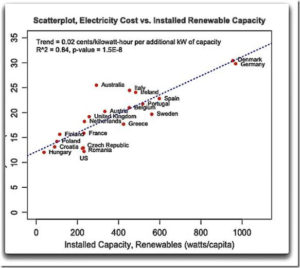
Over the last year, the media have published story after story after story about the declining price of solar panels and wind turbines.
People who read these stories are understandably left with the impression that the more solar and wind energy we produce, the lower electricity prices will become.
And yet that’s not what’s happening. In fact, it’s the opposite.
by Michael Kruger, April 21, 2018 in P Gosselin NoTricksZone
Michael Kruger at German skeptic site Science Skeptical here writes about how solar energy indutry in Germany has disintegrated spectacularly.
What follows are 4 charts that show us some shocking trends, and how in reality the German solar industry has seen a bloodbath that can be rated as one of the worst in a long time. The reality is that Germany’s green revolution is far from being a model for the world.
Fifteen years ago, Ken Caldeira, a senior scientist at the Carnegie Institution, calculated that the world would need to add about a nuclear power plant’s worth of clean-energy capacity every day between 2000 and 2050 to avoid catastrophic climate change. Recently, he did a quick calculation to see how we’re doing.
Not well. Instead of the roughly 1,100 megawatts of carbon-free energy per day likely needed to prevent temperatures from rising more than 2 ˚C, as the 2003 Sciencepaper by Caldeira and his colleagues found, we are adding around 151 megawatts. That’s only enough to power roughly 125,000 homes.
At that rate, substantially transforming the energy system would take, not the next three decades, but nearly the next four centuries. In the meantime, temperatures would soar, melting ice caps, sinking cities, and unleashing devastating heat waves around the globe (see “The year climate change began to spin out of control”).
L’ Alliance solaire internationale est une initiative lancée par l’Inde et la France lors de la COP21 qui vise à « augmenter de manière significative la production d’électricité solaire » dans les 121 pays situés en totalité ou en partie entre les tropiques du Cancer et du Capricorne (des pays en voie de développement pour la grande majorité).
by Benny Peiser, February 23, 2018 in ClimateChangeDispatch
Ørsted must repair up to 2,000 wind turbine blades because the leading edge of the blades has become worn down after just a few years at sea.
Siemens Gamesa also does not want to comment on the costs, but the company’s Danish subsidiary has just provided 4.5 billion Danish Krone ($750 million) or 16% of its revenue to guarantee its commitments (…)
Germany’s utopian dream of transforming itself into the world’s green powerhouse is collapsing as its political and media establishment is mugged by reality. The country’s climate obsession has turned into one of the country’s biggest political and economic handicaps, making Germany almost ungovernable.
Dans un essai édifiant, le journaliste Guillaume Pitron dévoile “la face cachée de la transition énergétique et numérique”. Selon lui, le recours aux éoliennes, panneaux solaires et autres véhicules électriques n’a fait que déplacer l’impact de l’activité humaine sur les écosystèmes.
Germany’s utopian dream of transforming itself into the world’s green powerhouse is collapsing as its political and media establishment is mugged by reality. The country’s climate obsession has turned into one of the country’s biggest political and economic handicaps, making Germany almost ungovernable.
Important information has emerged in the field of energy, and yet it is as if European politicians ignore it. Judge for yourself based on just the following facts (…)
Earlier this year, DEFRA published a report by the Air Quality Expert Group into the impacts of biomass on air quality. The results make for startling reading.
The hidden consequences of a massive use of intermittent renewable energy systems for electricity production are highlighted, using existing electricity production data from Germany from the last 5 years, where presently a system is in operation with an installed capacity of about 50 GW in wind turbines (sum of onshore and offshore wind) and 40GW in photovoltaic panels.This fleet of intermittent renewable systems produces more than half of the yearly renewable electrical energy of Germany, the rest being produced by hydro, so-called ‘biomass’ and a very small fraction of geothermal sources
The level of renewable use is now so high in Germany that serious electric grid reliability and stability issues now exist which require both fossil power plant emergency backup for failed renewable production and dictate rejecting renewable energy to ensure operation of fossil plants required for electric grid reliability and stability.
Après la sortie américaine de l’Accord de Paris, il se confirme que l’Europe s’engagera, seule, dans la voie d’une électricité tout intégralement générée par de l’énergie renouvelable (soleil, vent).
Hundreds of built and proposed hydroelectric dams may significantly harm life in and around the Amazon by trapping the flow of rich nutrients and modifying the climate from Central America to the Gulf of Mexico. These findings, published in Nature, emerge from a multidisciplinary, international collaboration of researchers from 10 universities, led by scientists at The University of Texas at Austin.
To meet energy needs, economic developers in South America have proposed 428 hydroelectric dams, with 140 currently built or under construction, in the Amazon basin — the largest and most complex network of river channels in the world, which sustains the highest biodiversity on Earth.
The 2017 Edition of the REN21 Renewables Global Status Report reveals a global energy transition well underway, with record new additions of installed renewable energy capacity, rapidly falling costs, and the decoupling of economic growth and energy-related carbon dioxide (CO2) emissions. This year’s report continues REN21’s long-standing tradition of providing the most up-to-date data and informative infographics to detail renewable energy’s contribution to the energy transition.
The electric car has dropped out of favor in the country that pioneered renewable energy.
Sales in Denmark of Electrically Chargeable Vehicles (ECV), which include plug-in hybrids, plunged 60.5 percent in the first quarter of the year, compared with the first three months of 2016, according to latest data from the European Automobile Manufacturers Association (ACEA). That contrasts with an increase of nearly 80 percent in neighboring Sweden and an average rise of 30 percent in the European Union.
Water reservoirs created by damming rivers could have significant impacts on the world’s carbon cycle and climate system that aren’t being accounted for, a new study concludes.
The study, conducted by researchers at the University of Waterloo and the Université libre de Bruxelles, appears in Nature Communications. It found that man-made dam reservoirs trap nearly one-fifth of the organic carbon moving from land to ocean via the world’s rivers.
Un des plus grands parcs éoliens offshore au monde a été mis en service le 8 mai au large des Pays-Bas. Ce parc, baptisé « Gemini », dispose d’une puissance installée de 600 MW et pourrait produire, selon son exploitant, 2,6 TWh par an grâce aux vents « les plus forts et les plus réguliers
Germany’s SolarWorld, once Europe’s biggest solar power equipment group, said on Wednesday it would file for insolvency, overwhelmed by Chinese rivals who had long been a thorn in the side of founder and CEO Frank Asbeck, once known as “the Sun King”.
La géologie, une science plus que passionnante … et diverse