Contrairement à ce que les médias tentent de vous faire croire, le changement climatique global n’est pas une cause majeure de disparition d’espèces. Une récente étude publiée en mars 2019 dans le journal Frontiers in Ecology and the Environment vous le démontre : la cause majeure d’extinction est l’introduction d’espèces exotiques envahissantes (EEE) dans les écosystèmes. Ce phénomène, bien connu des biologistes et confirmé par l’IUCN(Union Internationale pour la Conservation de la Nature), est malheureusement peu connu du grand public.
1. Introduction
En se déplaçant d’un continent à l’autre, l’être humain a toujours emmené avec lui toute une série de plantes et d’animaux qui se retrouvaient ainsi en dehors de leurs limites biogéographiques habituelles. Avec le développement du commerce international ce phénomène ne fait que s’amplifier. Par exemple, à l’intérieur de l’Union Européenne, le nombre d’EEE aurait augmenté de 76% entre 1970 et 2007. Bien que l’impact écologique de la plupart des espèces introduites est inconnu ou semble négligeable, il est démontré que certaines introductions d’espèces ont provoqué des changements substantiels dans des écosystèmes[1]. Ces changements incluent souvent la disparition d’espèces locales[2]. On a d’abord pensé que ces phénomènes d’extinction étaient exagérés et que des espèces locales pouvaient également être à la base d’extinctions[3], et certains auteurs pensent même que les efforts déployés pour contrôler ou éradiquer les espèces étrangères introduites ne seraient pas nécessaires[4]. Cependant, personne n’a jamais vraiment testé si les espèces introduites provoquaient plus ou moins d’extinctions par rapport aux espèces locales ou aux autres causes d’extinctions. Cette question a donc été étudiée par l’équipe de Tim Blackburn (University College London, UK) dans une récente publication de mars 2019[5]. Ils ont pour cela utilisé la base de données des extinctions globales fournie par l’IUCN.
…
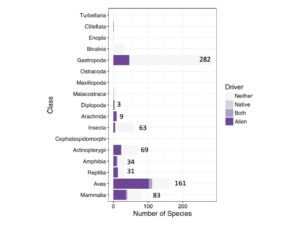
Figure 1. Nombre d’extinctions animales récentes (catégories IUCN “extinct” [EX] et “extinct in the wild” [EW]) pour différents groupes d’animaux (chiffres issus de la Table 3a de l’IUCN). Les couleurs renseignent sur les causes des extinctions (“Driver”); par exemple le mauve foncé est employé pour les EEE (“Alien”), les extinctions causées par des espèces locales (“Native”) sont en mauve clair. La catégorie “Neither” comporte les autres causes d’extinction ou alors des causes inconnues (source, Blackburn et al. 2019).
It is little wonder that kids are scared when grown-ups paint such a horrific picture of global warming.
For starters, leading politicians and much of the media have prioritized climate change over other issues facing the planet. Last September, United Nations Secretary-General António Guterres described climate change as a “direct existential threat” that may become a “runaway” problem. Just last month, The New York Times ran a front-page commentary on the issue with the headline “Time to Panic.” And some prominent politicians, as well as many activists, have taken the latest report from the United Nations Intergovernmental Panel on Climate Change (IPCC) to suggest the world will come to an end in just 12 years.
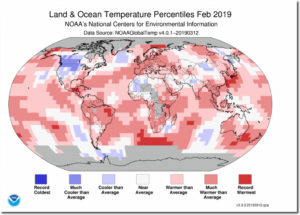
According to NCEI’s Regional Analysis, South America, Europe and Oceania had a February temperature that ranked among the eight warmest Februarys on record.
There is no such word as “Februarys” – plural for February is Februaries. But besides the fact they are illiterate, they are also lying
…
It looks like the world is burning up, with just a few slightly cool areas. It has an official government seal on it, so it must be accurate, right?
The map below shows where NOAA actually had surface temperatures in February.
Reagan observed: “It isn’t so much that liberals are ignorant. It’s just that they know so many things that aren’t so.”
So it is with the Green New Deal. Most liberals regard it as a simple proposition: Global warming is a really big problem, and it’s our fault, so let’s fix it.
But closer analysis reveals that the argument for the Green New Deal rests upon a long chain of interdependent assertions, every one of which must be believed for the problem to be of sufficient peril to warrant their drastic solution.
Here are links in their chain of logic. If you doubt the truth of any single step, you must discard the entire argument.
Most people were taken in by the false story of human-caused global warming. We can include all the students participating in the classroom walkout to demand governments stop climate change, organized by 16-year-old Greta Thunberg. Her goal is to keep global temperatures below 2 degrees Celsius above pre-industrial levels. Apparently, she has no idea that the temperature was near or above that level for most of the last 10,000-years in a period known as the Holocene Optimum.
They are taken in by the false claim that a minute amount of human-produced CO2 is effectively controlling the entire atmospheric system since 1950 and causing environmental collapse through global warming. They don’t know that there is an upper limit to the amount that CO2 can increase temperature. They don’t know that the average level of CO2 over the last 250 million years is 1200 ppm. They don’t know that every projection of temperature by the UN Intergovernmental Panel on Climate Change (IPCC) since 1990 was wrong. To paraphrase Winston Churchill, how did so few, fool so many, to such an extent, for so long?
Genesis of a Shakedown: New Records Expose Children’s Marches as Long-Planned Component of Litigation Campaign
…
These public records produced mere days after 60 Minutes’s promotional segment, and days before the nationwide children’s climate walkouts, affirm:
the climate litigation campaign was expressly grounded in this failure of “conventional approaches” otherwise known as our constitutional system
it was to be “linked to youth climate movement (world-wide marches)”;
it would be accompanied by a press strategy including documentaries featuring children;
the meeting was acknowledged, but this strategy laid out there was “not to be publicized”;
the strategy sought both a cooperative federal administration “Consent decrees (would be ideal)” — and to “Bring selected carbon majors to the table, then what?”
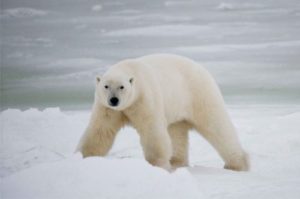
Abundant ice in Svalbard, East Greenland and the Labrador Sea is excellent news for the spring feeding season ahead because this is when bears truly need the presence of ice for hunting and mating. As far as I can tell, sea ice has not reached Bear Island, Norway at this time of year since 2010 but this year ice moved down to the island on 3 March and has been there ever since. This may mean we’ll be getting reports of polar bear sightings from the meteorological station there, so stay tuned.
Something this big today would surely fry electrical grids, GPS, and communications. It may be bigger than the Carrington Solar event of 1859.
Scientists have found evidence of a huge blast of radiation from the Sun that hit Earth more than 2,000 years ago. The result has important implications for the present, because solar storms can disrupt modern technology.
The team found evidence in Greenland ice cores that the Earth was bombarded with solar proton particles in 660BC. The event was about 10 times more powerful than any since modern instrumental records began.
The Sun periodically releases huge blasts of charged particles and other radiation that can travel towards Earth.
The particular kind of solar emission recorded in the Greenland ice is known as a solar proton event (SPE). In the modern era, when these high-energy particles collide with Earth, they can knock out electronics in satellites we rely on for communications and services such as GPS.
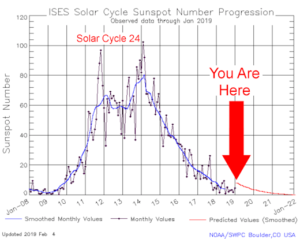
March 1, 2019: There are 28 days in February. This year, all 28 of them were spotless. The sun had no sunspots for the entire month of Feb. 2019. This is how the solar disk looked every day:
…
How does this affect us on Earth? The biggest change may be cosmic rays. High energy particles from deep space penetrate the inner solar system with greater ease during periods of low solar activity. Indeed, NASA spacecraft and space weather balloons are detecting just such an increase in radiation. Cosmic rays can alter the flow of electricity through Earth’s atmosphere, trigger lightning, potentially alter cloud cover, and dose commercial air travelers with extra “rads on a plane.”
As February ended, March is beginning … with no sunspots. Welcome to Solar Minimum!
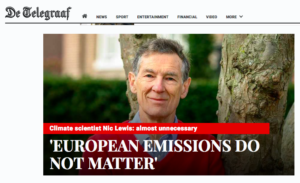
“What really matters is: what happens in developing countries such as China, India, Indonesia, Brazil and Nigeria”, says Lewis, who gave a presentation at De Groene Rekenkamer Foundation this week in Amsterdam. According to him, it is much more important that developing countries quickly become richer and how rising CO2 emissions that this entails can be limited.
“We have a lot of knowledge and expertise in Europe. We can spend our money better than investing billions in subsidies and other climate policies that have virtually no effect on global emissions.”
Lewis would prefer to see investments in the development of clean nuclear energy or techniques to get CO2 out of the air and shut down coal-fired plants. “That could then be rolled out over the rest of the world.”
You know we have overcome the dictatorship of the proletariat here in East Germany, and now we are facing a dictatorship of the climate law. I do not consider this law to be compatible with a market economy. –Andreas Lämmel, CDU member of the German Bundestag, Deutschlandfunk, 23 February 2019
Climate policy is increasingly splitting German’s coalition government of Christian Democrats (CDU/CSU) and Social Democrats (SPD). The coal exit was supposed to be part of a comprehensive climate law. But if and when that comes no one knows. That’s because the coalition committee has actually stopped the far advanced legislative project of Federal Environment Minister Svenja Schulze (SPD), according to the government. —Andreas Mihm, Frankfurter Allgemeine Zeitung, 19 February 2019
Le paysage énergétique du globe et de la France a peu changé durant les siècles antérieurs au 19ème siècle. Napoléon et César se déplaçaient, s’éclairaient, se chauffaient, s’habillaient à peu près de la même façon. Depuis le début du 19ème siècle, en revanche, ce paysage change rapidement et radicalement. Les énergies traditionnelles (hommes, animaux, vent, eau) ont été presque éliminées, et remplacées par des énergies nouvelles (charbon, pétrole, électricité, nucléaire). Dans le domaine des transports, par exemple, la marche à pied, le cheval et le bateau à voile ont été supplantés par le chemin de fer, puis l’automobile, puis l’avion, et par le bateau à moteur. Ces changements ont largement contribués à l’extraordinaire amélioration du niveau de vie enregistrée au cours des deux derniers siècles, dans les pays dits développés d’abord, puis, depuis un demi-siècle dans les pays dits en développement.
Until now, carbon dioxide has been dumped in oceans or buried underground. Industry has been reluctant to implement carbon dioxide scrubbers in facilities due to cost and footprint.
What if we could not only capture carbon dioxide, but convert it into something useful? S. Komar Kawatra and his students have tackled that challenge, and they’re having some success.
Princeton professor emeritus William Happer’s role in forming a White House climate security committee didn’t sit well with a number of media outlets, including The New York Times, which called the eminent physicist a “denialist.”
The headline prompted a backlash from those who object to applying a derogatory label associated with Holocaust disbelief to scientists and others who challenge worst-case climate-change scenarios.
The Las Vegas Valley Snow Event: What happened? Did we see this coming? Yes and no. We had been seeing very small chances for snow in the valley for a few days, but it wasn’t until Sunday afternoon that the hi-resolution models were consistently indicating that western parts of the valley could see up to 3 inches and up to an inch elsewhere. That’s when the decision was made to issue the Winter Weather Advisory.
by Rod Liddle, February 17, 2019 in GWPF/SundaTimes
Such a hectic life these kids lead. On Friday, my lovely 13-year-old daughter was out on the streets of Canterbury with her schoolmates demanding something be done, right now, about climate change, because adults are letting us down and it’s our future and it isn’t fair that horrid right-wing old white men are deliberately destroying the planet.
The next day she was at Gatwick with her mum, off for a half-term ski trip to Norway. I hope she got the irony: all those emissions, just so she could have a chance to snap her femur in half. Still, at least she wasn’t going to the Alps, where the wilderness has been murdered by skiers, the mountains stripped of forest and festooned with lifts and blue runs created by snow machines. Is there a more environmentally ruinous pastime than skiing?
A provocative hypothetical question: What if the Moon was not there? Video follows.
This giant rock lights up the night and can even change colors. So what would we do without it? Would we all need night vision goggles? How would it affect the ocean tides? Our seasons? Or our sleep cycles? Or would the consequences be far more drastic?
As the closest celestial body to our planet, the moon exerts a gravitational pull that governs much of what happens here on Earth Take the sea, for example. If you like surfing, you can thank the moon when the moon’s gravitational pull tugs on our spinning Earth, the oceans respond, giving us high tides in some parts of the world, and low tides elsewhere.
The Research Center for Gas Innovation is developing technology to separate CO2 and methane in oil and gas exploration and store it in offshore salt caverns
Fundação de Amparo à Pesquisa do Estado de São Paulo
A set of technologies that is expected to have its first results four years from now is designed to resolve one of the world’s greatest oil and gas exploration challenges today: carbon dioxide (CO2) and methane (CH4) emission in the atmosphere.
The innovation, the result of a patent deposited in 2018, consists of injecting the CO2 and CH4 that comes from wells during oil extraction into salt caverns as a way to reduce the amount of carbon gas in the emissions.
by J.C. Maurin, 8 février 2019, in ScienceClimatEnergie
A partir des notions intuitives de chaleur et température, les physiciens (Carnot, Thomson, Clausius, Maxwell, Boltzmann) arrivèrent progressivement à la notion scientifique de température thermodynamique. La Conférence Générale des Poids et Mesures adopta en 1927 l’échelle thermodynamique proposée en 1911, puis l’unité kelvin en 1954.
La notion de température thermodynamique nécessite que l’équilibre thermique soit atteint, ce qui n’est pas le cas dans l’atmosphère de la Terre. Il n’existe pas une « température thermodynamique de l’atmosphère ». A défaut, on utilise une « moyenne des températures » mesurées en divers points de l’atmosphère. Mais la température thermodynamique étant une grandeur intensive, une moyenne, quelle que soit son élaboration, ne peut jouer qu’un rôle d’indicateur. L’usage est néanmoins d’utiliser le kelvin pour les indicateurs. On exprimera de préférence les variations des indicateurs sous forme relative. L’indicateur va être dépendant de l’échantillonnage (spatial et temporel) des mesures et surtout de son mode d’élaboration.
by P. Homewood, February 11, 2019 in NotaLotofPeopleKnowThat
London, 11 February: The scientific paper behind newspaper claims that insect populations were threatened with extinction was based on data known to be unreliable. That’s according to the Global Warming Policy Foundation, which today called for the paper to be withdrawn.
The paper, by US scientists Bradford C Lister and Andres Garcia, claimed that a rapid decline in insect populations in a rainforest in Puerto Rico was the result of rising temperatures. The Washington Post called the study “hyperalarming”, while the Guardian discussed climate change causing “insect collapse”.
However, the authors’ evidence that temperatures had, in fact, risen turns out to be based on a single weather station, which was known to be unreliable because of undocumented changes to equipment and location resulting in a substantial and abrupt increase in recorded temperatures in September 1992.
Since 1992, temperatures at this station have actually declined.
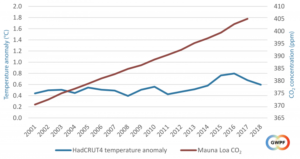
2018 was the fourth warmest year of the instrumental period (started 1850) having a temperature anomaly of 0.91 +/- 0.1 °C – cooler than 2017 and closer to the fifth warmest year than the third. But of course there are those that don’t like to say the global surface temperature has declined.
When Thomas Edison established his Pearl Street power plant in New York City in 1892, he used coal for fuel, not wood. Wood fuel could not compete with the cost of coal in 1892 and it still can’t today. Nevertheless, burning of biomass is widely regarded as sustainable and promoted as a solution for climate change, especially in Europe.
Today, Europe produces about 17 percent of its energy and 29 percent of its electricity from renewable sources. Biomass accounts for about 19 percent of the electricity generated from renewables. Since 2000, Europe’s biomass consumption for energy production is up 84 percent.
For example, biomass fuel produced 18 percent of Denmark’s electricity in 2017. For the last two decades, Denmark has been reducing coal-fired power plant output, but adding biomass-powered plants. Since 2000, Denmark’s use of coal fuel for electricity decreased 63 percent. But the use of biomass fuel for electricity in Denmark increased by a factor of five, almost exactly replacing the decline in coal output. About three-quarters of the biomass consumed by Denmark is wood, with most of it imported.
La stratégie des anciens président iranien et vénézuélien – Ahmadinejad et Chavez comme Maduro à sa suite – qui rêvaient de mettre à genoux les États-Unis grâce à leurs réserves de pétrole, a lamentablement échoué. Qui plus est, l’Iran et le Venezuela ne sont pas des pays où il fait bon vivre…
by SCE-info, 31 janvier 2019 in ScienceClimatEnergie
Chers Collègues scientifiques signataires de la pétition (ici),
Vous avez signé une pétition en tant qu’académique scientifique. Tous les signataires le sont-ils ? Avez-vous remarqué des signataires qui n’ont pas existé ou qui sont décédés ? Trofik Lysenkom, inconnu sur Google, par contre Trofim Lysenko a bien existé (1898-1976) et reste de triste mémoire dans le monde scientifique. Outre cet aspect cocasse, il y a plus grave : en tant que signataires vous cautionnez que la science est dite (‘the science is settled’) et si tel est bien le cas alors vous ignorez de très nombreuses publications scientifiques, émanant de scientifiques de ‘haut vol’ qui montrent que le doute est permis, qu’il doit rester la règle en science, et que la climatologie ne se résume pas aux énoncés simplistes de la pétition (qui ne mentionne aucune références pour argumenter). Bien entendu vous avez peut-être lu des articles et vous vous êtes fait une opinion. Dans ce cas, vous avez exercé votre esprit critique et vous avez tout compris de la climatologie. Il n’y a donc plus de doute pour vous, et du fait de votre signature la science est effectivement dite. L’essentiel des politiques et médias, bien qu’ils n’aient pas une grande connaissance scientifique, pensent comme vous.
Dans cet article, qui se veut une ouverture au débat, nous allons donner notre point de vue aux questions qui ont suscité votre adhésion. Nous ne ferons pas de politique, notre site Science, Climat et Energie (SCE) ayant une vocation scientifique. Nous souhaitons cependant que ceux qui n’ont pas fait l’effort de lire la manière dont les publications sont validées par le GIEC aillent consulter le site du GIEC.
Vous l’aurez compris, la climatologie est une science jeune, fort complexe, et contrairement aux affirmations et ‘matraquages’ quotidiens, elle est loin d’être comprise.
There has been almost a death watch going on for Chicago, looking for an all time new all-time low temperature record to beat the previous -27°F. For those wishing for a new datapoint, Chicago didn’t beat the all time record, but did set a new record for the day…
…
La géologie, une science plus que passionnante … et diverse