Archives par mot-clé : Disasters

Study Finds Extreme Weather Database Exaggerates Global Disaster Trends

by Climate Discussion Nexus, Aug 28, 2025 in ClimateChangeDispatch 


Disasters don’t count if you don’t count them.

City flood aftermath
According to its publishers, a dataset called EM-DAT, which stands for Emergency Events Database, so it’s not even an acronym, lists “data on the occurrence and impacts of over 26,000 mass disasters worldwide from 1900 to the present day.” [emphasis, links added]

Which makes it perfect for studying long-term trends. And what’s even better, for the climate change crowd anyway, is that, as the authors of a 2024 study noted, “There are very strong upward trends in the number of reported disasters.”

But as the same authors noted in the very next sentence, “However, we show that these trends are strongly biased by progressively improving reporting.” Simply put, before 2000, reporting of small disasters that caused fewer than 100 deaths was hit-and-miss.

So, historically, the record of giant disasters that killed hundreds or more persons is reasonably complete, but not the record of small ones.

And the authors of the recent study argue that once they adjust for the effect of underreporting, the trends in disaster-related mortality go away.

The paper, “Incompleteness of natural disaster data and its implications on the interpretation of trends,” by a group of scientists in Sweden, began by noting that they are not the first to point out the problem.

The weird thing is that many authors who have pointed out this massive flaw have then gone ahead and used the data anyway, as though it did not exist, or at least they had not noticed it:

“Various authors (Field et al., 2012; Gall et al., 2009; Hoeppe, 2016; Pielke, 2021) have noted that there are reporting deficiencies in the EM-DAT data that may affect trends then proceeded to present trend analyses based on it without correction. Even the EM-DAT operators themselves discourage using EM-DAT data from before 2000 for trend analysis (Guha-Sapir (2023)). Yet recently, Jones et al. (2022) investigated the 20 most cited empirical studies utilising EM-DAT as the primary or secondary data source, and found that with only one exception the mention of data incompleteness was limited to a couple of sentences, if mentioned at all.”

Having made that point, their study then digs into the records and shows that in the post-2000 period, there is a steady pattern relating the frequency of events to the number of fatalities (F) per event.

It follows something that statisticians call “power-law behaviour” in which the more extreme an outcome, the rarer it is, not in a straight line but in an inverse exponential relationship, where extreme things, [like] large numbers of fatalities in a disaster, are a lot rarer than small numbers on a logarithmic curve. (For instance, in boating accidents, there are tens of thousands of individuals falling out and drowning for every Titanic.)

Hydrological, meteorological, and geophysical disasters all follow power-law behaviour in recent decades. But in earlier decades, the relationship doesn’t appear to hold because of a deficiency of low-fatality disasters in the data, rather than because it wasn’t still true then..

21st Century Global Disasters

by P. Homewood, Aug 13, 2023 in NotaLotofPeopleKnowThat


A new peer-reviewed paper out this week by Alimonti and Mariani asks whether global disasters have increased. Their answer is that they have not (and if the name sounds familiar, it is the same Alimonti whose paper is being improperly retracted — more fresh info on that in the coming days).

As I read their paper today I noticed that the time series they reported from the EM-DAT databaselooked a bit different than that I had last explored and presented here at THB late last year. So today I downloaded the most recent data from EM-DAT, and indeed there has been some changes to the most recent three years, presumably due to late entries into the database (however I will enquire as all post-hoc dataset updates should be documented). EM-DAT has been funded since the late 1990s by the U.S. Agency for International Development.

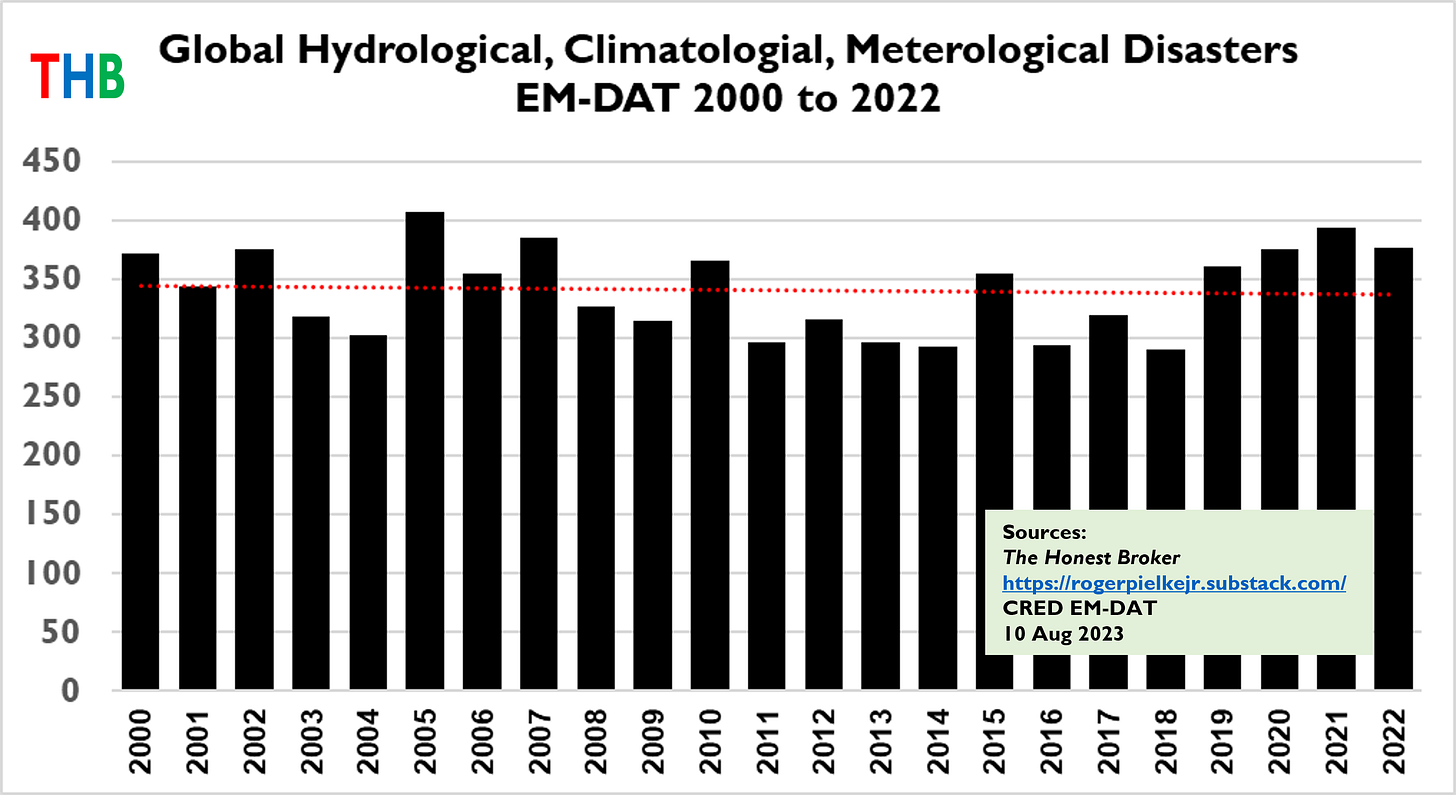
Below is the updated time series of global hydrological, climatological and meteorological disasters in the EM-DAT database, along with the linear trend, over the period 2000 to 2022.

De Telegraaf Misled By UN Disaster Report Researcher

by P. Homewood, Oct 20, 2020 in NotaLotofPeopleKnowThat


You will all recall the latest UN report, which claimed there had been a massive rise in “reported disasters” in the last two decades, compared to the previous two.

The Dutch newspaper, De Telegraaf, published an article in response complaining that the UN were not comparing like with like, because many smaller disasters were simply never recorded in the past. They also published this reply from Joris van Loenhout, researcher at the Belgian Centre  for  Research on the Epidemiology of Disasters  (CRED):

“From about 1960-1970 onward, the completeness of the data is much greater, and the share of missing disasters much smaller. We are constantly working to improve completeness, and this is also happening for previous years and decades. For this reason, statements made in 2004 and 2006 are now somewhat outdated, as the completeness of the database has since improved,”

 I have now had time to analyse CRED’s database, EM-DAT, and have the figures to show that Loenhout has not been telling the truth.


In their 2004 report, “Thirty Years of Natural Disasters”, CRED included this table of the number of natural disasters:

New book shreds the “climate to extreme weather” link

by  Anthony Watts, August 30, 2018 in WUWT


After nearly every hurricane, heatwave, drought, or other extreme weather event, commentators rush to link the disaster with climate change. But what does the science say?

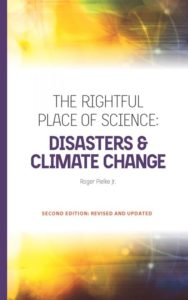
In this fully revised and updated edition of Disasters & Climate Change, renowned political scientist Roger Pielke Jr. takes a close look at the work of the Intergovernmental Panel on Climate Change, the underlying scientific research, and the climate data to give you the latest science on how climate change is related to extreme weather.

What he finds may surprise you and raise questions about the role of science in political debates.