Study: Ocean sediments support theory that comet impact triggered Younger Dryas cool-off

by A. Watts, Aug 13, 2025 in WUWT
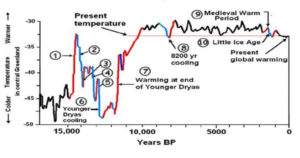

Northern Hemisphere cooling 12,800 years ago generally thought to be caused by glacial meltwater; new geochemical evidence might support comet impact.

Analysis of ocean sediments has surfaced geochemical clues in line with the possibility that an encounter with a disintegrating comet 12,800 years ago in the Northern Hemisphere triggered rapid cooling of Earth’s air and ocean. Christopher Moore of the University of South Carolina, U.S., and colleagues present these findings in the open-access journal PLOS One on August 6, 2025.

During the abrupt cool-off—the Younger Dryas event—temperatures dropped about 10 degrees Celsius in a year or less, with cooler temperatures lasting about 1,200 years. Many researchers believe that no comet was involved, and that glacial meltwater caused freshening of the Atlantic Ocean, significantly weakening currents that transport warm, tropical water northward. In contrast, the Younger Dryas Impact Hypothesis posits that Earth passed through debris from a disintegrating comet, with numerous impacts and shockwaves destabilizing ice sheets and causing massive meltwater flooding that shut down key ocean currents.

However, the impact hypothesis has been less well supported, lacking any evidence from ocean sediments. To address that gap, Moore and colleagues analyzed the geochemistry of four seafloor cores from Baffin Bay, near Greenland. Radiocarbon dating suggests the cores include sediments deposited when the Younger Dryas event began. To study them, the researchers used several techniques, including scanning electron microscopy, single-particle inductively coupled plasma time-of-flight mass spectrometry, energy dispersive spectroscopy, and laser ablation inductively coupled plasma mass spectrometry.

New Study: No Decline In Arctic Sea Ice Extent – ‘No Long-Term Trend’ – Since 2007

by K. Richard, Aug 11, 2025 in NoTricksZone 


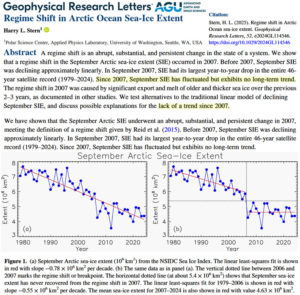
In 2007 Al Gore won a Nobel Peace prize for predicting summer (September) Arctic sea ice would “vanish” in the next 5 to 7 years, or by 2014.

Since 2007 Arctic sea ice extent (SIE) losses have ceased. Instead, the SIE trend has been stable for nearly two decades (Stern, 2025).

“Before 2007, September SIE was declining approximately linearly. In September 2007, SIE had its largest year‐to‐year drop in the entire 46‐year satellite record (1979–2024). Since 2007, September SIE has fluctuated but exhibits no long‐term trend.”


New Study Thoroughly Disassembles The CO2-Drives-Climate Assumption In One Fell Swoop

by K. Richard, Aug 15, 2025 in NoTricksZone 


Not only does CO2 have no discernible effect on climate, but any alleged anthropogenic role within the hypothetical greenhouse effect is not detectable either.

In recent decades there has been a concerted effort to assert it is “settled” science to characterize variability in the atmospheric CO2 concentration – assumed to be modulated by human activity – as the predominant factor in both climate change and the so-called greenhouse effect.

Science, however, is never truly settled.

A new Frontiers study succinctly unsettles this prevailing paradigm with surgeon-like precision. In under 20 pages the authors deliver a cogent critique of the CO2-drives-climate presumption. A few of the key points include:

• CO2 only contributes about 4-5% to the greenhouse effect, whereas water vapor and clouds contribute 95%.

• Of that 4-5% greenhouse effect contribution from CO2, just 4% of that can be attributed to human activities (i.e., fossil fuel emissions). Thus, about 96% of the 4% contribution from CO2 can be attributed to natural processes.

“WV [water vapor] and clouds (for which WV is responsible) dominate the ARE [atmospheric radiative effect], while CO2 contributes only 4-5% to it. Also, anthropogenic CO2 emissions are only 4% of the total, with the vast majority (96%) being natural. Additionally, evidence suggests that changes in temperature precede those in CO2 concentration, thus challenging the assumption that CO2 drives temperature.”

• As Fig. 10 in the study indicates, observed changes in the atmospheric CO2 concentration cannot be demonstrated to have exerted any effect in altering longwave radiation measurements, much less the surface temperature. A hypothetical doubling the CO2 concentration [NC-RAGs, or non-condensing radiatively active gases] “results in a temperature increase of zero”.

“[W]hile the role of CO2 in photosynthesis is important in biochemical terms, it becomes negligible in terms of its contribution to the surface energy balance.”

“[T]he observed increase of the atmospheric CO2 [from 300 ppm to 420 ppm] has not altered the ARE [atmospheric radiative effect or greenhouse effect] in any discernible way.”