Full-time professor at the Free University of Brussels, Belgium
apreat@gmail.com
apreat@ulb.ac.be
• Department of Earth Sciences and Environment
Res. Grp. - Biogeochemistry & Modeling of the Earth System
Sedimentology & Basin Analysis
• Alumnus, Collège des Alumni, Académie Royale de Sciences, des Lettres et des Beaux Arts de Belgique (mars 2013). http://www.academieroyale.be/cgi?usr=2a8crwkksq&lg=fr&pag=858&rec=0&frm=0&par=aybabtu&id=4471&flux=8365323
• Prof. Invited, Université de Mons-Hainaut (2010-present-day)
• Prof. Coordinator and invited to the Royal Academy of Sciences of Belgium (Belgian College) (2009-
present day)
• Prof. partim to the DEA (third cycle) led by the University of Lille (9 universities from 1999 to 2004) - Prof. partim at the University of Paris-Sud/Orsay, European-Socrates Agreement (1995-1998)
• Prof. partim at the University of Louvain, Convention ULB-UCL (1993-2000)
• Since 2015 : Member of Comité éditorial de la Revue Géologie de la France http://geolfrance.brgm.fr
• Since 2014 : Regular author of texts for ‘la Revue Science et Pseudosciences’ http://www.pseudo-sciences.org/
• Many field works (several weeks to 2 months) (Meso- and Paleozoic carbonates, Paleo- to Neoproterozoic carbonates) in Europe, USA (Nevada), Papouasia (Holocene), North Africa (Algeria, Morrocco, Tunisia), West Africa (Gabon, DRC, Congo-Brazzaville, South Africa, Angola), Iraq... Recently : field works (3 to 5 weeks) Congo- Brazzaville 2012, 2015, 2016 (carbonate Neoproterozoic).
Degree in geological sciences at the Free University of Brussels (ULB) in 1974, I went to Algeria for two years teaching mining geology at the University of Constantine. Back in Belgium I worked for two years as an expert for the EEC (European Commission), first on the prospecting of Pb and Zn in carbonate environments, then the uranium exploration in Belgium. Then Assistant at ULB, Department of Geology I got the degree of Doctor of Sciences (Geology) in 1985. My thesis, devoted to the study of the Devonian carbonate sedimentology of northern France and southern Belgium, comprised a significant portion of field work whose interpretation and synthesis conducted to the establishment of model of carbonate platforms and ramps with reefal constructions.
I then worked for Petrofina SA and shared a little more than two years in Angola as Director of the Research Laboratory of this oil company. The lab included 22 people (micropaleontology, sedimentology, petrophysics). My main activity was to interpret facies reservoirs from drillings in the Cretaceous, sometimes in the Tertiary. I carried out many studies for oil companies operating in this country.
I returned to the ULB in 1988 as First Assistant and was appointed Professor in 1990. I carried out various missions for mining companies in Belgium and oil companies abroad and continued research, particularly through projects of the Scientific Research National Funds (FNRS).
My research still concerns sedimentology, geochemistry and diagenesis of carbonate rocks which leads me to travel many countries in Europe or outside Europe, North Africa, Papua New Guinea and the USA, to conduct field missions.
Since the late 90's, I expanded my field of research in addressing the problem of mass extinctions of organisms from the Upper Devonian series across Euramerica (from North America to Poland) and I also specialized in microbiological and geochemical analyses of ancient carbonate series developing a sustained collaboration with biologists of my university. We are at the origin of a paleoecological model based on the presence of iron-bacterial microfossils, which led me to travel many countries in Europe and North Africa. This model accounts for the red pigmentation of many marble and ornamental stones used in the world. This research also has implications on the emergence of Life from the earliest stages of formation of Earth, as well as in the field of exobiology or extraterrestrial life ...
More recently I invested in the study from the Precambrian series of Gabon and Congo. These works with colleagues from BRGM (Orléans) are as much about the academic side (consequences of the appearance of oxygen in the Paleoproterozoic and study of Neoproterozoic glaciations) that the potential applications in reservoir rocks and source rocks of oil (in collaboration with oil companies).
Finally I recently established a close collaboration with the Royal Institute of Natural Sciences of Belgium to study the susceptibility magnetic signal from various European Paleozoic series. All these works allowed me to gain a thorough understanding of carbonate rocks (petrology, micropaleontology, geobiology, geochemistry, sequence stratigraphy, diagenesis) as well in Precambrian (2.2 Ga and 0.6 Ga), Paleozoic (from Silurian to Carboniferous) and Mesozoic (Jurassic and Cretaceous) rocks. Recently (2010) I have established a collaboration with Iraqi Kurdistan as part of a government program to boost scientific research in this country.
My research led me to publish about 180 papers in international and national journals and presented more than 170 conference papers. I am a holder of eight courses at the ULB (5 mandatory and 3 optional), excursions and field stages, I taught at the third cycle in several French universities and led or co-managed a score of 20 Doctoral (PhD) and Post-doctoral theses and has been the promotor of more than 50 Masters theses.
Global primary energy consumption grew strongly in 2017, led by natural gas and renewables, with coal’s share of the energy mix continuing to decline
Energy developments
Primary energy consumption growth averaged 2.2% in 2017, up from 1.2 % last year and the fastest since 2013. This compares with the 10-year average of 1.7% per year.
By fuel, natural gas accounted for the largest increment in energy consumption, followed by renewables and then oil.
Energy consumption rose by 3.1% in China. China was the largest growth market for energy for the 17th consecutive year.
Carbon emissions
Carbon emissions increased by 1.6%, after little or no growth for the three years from 2014 to 2016.
Black carbon refers to tiny carbon particles that form during incomplete combustion of carbon-based fuels. Black carbon particles absorb sunlight, so they are considered to contribute to global warming. However, the contribution of black carbon to the heating of the Earth’s atmosphere is currently uncertain. Models that can accurately assess the warming effect of black carbon on our atmosphere are needed so that we can understand the contribution of these tiny carbon particles to climate change. The mixing state of black carbon particles and their particle size strongly influence their ability to absorb sunlight, but current models have large uncertainties associated with both particle size and mixing state.
WUWT readers may recall that climate activists wanted the current epoch we live in to be named the “Anthropocene”, because they believe humans are the dominate force on the planet. The official organization that decides such things, The International Commission on Stratigraphy, would have none of it, and nixed the naming recently. Now, here’s a summary of the the Meghalayan.
Welcome to the new Meghalayan age – here’s how it fits with the rest of Earth’s geologic history
Steve Petsch
Associate Professor of Geosciences, University of Massachusetts Amherst
Jurassic, Pleistocene, Precambrian. The named times in Earth’s history might inspire mental images of dinosaurs, trilobites or other enigmatic animals unlike anything in our modern world.
Global tree canopy cover increased by 2.24 million square kilometers (865,000 square miles) between 1982 and 2016, reports a new study in Nature.
Researchers using satellite data tracked the changes in various land covers to find that gains in forest area in the temperate, subtropical, and boreal climatic zones are offsetting declines in the tropics. In addition, forest area is expanding even as areas of bare ground and short vegetation are shrinking. Furthermore, forests in montane regions are expanding as climate warming enables trees to grow higher up on mountain.
The question is how does the Intergovernmental Panel on Climate Change (IPCC) determine that an increase in atmospheric CO2 causes an increase in global temperature? The answer is they assumed it was the case and confirmed it by increasing CO2 levels in their computer climate models and the temperature went up. Science must overlook the fact that they wrote the computer code that told the computer to increase temperature with a CO2 increase. Science must ask if that sequence is confirmed by empirical evidence? Some scientists did that and found the empirical evidence showed it was not true. Why isn’t this central to all debate about anthropogenic global warming?
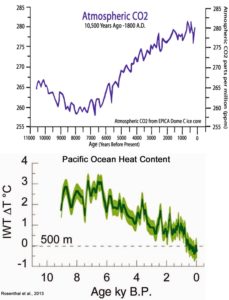
Even though CO2 concentrations hovered well below 300 ppm throughout most of the Holocene, newly published paleoclimate reconstructions affirm that today’s surface temperatures are only slightly warmer (if at all) than the coldest periods of the last 10,000 years. This contradicts the perspective that temperatures rise in concert with CO2 concentrations.
Lets all bow to the IPCC — a modern God that shalt not be questioned. The Holy Sacred Climate Cow!
The IPCC is an unaudited and unaccountable foreign committee. Not only are no scientists paid to check its findings, now the publicly mandated BBC is making sure none of their journalists will check its findings either.
In April, the UK regulator, Ofcom, found the BBC was guilty of not sufficiently challenging Lord Lawson, a skeptic. So in response the BBC now promises they will never sufficiently challenge the IPCC. That’s “false balance” for you.
by Ben Webster, September !, 2018 in TheSundayTimes
The BBC has told staff they no longer need to invite climate-change deniers on to its programmes, suggesting that allowing them to speak was like letting someone deny last week’s football scores.
It has also asked all editorial staff to take a course on how to report on climate change and said that its coverage of the topic “is wrong too often”.
Guest CNN-bashing by David Middleton (a geologist)
…
ran across this April 2018 article while looking for something else. I totally missed this episode of Trump Derangement Syndrome.
Secretary Zinke’s stance on climate change is one of several reasons the Climatariat News Network decided that he was being dishonest in describing himself as a geologist…
by P. Homewood, September 7, 2018 in NotaLotofPeopleKnowThat
Carbon Brief has obtained the internal four-page “crib sheet” sent yesterday to BBC journalists via an email from Fran Unsworth, the BBC’s director of news and current affairs. The crib sheet includes the BBC’s “editorial policy” and “position” on climate change.
All of the BBC’s editorial staff have also been invited to sign up for a one-hour “training course on reporting climate change”. Carbon Brief understands this is the first time that the BBC has issued formal reporting guidance to its staff on this topic.
From the University of Bristol and the “models before measurements” department comes this highly speculative claim that is entirely based entirely on climate models. There’s no actual measured data from any sort of paleo research. It’s science, but not as we know it.
A new study by scientists at the University of Bristol has shown that ancient global warming was associated with intense rainfall events that had a profound impact on the land and coastal seas.
The Palaeocene-Eocene Thermal Maximum (PETM), which occurred about 56 Million years ago, is of great interest to climate scientists because it represents a relatively rapid global warming event, with some similarities to the human-induced warming of today.
Although there have been many investigations of how much the Earth warmed at the PETM, there have been relatively few studies of how that changed the hydrological cycle.
by P. Homewood, September 5, 2018 in NotaLotofPeopleKnowThat
This article in something called Inside Climate News seems to be typical of many I have seen this year: Because we have had much attention in the media on heat waves this year, there must be an upward trend in heat waves and that is a warning signal that man-made global warming is destroying the planet. Typical of these articles are a couple of features
Declaration of a trend without any actual trend data, but just a single data point of events this year
Unstated implication that there must be a trend because the author can’t remember another year when heat wave stories were so prevalent in the media
Unproven link to man-made global warming, because I guess both involve warmth.
The Northern Territory holds enough natural gas to supply Australia for 200 years-plus and is comparable to the shale resources that have revolutionised the US energy sector, Resources and Northern Australia Minister Matt Canavan says.
Such abundant gas should enable Australia to reduce its current high energy prices, which were the fault of southern states preventing development, Senator Canavan told an NT Resources Week conference in Darwin.
by P. Homewood, September 6, 2018 in NotaLotofPeopleKnowThat
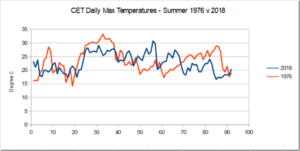
A lot of people have said they remember the summer of 1976 being hotter than this year. And they would be right.
According to CET data, at their peak temperatures went much higher and for longer than they did this summer. The only factor that kept the two summer remotely close was that in 1976 temperatures fell away during the middle of July to below average for a while.
Le blanchissement des coraux est un phénomène dont on entend souvent parler dans les médias. Il s’agirait d’un grave problème environnemental, dont la fréquence augmente, et qui pourrait mener à la perte totale des récifs coralliens. Le réchauffement climatique global, qui serait causé par l’augmentation de la concentration atmosphérique en CO2 est, bien entendu, pointé du doigt. Cependant, le blanchissement des coraux n’est-il pas un phénomène très ancien? Est-il seulement causé par des variations de température? Quel recul avons-nous à ce sujet? Une récente publication de Nicholas Kamenos et Sebastian Hennige, deux chercheurs anglais des Universités de Glasgow et d’Édimbourg, apporte de nouveaux éléments.
These ‘Conferences of the Parties’, or COPs as they are usually termed, involve all of the members of the United Nations Framework Convention on Climate Change and take place towards the end of the year. This year will see the 24th COP take place in Katowice, Poland.
Over the years the COPs have developed a style all of their own. Indeed, some observers have even gone as far as to suggest that each year sees less and less by way of meaningful activity, and more and more liturgy and ritual.
In Part A of the Great Debate series (see here) we discussed Dr. David Karoly’s and Dr. William Happer’s arguments regarding how unusual recent global warming is and how we know the recent observed increase in CO2 is due to human activities. In Part B we examined their thoughts on the amount of warming caused by greenhouse gas emissions and the accuracy of the calculation. In Part C we discussed the dangers of global warming, the calculation of the vital value of ECS (the equilibrium climate sensitivity to a doubling of CO2), and discuss the need to do something about climate change. In this final part of the series I will summarize the debate and provide my thoughts.
In Part A of the Great Debate series (see here) we discussed Dr. David Karoly’s and Dr. William Happer’s arguments regarding how unusual recent global warming is and how we know the recent observed increase in CO2 is due to human activities. In Part B we examined their thoughts on questions three and four. Number 3 is “How do we know that the increase in CO2 and other greenhouse gases in the atmosphere have caused most of the recent global warming?” Number 4 is “Climate models have been used to compute the amount of warming caused by human activities, how accurate are they?”
For an introduction to the debate and links to the original documents see Part A. In Part C we will examine the predictions that global warming and more CO2 are dangerous and that we (as a global society) need to do something about it.
In Part A of the Great Debate series (see here) we discussed Dr. David Karoly’s and Dr. William Happer’s arguments regarding how unusual the recent global warming is and how we know the recent observed increase in CO2 is due to human activities. In Part B we will examine their thoughts on questions three and four.
3. How do we know that the increase in CO2 and other greenhouse gases in the atmosphere have caused most of the recent global warming?
4. Climate models have been used to compute the amount of warming caused by human activities, how accurate are they?
For an introduction to the debate and links to the original documents see Part A.
La Lettre d’information 7 sort légèrement du cadre prévu à l’origine pour ces Lettres. Elle se rapporte à des commentaires qu’elles ont suscités et qui sont parus dansL’1Dex. L’1Dex est un média alternatif valaisan, dont le motto est « Pour un Valais
critique et libertaire ». Grâce au libéralisme de son rédacteur en chef, Me Stéphane Riand, et de son équipe dirigeante, les voix discordantes, les pensées de contre-courant, les points de vue tenus pour hérétiques, tout ce qui se heurte aux interdits des presses bien-pensantes, peuvent se faire entendre. De l’air frais sur la « Panurgie ». C’est ainsi que mes Lettres d’information ont connu une diffusion inespérée. L’1Dex offre aussi à ses lecteurs la possibilité de réagir avec des commentaires, qui sont le plus souvent anonymes. L’ignorance générale où l’on est des questions relatives au climat, ajoutée à l’illusion qu’un consensus se serait établi parmi les scientifiques, comme on le laisse entendre dans les milieux de la climatologie officielle, expliquent la cacophonie et la variété ébouriffante de certains de ces commentaires. Pour des raisons que j’expose plus loin, je ne m’y suis guère arrêté jusqu’ici. De par le contexte même, le contenu de la présente Lettre est plus local. Néanmoins, on passe à la généralité par des extrapolations simples.
New evidence now updates and confirms a column I wrote in June 2014 that some or all of the highly publicized melting of western coastal Antarctic glaciers may be caused by seabed volcanoes rather than having much or anything to do with climate change.
An article published in June 22 edition of the journal Nature Communications reports that an international team of scientists tracing a chemical signature of helium in the seawater discovered that contemporary volcanic heat is causing observed melting beneath the massive west Antarctic Ice Sheet (WAIS.)
The results of their analysis revealed that warming in this high Arctic site had proceeded at four times the global mean rate calculated in other data sets. However, Ding et al. note that over the last decade (2005-2014), “the warming rate in Ny-Ålesund slowed to 0.03 ± 1.85°C per decade,” which is essentially indicative of no-trend in the data. Lead-lag analysis further revealed that “Ny-Ålesund and global temperature variations were remarkably consistent, with a lag time of 8-9 years.” Consequently, the researchers say that “the ‘warming hiatus’ many scientists [have] studied also appears in Ny-Ålesund, it just started later than [that observed in] other areas.”
La géologie, une science plus que passionnante … et diverse