Full-time professor at the Free University of Brussels, Belgium
apreat@gmail.com
apreat@ulb.ac.be
• Department of Earth Sciences and Environment
Res. Grp. - Biogeochemistry & Modeling of the Earth System
Sedimentology & Basin Analysis
• Alumnus, Collège des Alumni, Académie Royale de Sciences, des Lettres et des Beaux Arts de Belgique (mars 2013). http://www.academieroyale.be/cgi?usr=2a8crwkksq&lg=fr&pag=858&rec=0&frm=0&par=aybabtu&id=4471&flux=8365323
• Prof. Invited, Université de Mons-Hainaut (2010-present-day)
• Prof. Coordinator and invited to the Royal Academy of Sciences of Belgium (Belgian College) (2009-
present day)
• Prof. partim to the DEA (third cycle) led by the University of Lille (9 universities from 1999 to 2004) - Prof. partim at the University of Paris-Sud/Orsay, European-Socrates Agreement (1995-1998)
• Prof. partim at the University of Louvain, Convention ULB-UCL (1993-2000)
• Since 2015 : Member of Comité éditorial de la Revue Géologie de la France http://geolfrance.brgm.fr
• Since 2014 : Regular author of texts for ‘la Revue Science et Pseudosciences’ http://www.pseudo-sciences.org/
• Many field works (several weeks to 2 months) (Meso- and Paleozoic carbonates, Paleo- to Neoproterozoic carbonates) in Europe, USA (Nevada), Papouasia (Holocene), North Africa (Algeria, Morrocco, Tunisia), West Africa (Gabon, DRC, Congo-Brazzaville, South Africa, Angola), Iraq... Recently : field works (3 to 5 weeks) Congo- Brazzaville 2012, 2015, 2016 (carbonate Neoproterozoic).
Degree in geological sciences at the Free University of Brussels (ULB) in 1974, I went to Algeria for two years teaching mining geology at the University of Constantine. Back in Belgium I worked for two years as an expert for the EEC (European Commission), first on the prospecting of Pb and Zn in carbonate environments, then the uranium exploration in Belgium. Then Assistant at ULB, Department of Geology I got the degree of Doctor of Sciences (Geology) in 1985. My thesis, devoted to the study of the Devonian carbonate sedimentology of northern France and southern Belgium, comprised a significant portion of field work whose interpretation and synthesis conducted to the establishment of model of carbonate platforms and ramps with reefal constructions.
I then worked for Petrofina SA and shared a little more than two years in Angola as Director of the Research Laboratory of this oil company. The lab included 22 people (micropaleontology, sedimentology, petrophysics). My main activity was to interpret facies reservoirs from drillings in the Cretaceous, sometimes in the Tertiary. I carried out many studies for oil companies operating in this country.
I returned to the ULB in 1988 as First Assistant and was appointed Professor in 1990. I carried out various missions for mining companies in Belgium and oil companies abroad and continued research, particularly through projects of the Scientific Research National Funds (FNRS).
My research still concerns sedimentology, geochemistry and diagenesis of carbonate rocks which leads me to travel many countries in Europe or outside Europe, North Africa, Papua New Guinea and the USA, to conduct field missions.
Since the late 90's, I expanded my field of research in addressing the problem of mass extinctions of organisms from the Upper Devonian series across Euramerica (from North America to Poland) and I also specialized in microbiological and geochemical analyses of ancient carbonate series developing a sustained collaboration with biologists of my university. We are at the origin of a paleoecological model based on the presence of iron-bacterial microfossils, which led me to travel many countries in Europe and North Africa. This model accounts for the red pigmentation of many marble and ornamental stones used in the world. This research also has implications on the emergence of Life from the earliest stages of formation of Earth, as well as in the field of exobiology or extraterrestrial life ...
More recently I invested in the study from the Precambrian series of Gabon and Congo. These works with colleagues from BRGM (Orléans) are as much about the academic side (consequences of the appearance of oxygen in the Paleoproterozoic and study of Neoproterozoic glaciations) that the potential applications in reservoir rocks and source rocks of oil (in collaboration with oil companies).
Finally I recently established a close collaboration with the Royal Institute of Natural Sciences of Belgium to study the susceptibility magnetic signal from various European Paleozoic series. All these works allowed me to gain a thorough understanding of carbonate rocks (petrology, micropaleontology, geobiology, geochemistry, sequence stratigraphy, diagenesis) as well in Precambrian (2.2 Ga and 0.6 Ga), Paleozoic (from Silurian to Carboniferous) and Mesozoic (Jurassic and Cretaceous) rocks. Recently (2010) I have established a collaboration with Iraqi Kurdistan as part of a government program to boost scientific research in this country.
My research led me to publish about 180 papers in international and national journals and presented more than 170 conference papers. I am a holder of eight courses at the ULB (5 mandatory and 3 optional), excursions and field stages, I taught at the third cycle in several French universities and led or co-managed a score of 20 Doctoral (PhD) and Post-doctoral theses and has been the promotor of more than 50 Masters theses.
Climate change action proponents regularly tell us we have to reduce our carbon dioxide (CO2) emissions to prevent “climate change”, even to the point of curtailing industry, travel, and food consumption. Fortunately, a real-world test of just those very things happened in 2020 due to the COVID-19 related lockdowns.
In a report released April 12th by the U.S. Energy Information Administration (EIA) the Monthly Energy Review, they report that energy-related CO2 emissions decreased by 11% in the United States in 2020 primarily because of the effects of the COVID-19 pandemic and related restrictions.
Furthermore, U.S. energy-related CO2 emissions fell in every end-use (consumer) sector for the first time since 2012. The EIA notes:
“CO2 emissions associated with energy use fell by 12% in the commercial sector in 2020. Part of this drop in emissions was due to pandemic restrictions. Because electricity is a large source of energy for the commercial sector, the declining carbon intensity of electric power also contributed to declining CO2emissions from commercial activity. Emissions from commercial electricity use fell by 13%. Commercial petroleum and natural gas emissions fell by 13% and 11%, respectively.”
“Within the U.S. power sector, emissions from coal declined the most, by almost a fifth, at 19%. Natural gas-related CO2 emissions rose by 3%. Also of note in 2020; fossil fuel generation declined, while power generation from renewables from wind and solar continued to grow.”
…
…
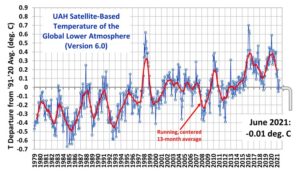
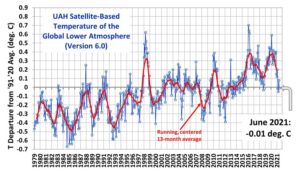
As seen in the graph above, CO2 in the atmosphere increased during 2020 during the economy crippling lockdowns at the same rate it has been for decades. There isn’t even a blip.
This lack of any reduction in atmospheric CO2 concentration clearly demonstrates that no matter how much the U.S. reduces CO2 emissions, no one living today will, at any point in life, see a measurable change in climate attributable to the reduction. This is especially true since other countries, such as China, who only give lip-service to the CO2 emissions reduction demanded by the 2015 Paris Climate Accord.
Data availability and temporal resolution make it challenging to unravel the anatomy (duration and temporal phasing) of the Last Glacial abrupt climate changes. Here, we address these limitations by investigating the anatomy of abrupt changes using sub-decadal-scale records from Greenland ice cores. We highlight the absence of a systematic pattern in the anatomy of abrupt changes as recorded in different ice parameters. This diversity in the sequence of changes seen in ice-core data is also observed in climate parameters derived from numerical simulations which exhibit self-sustained abrupt variability arising from internal atmosphere-ice-ocean interactions. Our analysis of two ice cores shows that the diversity of abrupt warming transitions represents variability inherent to the climate system and not archive-specific noise. Our results hint that during these abrupt events, it may not be possible to infer statistically-robust leads and lags between the different components of the climate system because of their tight coupling.
About the author iii Executive summary v 1. Introduction 1 2. Natural disaster analysis 2 3. Heatwave 6 4. Cold extremes 12 5. Drought 14 6. Precipitation and floods 16 7. Hurricanes 19 8. Tornadoes 23 9. Wildfires 26 10. Conclusions 31 Notes 33 Review process 38 About the Global Warming Policy Foundation 38
About the author
Retired physicist Dr. Ralph B. Alexander is the author of Global Warming False Alarm and Science Un- der Attack: The Age of Unreason. With a PhD in physics from the University of Oxford, he is also the author of numerous scientific papers and reports on complex technical issues. His thesis research in the interdisciplinary area of ion-solid interactions reflected his interest in a wide range of scien- tific topics.
Dr Alexander has been a researcher at major laboratories in Europe and Australia, a professor at Wayne State University in Detroit, the co-founder of an entrepreneurial materials company, and a market analyst in environmentally friendly materials for a small consulting firm.
It may be late-April, but spring 2021 is a no show across much of Europe.
The continent is suffering a climatic reality similar to that of the previous prolonged spell of reduced solar output: not since the Centennial Minimum (1880-1920) have Europeans suffered an April this cold and snowy.
ENGLAND’S COLDEST APRIL SINCE 1922
Despite the cherry-picking, the UHI-sidestepping, and the unrelenting propaganda, the British Isles simply won’t heat up — the UK’s agenda-shoveling Met Office has admitted as much themselves.
Recently, one of the Met Office’s key data sets revealed that the 2010s actually came out cooler than the 2000s — a fact that goes against ALL mainstream logic: we were told average temperatures would rise “linearly,” always up and up and up on an endless march to catastrophe if no poverty-inducing action was taken…
The Central England Temperature record (CET) measures the monthly mean surface air temperatures for the Midlands region of England. It is the longest series of monthly temperature observations in existence anywhere in the world, with data extending all the way back to the year 1659.
The CET’s mean reading for April, 2021 (to the 18th) is sitting at just 5.8C — that’s 1.5C below the 1961-1990 average (the current standard period of reference for climatological data used by the WMO–an historically cool era btw), and ranks as the coldest April since 1922, and the 18th coldest since records began 362 years ago.
GERMANY’S CHILLIEST SINCE 1917
With a mean temperature just of 4.5C, Germany is faring even worse than England — it is on for second coldest April since records began in 1881, and its coldest since 1917, according to German DWD national weather service records.
The following chart shows Germany’s mean temperature anomalies (through the 17th) — it’s been anomalously cold across the entire country:
James Hansen is often debited with having stirred up so much alarm with his notorious 1988 prediction of runaway global warming in front of the U.S. Senate that IPeCaC was hastily founded later that year, so as to Save The Planet.
His prediction ran to 2020. How, then, did fantasy-land compare with more than two decades of sober, observed reality? The graph, zeroed so that the 1988 HadCRUT4 observed anomaly lies between Hansen’s three scenarios, shows that observed warming was closest to Hansen’s Scenario C.
However, the assumption underlying Scenario C is that everyone would be so scared following Hansen’s Senate testimony that what is now called “net-zero” would be achieved by 2000. Well, it wasn’t. And it won’t be, even by 2050. The chief reason is discernible in the Texas electricity grid collapse.
The Lone Star State, which ought to have had more common sense, decided that once it had carpeted the state with windmills (14th-century technology to fail to solve a 21st-century non-problem) and solar panels (produced by slave labor in China) it could reduce its dispatchable thermal grid capacity.
However, as any grid manager will tell you, you can’t do that. Not the least of the reasons why unreliables are so cripplingly expensive is that it is necessary to maintain the entire pre-existing grid regardless of how many unreliables are bolted on to it. Unreliables, therefore, inflict not only a deadweight cost but also a deadweight surplus capacity to the grid, to say nothing of the costly instability caused by giving unreliables precedence over thermal in meeting demand.
Other than by misspelling “fjord,” how would an American geologist draw the ire of a pair of Norwegian politicians? Answer: Write a book that counters the notion that human activity is causing the globe to warm with catastrophic consequences.
Backed with 90 illustrations and 15 pages of references, the book presents 60 footnoted facts inconvenient to the Western elite’s absurd narrative about global warming. Among them: Most of the last 10,000 years have been warmer than today, including the Medieval Warm Period, when Vikings raised barley on Greenland, and the Roman Warm Period, when citrus grew in northern England.
According to NASA and NOAA satellite instruments, sea level is rising at a mere 3 millimeters per year, which is a pace of just under one foot per century. (Note, the NASA/NOAA-reported 3.3 mm/year rise in Global Mean Sea Level includes a 0.3 mm “adjustment” that accounts for land rising as glaciers melt. The sea-level rise in relation to coastal shorelines is therefore 3.0 mm/year.) Moreover, the satellite measurements show no significant acceleration during recent decades in the pace of sea-level rise.
Given that seas are rising at a pace of merely one foot per century, which is little if any faster than the pace of sea-level rise throughout the global warming of the 1800s and 1900s, it is almost certain that seas will not rise 20 feet during the next 100 to 200 years. It is also almost certain that seas will not rise two feet during the next 20 years.
Revolutions, droughts, famines, invasions, wars, regicides – the calamities of the mid-seventeenth century were not only unprecedented, they were agonisingly widespread. A global crisis extended from England to Japan, and from the Russian Empire to sub-Saharan Africa. North and South America, too, suffered turbulence. The distinguished historian Geoffrey Parker examines first-hand accounts of men and women throughout the world describing what they saw and suffered during a sequence of political, economic and social crises that stretched from 1618 to the 1680s. Parker also deploys scientific evidence concerning climate conditions of the period, and his use of ‘natural’ as well as ‘human’ archives transforms our understanding of the World Crisis. Changes in the prevailing weather patterns during the 1640s and 1650s – longer and harsher winters, and cooler and wetter summers – disrupted growing seasons, causing dearth, malnutrition, and disease, along with more deaths and fewer births. Some contemporaries estimated that one-third of the world died, and much of the surviving historical evidence supports their pessimism.
Amongst these catastrophic events, Parker lists:
Early 17thC
1) West Africa, from the Sahel in the north to Angola in the south, suffered a prolonged drought between 1614 and 1619.
2) Catalonia suffered “the year of the flood” in 1617.
3) All Europe experienced an unusually cold winter in 1620/21, when many rivers froze so hard for 3 months that they could bear the weight of loaded carts; even the Bosphorus froze, an unheard of event.
4) Japan suffered its coldest spring of the century in 1616, while the sub tropical region of Fujian in China had heavy snowfall two years later, another extremely rare event.
5) Droughts in five years out of six between 1616 and 1621 almost the destroyed the new colonies in Virginia.
6) After a few better years, the summer of 1627 in Europe was the wettest for 500 years, followed by the “year without a summer” in 1628, when it was so cold that many crops never ripened.
7) Between 1629 and 1632, much of Europe suffered excessive rains, followed by drought.
8) Conversely, northern India suffered a “perfect drought” in 1630/31, followed the next year by catastrophic floods.
Parker notes that “all of these regions experienced dramatic falls in population”
The Irish Climate Science Forum (ICSF) in cooperation with CLINTEL hosted a lecture by the world-renowned climate scientist Richard Lindzen. The online lecture was attended by around 200 people from around the world (including a group of climate activists who disturbed the talk. The recorded talk can be viewedhere.
Professor Lindzen kindly agreed that his written speech could be posted here at CLINTEL. It follows below.
Richard S. Lindzen, Professor Emeritus of Atmospheric Sciences, MIT
For about 33 years, many of us have been battling against climate hysteria. We have correctly noted
The exaggerated sensitivity,
The role of other processes and natural internal variability,
The inconsistency with the paleoclimate record,
The absence of evidence for increased extremes, hurricanes, etc. and so on.
We have also pointed out the very real benefits of CO2 and even of modest warming. And, as concerns government policies, we have been pretty ineffective. Indeed our efforts have done little other than to show (incorrectly) that we take the threat scenario seriously. In this talk, I want to make a tentative analysis of our failure.
Denmark has for the first time put mineral-rich Greenland top of its national security agenda, ahead of terrorism and cybercrime.
The Defence Intelligence Service (FE) linked its change in priorities to US interest in Greenland, expressed in President Donald Trump’s desire to buy the vast Arctic territory.
Greenland is part of Denmark, but has significant autonomy, including freedom to sign major business deals.
China has mining deals with Greenland.
The FE’s head Lars Findsen said Greenland was now a top security issue for Denmark because a “power game is unfolding” between the US and other global powers in the Arctic.
In August the Danish government dismissed as “absurd” President Trump’s suggestion of a US-Denmark land deal over Greenland.
The US interest in Greenland goes back decades. The US has a key Cold War-era air base at Thule, used for surveillance of space using a massive radar. It is the US military’s northernmost base, there to provide early warning of a missile attack on North America.
Why the new focus on Greenland?
Greenland’s strategic importance has grown amid increased Arctic shipping and international competition for rare minerals. Arctic waters are becoming more navigable because of melting ice, linked to global warming.
by P. Homewood, Mach 26, 2021 in NotaLotofPeopleKnowThat
Absolute sea levels are rising by about 2mm a year, yet the land is subsiding by 2.2cm a year. A small part of this is due to isostasy, but most is evidently the result of “dewatering”, what we would call water extraction. (see here)
Whatever problems farmers in Bangladesh are having, it has nothing to do with climate change.
Land masses across the northern hemisphere are experiencing a true taste of the GRAND SOLAR MINIMUM this spring, as while brief pockets of heat have intermittently prevailed, Arctic cold has never been far away, forever-threatening to wipe out those tender early-season crops that have been “tricked” into sprouting.
Overall, Earth’s temperature is falling (the UAH for March 2021 was 0.01C BELOW 30-year baseline), but brief pockets of heat will ALWAYS occur–even during the depths of an ice age. It is actually these swings between extremes that will hasten the failure of our modern, and surprisingly fragile, food production systems — constants are workable, even if those constants are cold, it is climatic unpredictability and extreme flip-flopping that is a growers most bitter foe.
EUROPE’S POLAR COLD TO INTENSIFY THROUGH APRIL
Recently, Europe has suffered a sharp reversal of fortunes — the continent has shifted gears, going from enjoying some of its warmest March temperatures on record, to a historic blast of polar cold and snow.
The low solar activity we’ve seen over the past few years has weakened the jet stream, reverting its usual strong zonal flow to more of a wavy meridional one. At the end of March, this flow was pulling warm African air anomalously far north, which resulted in the likes of Holland, Germany, France, and Belgium registering some of their warmest March temperatures ever recorded; and now, barely a week later, this loosey-goosey jet stream has conspired to drop brutal, record-breaking Arctic air over these exact same regions.
by K. Richard, Apr 6, 2021 in ClimateChangeDispatch
In contrast to alarming claims about rare, 100-year flood events now occurring every few years due to global warming, scientists have determined the exact opposite is more likely true.
Not only have flood frequencies declined globally in the last 50 years, but the probability of a 100-year flood event is now so rare it has only been occurring once every 358 years on average since 1970.
According to the IPCC, there has been no clear evidence of a global-scale increase in flood magnitude or frequency in the last century (Hodgkins et al., 2017).
A new study (Slater et al., 2021) suggests that claims of flood magnitude, frequency, and probability dramatically increasing with global warming can be “misleading” if they use a stationary calculation approach instead of continually updating significant changes over time.
These scientists, using “observed annual maximum daily streamflow” records and a “nonstationary approach,” concluded there has been no obvious global-scale trend in 20-, 50-, and 100-year flood magnitude since 1970, with 100-year flood events defined as “flows of a given exceedance probability in each year.”
“The scientific community has been unclear on the role that solar variability plays in influencing weather and climate events here on Earth. This study shows there’s reason to believe it absolutely does and why the connection may have been missed in the past.”
Top: Six-month smoothed monthly sunspot number from SILSO. Bottom: Oceanic El Niño Index from NOAA. Red and blue boxes mark the El Niño and La Niña periods in the repeating pattern. Source: Climate Etc, September 2019
If you ask most climate scientists, they will tell you that the Sun’s small variability is unimportant when it comes to influencing climate. They may have to change their minds if a new line of research holds up. It seems that solar variability can drive climate variability on Earth on decadal timescales (the decadal climatic variability that Michael Mann recently ‘proved’ doesn’t exist). That’s the conclusion of a new study showing a correlation between the end of solar cycles and a switch from El Nino to La Nina conditions in the Pacific Ocean. It’s a result that could significantly improve the predictability of the largest El Nino and La Nina events, which have several global climate effects.
The Version 6.0 global average lower tropospheric temperature (LT) anomaly for March, 2021 has come in at -0.01 deg. C below the 30-year baseline, down from the February, 2021 value of +0.20 deg. C, and down substantially (approx. 0.6C deg. C) from where we were around a year ago.
A continuation of this downward plunge is highly probable over the coming months (with the odd bump along the way–climate is cyclic after all) as low solar activity and La Nina conditions persist.
According to the 15x NASA/NOAA AMSU satellites that measure every square inch of the lower troposphere (where us humans reside), planet Earth was actually warmer back in 1983:
REMINDER: We have changed the 30-year averaging period from which we compute anomalies to 1991-2020, from the old period 1981-2010. This change does not affect the temperature trends. [www.drroyspencer.com]
In addition, the global average oceanic tropospheric temperature anomaly is -0.07 deg. C–the lowest since November 2013. Also, the tropical (20N-20S) departure from average is -0.29 deg. C–the coolest since June of 2012. While Australia, at -0.79 deg. C, is the coolest reading since August 2014.
Bottom line, the Grand Solar Minimum is intensifying — and fast.
Sunspots (a great barometer for solar activity) have remained sparse in 2021, even at a time when the next the next solar cycle (25) should be firing-up.
The Solar Minimum of cycle 24 began bottoming-out way back in late-2017, and went on to develop into the deepest minimum of the past 100+ years — and it is still proving reluctant to release its grip:
by C. Rotter, April 5, 2021 in NATIONAL CENTER FOR ATMOSPHERIC RESEARCH/UNIVERSITY CORPORATION FOR ATMOSPHERIC RESEARCH
A new study shows a correlation between the end of solar cycles and a switch from El Nino to La Nina conditions in the Pacific Ocean, suggesting that solar variability can drive seasonal weather variability on Earth.
If the connection outlined in the journal Earth and Space Science holds up, it could significantly improve the predictability of the largest El Nino and La Nina events, which have a number of seasonal climate effects over land. For example, the southern United States tends to be warmer and drier during a La Nina, while the northern U.S. tends to be colder and wetter.
“Energy from the Sun is the major driver of our entire Earth system and makes life on Earth possible,” said Scott McIntosh, a scientist at the National Center for Atmospheric Research (NCAR) and co-author of the paper. “Even so, the scientific community has been unclear on the role that solar variability plays in influencing weather and climate events here on Earth. This study shows there’s reason to believe it absolutely does and why the connection may have been missed in the past.”
The study was led by Robert Leamon at the University of Maryland-Baltimore County, and it is also co-authored by Daniel Marsh at NCAR. The research was funded by the National Science Foundation, which is NCAR’s sponsor, and the NASA Living With a Star program.
by P. Homewood, April 6, 2021 in NotaLotofPeopleKnowThat
Seventh lowest? The NSIDC would of course like you to believe that this is all part of a declining trend. In reality, since the sharp decline beginning in 2004, sea ice extent has gone up and down, but with little overall change. This year and last year, average March extent has actually been higher than in 2006.
This March, extent was the 8th highest in the last 18 years, putting it around the median.
What about prior to 2004 though? Should we not be comparing this year with the 1981-2010 average?
Like it or not, and whatever the reason, the loss of summer ice in 2007 has had a direct effect on sea ice at all times of year since. Much of the sea ice is now thin, new ice, which melts more readily in summer. Consequently, winter ice takes longer to form as well.
It would probably take a climatic regime shift, such as occurred in the 1960s, for ice to return to pre 2004 levels. But the evidence shows that winter sea ice extent is currently stable.
HH Lamb’s Climate, History and The Modern World tells us much about the history of Alpine glaciers. For instance, how they advanced rapidly between 800 and 400 BC. They then retreated before advancing again between AD 600 and AD 850, when they may have even reached Little Ice Age maximum extents.
We are probably all familiar with the terrifying glacier advances, which began in the 17thC, following centuries of a much warmer climate. These were catastrophic for anybody living nearby, as farming land was wiped out, and even the land that escaped being overrun was far too cold to farm. As a result, famine was rife in Switzerland and elsewhere, even in cities which relied on the countryside for food.
People living in those days would have been dumfounded to hear that there are some now who are worried that glaciers are getting smaller.
A paper by Zumbuhl et al, published in 2006, offers a detailed history of the Lower Grindelwald glacier, as well as the Mer de Glace in the Mont Blanc region:
Antarctic sea ice grows 2 million square kilometers in 4 years…
It’s hard to back up the statement: Global warming is global. Some places have seen warming over the past 40 years (e.g. Arctic), but other places have not.
Antarctica definitely has not been playing along with the man-made global warming hoax. (Yes, man has caused some of the warming, but not all – and it certainly isn’t catastrophic).
Antarctic sea ice surges
Though Antarctic sea ice fell to a “record minimum” in 2017 – after having reached a “record high” in 2015 – the latest data from the National Snow and Ice Data Centershow sea ice at the South Pole has bounced back robustly since, surging some 500,000 sq km above the mean.
On March 26, 2017, Antarctic sea ice measured 3.055 million sq km. Four years later, sea ice reached 5.103 million sq km. That’s a difference of more than 2 million sq. km., which is an area the size of Saudi Arabia!
No way to ignore natural factors
So why would sea ice grow so quickly? If the ice had disappeared, many would blame it on greenhouse gases – absurd of course. And it would be just as absurd to blame the recent gain on global cooling. Obviously there is a complex array of natural factors at work – factors that climate alarmists consistently have ignored over the past decades.
Here’s the March 26, 2021 satellite photo of Antarctica:
My mind runs to curious corners of the climate question. I got to thinking about how little the atmospheric CO2 level has changed over most of the last two thousand years. Here is the CO2 data from ice cores (colored dots) and from the Mauna Loa CO2 measuring stations (red/black line).
Morano’s probably single-handedly, in a civilian sense, the guy (other than me, of course) doing a better job of ringing the bells alarming people of what’s going on here.” —Rush Limbaugh
“This is a must-read book that shows how the Green New Deal is dangerous, impractical, misguided, and guaranteed to fail with disastrous results for the American people.”—Sean Hannity, host of Hannity on Fox News
“’Green Fraud’ is the ultimate guidebook to exposing and fighting this Marxist plan masquerading as environmental policy.” —Mark R. Levin, author and nationally syndicated TV and radio broadcaster
“If you care about America’s future, read this book.”—Mark Levin
“A must-read book that shows how the Green New Deal is dangerous, impractical, misguided, and guaranteed to fail with disastrous results for the American people.”—Sean Hannity
A New Lockdown to “Save” the Climate
That’s what’s in store for us if Alexandria Ocasio-Cortez and the Democrats pass their radical climate plan—the Green New Deal.
It is packed with guarantees so completely irrelevant to the problem it purports to “solve” (like “free college” and incomes for everyone “unable or unwilling to work”) that even its boosters have admitted it’s not really about the climate.
The intrepid Marc Morano, author of the bestselling Politically Incorrect Guide to Climate Change, breaks down the science and the politics to expose the truth about the Green New Deal:
• The science is settled: copious evidence—and prominent defections from the “climate consensus”—make clear we are not facing a man-made climate disaster
• “Climate change” is the perfect Trojan horse for the socialist agenda of the Left
• Fossil fuels lifted the West out of poverty—but our elites now want to deny them to the world’s poor
• The Green New Deal is on a collision course with self-government and our fundamental rights
Climate change has already been “solved” multiple times over the past two decades—with highly touted international agreements—and yet it never goes away as an excuse for leftist policies that will cripple our economy, impoverish the world, and take away our freedoms.
Packed with telling statistics, damning quotations, and real science, Green Fraud is your source for all the facts you need to understand—and resist—the threat.
THE CAPITAL REGION of Finland has received so much snow this winter that the metres-high piles hauled to designated snow dump areas may not melt during the course of the summer, reports Helsingin Sanomat.
In Uusimaa, for example, the amount of snow was 1.7 times higher than last year in January, according to Foreca.
Helsingin Sanomat on Friday wrote that the piles of snow stand almost as high as 20 metres at the dump area in Herttoniemi, eastern Helsinki. In Maununneva, a north-western neighbourhood of the city, lorries have dumped roughly 16,000 loads of snow at the dump area, revealed Tero Koppinen, a production manager at Helsinki City Construction Services (Stara).
The snow ploughed from roads forms a large structure, nicknamed by the locals as the Alps, also at the only snow dump area in Espoo, in Vanttila.
The Fins mostly seem to be treating this as a joke, maybe a chance to cool off on warm Summer days. And most likely this event will have no long term consequences.
There have been dozens of good books written in the past decade telling the true stories countering the incessant lies of alarmists blaming impending environmental disasters on carbon dioxide emissions.
None have been better than the newest contribution by Patrick Moore and certainly none as up to date as this just published contribution to real science. We all know by now that Patrick co-founded Greenpeace. It was in an effort to stop underground hydrogen bomb testing and later to save whales and Harp seals. He was still studying for his degree in Ecology at the University of British Columbia (UBC). Fifteen years later when Greenpeace became a money machine in the war to scare the public with one environmental lie after another, he resigned and became their public enemy number one. The tipping point was the organization’s initiation of a campaign to ban chlorine, the most important of all 94 natural elements for both public health and medicine.
In many ways his newest book can be seen as eleven brief books teaching the important facts and research on the major environmental issues of our time. They include in addition to the finest argument against human-caused climate change, dying trees in Africa, the Great Barrier Reef, Polar Bears, Species Extinction, the Great Pacific Garbage Patch, Genetically Modified Food, Nuclear Radiation, Forest Fires, Ocean Acidification, and the faked deaths of Walruses falling from cliffs in Russia.
What sets this outstanding book apart from most is that while Moore is an academic with a Ph.D. in ecology from UBC (which he describes as the study of how all components of our world interrelate and interact), he has a somewhat unique ability to dive into the weeds on each subject and emerge with a basic understanding of each issue for the reader. While I have read a great deal on all his topics, I was amazed how much I learned, and you will be too.
He tells us what most of us realize today, that to many if not most activists “the people are a kind of afterthought to be considered only once the perfect environmental policy has been identified, without regard for how negative the impact is on humanity”. The push to phase out all fossil fuel consumption in the next 30 years he says, “is the biggest threat to civilization in the world today.”
In this 204-page 11-chapter book, as you would imagine, its longest chapter (49 pages) Climate of Fear and Guilt, is devoted to climate change. Most readers have read numerous arguments against the well-known fraud of human caused global warming. You may not want to read another. I can tell you, however, that no one has done it better. This well illustrated chapter manages to add common sense ways to convince your friends of the absurd effort by our new administration to convince you to give up your freedoms in order to save the world. He deals with 19 separate crazy predictions laid at the feet of climate change. He skewers them all with excellent technical references. While it is worth the price of the book, it is the less well-known information in the other chapters that produce a truly outstanding book.
…
La géologie, une science plus que passionnante … et diverse