Archives de catégorie : climate-debate

Doomsday poll shrinks 25%: Now just 11,000 MeToo scientists say “panic now”

by JoNova, November 2019


Who remembers that 15,000 scientists signed some climate declaration in 2017? The same Prof Ripple, and Bioscience probably hope you don’t, because two years later there is the same rehashed, but with only 11,000 signatories. So 4,000 disappeared without a trace. There are however, the same comic indefendable graphs. Call it “extreme graphing” — every line needs to be diagonal. All “pauses” are disappearing. No fallacy remains unbroken.

To stop storms we apparently need to reduce the global population, stop mining “excessive” minerals, eat more veges,  and we need to preserve biodiversity, reefs, forests and greenery at whatever it was in 1685 or whenever the sacred preindustrial year of Life On Earth is declared. You know the drill — coal and oil are demon spirits. Exorcise them now! Then rinse, repeat and …hand-wash your undies.

After crowing about how unqualified skeptics were, only 156 (1%) of the 11,000 have the word “climate” in their job title or specialty. And even these climate experts mostly seem to be experts in adapting or mitigating climate change. They know things about food, forests, ecology, land use, disease, law, agriculture, policy, economics, communication and tree survival. This is not to say that they are wrong because of their qualifications (they’re wrong because of the arguments they make), but isn’t it rather odd, that the real experts in the field of climate modeling are all missing? Could it be that these 11,000 scientists are the me-too propaganda arm endorsing graphs and arguments that real modelers can’t afford to?

Also here and  here

FINLAND’S COLDEST-EVER AUTUMN TEMPERATURE HAS JUST BEEN SMASHED + SNOW-DEPTH AT ITS HIGHEST LEVEL IN [AT LEAST] 60 YEARS

Cap Allon, November 5, 2019 in Electroverse


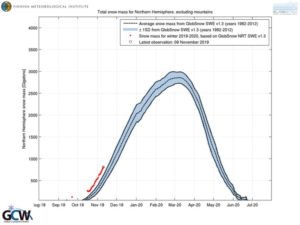
Brutal Arctic fronts have engulfed Scandinavia over the past few weeks. The record for Finland’s lowest-ever Autumn temp has just been smashed (for the second time this week), as has Sodankylä’s all-time snow-depth record (for early Nov).

The temperature in Enontekiö –a municipality in the Finnish part of Lapland– plunged to a Santa-freezing –28.2C(-18.8F) on Tuesday, Nov 5; beating-out the nation’s previous all-time autumnal low set just the previous day — Muonio’s -26.4C (15.5F) –located in far-northern Finland.

The previous record low for any autumn day in Enontekio was -26.3C (-15.3F).

Temperatures below -27C (-16.6F) were also recorded in Sodankylä, Luosto, and Kittilä on Tuesday, breaking local all-time record lows.

New climate models – even more wrong

by P. Matthews, Nov. 5, 2019 in ClimateScepticsim


The IPCC AR5 Report included this diagram, showing that climate models exaggerate recent warming:

If you want to find it, it’s figure 11.25, also repeated in the Technical Summary as figure TS-14. The issue is also discussed in box TS3:

“However, an analysis of the full suite of CMIP5 historical simulations (augmented for the period 2006–2012 by RCP4.5 simulations) reveals that 111 out of 114 realizations show a GMST trend over 1998–2012 that is higher than the entire HadCRUT4 trend ensemble (Box TS.3, Figure 1a; CMIP5 ensemble mean trend is 0.21°C per decade). This difference between simulated and observed trends could be caused by some combination of (a) internal climate variability, (b) missing or incorrect RF, and (c) model response error.”

Well, now there is a new generation of climate models, imaginatively known as CMIP6. By a remarkable coincidence, two new papers have just appeared, from independent teams, giving very similar results and published on the same day in the same journal. One is UKESM1: Description and evaluation of the UK Earth System Model, with a long list of authors, mostly from the Met Office, also announced as a “New flagship climate model” on the Met Office website.  The other is Structure and Performance of GFDL’s CM4.0 Climate Model, by a team from GFDL and Princeton. Both papers are open-access.

Now you might think that the new models would be better than the old ones. This is mathematical modelling 101: if a model doesn’t fit well with the data, you improve the model to make it fit better. But such elementary logic doesn’t apply in the field of climate science.

Paris Climate Accord — A Blank Check For CO2 Emissions By China And India

by Dr. B. Peiser, No. 5, 2018 in ClimateChangeDispatch


The Paris Climate Agreement, far from securing a reduction in global CO2 emissions, is fundamentally a blank cheque that allows China and India to increase their emissions as they see fit in pursuit of economic growth.

This is the conclusion of a new paper by Law Professor David Campbell (Lancaster University Law School) and published today by the Global Warming Policy Foundation.

For the last 25 years, international climate change law has failed to agree on a program of global emissions reductions.

Indeed this law grants permission to major emitters such as China and India to emit as much as they see fit. Global emissions reductions, therefore, have always been impossible and since 1992 global emissions have enormously increased.

Indeed, the Paris Agreement contains a categorical statement that countries such as China and India will not be obliged to undertake any reductions.

The UK Government proposes to continue with decarbonization even though Britain’s unilateral decarbonization is utterly pointless and thus wholly irrational.

Read the full paper here (PDF)

A STAGGERING 1,204 U.S. SITES RECORDED THEIR COLDEST-EVER OCTOBER TEMPERATURES LAST MONTH

by Cap Allon, November 4, 2019 in Electroverse


According to official NOAA data, more than twelve-hundred monthly low temperature records fell ACROSS the U.S. in October 2019 — multiple Arctic air masses rode anomalously-far south on the back of a wavy jet stream flow, itself associated with historically low solar activity.

The sun is currently in its deepest solar minimum of the past 100+ years, and the jet stream has weakened as a result; its usual tight ‘zonal’ flow has more-often-than-not reverted to a loose ‘meridional’ one. This wavy flow has diverted brutal Arctic air into the lower-latitudes, and is responsible for the U.S. either busting or tying a staggering 1204 all-time MONTHLY low temperature records in October 2019 (double the number of new heat records).


See also here and  here


U.S. Starts withdrawal from Paris Climate Accord.

by A. Watts, November 4, 2019 in WUWT


President Trump is fulfilling his most important de-regulatory promise.  This is a great day for America, and 4th November 2020 when U. S. withdrawal becomes final will be an even greater day. 


On the U.S. Withdrawal from the Paris Agreement

Press Statement by Michael R. Pompeo, Secretary of State

November 4, 2019

Today the United States began the process to withdraw from the Paris Agreement.  Per the terms of the Agreement, the United States submitted formal notification of its withdrawal to the United Nations.  The withdrawal will take effect one year from delivery of the notification.

As noted in his June 1, 2017 remarks, President Trump made the decision to withdraw from the Paris Agreement because of the unfair economic burden imposed on American workers, businesses, and taxpayers by U.S. pledges made under the Agreement.  The United States has reduced all types of emissions, even as we grow our economy and ensure our citizens’ access to affordable energy.  Our results speak for themselves:  U.S. emissions of criteria air pollutants that impact human health and the environment declined by 74% between 1970 and 2018.  U.S. net greenhouse gas emissions dropped 13% from 2005-2017, even as our economy grew over 19 percent.

The U.S. approach incorporates the reality of the global energy mix and uses all energy sources and technologies cleanly and efficiently, including fossils fuels, nuclear energy, and renewable energy.  In international climate discussions, we will continue to offer a realistic and pragmatic model – backed by a record of real world results – showing innovation and open markets lead to greater prosperity, fewer emissions, and more secure sources of energy.  We will continue to work with our global partners to enhance resilience to the impacts of climate change and prepare for and respond to natural disasters.  Just as we have in the past, the United States will continue to research, innovate, and grow our economy while reducing emissions and extending a helping hand to our friends and partners around the globe.

Oscillations of the baseline of solar magnetic field and solar irradiance on a millennial timescale

by Zharkova V. V. et al., June  24, 2019 in Nature OPEN ACCESS


Abstract

Recently discovered long-term oscillations of the solar background magnetic field associated with double dynamo waves generated in inner and outer layers of the Sun indicate that the solar activity is heading in the next three decades (2019–2055) to a Modern grand minimum similar to Maunder one. On the other hand, a reconstruction of solar total irradiance suggests that since the Maunder minimum there is an increase in the cycle-averaged total solar irradiance (TSI) by a value of about 1–1.5 Wm−2 closely correlated with an increase of the baseline (average) terrestrial temperature. In order to understand these two opposite trends, we calculated the double dynamo summary curve of magnetic field variations backward one hundred thousand years allowing us to confirm strong oscillations of solar activity in regular (11 year) and recently reported grand (350–400 year) solar cycles caused by actions of the double solar dynamo. In addition, oscillations of the baseline (zero-line) of magnetic field with a period of 1950 ± 95 years (a super-grand cycle) are discovered by applying a running averaging filter to suppress large-scale oscillations of 11 year cycles. Latest minimum of the baseline oscillations is found to coincide with the grand solar minimum (the Maunder minimum) occurred before the current super-grand cycle start. Since then the baseline magnitude became slowly increasing towards its maximum at 2600 to be followed by its decrease and minimum at ~3700. These oscillations of the baseline solar magnetic field are found associated with a long-term solar inertial motion about the barycenter of the solar system and closely linked to an increase of solar irradiance and terrestrial temperature in the past two centuries. This trend is anticipated to continue in the next six centuries that can lead to a further natural increase of the terrestrial temperature by more than 2.5 °C by 2600.

Ancient Air Challenges Prominent Explanation For A Shift In Glacial Cycles

by E. W. Wolf, November 4, 2019 in WUWT


From Nature

An analysis of air up to 2 million years old, trapped in Antarctic ice, shows that a major shift in the periodicity of glacial cycles was probably not caused by a long-term decline in atmospheric levels of carbon dioxide.

Eric W. Wolff

During the past 2.6 million years, Earth’s climate has alternated between warm periods known as interglacials, when conditions were similar to those of today, and cold glacials, when ice sheets spread across North America and northern Europe. Before about 1 million years ago, the warm periods recurred every 40,000 years, but after that, the return period lengthened to an average of about 100,000 years. It has often been suggested that a decline in the atmospheric concentration of carbon dioxide was responsible for this fundamental change. Writing in Nature, Yan et al.1 report the first direct measurements of atmospheric CO2 concentrations from more than 1 million years ago. Their data show that, although CO2levels during glacials stayed well above the lows that occurred during the deep glacials of the past 800,000 years, the maximum CO2 concentrations during interglacials did not decline. The explanation for the change must therefore lie elsewhere.

Understanding what caused the shift in periodicity, known as the mid-Pleistocene transition (MPT), is one of the great challenges of palaeoclimate science. The 40,000-year periodicity that dominated until about 1 million years ago is easily explained, because the tilt of Earth’s spin axis relative to its orbit around the Sun varies between 22.1° and 24.5° with the same period. In other words, before the MPT, low tilts led to cooler summers that promoted the growth and preservation of ice sheets.

But after the MPT, glacial cycles lasted for two to three tilt cycles. Because the pattern of variation in Earth’s orbit and tilt remained unchanged, this implies that the energy needed to lose ice sheets2 had increased. One prominent explanation3 is that atmospheric levels of CO2 were declining, and eventually crossed a threshold value below which the net cooling effect of the decline allowed ice sheets to persist and grow larger.

Halloween Surprise: 96-Year-Old Record Snowfall In Chicago, Across U.S.

by K. Rodriguez, November 1, 2019 in ClimateChangeDispatch


A storm that made many areas of the Midwest feel more like winter than fall shattered a 96-year-old winter weather record in Chicago.

The historic storm system— which brought snow and cold over the Colorado Rockies this week— made it to the Midwest on Thursday morning, unleashing moderate-to-heavy snowfall in northeastern Kansas, eastern Iowa, Illinois, and southern Wisconsin.

The total accumulation expected in these areas is 3 to 5 inches of snow.

Chicago experienced its earliest snow day of the year where an inch or more of snow fell since October 20, 1989, and smashed its previous record of 0.7 inches at Chicago O’Hare International Airport on Wednesday with a whopping 1.2 inches of snow.

COLORADO: HEAVY SNOW BREAKS A 102-YEAR-OLD RECORD IN PUEBLO — CANCELS/DELAYS 800+ FLIGHTS AT DENVER INTERNATIONAL AIRPORT

by Cap Allon, Oct 30, 2019 in Electroverse


The Centennial State has seen a myriad of all-time cold records tumble this fall, and this week is continuing that trend towards cooler climes.

The 3.8 inches (9.7 cm) of snow that accumulated in Pueblo on Monday, October 28 comfortably eclipsed the city’s previous record for the date — the 2.9 inches (7.4 cm) from back in 1917. It also adds to the early-season inches already received during the first week of October.

For reference, Pueblo’s mean date for first measurable snowfall isn’t until Nov 6, according to weather.gov.

And yet more powder is forecast for the city on Wednesday, meaning this year will likely win third spot for snowiest October on record, surpassing the 8.2 inches (20.8 cm) that accumulated in October 1997(solar minimum of cycle 22).


La COP 25 annulée … catastrophe ou opportunité ?

by SCE-info, 1 novembre 2019 in ScienceClimatEnergie


Nous revoici plongé une fois de plus dans la énième COP censée répondre à l’Urgence Climatique. Pour rappel c’est lors du Sommet de la Terre, en juin 1992, à Rio de Janiero que cette urgence climatique, qui ne disait pas encore si haut son nom, a démarré. Depuis lors l’Urgence Climatique fait partie de notre quotidien avec ses prédictions apocalyptiques jamais avérées, sauf à établir un amalgame entre climat et catastrophes non liées au climat. Quelques amalgames parmi d’autres ? Les exagérations climatiques extrêmes, analysées à SCE et qui montrent comment les médias par un tour de passe-passe nous vendent du global à partir de ce qui est le plus souvent local, même démarche avec la forêt amazoniennedécrétée à tort ‘poumon de la planète’ ou encore les incendies de grande ampleur de 2017en Californie ‘simplement’ liés à une gestion idéologique des forêts par les pouvoirs publics. Que n’a-t-on pas entendu sur ces phénomènes et bien d’autres…

Oui les COP se succèdent, ne rectifient jamais le tir et n’ont toujours qu’un seul ennemi à combattre, le mal du siècle, le CO2, symbolisé par le ‘bouton CO2’ censé être à l’origine de tous les dérèglements rapportés. Force est de constater que dans cette hypothèse du CO2toutes ces COP se révèlent un échec cuisant, pour preuve l’augmentation de 1,7% de ce gaz en 2018 atteignant ainsi un nouveau record (ici et ici). Non seulement ces grands-messes onusiennes sont des échecs, mais elles entretiennent également une belle incohérence : outre que chaque sommet coûte très cher (130 millions de dollars pour plus de 30 000 participants (sic) au dernier sommet de Katowice en Pologne et environ 2 milliards de dollars depuis la première COP), ces réunions émettent plus de CO2 que 8200 familles américaines en un an, ou l’équivalent de 11700 voitures pendant un an, ou encore 728 camions pour la même période (ici).

Is the Man-Made Climate Change Debate Really Over?

by Dom Armentano, Oct 30, 2019 in ClimateChangeDispatch


Climate change enthusiasts are convinced that man-made global warming poses a near-term environmental disaster. Yet gloom-and-doom forecasts about the fate of the Earth are hardly new, and few have proven accurate.

In 1798 the Rev. Thomas Malthus predicted that mass starvation would strike England in the 19th century because population growth would inevitably overwhelm food production. It didn’t happen.

Or recall the dire predictions by experts in the 1970s that the world was running out of oil and that prices would skyrocket and stay high for decades.

These views were supported by analyses from the CIA and a boatload of geologists who believed in the so-called “peak oil” theory.

But the experts were wrong. Adjusted for inflation, a barrel of crude oil today is cheaper than it was in 1980, which is arguably one of the most pro-consumer developments in recent economic history.

And now we are told that the world is on the brink of environmental disaster due to man-made global warming.

The conventional wisdom, repeated endlessly in the popular press, is that the Earth is heating dangerously because we burn fossil fuels and that this will generate devastating droughts, fires, floods, and rising ocean levels. (The oceans are currently rising by about one-eighth of an inch per year).


Mother Nature, Not Global Warming, Behind The California Wildfires

by Chris Martz, Oct 30, 2019 in ClimateChangeDispatch


Articles, like the one from Politico above (Figure 1)¹, have been popping up left and right claiming that climate change is causing the wildfires.

Endless amounts of disinformation are being spread around on Twitter and Facebook from well-known media outlets, public figures, government officials, and even a handful of well-known scientists.

There’s no doubt that the dozen or more wildfires that have broken out in the state, including the Getty and Kincade fires, are serious.

Firefighters are doing their best to try and contain these fires before any more serious damage occurs. But, playing the blame game on climate change does nothing for public safety whatsoever.

What’s really to blame for these fires?

The Kincade Fire, in particular, was caused by a broken jumper wire of the Pacific Gas & Electric company(PG&E), though “mother nature,” as you will find out below, has enhanced the fire and others that have since broken out across the state.

October through March is the prime time of the year for wildfires to break out in the Western United States (Raphael, 2003).²

This is largely because atmospheric and surface conditions tend to be very favorable in the region for fire weather; that is a.) dry soil and vegetation, b.) low relative humidity, c.) warm temperatures, and d.) strong winds.³

See also here and here

Scientists: The Entirety Of The 1979-2017 Global Temperature Change Can Be Explained By Natural Forcing

by K. Richard, October 28, 2019 in NoTricksZone


The last 40 years of global temperature changes can be radiatively explained by a natural reduction in cloud cover.

From 1979 to 2011, satellite data provide documentation of a reduction in cloud cover and aerosol depth that allowed an additional 2.3 W/m² of positive shortwave energy to be absorbed by the Earth’s surface rather than reflected to space.

This change in absorbed solar radiation can account for the energy imbalance and warming during this period far better than the much smaller 0.2 W/m² forcing associated with a +22 ppm CO2 change over 10 years (representing just 10% of the overall trend in downwelling longwave).

German Portrait Of The Thunberg-Ernman Family: Acutely Dysfunctional, “An Infinitely Sad Family History”

by U. Stockman, October 26, 2019 in NoTricksZone


At the German libertarian site achgut.com here, guest writer Ulrike Stockmannwrites a portrait of climate activist Greta Thunberg’s family. The title: “The Thunberg-Ernmans: An infinitely sad family history“.


Stockmann portrait is based on the published book by Greta Thunberg’s mother, Malena Ernman: “Scenes from the Heart”, which describes Greta’s past life and her path to becoming an environmental activist.

Family a drama and tragedy

Having read the book, Stockmann writes that “nothing surprises any more and that Greta being climate prophet is merely the tip of the iceberg of a family drama.”

What follows are excerpts of Stockmann’s portrait of the Ernman-Thunberg family:

Malena Ernman is a successful opera singer. Her husband Svante Thunberg is an actor. […] By the time Greta enters the fifth grade, suddenly she is no longer feeling well at all. She refuses to eat, cries all day long and is depressed. […]

Greta’s hunger strike becomes life-threatening: she eats almost nothing for two months. The parents take her to the hospital and the Centre for Eating Disorders. [..] In addition, Asperger’s syndrome, highly functional autism and OCD (obsessive-compulsive disorder) are diagnosed.

One day at school Greta sees a film about the pollution of the oceans showing a huge island of plastic waste and bursts into tears. Overall Greta is unhappy at school. […]  She doesn’t feel well at school. Everything becomes too much for her.”

Stockmann sees parental neglect, quoting Ernman in the book

Debunking Popular Climate Myths About CO2

by N. Thurner, October 25, 2019 in ClimateChageDispatch


If you believe the debate over global warming has ever been about science—or for that matter climate—you have been conditioned, through formal education or through reports warning of doom and gloom, to believe what others rightly describe as a world-wide hoax concocted to unite the world under a single socialistic government where there is no capitalism, no democracy, and no freedom.

Why is exposing the truth so important? Because it has everything to do with the redistribution of wealth and the establishment of political agendas aimed at destroying the foundation of eastern democracies and free markets.

Accordingly, it is therefore critical for everyone to become informed so free and open debate can exist, rather than the suppression and falsification of actual scientific climate data.

This article will expose some of the popular climate myths about CO2, so the reader will be equipped with ammunition to spread the truth to those who are willing to listen and have not yet become environmental extremists.

Links are included after each myth to substantiate information and to provide reference material for further interest and clarification.

The article was written using individual articles, with permission from my friend Jay Lehr, Ph.D., in which he exposed popular climate myths related to CO2. Jay Lehr is a Senior Policy Analyst for The International Climate Science Coalition.

Myth #1:  Carbon dioxide emissions cause catastrophic global warming.

Does the Climate System Have a Preferred Average State? Chaos and the Forcing-Feedback Paradigm

by Roy Spencer, October 25, 2019 in GlobalWarming


The UN IPCC scientists who write the reports which guide international energy policy on fossil fuel use operate under the assumption that the climate system has a preferred, natural and constant average state which is only deviated from through the meddling of humans. They construct their climate models so that the models do not produce any warming or cooling unless they are forced to through increasing anthropogenic greenhouse gases, aerosols, or volcanic eruptions.

This imposed behavior of their “control runs” is admittedly necessary because various physical processes in the models are not known well enough from observations and first principles, and so the models must be tinkered with until they produce what might be considered to be the “null hypothesis” behavior, which in their worldview means no long-term warming or cooling.

What I’d like to discuss here is NOT whether there are other ‘external’ forcing agents of climate change, such as the sun. That is a valuable discussion, but not what I’m going to address. I’d like to address the question of whether there really is an average state that the climate system is constantly re-adjusting itself toward, even if it is constantly nudged in different directions by the sun.


1575 Winter Landscape with Snowfall near Antwerp by Lucas van Valckenborch.Städel Museum/Wikimedia Commons

La science classique s’arrête où commence le chaos…

Prof. Igr. H. Masson, 25 octobre 2019 in ScienceClimatEnergie


1. Un nouveau paradigme : les systèmes chaotiques

« Depuis les premiers balbutiements de la Physique, le désordre apparent qui règne dans l’atmosphère, dans la mer turbulente, dans les fluctuations de populations biologiques, les oscillations du cœur et du cerveau ont été longtemps ignorées ».

 « Il a fallu attendre le début des années soixante-dix, pour que quelques scientifiques américains commencent à déchiffrer le désordre, il s’agissait surtout de mathématiciens, médecins, biologistes, physiciens, chimistes cherchant tous des connections entre diverses irrégularités observées. Le syndrome de la mort subite fut expliqué, les proliférations puis disparitions d’insectes furent comprises et modélisées, et de nouvelles méthodes d’analyse de cours boursiers virent le jour, après que les traders aient dû se rendre à l’évidence que les méthodes statistiques conventionnelles n’étaient pas adaptées. Ces découvertes furent ensuite transposées à l’étude du monde naturel : la forme des nuages, les trajectoires de la foudre, la constitution de galaxies. La science du chaos (« dynamical systems » pour les anglo-saxons) était née et allait connaître un développement considérable au fil des années ».


Figure 4. L’effet papillon : analogie entre les ailes d’un papillon et l’attracteur étrange découvert par E. Lorenz.

West Antarctic Ice Sheet Growing As Southern Ocean Warms Slightly

by Michaels, P.J., October 22, 2019 in ClimateChangeDispatch


The West Antarctic Ice Sheet is growing, but I bet you didn’t read about it in the news. Nor would you probably be able to find it if you entered “West Antarctic Ice Sheet Growing” in a Google search.

That search would likely uncover one 2015 publication by NASA’s Jay Zwally in the Journal of Glaciology using actual weather data that showed increasing snowfall, primarily over East Antarctica, was adding a small amount of ice.

That report generated a flurry of coverage, but of course in the current era of public shaming of any deviation from the apocalyptic orthodoxy, you don’t hear much about it anymore.

Which may explain why you have heard nothing about this new publication which has been accepted in Journal of Geophysical Research-Atmospheres but isn’t in print yet:


Who Are the “Experts” on Climate Change?

by John Droz, Jr October 22, 2019 in WUWT


We live in complicated times, immersed in a society of incessant, loud, conflicting voices. Nowhere is this more true than in the discussion of the impact of carbon dioxide on the planet, oceans, better known as “climate change.” When interested citizens try to get to the bottom of such a highly complex issue, the standard, and proper, rejoinder is: “Listen to the Experts.”

Although that sounds like common sense, such advice is not as simple as it’s made out to be. For millennia, it was safe to assume that mainstream scientists (as a matter of principle) faithfully adhered to high scientific standards (see below). In our lifetime that has dramatically (and disappointingly) changed.

Today there is an ever-increasing number of scientists driven by political agendas, peer pressure, job security, etc. rather than scientific mores. This change has extraordinarysocietal implications — and none of them are beneficial.

Real Experts on a science-related subject have six distinguishing characteristics, which are really no more than the traditional scientific standards:

1 – They have a high degree of competence in the topic at hand.

[For example, out of 1000 people, they would know more than 999.]

2 – They have a comprehensive understanding of the topic.

[They are not one of the blind people examining just a part of the elephant.]

3 – They are objective in their conclusions and recommendations.

[They are not influenced by economic incentives, or undeclared political agendas.]

4 – They are genuinely open-minded regarding their positions.

[They encourage other parties to critique their analyses and conclusions.]

5 – Their research and data are transparent.

[No pertinent information is hidden behind such claims as “work product.”]

6 – Their research and data are based on empirical evidence.

[Real world data always takes priority over computer-generated information.]

Human CO2 Emissions Have Little Effect On Atmospheric CO2

by Ed Berry, October 21, 2019 in PrincipiaScientificInternational


The United Nations Intergovernmental Panel on Climate Change (IPCC) agrees human CO2 is only 5 percent and natural CO2 is 95 percent of the CO2 inflow into the atmosphere. The ratio of human to natural CO2 in the atmosphere must equal the ratio of the inflows.

Yet IPCC claims human CO2 has caused all the rise in atmospheric CO2 above 280 ppm, which is now 130 ppm or 32 percent of today’s atmospheric CO2.

To cause the human 5 percent to become 32 percent in the atmosphere, the IPCC model treats human and natural CO2 differently, which is impossible because the molecules are identical. IPCC’s Bern model artificially traps human CO2 in the atmosphere while it lets natural CO2 flow freely out of the atmosphere.

By contrast, a simple Physics Model treats all CO2 molecules the same, as it should, and shows how CO2 flows through the atmosphere and produces a balance level where outflow equals inflow. Thereafter, if inflow is constant, level remains constant.

The Physics Model has only one hypothesis, that outflow is proportional to level. The Physics Model exactly replicates the 14C data from 1970 to 2014 with only two physical parameters: balance level and e-time. The 14C data trace how CO2 flows out of the atmosphere.

The Physics Model shows the 14CO2 e-time is a constant 16.5 years. Other data show e-time for 12CO2 is about 4 to 5 years. IPCC claims human CO2 reduces ocean buffer capacity. But that would increase e-time. The constant e-time proves IPCC’s claim is false.

IPCC argues that the human-caused reduction of 14C and 13C in the atmosphere prove human CO2 causes all the increase in atmospheric CO2. However, numbers show these isotope data support the Physics Model and reject the IPCC model.

The Physics Model shows how inflows of human and natural CO2 into the atmosphere set balance levels proportional to their inflows. Each balance level remains constant if its inflow remains constant. Continued constant CO2 emissions do not add more CO2 to the atmosphere. No CO2 accumulates in the atmosphere.

Present human CO2 inflow produces a balance level of about 18 ppm. Present natural CO2 inflow produces a balance level of about 392 ppm. Human CO2 is insignificant to the increase of CO2 in the atmosphere. Increased natural CO2 inflow has increased the level of CO2 in the atmosphere.

Keywords: carbon dioxide, CO2, climate change, anthropogenic

Antarctic ice cliffs may not contribute to sea-level rise as much as predicted

by Massachusetts Institute of Technology, October 21, 2019 in ScicnceDaily


Researchers report that in order for a 90-meter ice cliff to collapse entirely, the ice shelves supporting the cliff would have to break apart extremely quickly, within a matter of hours — a rate of ice loss that has not been observed in the modern record.

A realistic picture

The results suggest that the Earth’s tallest ice cliffs are unlikely to collapse catastrophically and trigger a runaway ice sheet retreat. That’s because the fastest rate at which ice shelves are disappearing, at least as documented in the modern record, is on the order of weeks, not hours, as scientists observed in 2002, when they captured satellite imagery of the collapse of the Larsen B ice shelf — a chunk of ice as large as Rhode Island that broke away from Antarctica, shattering into thousands of icebergs over the span of two weeks.

“When Larsen B collapsed, that was quite an extreme event that occurred over two weeks, and that is a tiny ice shelf compared to the ones that we would be particularly worried about,” Clerc says. “So our work shows that cliff failure is probably not the mechanism by which we would get a lot of sea level rise in the near future.”

Reforesting is a good idea, but it is necessary to know where and how

by Charles the moderator, October 20, 2019 in WUWT


An international group of ecologists contests an article published in Science, which among other cardinal errors proposed ‘reforestation’ of the Cerrado, Brazil’s savanna biome

Fundação de Amparo à Pesquisa do Estado de São Paulo

An article recently published in Science, entitled “The global tree restoration potential”, presents what it calls “the most effective solution at our disposal to mitigate climate change”. The lead author is Jean-François Bastin, an ecologist affiliated with the Swiss Federal Institute of Technology (ETH Zurich).

The article attracted enormous media attention. It reports the results of a study in which Bastin and collaborators used remote sensing and modeling techniques to estimate that forest restoration in areas totaling 900 million hectares worldwide could store 205 gigatonnes of carbon.

The study was contested by a large international group of ecologists led by Joseph Veldman, a professor in Texas A&M University’s Department of Ecosystem Science and Management (USA). At the invitation of the editors of Science, the group formulated a reply, now featuring on the October 18th edition of Science under the title “Comment on ‘The global tree restoration potential’..

Its authors include William Bond, Emeritus Professor in the University of Cape Town’s Department of Biological Sciences (South Africa) and considered the world’s foremost expert on savanna ecology. Several Brazilian researchers also co-authored the reply, such as Giselda Durigan, affiliated with the São Paulo State Forestry Institute’s Ecology and Hydrology Laboratory.

“The plan proposed by Bastin et al. is based on flawed calculations and is actually a threat to the planet’s savannas, meadows and water resources,” Durigan said.