Charismatic Swiss meteorologist Jörg Kachelmann posted a comment at Twitterwhere he wondered what flagship German ZDF television was thinking when its evening news announced the polar vortex was some sort of new phenomenon arising from global warming.
Recently in the media we’ve been hearing a lot about the junk science that a warmer Arctic is somehow miraculously producing extreme cold over vast neighboring continents.
NOAA: “Polar vortex nothing new […] term appeared in 1853”
…
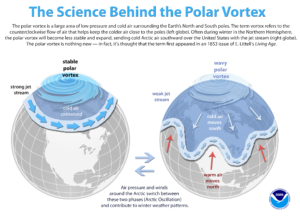
The science behind the polar vortex.(NOAA)Download
Paleoclimatic records indicate that most of Greenland was ice-free within the last 1.1 million years even though temperatures then were not much warmer than conditions today. To explain this, the researchers point to there being more heat beneath the ice sheet in the past than today.
Data show that when the Iceland hot spot — the heat source that feeds volcanoes on Iceland — passed under north-central Greenland 80 to 35 million years ago, it left molten rock deep underground but did not break through the upper mantle and crust to form volcanoes as it had in the west and east. The Earth’s climate then was too warm for Greenland to have an ice sheet, but once it cooled the ice sheet formed, growing and shrinking successive with ice ages.
by SCE-info, 31 janvier 2019 in ScienceClimatEnergie
Chers Collègues scientifiques signataires de la pétition (ici),
Vous avez signé une pétition en tant qu’académique scientifique. Tous les signataires le sont-ils ? Avez-vous remarqué des signataires qui n’ont pas existé ou qui sont décédés ? Trofik Lysenkom, inconnu sur Google, par contre Trofim Lysenko a bien existé (1898-1976) et reste de triste mémoire dans le monde scientifique. Outre cet aspect cocasse, il y a plus grave : en tant que signataires vous cautionnez que la science est dite (‘the science is settled’) et si tel est bien le cas alors vous ignorez de très nombreuses publications scientifiques, émanant de scientifiques de ‘haut vol’ qui montrent que le doute est permis, qu’il doit rester la règle en science, et que la climatologie ne se résume pas aux énoncés simplistes de la pétition (qui ne mentionne aucune références pour argumenter). Bien entendu vous avez peut-être lu des articles et vous vous êtes fait une opinion. Dans ce cas, vous avez exercé votre esprit critique et vous avez tout compris de la climatologie. Il n’y a donc plus de doute pour vous, et du fait de votre signature la science est effectivement dite. L’essentiel des politiques et médias, bien qu’ils n’aient pas une grande connaissance scientifique, pensent comme vous.
Dans cet article, qui se veut une ouverture au débat, nous allons donner notre point de vue aux questions qui ont suscité votre adhésion. Nous ne ferons pas de politique, notre site Science, Climat et Energie (SCE) ayant une vocation scientifique. Nous souhaitons cependant que ceux qui n’ont pas fait l’effort de lire la manière dont les publications sont validées par le GIEC aillent consulter le site du GIEC.
Vous l’aurez compris, la climatologie est une science jeune, fort complexe, et contrairement aux affirmations et ‘matraquages’ quotidiens, elle est loin d’être comprise.
There has been almost a death watch going on for Chicago, looking for an all time new all-time low temperature record to beat the previous -27°F. For those wishing for a new datapoint, Chicago didn’t beat the all time record, but did set a new record for the day…
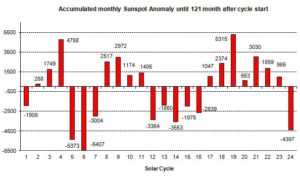
Our sun was also very sub-normally active in December last year. We are writing the 121st month since the beginning of cycle number 24, in December 2008, and since 2012 (when we started the blog here) we could only reformulate the opening sentence once: In September 2017 when the sun was 13% more active than the long-term (since 1755) average.
All other months were below average. With the sunspot number (SSN) of 3.1 for the monthly average for December and a total of 24 days without any spot (throughout the second half of the month the sun was spotless) we are in the middle of the cycle minimum.
…
Fig. 2: The sunspot activity of our sun since cycle 1 (1755). The numbers are calculated by adding the monthly differences with respect to the mean (blue in Fig.1) up to the current cycle month 121.
A message to French Yellow Vests that greens and EU supporters can field large groups of demonstrators. But half the pro-climate action marchers were school children.
I’m disgusted by how greens seem to think it is OK to use children as political pawns in their nasty game.
The school children, half of the climate action marchers, have no idea about the real world. They have never experienced the misery of watching their meagre weekly pay packets taxed away by distant green politicians who have no empathy or concern for the problems of ordinary people.
I wanted to expand upon something that was mentioned in yesterday’s blog post about the recent Cheng et al. paper which was widely reported with headlines suggesting a newer estimate of the rate of ocean warming is 40% higher than old estimates from the IPCC AR5 report in 2013. I demonstrated that the new dataset was only only 11% warmer when compared to the AR5 best estimate of ocean warming during 1971-2010.
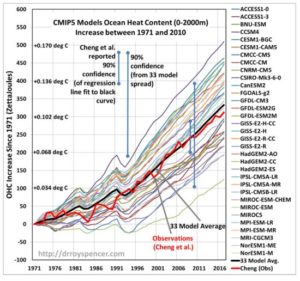
The point I want to reemphasize today is the huge range in ocean warming between the 33 models included in that study. Here’s a plot based upon data from Cheng’s website which, for the period in question (1971-2010) shows a factor of 8 range between the model with the least ocean warming and the model with the most warming, based upon linear trends fitted to the model curves:
Yearly ocean heat content (OHC) changes since 1971 in 33 models versus the recent Cheng reanalysis of XBT and Argo ocean temperature data for the surface to 2,000m layer. The vertical scale is in both ZettaJoules (10^21 Joules) and in deg. C (assuming an ocean area of 3.6 x 10^14 m^2). The Cheng et al. confidence interval has been inflated by 1.43 to account for the difference between the surface area of the Earth (Cheng et al. usage) and the actual ocean surface area.
Researchers from Leipzig cooperate with scientists from Punta Arenas (Chile) to learn more about the relationship between air pollution, clouds and precipitation.
Leipzig/Punta Arenas. How do airborne particles, so-called aerosols, affect the formation and life cycle of clouds and precipitation? In order to come one step closer to solving this question, atmospheric scientists from the Leibniz Institute for Tropospheric Research (TROPOS) and the Leipzig Institute for Meteorology (LIM) at Leipzig University will observe the atmosphere at one of the cleanest places in the world for at least a year. The choice fell on Punta Arenas because the city is located on a comparable geographical latitude as Germany and will thus enable comparisons between the northern and southern hemispheres. The measurement campaign is part of the International Year of Polar Prediction (YOPP), which aims to improve weather and climate forecasts for the polar regions through intensive measurements.
From the LA times, a bold move, but unlikely they can pull it off.
Germany to close all 84 of its coal-fired power plants, will rely primarily on renewable energy
…
…
The decision to quit coal follows an earlier bold energy policy move by the German government, which decided to shut down all of its nuclear power plants by 2022 in the wake of Japan’s Fukushima disaster in 2011.
…
The initial targets are considerable, calling for a quarter of the country’s coal-burning plants with a capacity of 12.5 gigawatts to be shut down by 2022. That means about 24 plants will be shut within the first three years. By 2030, Germany should have about eight coal-burning plants remaining, producing 17 gigawatts of electricity, the commission said.
A “Siberian Express” weather disturbance currently crossing the Arctic Ocean will meet up with the semi-permanent winter “polar vortex” over Canada, pushing a record-breaking cold air mass into the Upper Plains and Midwest U.S. by Wednesday.
Chicago All-Time Record Low?
Both the European (ECMWF) and U.S. (GFS) weather forecast models are in agreement that by Wednesday morning temperatures in the Chicago suburbs will be approaching -30 deg. F. The all-time official record low for the Chicago metro area was -27 deg. F (O’Hare) on January 20, 1985, and that 34 year old record could fall as the ECMWF model is forecasting -32 deg. F for Thursday morning while the GFS model is bottoming out at -26 deg. F on Wednesday morning. Of course, these forecasts will change somewhat in the coming days as the cold wave approaches.
by Jean, N. 25 janvier 2019 in ScienceClimatEnergie
En octobre 2017 un article signé Carl Brehmer[1] et traitant de la théorie de l’effet de serre radiatif était publié sur le site web de l’association anglaise Principia Scientific International[2]. Dans cet article, l’auteur utilisait des données fournies par les stations météorologiques SURFRAD et démontrait que la théorie de l’effet de serre ne pouvait pas expliquer les observations. Si l’auteur a raison, il s’agit encore d’un sérieux problème pour la théorie. Dans le présent article nous allons suivre les pas de Carl Brehmer mais nous allons faire nos propres calculs en employant une autre méthodologie. Arriverons-nous aux mêmes conclusions?
.
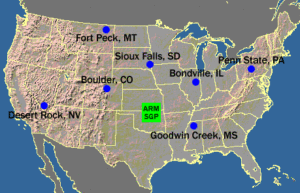
Figure 1. Les stations SURFRAD de la NOAA aux Etats-Unis
A careful look at the early 20th century global warming, which is almost as large as the warming since 1950. Until we can explain the early 20th century warming, I have little confidence IPCC and NCA4 attribution statements regarding the cause of the recent warming.
This is an issue that has long interested me. Peter Webster wrote a previous post Mid 20th Century Global(?) Warming, which focused on the warm bump that culminated in the 1940’s. My interest in this period was reignited while working on my report Sea Level and Climate Change. Then, the recent paper by Zanna et al. discussed in Ocean Heat Content Surprises further made the wheels turn.
In response to the Ocean Heat Content thread, David Appell posted a link to this paper on twitter:
A very large majority of establishment academic climate scientists have succumbed to a virulent infectious disease – the CO2 Derangement Syndrome. Those afflicted by this syndrome present with a spectrum of symptoms .The first is an almost total inability to recognize the most obvious Millennial and 60 year emergent patterns which are trivially obvious in solar activity and global temperature data.
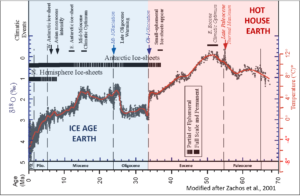
Note how the PETM (55 Ma) is about as far from a CO2 analog to modern times as it possibly could be… unless the PETM stomata data are correct, in which case AGW is even more insignificant than previously thought.
Regarding temperatures, the PETM is also about as far from being an analog to modern times as it possibly could be.
Figure 2. High latitude SST (°C) From benthic foram δ18O. Funny how the PETM is often cited as a nightmarish version of a real-world RCP8.5… While the warmer EECO is a climatic optimum. (Zachos et al., 2001). Note: Older is to the right.
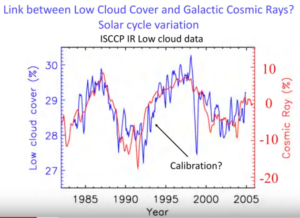
Danish Professor Henrik Svensmark is a leading physicist of cosmic radiation. At the end of last year he made a presentation at the 12th International Climate Conference in Munich, where he demonstrated that the climate is indeed modulated in large part by cloud cover, which in turn is modulated by solar activity in combination with cosmic rays.
His theory is that cosmic rays, which are extremely fast-flying particles – which originate from dying supernovae – travel through the cosmos, strike the Earth’s atmosphere and have a major impact on cloud cover and thus climate on the Earth’s surface.
This, Svensmark says, has been confirmed in numerous laboratory experiments.
There are a number of statements in Cheng et al. (2019) ‘How fast are the oceans warming’, (‘the paper’) that appear to be mistaken and/or potentially misleading. My analysis of these issues is followed by a reply from the paper’s authors.
Contrary to what the paper indicates:
Contemporary estimates of the trend in 0–2000 m depth ocean heat content over 1971–2010 are closely in line with that assessed in the IPCC AR5 report five years ago
Contemporary estimates of the trend in 0–2000 m depth ocean heat content over 2005–2017 are significantly (> 95% probability) smaller than the mean CMIP5 model simulation trend.
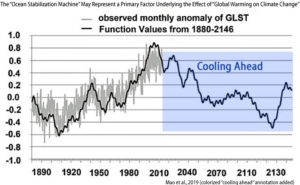
Four climate scientists assert (1) the last ~130 years of temperature changes fit “perfectly” into statistical indices of natural variation, and (2) a long-term deep cooling of the Earth system has recently commenced.
An analysis published in the journal Atmospheric and Climate Sciences by 4 climate scientists reveals the 1880-2013 temperature changes fit “perfectly” (0.9 correlation) into a calculation utilizing 15,295 periodic functions of natural variation.
Après trois années de baisse, les émissions américaines de CO2 liées à l’énergie auraient augmenté de 3,4% en 2018 selon les dernières estimations du cabinet Rhodium Group. Explications.
Une hausse des émissions malgré la baisse de consommation de charbon
Les émissions américaines de CO2 liées à l’énergie auraient connu en 2018 (+ 3,4%) leur deuxième plus forte hausse annuelle des deux dernières décennies, après 2010 (+ 3,8% dans un contexte de reprise économique après la crise de 2008) selon les dernières estimations de Rhodium Group publiées le 8 janvier.
La consommation de charbon a pourtant significativement baissé aux États-Unis en 2018 selon l’EIA. Dans le secteur électrique, le « King Coal » s’efface peu à peu au profit du gaz naturel, plus compétitif (avec l’exploitation du gaz de schiste) : la part du charbon dans la production nationale d’électricité aurait atteint 28% en 2018 (et pourrait encore diminuer à 26% en 2019), contre 35% pour le gaz naturel selon le Short-Term Energy Outlook de l’EIA publié en décembre dernier.
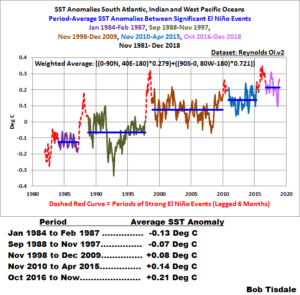
It was a little more than 10 years ago that I published my first blog posts on the obvious upward steps in the sea surface temperatures of a large portion of the global oceans…upward steps that are caused by El Niño events…upward steps that lead to sunlight-fueled, naturally occurring global warming.
There is a very simple explanation for those El Niño-caused upward shifts that also make themselves known in the sea surface temperature data for much larger portion of the global oceans than I first presented a decade ago…the upward steps that are blatantly obvious in the satellite-era (starts November 1981) of sea surface temperature data for the South Atlantic, Indian and West Pacific Oceans, as shown in Figure 1, which together cover about 52% of the surfaces of the global oceans.
by P. Homewood, January 20, 2019 in NotaLotofPeople KnowThat
…
Clearly the whole study is worthless, and the paper should be withdrawn.
There are some alarming facts about all of this:
1) Why did the researchers not suspect that the temperature data looked hopelessly wrong at the outset?
2) Why did peer review not do the basic checks that I did?
3) The study carries out some mindbendingly complex statistical analysis, linking arthropod decline to rising temperatures. But how can this analysis have been robust, when the temperature data was hopelessly wrong?
The conclusion is that the faulty temperature data matched the researchers’ expectations of climate warming, and consequently they never bothered to crosscheck. It would after all have been extremely simple to have asked the people who maintain the data.
Whether or not arthropods are in decline I have no idea. But by blaming non existent climate warming, there is a very real danger that the true cause is being missed. Indeed, looking at those graphs, it may well be climate cooling that is responsible.
I plan to contact PNAS, who published the paper, to request that it be withdrawn.
London, 20 December: One of Europe’s most eminent climate scientists has documented the main scientific reasons why the recent UN climate summit failed to welcome the IPCC’s report on global warming of 1.5°C.
In a paper published today by the Global Warming Policy Foundation Professor Ray Bates of University College Dublin explains the main reasons for the significant controversy about the latest IPCC report within the international community.
The IPCC’s Special Report on a Global Warming of 1.5°C (SR1.5) was released by the Intergovernmental Panel on Climate Change (IPCC) in advance of the recent COP24 meeting in Katowice, Poland, but was not adopted by the meeting due to objections by a number of governments.
Professor Bates examines some key aspects of the SR1.5 report. He assesses if the IPCC report exhibits a level of scientific rigour commensurate with the scale of its extremely costly and highly disruptive recommendation that carbon emissions be reduced to zero by mid-century.
The paper concludes that such a level of scientific rigour is not present in the report. Specifically, SR1.5 is deficient in scientific rigour in the following respects:
For all its green talk, China is sticking to fossil fuels
London, 12 December – While leaders of western countries fret about their greenhouse gas emissions in Katowice, China is forging ahead with new projects and investments in coal and gas. According to a new paper from the Global Warming Foundation (GWPF), the Communist Party’s survival depends on delivering economic growth and cleaner air.
Climate change: How could artificial photosynthesis contribute to limiting global warming?
Scientists calculate areas needed for forestation and artificial photosynthesis.
After several years during which global emissions at least stagnated, they rose again somewhat in 2017 and 2018. Germany has also clearly missed its climate targets. In order to keep global warming below 2 degrees Celsius, only about 1100 gigatonnes of CO2 may be released into the atmosphere by 2050[1]. And In order to limit global warming to 1.5 degrees, only just under 400 gigatonnes of CO2 may be emitted worldwide. By 2050, emissions will have to fall to zero even. Currently, however, 42 gigatonnes of CO2 are added every year.
Almost all the various scenarios require “negative emissions”
Recently, CO2 Science brought up a paper in Nature Communications.
Using satellite images, Venter et al. 2018 found an eight percent increase in woody vegetation in sub-Saharan Africa over the last three decades, underscoring the global “greening trend”.
…
According to Wikipedia, the Sahara covers a vast area of some 9.2 million square kilometers. Eight percent of that translates into more than 700,000 square kilometers. That’s an area that’s almost as big as Germany and France combined! This is profound.
In other words, it’s well over 10,000 Manhattans!
Recent study by Venter et al finds that the Sahara has shrunk by 8% over the past three decades. NASA image, public domain.
…
La géologie, une science plus que passionnante … et diverse