Archives de catégorie : climate-debate

Hottest Summer Evah? Not According To CET.

by Paul Homewood, September 1, 208  in NotaLotofPeopleKnowThat


With one day to go, it is clear that 2018 has been one of the hottest summers on record for the UK, however, the margin between the mean temperatures at the top of the league tables (records dating back to 1910) is so small that at this point it is impossible to say if 2018 will be an outright winner.  It is very close to the record-breaking summers of 2006 (15.78C), 2003 (15.77C), and 1976 (15.77C) all of which are within 0.01C of each other.

The margin is so small that different datasets and different regions of the UK will have different ranking. Usually we will only quote statistics to the nearest 0.1C as differences smaller than this could result from small numerical differences arising from the statistical calculations. A more comprehensive analysis of the 2018 summer data will be undertaken early next week and data for summer 2018 will continue to be analysed over the coming months.

Ralentissement de la fonte de la banquise Arctique : pas de record en 2018

by Météo Paris, 25 août 2018


Malgré des températures particulièrement élevées ces dernières semaines sur l’Hémisphère Nord, voire exceptionnelles sur l’Europe, le déclin des glaces de l’Arctique s’est vu ralenti.

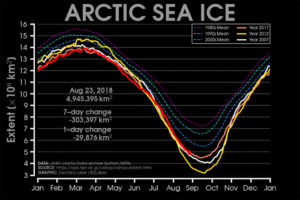
Au 23 août, l’étendue des glaces de l’Arctique était d’approximativement 4.945 millions de kilomètres carrés. Des niveaux toujours particulièrement bas au regard de la moyenne observée sur la période 1981-2010 (6.866 millions de km2, soit un déficit de 28%). Néanmoins, ce niveau n’est « que » le 6e plus bas observé à cette date, très loin de la triste année 2012 (une superficie inférieure à 4 millions de km2 à la fin août). Une timide amélioration, puisque l’étendue de ces glaces avait alors été la 4e plus faible jamais observée sur l’ensemble du mois de juin.


Graphique de l’étendue des glaces de l’océan Arctique (en millions de km2) – Zachary Michael Labe

nb se reporter à la courbe rouge/see red curve

Media Claims Of More Heat Waves Refuted By Multiple Recent Studies, Longterm Data

by Dr. S. Lüning and Prof. F. Vahrenholt, August 31, 2018 in NoTricksZone


The playbook is well-known: After a drought, heat wave or flood occurs, journalists and climate alarmists fall all over themselves in the race to issue shrill warnings that this is only the beginning and that it is known that evil climate change is behind it.

This summer of 2018 we experienced again a Central European heat wave. However the usual alarmists failed again to provide any solid statistics on the frequency of heat waves during the last 100 and 1000 years.

Here we are glad to help out by presenting the latest results on heat wave trend in North America. Let’s begin with a spring heat wave in the USA in 2012 which was examined by Dole & Hoerling (2014) within a long-term context. The authors see a purely natural cause behind the unusual heat:

@UCSUSA “Union of Concerned Scientists” doesn’t understand what “unprecedented” means when used with the word “warming”

by Anthony Watts, August 30, 2018 in WUWT


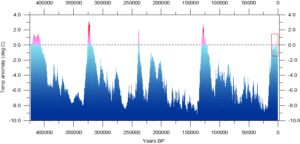
Earth’s surface has undergone unprecedented warming over the last century, and especially in this century.

Every single year since 1977 has been warmer than the 20th century average, with 16 of the 17 warmest years on record occurring since 2001, and 2016 being the warmest year on recorded history. A study from 2016 found that without the emissions from burning coal and oil, there is very little likelihood that 13 out of the 15 warmest years on record would all have happened.

Source: https://www.ucsusa.org/global-warming/science-and-impacts/science/human-contribution-to-gw-faq.html


First a definition of the word “unprecedented”:

Note that “in this century” isn’t part of the definition. it says “never done or known before”

So in that spirit, here’s some other “unprecedented” warming in Earth’s history, via the Vostok Ice Core dataset:

New book shreds the “climate to extreme weather” link

by  Anthony Watts, August 30, 2018 in WUWT


After nearly every hurricane, heatwave, drought, or other extreme weather event, commentators rush to link the disaster with climate change. But what does the science say?

In this fully revised and updated edition of Disasters & Climate Change, renowned political scientist Roger Pielke Jr. takes a close look at the work of the Intergovernmental Panel on Climate Change, the underlying scientific research, and the climate data to give you the latest science on how climate change is related to extreme weather.

What he finds may surprise you and raise questions about the role of science in political debates.


What is warming the Earth?

by Javier, August 29, 2018 in WUWT


A no-assumptions look at the global warming evidence helps clarify the possibilities.

The planet’s surface has been warming since the depths of the Little Ice Age, and particularly since ~ 1850 AD. The surface temperature record, however incomplete or uncertain, reflects this warming. Hypotheses about why the warming is taking place can be grouped into three general categories:

  1. The energy input is increasing. This is the basis of the variable solar output hypothesis.
  2. The energy output is decreasing. This is the basis of the greenhouse gases hypothesis.
  3. The transfer of heat within the system is changing. This is the basis of some hypotheses for a reduced vertical exchange in the ocean, or for changes in the oceanic currents that redistribute the heat.

A combination of these categories cannot be ruled out.

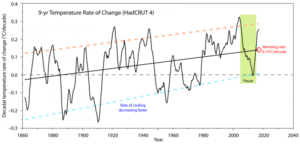
Whatever causes the temperature change must necessarily affect its rate of change, the velocity at which temperature changes over time, measured in °C/decade. A velocity that varies continuously and can be positive (warming) or negative (cooling).


Figure 1. 9-year global surface temperature rate of change (4-year averaged) in °C/decade. The Pause is indicated by the khaki box. Source: Met Office UK, HadCRUT 4.

A Second Letter to the Geological Society

by Andy May, August 29, 2018 in WUWT


In June of this year, Howard Dewhirst, a fellow of The Geological Society (London), wrote a letter to the President of the Society voicing the concern of 33 current and former fellows of the society, as well as other concerned geoscientists, that the Society’s position on climate change is outdated and one-sided. As of this writing, receipt of the letter has been acknowledged, but no reply has been received. Given the long period of time, Howard has sent a second letter to the Society, it is reproduced below.

Dear President

We understand that the council is reviewing the The Geological Society’s 2010 and 2013 position papers on climate change which was the subject of the letter we wrote to the society in early June. We also understand that despite the clear interest amongst Fellows – and other scientists, that the society will not be publishing further letters until the new position paper has been agreed. If true, we (the contributors to the first letter) think this is unfortunate, as now would be the very time to solicit informed opinion from Fellows and others as there clearly is not a consensus. …

Scrutinizing the carbon cycle and CO2 residence time in the atmosphere

by H. Harde, May 2017 in GlobalPanetaryChange


Highlights
•  We present a carbon cycle with an uptake proportional to the COconcentration.
• Temperature dependent natural emission and absorption rates are considered.
• The average residence time of CO2 in the atmosphere is found to be 4 years.
• Paleoclimatic CO2 variations and the actual CO2 growth rate are well reproduced.
• Human emissions only contribute 15 % to the CO2 increase over the Industrial Era.

Warmists Censor CO2-Climate Debate By Refusing To Publish Author’s Response To Attacks

by K. Richard, August 27, 2018 in ClimateChangeDispatch


A 2017 peer-reviewed paper authored by physicist Dr. Hermann Harde drew considerable response upon its publication in the journal Global and Planetary Change.

Harde’s conclusion that less than 15% of the increase in CO2 concentration since the 19th century could be attributed to anthropogenic emissions was deemed unacceptable by gatekeepers of the anthropogenic global warming (AGW) viewpoint.

A critical reply to the paper was consequently published, but it included assumptive errors and misrepresentations of the original points …

Germany’s retreat from Paris Climate Accord goals

by Anthony Watts, August 27, 2018 in WUWT


Via Reuters:

Merkel says EU should meet existing emissions aims, not set new ones

A proliferation of extreme weather events around the world provides ample evidence that climate change is a reality, German Chancellor Angela Merkel said on Sunday, but she rejected calls for more ambitious climate protection goals.

But Merkel said such calls, most recently from the European Commission’s climate chief Miguel Arias Canete, for swifter cuts to harmful carbon dioxide emissions would be counterproductive, adding that setting new goals made little sense when European countries were already struggling to meet their cuts targets.

Why I Don’t Deny: Confessions of a Climate Skeptic — Part 2

by Kip Hansen, August 27, 2018 in WUWT


Note:  Please read Part 1 before reading this — this is a continuation of that essay (a rather long continuation….).

Readers will have heard the line “multiple lines of evidence” attached to the attribution of anthropogenic causes.  However, that phrase is used only once in AR5 SPM as “Multiple lines of evidence indicate a strong, consistent, almost linear relationship between cumulative CO2 emissions and projected global temperature change to the year 2100….”  I’m sure I don’t need to point out that there is never ever evidence about the future…..They do not claim in the Summary for Policy Makers that there are multiple lines of evidence for the attribution statement that apply to the past-to-present.


Harmonic Analysis of Worldwide Temperature Proxies for 2000 Years

by H.J. Lüdecke and C.O. Weiss, April 27, 2017 in TheOpenAtm.Sci.J.


Abstract

The Sun as climate driver is repeatedly discussed in the literature but proofs are often weak. In order to elucidate the solar influence, we have used a large number of temperature proxies worldwide to construct a global temperature mean G7 over the last 2000 years. The Fourier spectrum of G7 shows the strongest components as ~1000-, ~460-, and ~190 – year periods whereas other cycles of the individual proxies are considerably weaker. The G7 temperature extrema coincide with the Roman, medieval, and present optima as well as the well-known minimum of AD 1450 during the Little Ice Age. We have constructed by reverse Fourier transform a representation of G7 using only these three sine functions, which shows a remarkable Pearson correlation of 0.84 with the 31-year running average of G7. The three cycles are also found dominant in the production rates of the solar-induced cosmogenic nuclides 14C and 10Be, most strongly in the ~190 – year period being known as the De Vries/Suess cycle. By wavelet analysis, a new proof has been provided that at least the ~190-year climate cycle has a solar origin.

Modulation of Ice Ages via Precession and Dust-Albedo Feedbacks

by Ralph Ellis, August 2018 in FriendsofScience


Why do ice ages occur? Surprisingly, even after many decades of paleoclimatic research we simply do not know for sure. Most scientists will agree that ice age cycles have something to do with precession: the slow wobble of the axis of the Earth. The ancient Egyptians and Greeks knew of precession and called it the Great Year, because it gives warm and cool seasons over its approximate 23,000-year cycle. But there is a problem with invoking the Great Year as the regulator of ice ages, because we should really get an interglacial warming every 23,000 years or so. And we don’t – they only happen every fourth or fifth Great Year.

But why should the global climate give a selective response to orbital warming and cooling? (Called ‘forcing’ in the climate trade.) This is one of the great unknowns of modern science.

Why I Don’t Deny: Confessions of a Climate Skeptic — Part 1

by Kip Hansen, August 25, 2018 in WUWT


I have often been asked “Why do you deny climate change?”  I am always stumped by the question.  It is rather like being asked “Why do you torture innocent animals?”  The questioner is not merely asking for information, they are always making an accusation — an accusation that they consider very serious and a threat to themselves and others.

The reason it stumps me is that, as you have guessed already, I do not deny climate change (and I do not torture innocent animals — nor even guilty ones).  And there is nothing about me or my behavior, present or past, that I am aware of, that would lead any reasonable person to think such a thing of me.

I am thoroughly guilty though of being very skeptical of what is generally referred to as the Climate Consensus — usually said to be represented by the latest reports and policy recommendations put out by the Intergovernmental Panel on Climate Change (IPCC) and its supporters; political, ideological and scientific.  I suppose it is this that leads to the false accusation of “denying climate change”.

And there is the crux of the matter — it is something in the mind of the accuser, not any action of the accused, which leads to the false accusation.

Carbon emissions in African savannas triple previous estimates

by Edinburgh University, August 24, 2018 in ScienceDaily


The findings highlight the extent to which humans are impacting one of the world’s major ecosystems — the Miombo woodlands, which cover 2.5 million square kilometres, across countries including Angola, Zambia, Tanzania and Mozambique.

At the same time, however, the growing number of trees in remote parts of these woodlands is helping to offset the emissions, researchers say.

The study is the first to provide an in-depth analysis of areas gaining carbon while also losing it through degradation — a process where some, but not all, trees are removed, usually as a result of logging and fire.

See original article in Nature

Arctic Summer Sea Ice Growth Trend Extends Another Year …Greenland Summer One Of Coldest In 30 Years!

by P. Gosselin, August 24, 2018 in NoTricksZone


As the Arctic summer ice melt approaches its peak, we can say with high certainty that this year’s ice melt will extend the trend of a rebounding Arctic ice mass by another year.

Arctic summer sea ice now growing 12 years

Our Japanese skeptic blogger and good friend Kirye reports using the data from the Danish Meteorological Institute (DMI) that peak summer Arctic sea ice volume upward growth trend has been extended yet another year – now 12 years.

Chart by Kirye. Data source: Danish Meteorology Institute (DMI).

NASA alarmism headline: ‘A World On Fire’

by Anthony Watts, August 23, 2018 in WUWT


The world is on fire. Or so it appears in this image from NASA’s Worldview. The red points overlaid on the image designate those areas that by using thermal bands detect actively burning fires. Africa seems to have the most concentrated fires. This could be due to the fact that these are most likely agricultural fires. The location, widespread nature, and number of fires suggest that these fires were deliberately set to manage land. Farmers often use fire to return nutrients to the soil and to clear the ground of unwanted plants. While fire helps enhance crops and grasses for pasture, the fires also produce smoke that degrades air quality.

Scientists discover that the world contains dramatically more trees than previously thought

by Chris Money, September 2, 2015 in TheWashingtonPost


In a blockbuster study released Wednesday in Nature, a team of 38 scientists finds that the planet is home to 3.04 trillion trees, blowing away the previously estimate of 400 billion. That means, the researchers say, that there are 422 trees for every person on Earth.

However, in no way do the researchers consider this good news. The study also finds that there are 46 percent fewer trees on Earth than there were before humans started the lengthy, but recently accelerating, process of deforestation.

“We can now say that there’s less trees than at any point in human civilization,” says Thomas Crowther, a postdoctoral researcher at the Yale School of Forestry and Environmental Studies who is the lead author on the research. “Since the spread of human influence, we’ve reduced the number almost by half, which is an astronomical thing.”

Greenland Temperatures In 2017

by P. Homewood, July 1, 2018 in NotaLotofPeopleKnowThat


As we all know, Greenland is warming up rapidly, causing the ice sheet to melt faster and faster.

Well, according to the BBC and New York Times, at least.

Only one slight problem – the temperature record shows quite a different story.

There is certainly no evidence of rising temperature trends, and every likelihood that temperatures will plummet again when the AMO turns cold again.

Holocene Sea Level Trends

by P. Homewood, August 22, 2018 in NotaLotofPeopleKnowThat


There seems to be a general acceptance about overall sea level trends during the Holocene.

There was naturally a very rapid rise in sea levels at the end of the ice age, until 6000 years ago, since when the rise has been much more gradual. Some research puts the rate of rise in the last 2000 years at 0.07mm/yr, and this reflects the fact that ice caps left over from the ice age are still melting, rather than that the world is warmer than before.

However, the impression is often given that, until the 20thC, this rate of rise has been pretty steady. This is despite the fact some of the authors of the above studies have warned of the existence of significant short-term fluctuations in sea level such that the sea level curve might oscillate up and down about this ~1 kyr mean state. [The above graph is based around 1000 year averages].


HH Lamb looked carefully at many expert studies in his day, and wrote about the very significant fluctuations they found. The following excerpts come from “Climate, History and the Modern World”:

1) The most rapid phases [of sea level rise] were between 8000 and 5000 BC, and that the rise of general water level was effectively over by about 2000 BC, when it may have stood a metre or two higher than today.

2) …

….

https://commons.wikimedia.org/wiki/File:Holocene_Sea_Level.png


Observing glaciers in “real time”

by Anthony Watts, August 20, 2018 in WUWT


From ETH Zurich and the “slow as molasses in winter” department.

Hot summers cause glaciers to melt. That not only changes the makeup of the landscape and hence the maps of Switzerland, it also affects every area of society. A new, dynamic glacier inventory makes the impact of climate change and the changing landscape visible.

The last time Swiss glaciers managed to grow at all was in 2001. Since then, the country’s 1,500 glaciers – as well as others elsewhere – have been suffering a slow but inexorable death. Until now, though, we have understood only partially how quickly they are really disappearing, and what effect that has on the landscape, people and animals. That is about to change, thanks to the Glacier Monitoring in Switzerland (GLAMOS) project. GLAMOS is working on behalf of various Swiss federal offices to put together a comprehensive inventory of the country’s glaciers – at an unprecedented level of detail.

Glacier observation under the spell of several Valais four-thousand-metre peaks. (Photograph: GLAMOS)

The coloured lines show where the edge of the Aletsch glacier once was (red line 1850, green=1973, blue=2010). (Graphic: Swisstopo/GLAMOS)

America Had Lower CO2 Emissions Than Paris Climate Accord Signatories

by Stephen Moore, August 20, 2018 in ClimateChangeDispatch


Take a wild guess what country is reducing its greenhouse gas emissions the most? Canada? Britain? France? India? Germany? Japan? No, no, no, no, no and no.

The answer to that question is the United States of America. Wow! How can that be? This must be a misprint. Fake news. America never signed the Kyoto Protocol some two decades ago.