La découverte a été effectuée par des scientifiques français du CNRS, dans ce groupe qui vivait sur l’île de Petrels, en terre Adélie. Hormis les deux bébés manchots survivants, ils n’ont retrouvé que des corps d’animaux affamés et des oeufs non-éclos. Ces chercheurs, soutenus par le Fonds mondial pour la nature (WWF), observaient depuis 2010 cette colonie. Selon eux, l’étendue inhabituelle de la banquise a contraint les parents à aller plus loin chercher leur nourriture. Leur progéniture ont succombé à la faim.
L’OPEP (Organisation des Pays Exportateurs de Pétrole), dénommée OPEC en anglais (Organization of Petroleum Exporting Countries), est une organisation intergouvernementale fondée à l’issue de la conférence de Bagdad le 14 septembre 1960 par le Venezuela, l’Irak, l’Arabie saoudite, le Koweït et l’Iran.
The extraordinary sight was witnessed by tourists on an Arctic cruise aboard the Finnish-built MV Akademik Shokalskiy.
A source at Wrangel Island Nature Reserve said: “There were at least 230 polar bears, including single males, single females, mothers with cubs and even two mothers with four cubs each.”
Experts called the sight of so many polar bears together “unique”. The huge number could in fact amount to as much one per cent of the entire world’s population of the creatures.
Important information has emerged in the field of energy, and yet it is as if European politicians ignore it. Judge for yourself based on just the following facts (…)
Les gisements sont des zones généralement profondes où l’on trouve de grandes quantités de charbon. Il faut forer des puits pour y accéder et extraire le minerai. Lorsque les réserves de charbon sont relativement proches de la surface de la terre, une exploitation à ciel ouvert peut être mise en place. Il existe également des gisements de charbon sous les océans, pour le moment inexploités.
by Tony Heller, September 21, 2017 in TheDeplorableClimSciBlog
New England hasn’t had a major hurricane in over 60 years, but on this date in 1938, New Jersey, New York, New England and Quebec were hit by a major hurricane – which would have destroyed Lower Manhattan had it tracked 30 miles to the west
We describe late Miocene tetrapod footprints (tracks) from the Trachilos locality in western Crete (Greece), which show hominin-like characteristics. They occur in an emergent horizon within an otherwise marginal marine succession of Messinian age (latest Miocene), dated to approximately 5.7 Ma (million years), just prior to the Messinian Salinity Crisis.
Dans la lutte que mènent nos villes contre la pollution urbaine, on perçoit la recherche désespérée de solutions alternatives aux véhicules conventionnels. C’est le cas en particulier pour les particules fines, même s’il est de bon ton de passer sous silence que le chauffage contribue aussi largement à cette pollution….
Currently (as of year 2007), human population on earth is 6.6 billion (via wikipedia). I went around to look for how much CO2 is exhaled out per person, and 2 claims were found (both via wikipedia)
by Roger Andrews, August 23, 2017 in Energy Matters (blog)
Between 2007 and 2015 total annual US CO2 emissions decreased by 740 million tons (12%). An updated analysis shows that 35% of this decrease was caused by natural gas replacing coal in electricity generation, 30% by lower fuel consumption in the transportation sector, 28% by renewables replacing
What is causing the death of the polar bear as a climate change icon? Fat bears are part of it, but mostly it’s the fact that polar bear numbers haven’t declined as predicted.
Earlier this year, DEFRA published a report by the Air Quality Expert Group into the impacts of biomass on air quality. The results make for startling reading.
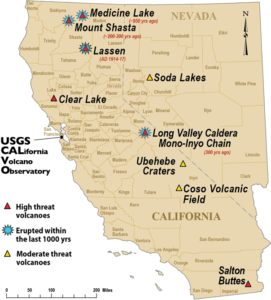
If “the supervolcano threat is substantially greater than the asteroid or comet threat,” does this mean we can stop fretting about Gorebal Warming and the Sixth Mass Extinction? Is NASA really moving on to actual threats to the planet? Well, not threats to the planet… The planet has handled supervolcanoes, asteroids and comets quite well over its 4.5 billion year lifespan.
While we obsess about climate change and debate if we live in the Anthropocene, we prepare poorly or not at all for natural forces like volcanoes that can level cities. This is folly we can no longer afford. Experts recommend a simple first step to better protect ourselves. Let’s start listening, or nature will teach us an expensive lesson.
by P Gosselin, August 15, 2017 in ClimateChangeDispatch
Here’s a good example of how climate alarmists and leftists in Germany react when confronted with different opinions or the truth. It just illustrates the brand of radicalism we’re up against.
Specifically the Bureau of Land Management Health Risk Evaluation for Cabon Dioxyde points out:
A value of 40,000 ppm is considered immediately dangerous to life and health based on the fact that a 30-minute exposure to 50,000 ppm produces intoxication, and concentrations greater than that (7-10%) produce unconsciousness (NIOSH 1996; Tox. Review 2005). Additionally, acute toxicity data show the lethal concentration low (LCLo) for CO2 is 90,000 ppm (9%) over 5 minutes (NIOSH 1996).
I mentioned in my previous post that the latest draft climate report, published in June, had seemingly left out a rather embarrassing table from the Executive Summary, one that had previously been written into the Third Draft, published last December.
As the link to the Third Draft had disappeared from the NYT, I could not show it.
However, Michael Bastasch, writing over at WUWT, did have the link, so we can now compare the relevant sections.
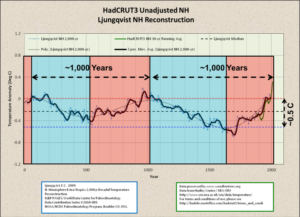
So… If climate change caused the Vikings to turn their plowshares into swords, abandoning their farms to become terrorists… the climate change would have been of the warming variety. I’m not a farmer, but it seems to me that global warming would have actually enhanced the Vikings’ ability to farm up around the Arctic Circle.
by JoNova, August 7, 2017 in ClimateChangeDispatch
In the mid-1990s thermometers changed right across Australia — new electronic sensors were installed nearly everywhere. Known as automatic weather sensors (AWS) these are quite different to the old “liquid in glass” type.
The electronic ones can pick up very short bursts of heat—so they can measure extremes of temperatures that the old mercury or liquid thermometers would not pick up unless the spike of heat lasted for a few minutes.
It is difficult (impossible) to believe that across the whole temperature range that these two different instruments would always behave in the exact same way.
As noted in my article four years ago, Japan has a program for producing natural gas from methane hydrates located near its coast, and predicts it will be successful by 2019.
Most people believe that Japan’s objective is highly optimistic, but it does shed light on the efforts currently underway to develop the technology for extracting natural gas from methane hydrates.
Not surprisingly, when all was said and done, the authors report that “increasing [the] CO2 concentration to 3000 ppm at 35°C did not cause changes in any of the measured responses.” They did note, however, that the heart rates of the subjects were slightly reduced under elevated CO2 conditions (Figure 1, top left panel), although these reductions were not statistically significant.
Since 1988, a mere 100 companies have been responsible for 71 percent of the entire world’s industrial greenhouse gas emissions.
This data comes from an inaugural report published by the Carbon Disclosure Project (CDP), an environmental non-profit. Charting the rapid expansion of the fossil fuel industry in the last 28 years, they have now released some truly staggering numbers on the world’s major carbon polluters.
La géologie, une science plus que passionnante … et diverse