
by Massachusetts Institute of Technology, Sep 19 in ScienceDaily
Based on mini “lab-quakes” in a controlled setting, MIT findings could help researchers assess the vulnerability of quake-prone regions.
- MIT scientists have unraveled the hidden energy balance of earthquakes by recreating them in the lab. Their findings show that while only a sliver of energy goes into the shaking we feel on the surface, the overwhelming majority is released as heat—sometimes hot enough to melt surrounding rock in an instant
-
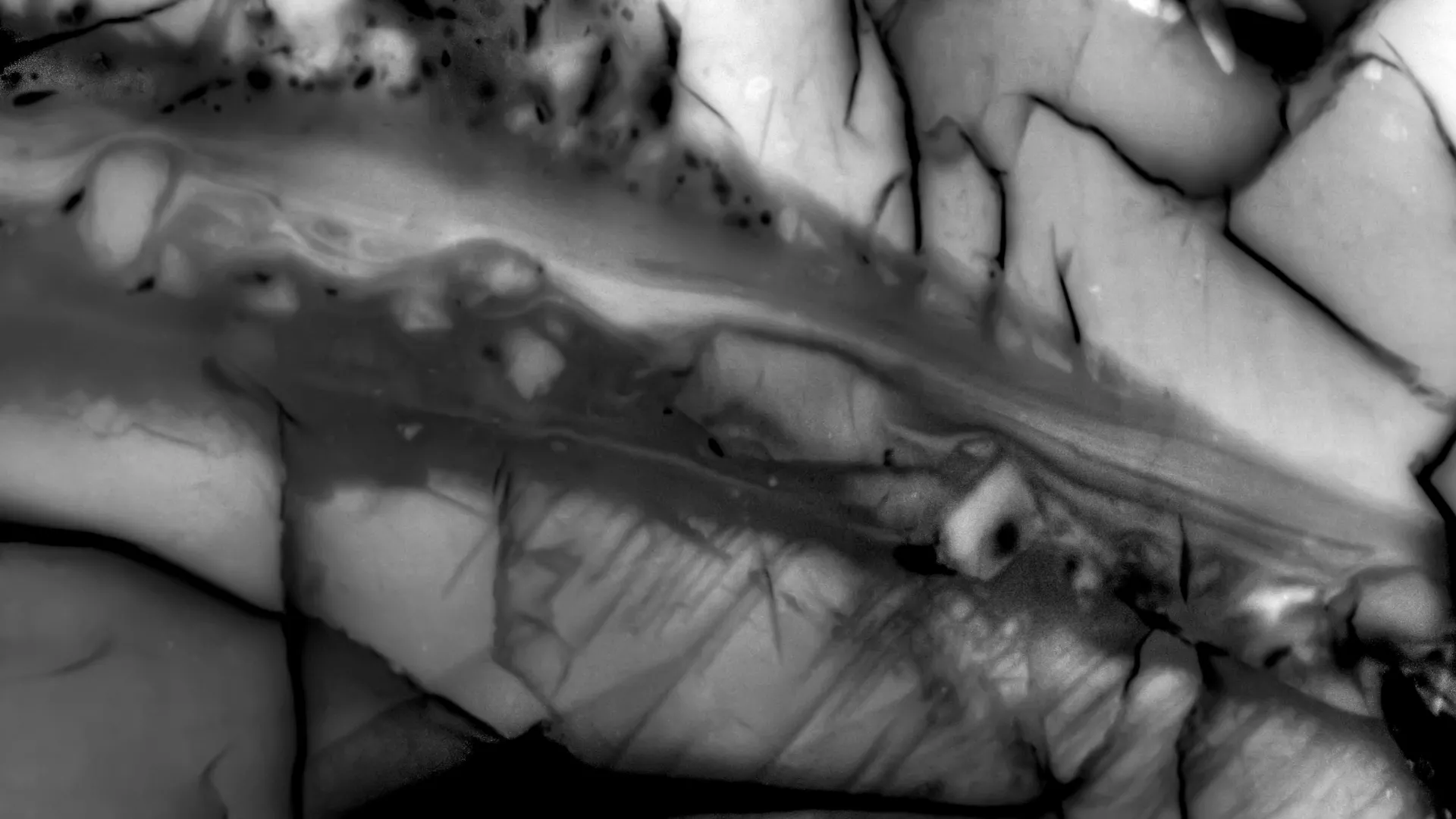
A scanning electron photomicrograph highlights a region of rock that slipped during a laboratory-induced earthquake. The “flowy” central area represents a portion of the rock that was melted and turned into glass due to intense frictional heating. Credit: Matěj Peč, Daniel Ortega-Arroyo The ground-shaking that an earthquake generates is only a fraction of the total energy that a quake releases. A quake can also generate a flash of heat, along with a domino-like fracturing of underground rocks. But exactly how much energy goes into each of these three processes is exceedingly difficult, if not impossible, to measure in the field.
Now MIT geologists have traced the energy that is released by “lab quakes” — miniature analogs of natural earthquakes that are carefully triggered in a controlled laboratory setting. For the first time, they have quantified the complete energy budget of such quakes, in terms of the fraction of energy that goes into heat, shaking, and fracturing.
…