by K.I. Dahl-Madsen, July 21 ,2026 in Clintel.org
Something unusual and encouraging has happened in Danish climate journalism. Berlingske, one of Denmark’s leading national daily newspapers, has published an excellent and genuinely inquisitive article about the dismissal of physicist Henrik Svensmark from the Technical University of Denmark (DTU), where he has been working since the late nineties. The headline leaves no room for doubt: “Controversial Danish climate and space researcher has received the pink slip from DTU: It is ‘a death blow’ to my research”.
Here is how the article starts:
He is one of Denmark’s most internationally recognized researchers – and at the same time one of the most controversial. But now space and climate researcher Henrik Svensmark has, in his own words, been “good old-fashioned fired” by his employer, the Technical University of Denmark (DTU) in Lyngby. He does not rule out that “political considerations” – as he puts it – were involved in the years-long process that led to his final dismissal. At the same time, Henrik Svensmark does not hesitate to call it “a death blow” to a branch of research that he has largely developed single-handedly and that climate researchers around the world, including the UN’s climate panel (IPCC), have had to relate to – often reluctantly. This is mainly because Svensmark’s research points to what he sees as an overlooked natural factor behind a large part of the climate changes Earth has undergone. He finally does not rule out that the dismissal may be linked to the fact that he is perceived as a controversial researcher in wide circles: “There is nothing controversial about the research itself. But it is true that many perceive my research as controversial, even though it shouldn’t be.” DTU has no comments on the actual dismissal of Svensmark and refers to it as a personnel matter. However, the director of DTU Space, Henning Skriver, confirms that Svensmark’s overarching research area, atmospheric physics, will now “be significantly down-prioritized.”
Science journalist Lars Henrik Aagaard deserves credit for the whole article. Rather than dismissing Svensmark as merely ‘controversial’, he asks the essential question: is DTU retiring an ageing employee, or is it terminating an internationally recognized but scientifically inconvenient research program?
…
by L. Peter, Nov 2019 in BBCNews
Denmark has for the first time put mineral-rich Greenland top of its national security agenda, ahead of terrorism and cybercrime.
The Defence Intelligence Service (FE) linked its change in priorities to US interest in Greenland, expressed in President Donald Trump’s desire to buy the vast Arctic territory.
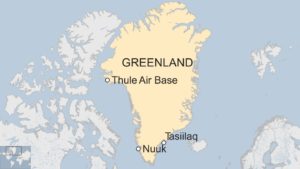
Greenland is part of Denmark, but has significant autonomy, including freedom to sign major business deals.
China has mining deals with Greenland.
The FE’s head Lars Findsen said Greenland was now a top security issue for Denmark because a “power game is unfolding” between the US and other global powers in the Arctic.
In August the Danish government dismissed as “absurd” President Trump’s suggestion of a US-Denmark land deal over Greenland.
The US interest in Greenland goes back decades. The US has a key Cold War-era air base at Thule, used for surveillance of space using a massive radar. It is the US military’s northernmost base, there to provide early warning of a missile attack on North America.
Why the new focus on Greenland?
Greenland’s strategic importance has grown amid increased Arctic shipping and international competition for rare minerals. Arctic waters are becoming more navigable because of melting ice, linked to global warming.
…
La géologie, une science plus que passionnante … et diverse