New York (CNN Business)Move over, Saudi Arabia. America is about to steal the kingdom’s energy exporting crown.
The United States will surpass Saudi Arabia later this year in exports of oil, natural gas liquids and petroleum products, like gasoline, according to energy research firm Rystad Energy.
That milestone, driven by the transformative shale boom, would make the United States the world’s leading exporter of oil and liquids. That has never happened since Saudi Arabia began selling oil overseas in the 1950s, Rystad said in a report Thursday.
“It’s nothing short of remarkable,” said Ryan Fitzmaurice, energy strategist at Rabobank. “Ten years ago, no one thought it could happen.”
The expected breakthrough reflects how technology has reshaped the global energy landscape. Drilling innovations have opened up huge swaths of oil and natural gas resources that had been trapped in shale oilfields in Texas, North Dakota and elsewhere.
Led by shale, US oil production has more than doubled over the past decade to all-time highs. The United States now pumps more oil than any other country, including Russia and Saudi Arabia.
“The shale boom has driven incredible increases in production,” said Fitzmaurice. “US production is off the charts.”
And the U.S. is not alone in trying to maximize oil and gas production. Despite the financial failures of the U.S. fracking industry, international efforts to duplicate the American fracking story are ramping up across the globe.
The CEO of Saudi Arabian state oil company Aramco recently dismissed the idea that global demand for oil will decrease anytime soon and urged the oil industry to “push back on exaggerated theories like peak oil demand.”
Khalid al Falih, Saudi Arabia’s energy minister, told the Financial Times, “Going forward the world is going to be Saudi Aramco’s playground.” But not if other countries frack there first.
China Expanding Fracking Efforts, Testing New Technology
The Las Vegas Valley Snow Event: What happened? Did we see this coming? Yes and no. We had been seeing very small chances for snow in the valley for a few days, but it wasn’t until Sunday afternoon that the hi-resolution models were consistently indicating that western parts of the valley could see up to 3 inches and up to an inch elsewhere. That’s when the decision was made to issue the Winter Weather Advisory.
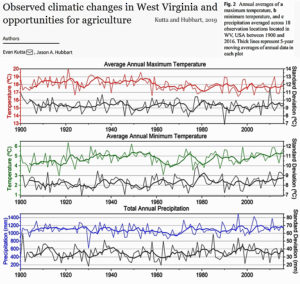
“Between 1900 and 2016, climatic trends were characterized by significant reductions in the maximum temperatures (−0.78°C/century; p = 0.001), significant increases in minimum temperatures (0.44 °C/century; p = 0.017) [overall -0.34°C/century], and increased annual precipitation (25.4 mm/century) indicative of a wetter and more temperate WV climate. Despite increasing trends of growing degree days during the first (p ≤ 0.015) and second half of the period of record, the long-term trend indicated a decrease in GDD [warm growing degree days] of approximately 100 °C/days.”
There has been almost a death watch going on for Chicago, looking for an all time new all-time low temperature record to beat the previous -27°F. For those wishing for a new datapoint, Chicago didn’t beat the all time record, but did set a new record for the day…
A “Siberian Express” weather disturbance currently crossing the Arctic Ocean will meet up with the semi-permanent winter “polar vortex” over Canada, pushing a record-breaking cold air mass into the Upper Plains and Midwest U.S. by Wednesday.
Chicago All-Time Record Low?
Both the European (ECMWF) and U.S. (GFS) weather forecast models are in agreement that by Wednesday morning temperatures in the Chicago suburbs will be approaching -30 deg. F. The all-time official record low for the Chicago metro area was -27 deg. F (O’Hare) on January 20, 1985, and that 34 year old record could fall as the ECMWF model is forecasting -32 deg. F for Thursday morning while the GFS model is bottoming out at -26 deg. F on Wednesday morning. Of course, these forecasts will change somewhat in the coming days as the cold wave approaches.
Après trois années de baisse, les émissions américaines de CO2 liées à l’énergie auraient augmenté de 3,4% en 2018 selon les dernières estimations du cabinet Rhodium Group. Explications.
Une hausse des émissions malgré la baisse de consommation de charbon
Les émissions américaines de CO2 liées à l’énergie auraient connu en 2018 (+ 3,4%) leur deuxième plus forte hausse annuelle des deux dernières décennies, après 2010 (+ 3,8% dans un contexte de reprise économique après la crise de 2008) selon les dernières estimations de Rhodium Group publiées le 8 janvier.
La consommation de charbon a pourtant significativement baissé aux États-Unis en 2018 selon l’EIA. Dans le secteur électrique, le « King Coal » s’efface peu à peu au profit du gaz naturel, plus compétitif (avec l’exploitation du gaz de schiste) : la part du charbon dans la production nationale d’électricité aurait atteint 28% en 2018 (et pourrait encore diminuer à 26% en 2019), contre 35% pour le gaz naturel selon le Short-Term Energy Outlook de l’EIA publié en décembre dernier.
A growing number of climate advocates say increasing the price of fossil fuels is the surest way to reduce greenhouse gas emissions, but leaders in the House and Senate are resisting calls for a carbon tax in Vermont.
During the last two legislative sessions, lawmakers introduced several bills that would have assessed a new tax on carbon-emitting fossil fuels. Last week, on the opening day of the legislative session, 40 or so people rallied in the Statehouse cafeteria against a carbon tax.
Du gaz et du pétrole de schiste sont découverts à profusion dans le monde, notamment aux États-Unis. Qui en parle dans nos grands media ? Serait-ce politiquement incorrect de l’évoquer ?
LE SUCCÈS DU PARI DU GAZ ET DU PÉTROLE DE SCHISTE
Le Texas aux États-Unis regorge de pétrole et de gaz de schiste au point que les gazoducs existants sont saturés ! Le gaz doit même être « torché » ou « éventé ».
En attendant la mise en service de nouvelles capacités de transport, la production doit être réduite faute de pouvoir exporter les quantités extraites. La production de pétrole de schiste doit aussi être réduite en parallèle car il est extrait avec le gaz (et vice-versa).
Des projets sont en développement pour évacuer le gaz vers le Golfe du Mexique pour le liquéfier (GPL) et pouvoir ainsi l’exporter par bateau méthanier.
PREMIER PRODUCTEUR DE PÉTROLE
Les États-Unis ont dépassé la Russie et l’Arabie Saoudite pour devenir le premier producteur de pétrole brut en 2018 a annoncé l’agence américaine de l’énergie (EIA).
Après avoir stagné autour de 6 millions de barils par jour (Mb/j) en moyenne de 1933 à 2013, la production a grimpé à 9,4 Mb/j en 2017, puis à 10,4 Mb/j en 2018, et elle passera à 11,5 Mb/j 2019.
La surabondance de gaz de schiste associé à l’extraction du pétrole de schiste a fait chuter les prix au terminal gazier à l’ouest du Texas jusqu’à 1 dollar par million d’unité thermique britannique (dollar/MM-Btu), alors qu’il vaut 13 à 14 dollars/MM-Btu sur le marché européen.
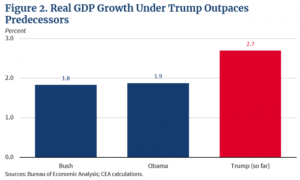
A booming economy. GDP growth during the first 2 years of the Trump administration has been about 50% higher than that of Obama’s eight-year maladministration.
Our manufacturing sector is booming.
A cold winter.
A booming economy drove up trucking and air travel.
Electricity demand increased and most of the increasing was powered by natural gas because renewables couldn’t even keep up with no growth.
The Appalachian Basin is driving growth of record-shattering U.S. natural gas production, which in turn has helped spur more than $25 billion in natural gas electricity generation investment in the region. In fact, there are 29 new 475-megawatt (MW) or greater natural gas-fired power plants that are in various stages of permitting, under construction or have recently become operational in Ohio (10), Pennsylvania (16) and West Virginia (3), representing more than 26,000 MW of added electric capacity, more than 17,000 jobs during construction and incredible emissions reductions in the electricity sector.
Things often calm down after January 1 during El Nino years….but not this year…with the U.S. West Coast from central California to Washington State about to be pummeled by a series of storms. Rain, snow, wind? Plenty for everyone.
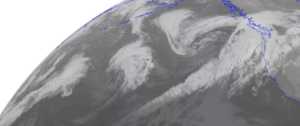
A view of the latest infrared satellite imagery shows an amazing line-up of one storm after another stretching way into the Pacific. A traffic jam of storms.
Let’s examine our stormy future, using a series of sea level pressure forecasts from the UW WRF weather forecast models (solid lines are sea level pressure, shading in lower atmosphere temperature).
In the whirlwind that is 2018, there has been a notable lack of high-end twisters.
We’re now days away from this becoming the first year in the modern record with no violent tornadoes touching down in the United States. Violent tornadoes are the strongest on a 0 to 5 scale, or those ranked EF4 or EF5.
It was a quiet year for tornadoes overall, with below normal numbers most months. Unless you’re a storm chaser, this is not bad news. The low tornado count is undoubtedly a big part of the reason the 10 tornado deaths in 2018 is also vying to be a record low.
While we still have several days to go in 2018, and some severe weather is likely across the South to close it out, odds favor the country making it the rest of the way without a violent tornado.
If and when that happens, it will be the first time since the modern record began in 1950.
Along the US East Coast, the Earth’s continued response to the end of the last ice age explains variances in relative sea level rates
Chestnut Hill, Mass. (12/20/2018) – Along the East Coast of the United States, relative sea level change does not happen uniformly between Maine and Florida.
Data have shown that sea level rise in the Mid-Atlantic region surpassed changes in relative sea level along the coastlines of the South Atlantic and the Gulf of Maine. A team of researchers took a look back at historical data through new analytical methods to pinpoint the reason behind the different rates of sea level change.
Assessing data from a range of sources and previous studies, the team concluded that the movement of the earth – referred to as vertical land motion – is the dominant force behind variations in rates of sea level rise up and down the East Coast, the team reports today in the journal Nature.
The L. A. Times published an article addressing a panel discussion at the latest U.N. climate alarmist confab in Poland touting protests by attendees regarding the need for continued use of fossil fuels.
I keep reading about all kinds of crazy schemes to reduce US CO2 emissions. Now, I don’t think that CO2 is the secret knob that controls the climate. I think that the earth has a host of emergent thermoregulatory mechanisms that act to keep the temperature within narrow limits (e.g. 0.6°C temperature change over the entire 20th Century). I don’t believe the claims that the modern changes in CO2 will affect the temperature.
But solely for the purposes of this post, let’s assume that the alarmists are correct. And for purposes of discussion only, let’s assume that the Earth’s temperature is free to go up and down any amount. Let’s assume that CO2 is, in fact, the secret control knob that controls the temperature of the earth. And let’s further assume that the pundits are right that the “climate sensitivity” is three degrees of warming for every doubling of CO2.
And finally, let’s assume that in 2018 the US magically stopped emitting any CO2 at all.
With all of those assumptions as prologue, here’s the question of interest.
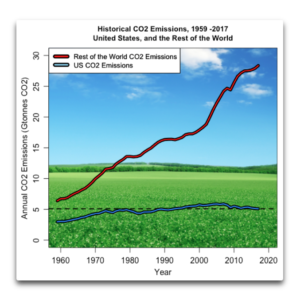
Other things being equal, if the US stopped emitting CO2 entirely in 2018, and stayed at zero CO2 emissions indefinitely, how much cooler would that make the planet in the year 2050?
Five degrees cooler? Two degrees? One degree?
…
Figure 1. Historical CO2 emissions. Data from CDIAC and BP Statistical Review of World Energy
The “amazing” thing is that this isn’t a “new” oil discovery. It’s just a realization that a lot more oil and gas can be produced from these formations than was previously imagined.
The Permian Basin a nearly infinite resource. It seems as if there will always be more hydrocarbons to squeeze out of its numerous oil & gas reservoirs. From a Warmunist perspective the Bone Spring and Wolfcamp are much worse than previously thought…
New Mexico contains hundreds of historic uranium mines. Although active uranium mining in the state has ceased, rates of cardiovascular and metabolic disease remain high in the population residing close to mines within the Navajo Nation. According to a new study in ACS’ journal Environmental Science & Technology Letters, inhaled uranium in dusts from the mines could be a factor.
Stronger oil and natural gas prices combined with continuing development of shales and low permeability formations drove producers of crude oil and natural gas in the United States to report new all-time record levels of proved reserves for both fuels in 2017. Total U.S. oil reserves in 2017 exceeded a brief, one-year, 47-year-old record, highlighting the importance of crude oil development in shales and low permeability plays, mainly in the Southwest. The new record for natural gas extends a longer-term trend of development, mainly in shale plays in the Northeast. Both U.S. proved reserves of crude oil and natural gas are approximately double their levels from a decade ago. These new proved reserves records were established in 2017 despite production of crude oil at levels not seen since 1972, and record natural gas production.
Talk about cold turkey! The coldest Thanksgiving in 100 years, and quite possibly the coldest Thanksgiving ever, has hit the Northeast United States today.
The unprecedented cold snap comes courtesy of a large Canadian chill working its way across the country on its way to the Atlantic. According to the Weather Network, the deep freeze is the result of a large, low pressure system moving south from the Arctic across the Great Lakes. Combine that with a wicked wind chill, and many Americans are looking at the coldest Thanksgiving in a century.
Chapter 6 – Temperature Changes in the United States of the U.S. Global Change Research Program’s recently published Climate Science Special Report (2017) clearly shows and discusses, under the heading of “6.1.2 Temperature Extremes”, how temperature extremes for the contiguous United States have become more moderate over the last 118 years, with the coldest daily temperatures warming and the warmest daily temperatures cooling. In other words, temperature-extreme-related climate in the United States has improved.
The Camp Fire that struck the northern California town of Paradise and vicinity is a profoundly disturbing environmental disaster of first magnitude. Nearly 100 people have lost their lives, approximately 10,000 homes have been lost, a major community has essentially been destroyed, and millions of people have been exposed to high concentrations of smoke. Tens of thousands of people have been displaced and lives of millions substantially affected.
And beyond the heart-wrenching losses noted above, it is doubly tragic that this disaster was both foreseeable and avoidable, resulting from a series of errors, poor judgment, lack of use of available technology, and poor urban planning.
It is more than unfortunate that some politicians, environmental advocacy groups, and activist scientists are attempting to use this tragedy as a tool for their own agenda, make the claim that the Camp Fire was result of global warming.
A few news items from The Shale Gas News, by Bill desRosiers of Cabot Oil & Gas. The main paragraphs below are adapted from desRosiers, but I’ve added some detail. Things are looking very good for the U.S. oil, gas and coal industries.
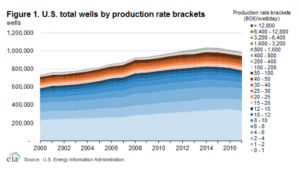
U.S. crude oil and natural gas production increased in 2017, with fewer wells. The total number of wells producing crude oil and natural gas in the United States fell to 991,000 in 2017, down from a peak of 1,039,000 wells in 2014. This recent decline in the number of wells reflects advances in technology and drilling techniques. EIA’s updated U.S. Oil and Natural Gas Wells by Production Rate report shows how daily production rates of individual wells contributed to U.S. total crude oil and natural gas production in 2017.
The well efficiency gains, in part, reflect an increase in the proportion of horizontal wells. The number of vertical wells decreased from 940,000 in 2014 to 864,000 in 2017. The number of horizontal wells increased from 99,000 in 2014 to 127,000 in 2017, an increase of 28%. This is important since only one percent of vertical wells produce 100 barrels of oil per day (BOPD) or more, but 30% of horizontal wells do. Typically, a horizontal well costs about twice as much as a vertical well to the same reservoir.
U.S. oil production grew from 10 million BOPD to 11 million BOPD between December 2017 and July 2018. Over the same period natural gas production grew from 97 BCF (billion cubic feet) to 100 BCF. Figures 1, 2, and 3 show the total number of wells drilled and the total oil and natural gas production.
Not all polar bears are in the same dire situation due to retreating sea ice, at least not right now. Off the western coast of Alaska, the Chukchi Sea is rich in marine life, but the number of polar bears in the area had never been counted. The first formal study of this population suggests that it’s been healthy and relatively abundant in recent years, numbering about 3,000 animals.
The study by researchers at the University of Washington and federal agencies is published Nov. 14 in Scientific Reports, an open-access journal from the Nature Publishing Group.
“This work represents a decade of research that gives us a first estimate of the abundance and status of the Chukchi Sea subpopulation,” said first author Eric Regehr, a researcher with the UW’s Polar Science Center who started the project as a biologist in Alaska with the U.S. Fish and Wildlife Service. “Despite having about one month less time on preferred sea ice habitats to hunt compared with 25 years ago, we found that the Chukchi Sea subpopulation was doing well from 2008 to 2016.