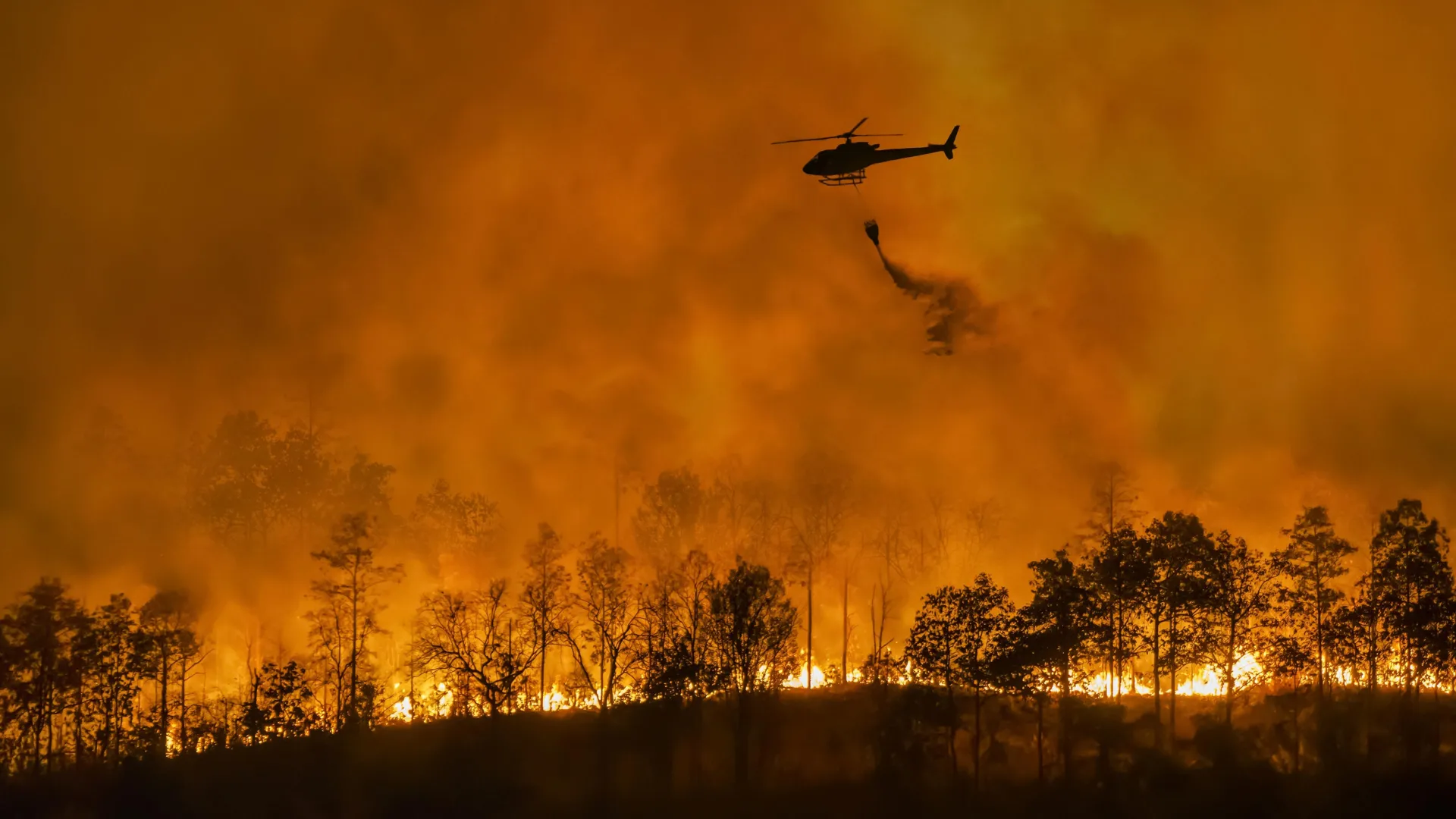
The surprising reason timber plantations explode into megafires

by University of Utah, Aug 21, 2025 in ScienceDaily


The odds of high-severity wildfire are nearly one-and-a-half times higher on industrial private land than in publicly owned forests. Reducing tree density mitigates megafire risk, even in extreme weather conditions.

The odds of high-severity wildfire were nearly one-and-a-half times higher on industrial private land than on publicly owned forests, a new study found. Forests managed by timber companies were more likely to exhibit the conditions that megafires love — dense stands of regularly spaced trees with continuous vegetation connecting the understory to the canopy.

Are surface temperature records reliable?

by Sue Bin Park, Aug 22, 2025 in SkepticalScience


Surface temperature records are consistent and have been confirmed by multiple independent analyses.

Measurements come from over 30,000 stations worldwide, with around 7,000 having long, continuous monthly records. Scientists adjust for known local anomalies such as urban heat islands by comparing urban and rural trends and accounting for differences.

Allegations in 2009 that poorly located U.S. stations skewed data were tested by NOAA, which found those sites actually read slightly cooler on average.

The independent Berkeley Earth Surface Temperature (BEST) study, led by a former climate skeptic, merged global datasets and concluded that the warming trend is unaffected by stations’ local conditions and nearly identical to NASA and NOAA records.

Temperature measurements are corroborated by satellites, ocean data, melting ice, and shifting ecosystems, all showing the same warming trend. No credible analysis has found that site issues or adjustments undermine the global record.

Go to full rebuttal on Skeptical Science or to the fact brief on Gigafact


This fact brief is responsive to quotes such as this one.


Sources

Skeptical Science Understanding adjustments to temperature data

NASA GISS Surface Temperature Analysis (v4)

Geoscience Data Journal The international surface temperature initiative global land surface databank: monthly temperature data release description and methods

Skeptical Science Berkeley Earth Surface Temperature Study: “The effect of urban heatingon the global trends is nearly negligible”

NOAA On the reliability of the U.S. surface temperature record

Carbon Brief Explainer: How data adjustments affect global temperature records

New Study: Corals Thrived In Warmer-Than-Today Temps And When Sea Levels Were Meters Higher

by K. Richard, Aug 19, 2025 in NoTricksZone 


hen the ocean was warmer than today, coral reef growth was rapid, averaging ~6 mm per year.

Sea levels rose rapidly from the Early to Mid Holocene in this region, as they were up to 2 m higher than today 6000 years ago. The higher sea levels meant there was more room for coral reef growth.

As the ocean cooled and sea levels fell ~2 meters from the Mid-Holocene highstand, coral growth slowed to ~2-3 mm per year.

Today corals are only growing at rates of ~1 mm per year, as the water depths are too low to accommodate reef expansion. In fact, coral coverage “has declined on the flats over the last few decades,” as the “accommodation space is less than a meter at points.”

Research from the Great Barrier Reef region (e.g., Leonard et al., 2020) also indicates coral growth experienced “turn-off” periods during cold centuries (such as the Little Ice Age) with falling sea levels. When the ocean was “~1-2°C warmer than present” and sea levels were “~1.0 m higher than present,” this “allowed reefs to accrete uninhibited.”

UN: Renewables are So Cheap They Need Lots of Subsidies

by E. Worrall, Aug 21, 2025 in WUWT


Inflexion Point: Renewable Energy Is Cheaper Than Fossil Fuels

PRABIR PURKAYASTHA

The tipping point between renewable energy and fossil fuels has been reached, says a new United Nations (UN) report. The UN Secretary-General Antônio Guterres said that we are entering a renewable era and leaving the era of fossil fuels. According to the report, ‘In 2024, renewables made up 92.5% of all new electricity capacity additions and 74% of electricity generation growth’. While almost the entire world has increasingly switched to renewables, the United States stands out as the sole ‘dissident’, with the Trump administration denying climate change and still backing fossil fuels.

The long-talked-about renewable transition is finally here! The question is, do we have the political will to do what is not only necessary in climate terms but also economically a better option for all of us? Or will the old fossil lobby, particularly in the US, sabotage humanity’s transition to a low-carbon future?

Not surprisingly, an analysis—Li, M., Trencher, G., & Asuka, J., Feb 16, 2022, PLOS ONE —of their business activities shows, ‘a continuing business model dependence on fossil fuels…We thus conclude that the transition to clean energy business models is not occurring, since the magnitude of investments and actions does not match discourse’. In other words, oil companies are continuing with their business as usual under the cloak of carbon capture, grey hydrogen, etc., along with a lot of hot air. Incidentally, these four companies alone are responsible for 10% of all global warming in the world since 1965.

The only country acting as the spoiler is the United States, which, though it is no longer competitive in manufacturing, believes that it can extract ‘rent’ from others. This is the new G1’s ‘Trump-based world order’, instead of the G7’s so-called ‘rule-based world order’.

Read more: https://www.counterpunch.org/2025/08/20/inflexion-point-renewable-energy-is-cheaper-than-fossil-fuels/

What about that cited UN report?

The New York Times Publishes False Energy and Climate Information and Refuses to Correct Its Errors

by H. Greuenspecht, Aug 22, 2025 in WUWT


les addressing energy and climate topics in The New York Times (NYT) increasingly include Inaccurate data and false information. The problem is compounded by the paper’s failure to follow its own corrections policy when errors are called to its attention.

Readers look to the NYT to deliver well-reasoned and fact-checked information and analysis in areas where they are not themselves experts. However, based on my professional focus on data and analysis of energy and related environmental issues over the past 45 years, which includes White House and Department of Energy senior positions in the Carter, Bush 41, Clinton, Bush 43, Obama, and Trump 45 administrations as well as work at leading universities and think tanks, NYT coverage of these subjects too often fails to live up to its own standards for accuracy and journalistic integrity.

As a lifetime reader of the NYT, the frequency of errors and a refusal to fix them raises doubts regarding the accuracy of information presented on other topics. Whether or not the problem extends beyond energy and climate, the NYT readership clearly deserves better.

Three recent NYT articles illustrate the problem: a July 22 article by Max Bearak, ostensibly reporting on remarks by UN Secretary-General Guterres’ on renewable energy; a May 26 article by Ivan Penn on competition between electric vehicles (EVs) and vehicles powered by internal combustion engine (ICEVs); and an April 23 column by David Wallace-Wells on the loss of cultural and political momentum for action to reduce greenhouse gas emissions. These are considered in turn below, followed by some summary conclusions.

  1. Max Bearak’s July 22 2025 article “U.S. Is Missing the Century’s ‘Greatest Economic Opportunity,’ U.N. Chief Says” (July 23 print edition).