Full-time professor at the Free University of Brussels, Belgium
apreat@gmail.com
apreat@ulb.ac.be
• Department of Earth Sciences and Environment
Res. Grp. - Biogeochemistry & Modeling of the Earth System
Sedimentology & Basin Analysis
• Alumnus, Collège des Alumni, Académie Royale de Sciences, des Lettres et des Beaux Arts de Belgique (mars 2013). http://www.academieroyale.be/cgi?usr=2a8crwkksq&lg=fr&pag=858&rec=0&frm=0&par=aybabtu&id=4471&flux=8365323
• Prof. Invited, Université de Mons-Hainaut (2010-present-day)
• Prof. Coordinator and invited to the Royal Academy of Sciences of Belgium (Belgian College) (2009-
present day)
• Prof. partim to the DEA (third cycle) led by the University of Lille (9 universities from 1999 to 2004) - Prof. partim at the University of Paris-Sud/Orsay, European-Socrates Agreement (1995-1998)
• Prof. partim at the University of Louvain, Convention ULB-UCL (1993-2000)
• Since 2015 : Member of Comité éditorial de la Revue Géologie de la France http://geolfrance.brgm.fr
• Since 2014 : Regular author of texts for ‘la Revue Science et Pseudosciences’ http://www.pseudo-sciences.org/
• Many field works (several weeks to 2 months) (Meso- and Paleozoic carbonates, Paleo- to Neoproterozoic carbonates) in Europe, USA (Nevada), Papouasia (Holocene), North Africa (Algeria, Morrocco, Tunisia), West Africa (Gabon, DRC, Congo-Brazzaville, South Africa, Angola), Iraq... Recently : field works (3 to 5 weeks) Congo- Brazzaville 2012, 2015, 2016 (carbonate Neoproterozoic).
Degree in geological sciences at the Free University of Brussels (ULB) in 1974, I went to Algeria for two years teaching mining geology at the University of Constantine. Back in Belgium I worked for two years as an expert for the EEC (European Commission), first on the prospecting of Pb and Zn in carbonate environments, then the uranium exploration in Belgium. Then Assistant at ULB, Department of Geology I got the degree of Doctor of Sciences (Geology) in 1985. My thesis, devoted to the study of the Devonian carbonate sedimentology of northern France and southern Belgium, comprised a significant portion of field work whose interpretation and synthesis conducted to the establishment of model of carbonate platforms and ramps with reefal constructions.
I then worked for Petrofina SA and shared a little more than two years in Angola as Director of the Research Laboratory of this oil company. The lab included 22 people (micropaleontology, sedimentology, petrophysics). My main activity was to interpret facies reservoirs from drillings in the Cretaceous, sometimes in the Tertiary. I carried out many studies for oil companies operating in this country.
I returned to the ULB in 1988 as First Assistant and was appointed Professor in 1990. I carried out various missions for mining companies in Belgium and oil companies abroad and continued research, particularly through projects of the Scientific Research National Funds (FNRS).
My research still concerns sedimentology, geochemistry and diagenesis of carbonate rocks which leads me to travel many countries in Europe or outside Europe, North Africa, Papua New Guinea and the USA, to conduct field missions.
Since the late 90's, I expanded my field of research in addressing the problem of mass extinctions of organisms from the Upper Devonian series across Euramerica (from North America to Poland) and I also specialized in microbiological and geochemical analyses of ancient carbonate series developing a sustained collaboration with biologists of my university. We are at the origin of a paleoecological model based on the presence of iron-bacterial microfossils, which led me to travel many countries in Europe and North Africa. This model accounts for the red pigmentation of many marble and ornamental stones used in the world. This research also has implications on the emergence of Life from the earliest stages of formation of Earth, as well as in the field of exobiology or extraterrestrial life ...
More recently I invested in the study from the Precambrian series of Gabon and Congo. These works with colleagues from BRGM (Orléans) are as much about the academic side (consequences of the appearance of oxygen in the Paleoproterozoic and study of Neoproterozoic glaciations) that the potential applications in reservoir rocks and source rocks of oil (in collaboration with oil companies).
Finally I recently established a close collaboration with the Royal Institute of Natural Sciences of Belgium to study the susceptibility magnetic signal from various European Paleozoic series. All these works allowed me to gain a thorough understanding of carbonate rocks (petrology, micropaleontology, geobiology, geochemistry, sequence stratigraphy, diagenesis) as well in Precambrian (2.2 Ga and 0.6 Ga), Paleozoic (from Silurian to Carboniferous) and Mesozoic (Jurassic and Cretaceous) rocks. Recently (2010) I have established a collaboration with Iraqi Kurdistan as part of a government program to boost scientific research in this country.
My research led me to publish about 180 papers in international and national journals and presented more than 170 conference papers. I am a holder of eight courses at the ULB (5 mandatory and 3 optional), excursions and field stages, I taught at the third cycle in several French universities and led or co-managed a score of 20 Doctoral (PhD) and Post-doctoral theses and has been the promotor of more than 50 Masters theses.
by Kenneth Richard, December 3, 2018 in NoTricksZone
Agrobiologist and scientific researcher Dr. Albrecht Glatzle, author of over 100 scientific papers and two textbooks, has published research that shows “there is no scientific evidence, whatsoever, that domestic livestock could represent a risk for the Earth’s climate” and that the “warming potential of anthropogenic GHG [greenhouse gas] emissions has been exaggerated”.
More than two miles below the ocean’s surface, microbes, worms, fishes, and other creatures great and small thrive. They rely on the transport of dead and decaying matter from the surface (marine snow) for food at these dark depths.
Up near the sea surface, carbon dioxide from the atmosphere is incorporated in the bodies of microscopic algae and the animals that eat them. When they die, these organisms sink to the depths, carrying carbon with them.
This supply of carbon to the deep sea isn’t steady. At times, months’ to years’ worth of marine snow falls to the abyss during very short “pulse” events.
In a new study published in the Proceedings of the National Academy of Sciences (PNAS), MBARI scientists and their collaborators show that there has been an increase in pulse events off the coast of California. They also show that, although such episodes are very important to the carbon cycle, they are not well represented in global climate models.
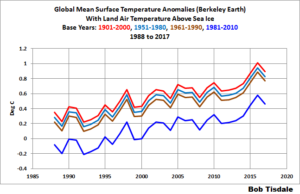
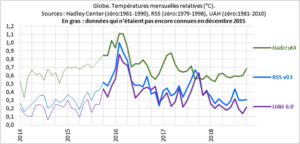
Most of us are familiar with the World Meteorological Organization (WMO)-recommended 30-year period for “normals”, which are also used as base years against which anomalies are calculated. Most, but not all, climate-related data are referenced to 30-year periods. Presently the “climatological standard normals” period is 1981-2010. These “climatological standard normals” are updated every ten years after we pass another year ending in a zero. That is, the next period for “climatological standard normals” will be 1991-2020, so the shift to new “climatological standard normals” will take place in a few years.
But were you aware that the WMO also has another recommended 30-year period for “normals”, against which anomalies are calculated? It’s used for the “reference standard normals” or “reference normals”. The WMO-recommended period for “reference normals” is 1961-1990. And as many of you know, of the primary suppliers of global mean surface temperature data, the base years of 1961-1990 are only used by the UKMO.
While there’s little cobalt mining in China itself (1 percent of the world’s total output in 2017), Chinese companies have snapped up cobalt mines abroad in recent years, particularly in the Democratic Republic of Congo, the largest source of the metal.
More honesty and less hubris, more evidence and less dogmatism, would do a world of good
Dr. Jeffrey Foss
“What can I do to correct these crazy, super wrong errors?” Willie Soon asked plaintively in a recent e-chat. “What errors, Willie?” I asked.
“Errors in Total Solar Irradiance,” he replied. “The Intergovernmental Panel on Climate Change keeps using the wrong numbers! It’s making me feel sick to keep seeing this error. I keep telling them – but they keep ignoring their mistake.”
Astrophysicist Dr. Willie Soon really does get sick when he sees scientists veering off their mission: to discover the truth. I’ve seen his face flush with shock and shame for science when scientists cherry-pick data. It ruins his appetite – a real downer for someone who loves his food as much as Willie does.
Paper Reviewed
Cross, E.L., Harper, E.M. and Peck, L.S. 2018. A 120-year record of resilience to environmental change in brachiopods. Global Change Biology24: 2262-2271.
…
In light of all their findings, Cross et al. conclude that “these rhynchonelliform brachiopods have therefore been unaffected in their abilities to construct and maintain their extensive skeletons by the change in ocean acidity and temperature over the last 120 years.” And this is a noteworthy conclusion, given that C. inconspicua is one of the most calcium-carbonate-dependent species globally, and is therefore presumed to be highly susceptible to ocean acidification. It would thus appear that proper incorporation of species’ adaptation and/or acclimation potentials is essential if scientists are to get predictions of the impacts of ocean acidification on marine life correct.
Germany’s task force on planning the definite phase-out of coal-fired power production has scrapped plans to present a decision before the end of this year.
Several days after three eastern German federal states had demanded better and more detailed plans to support coal mining regions, the so-called coal commission has decided to “conclude its work on 1 February 2019”.
The task force set up a working group from its ranks to draw up further concrete proposals for coal regions and to hold talks on these with both the federal and state governments, the commission said in a press release.
Summary: Volume II of the Fourth National Climate Assessment (NCA) has dominated the news in the weeks since its release. One of the major findings that journalists headlined was the effect of climate change on the US economy. Ten percent is vivid number to grab the attention of Americans still skeptical after thirty years of dire warnings about climate change. Unfortunately it is a dubious story, as explained in these tweets by Roger Pielke Jr.
by P. Homewood, December 2, 2018 in NotaLotofPeopleKnowThat
The BBC have now stopped even trying to camouflage their bias on climate change, with this latest piece of propaganda:
…
Representatives from nearly 200 countries are gathering in Poland for talks on climate change – aimed at breathing new life into the Paris Agreement.
The UN has warned the 2015 Paris accord’s goal of limiting global warming to “well below 2C above pre-industrial levels” is in danger because major economies, including the US and the EU, are falling short of their pledges.
But scientists at the Intergovernmental Panel on Climate Change (IPCC) – the leading international body on global warming – last month argued the 2C Paris pledge didn’t go far enough. The global average temperature rise actually needed to be kept below 1.5C, they said.
So how warm has the world got and what can we do about it?
Draft of article to be submitted for journal publication.
Well, I hope you are not overdosing on the issue of sea level rise. But this paper is somewhat different, a philosophy of science paper. Sort of how we think about thinking.
I would appreciate any comments, as well as suggestions as to which journals I might submit to. I have two in mind, but am open to suggestions (and I may need backups).
Thanks in advance for your comments.
Sea level rise: What’s the worst case?
Abstract. The objective of this paper is to provide a broader framing for how we bound possible scenarios for 21st century sea level rise, in particular how we assess and reason about worst-case scenarios. This paper integrates climate science with broader perspectives from the fields of philosophy of science and risk management. Modal logic is used as a basis for describing construction of the scenario range, including modal inductivism and falsification. The logic of partial positions and strategies for speculating on black swan events associated with sea level rise are described. The rapidly advancing front of background knowledge is described in terms of how we extend partial positions and approach falsifying extreme scenarios of 21st century atmospheric CO2 concentrations, warming and sea level rise. The application of partial positions and worst-case scenarios in decision making strategies is described for examples having different sensitivities to Type I versus Type II errors.
We have looked at quality, long term records from three different regions. Two of these are on opposite sides of the North Atlantic, one is in the South Pacific. The two regions bordered by the North Atlantic are similar, but not identical. The record from Australia is only similar in that temperature has varied over time and has warmed in the recent past.
In all three regions there is no evidence of any strong correlation to CO2. There is ample evidence to support a conjecture of little to no influence.
There is ample evidence, widely shown in other studies, of localized influence due to development and population growth. The CET record has a correlation of temperature to CO2 of 0.54, which is the highest correlation of any individual record in this study. This area is also the most highly developed. While this does not constitute proof, it does tend to support the supposition the weak CO2 signal is enhanced by a coincidence between rising CO2 and rising development and population.
The efficacy of combining US records with those records from Greenland, Iceland, and the UK may be subject to opinion. However, there is little doubt combining records from Australia would create an extremely misleading record. Like averaging a sine curve and a cosine curve.
It appears the GISS data set does a poor job of estimating the history of temperature in all three regions. It shows a near perfect correlation to CO2 levels which is simply not reflected in any of the individual or regional records. There are probably numerous reasons for this. I would conjecture the reasons would include the influence of short-term temperature record bias, development and population growth bias, and data estimation bias. However, a major source of error could be attributed to the simple mistake of averaging regions where the records simply are too dissimilar for an average to yield useful information.
by P. Homewood, November 30, 2018 in NotaLotofPeopleKnowThat
…
I wholeheartedly agree with David’s comments, in particular the need to show graphs.
I am sometimes accused of cherry picking or coming to different conclusions to others. But what I always try to do is actually show the graph, so readers can form their own opinions.
While we are on the topic, I will put up that Woodfortrees graph, which I posted yesterday. According to Woodfortrees, the warming trend since 1950 has been 0.012C/yr, or 1.2C/C.
Yet the BBC report, referred to by Dr Whitehouse, actually states that:
If the trend continues, the WMO says temperatures may rise by 3-5C by 2100.
This claim clearly is not compatible with the historical data
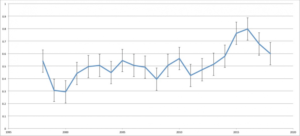
Fig 2 shows the same data with error bars from which it can be seen that 2018 is statistically equivalent to some years before the El Nino event.
Stronger oil and natural gas prices combined with continuing development of shales and low permeability formations drove producers of crude oil and natural gas in the United States to report new all-time record levels of proved reserves for both fuels in 2017. Total U.S. oil reserves in 2017 exceeded a brief, one-year, 47-year-old record, highlighting the importance of crude oil development in shales and low permeability plays, mainly in the Southwest. The new record for natural gas extends a longer-term trend of development, mainly in shale plays in the Northeast. Both U.S. proved reserves of crude oil and natural gas are approximately double their levels from a decade ago. These new proved reserves records were established in 2017 despite production of crude oil at levels not seen since 1972, and record natural gas production.
The unexpected results of a 20-year study into reef fisheries published in the journal Nature Ecology and Evolution this week showed fisheries being maintained despite extreme coral bleaching. Remarkably, rapid proliferation of fishes with low dependence on corals led to catches remaining stable or even increasing.
But the results also showed fishing success was ‘patchy’ and more dependent on fewer species.
Around six million people fish on coral reefs. Each year their catch — estimated to be between 1.4 and 4.2 million tonnes — provides a critical source of food and income for many millions more.
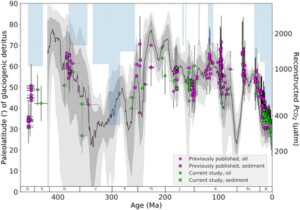
Here, we reconstructed Phanerozoic PCO2 from a single proxy: the stable carbon isotopic fractionation associated with photosynthesis (Ɛp) that increases as PCO2 increases. This concept has been widely applied to alkenones, but here, we expand this concept both spatially and temporally by applying it to all marine phytoplankton via a diagenetic product of chlorophyll, phytane. We obtained data from 306 marine sediments and oils, which showed that Ɛp ranges from 11 to 24‰, agreeing with the observed range of maximum fractionation of Rubisco (i.e., 25 to 28‰). The observed secular PCO2 trend derived from phytane-based Ɛp mirrors the available compilations of PCO2over the past 420 Ma, except for two periods in which our higher estimates agree with the warm climate during those time periods. Our record currently provides the longest secular trend in PCO2 based on a single marine proxy, covering the past 500 Ma of Earth history
…
Fig. 2Ɛp calculated from phytane in Witkowski et al., 2018
by H. Schreuder, November 28, 2018 in ClimateChangeDipsatch
After decades of alarm calls over the impact of human emissions of carbon dioxide (CO2) on global temperatures and climate change, a glaring lack of factually demonstrated and scientifically proven evidence remains.
The evidence presented has been based on computer modeling of temperatures from global weather stations, a larger percentage of which are sited in towns and cities and no data, numerous studies show.
For the 70% of oceans, seas, and lakes, satellite measurements are routinely adjusted to take account of anomalies and sea level rise alarm, expressed in measurements of millimeters per century, does not quantify in that tidal gauges are subjected to landmass upheavals and/or subsidence, none of which can be taken to represent empirical evidence.See Also: New study shows coastlines gaining land despite sea level alarmism) …
This report reflects 18 months of work on this topic. Why have I devoted so much time to the sea level rise issue? First, I regard sea level rise to be the most consequential potential impact of predicted global warming. Second, there is a great deal of public confusion about the issue, including decision makers. Third, a number of CFAN’s clients have queried me about a range of specific concerns that they have regarding sea level rise (and I have been doing consulting on this topic).
Why do I think an independent assessment of the sea level rise issue by yours truly is needed, given the plethora of international and national assessment reports? My clients are concerned about the alarmist predictions they have encountered. I have seen various ‘experts’ make public statements projecting 21stcentury sea level to be as high as 9 m [30 feet]. My clients are looking for someone that they trust to provide an objective assessment that focuses on their issues of concern.
The levels of oxygen dramatically rose in the atmosphere around 2.4 billion years ago, but why it happened then has been debated. Some scientists think that 2.4 billion years ago is when organisms called cyanobacteria first evolved, which could perform oxygen-producing (oxygenic) photosynthesis.
Other scientist think that cyanobacteria evolved long before 2.4 billion years ago but something prevented oxygen from accumulating in the air.
Cyanobacteria perform a relatively sophisticated form of oxygenic photosynthesis — the same type of photosynthesis that all plants do today. It has therefore been suggested that simpler forms of oxygenic photosynthesis could have existed earlier, before cyanobacteria, leading to low levels of oxygen being available to life.
Now, a research team led by Imperial College London have found that oxygenic photosynthesis arose at least one billion years before cyanobacteria evolved. Their results, published in the journal Geobiology, show that oxygenic photosynthesis could have evolved very early in Earth’s 4.5-billion-year history.
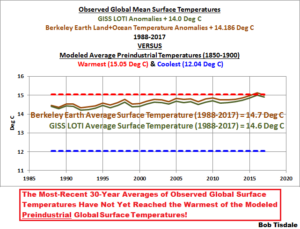
And What Have the Average Temperatures of Earth’s Surfaces Been Recently in Absolute Terms, Not Anomalies?
The answers may surprise you.
THIS POST HAS BEEN UPDATED. The update is near the end of the post.
…
So, for the purpose of this very simple illustration and comparison, and for the discussions it will generate, I’ve added 14 deg C to the annual GISS LOTI data available here, and added 14.186 deg C to the annual Berkeley Earth data. I also compared them to the 12.04 deg C to 15.05 deg C range of hindcast preindustrial global mean surface temperatures from the climate model ensemble members discussed earlier. See Figure 3. Not too surprisingly, the Berkeley Earth and GISS global mean surface temperatures, in absolute form, are very similar, with only a 0.1 deg C difference during the most recent 30-years.
Winter has arrived much earlier than normal this year, particularly across North America, where cold records have been shattered.
This Thanksgiving is in fact going down as one of the coldest ever on record across the Northeast. The Washington Post here, for example, reports that Thanksgiving and Black Friday 2018 will be remembered for a record-shattering cold snap across the Northeast United States.”
…
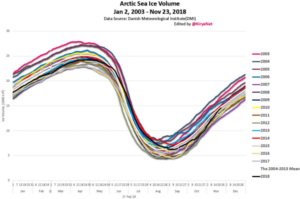
Arctic sea ice, snow and ice cover rebound
Arctic sea ice volume has rebounded and is near normal levels. The sea ice trend has remained stable over the past decade and thus defy all the climate alarmist predictions of an Arctic meltdown.
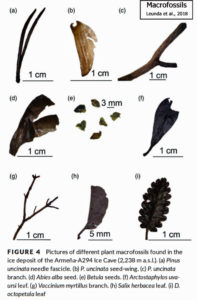
Newly published macrofossil discoveries from 4 papers strongly suggest that modern warmth may still be about 3°C colder than nearly all of the last 10,000 years.
Talk about cold turkey! The coldest Thanksgiving in 100 years, and quite possibly the coldest Thanksgiving ever, has hit the Northeast United States today.
The unprecedented cold snap comes courtesy of a large Canadian chill working its way across the country on its way to the Atlantic. According to the Weather Network, the deep freeze is the result of a large, low pressure system moving south from the Arctic across the Great Lakes. Combine that with a wicked wind chill, and many Americans are looking at the coldest Thanksgiving in a century.
La raison d’être de la taxe carbone qui pèse sur les carburants est qu’en augmentant le prix des carburants en France, cette taxe va diminuer la consommation de carburant, et les rejets de CO2 qui vont avec. Le raisonnement est solide. Mais la question est : de combien ? C’est l’enjeu. L’augmentation de cette taxe met le pays à feu et à sang. C’est la chandelle. Le jeu en vaut-il bien la chandelle ?
Pour y répondre il faut connaître la sensibilité de la consommation au prix, ce qu’on appelle l’élasticité-prix. C’est le rapport de l’effet, la variation de consommation (mesurée en %) sur la cause, la hausse de prix (également mesurée en %). Si une hausse des prix de 10% entraîne une diminution de consommation de 8%, l’élasticité est de -0,8.
…
La géologie, une science plus que passionnante … et diverse