by Jo Nova, Aug 11, 2026 in JoNovaBLog
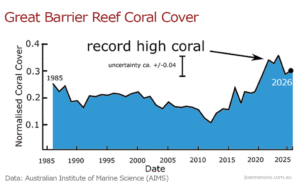
The Fact is, after forty years of man made global warming and 1,100 billion tons of CO2 there is better coral cover on the Great Barrier Reef than there was in 1985.
The ABC hasn’t reported this, so I feel compelled to share the news as a public service. We know if it were “another record low” it would have been the lead story on the 7pm news.
So here we are, yet again — Humans have dumped 1.1 Trillion tons of CO2 into our atmosphere since these comprehensive surveys started and who can tell? That’s over sixty percent of all human CO2 emissions ever, that have been recklessly released since 1985 and there is nothing to show for it in the largest and longest surveys we have of the biggest reef in the world.
“Lucky” the UN didn’t slap an endangerment warning on it isn’t it? Lucky for them.
…
…
Misinformation is a government funded industry
Ten years after the corals hit a record low, the Australian Environment Foundation survey showed that half the country didn’t realize the reef has recovered. Only 3% knew the corals were at a record high, and nearly half the Green voters were as wrong as they possibly could be — they thought coral cover was at a record low.
This mass ignorance is not an accident. The ABC cultivates it. But AIMS, the CSIRO and most of our academics stayed silent when they could have spoken up. All around the world right wing governments are being created that are taking an axe to corrupt programs. Will these self-serving institutions wise up and raise their game in time, or will they sink with the Big Bloated Government Team that they nakedly campaign for?