Tous les articles par Alain Préat

Full-time professor at the Free University of Brussels, Belgium apreat@gmail.com apreat@ulb.ac.be • Department of Earth Sciences and Environment Res. Grp. - Biogeochemistry & Modeling of the Earth System Sedimentology & Basin Analysis • Alumnus, Collège des Alumni, Académie Royale de Sciences, des Lettres et des Beaux Arts de Belgique (mars 2013). http://www.academieroyale.be/cgi?usr=2a8crwkksq&lg=fr&pag=858&rec=0&frm=0&par=aybabtu&id=4471&flux=8365323 • Prof. Invited, Université de Mons-Hainaut (2010-present-day) • Prof. Coordinator and invited to the Royal Academy of Sciences of Belgium (Belgian College) (2009- present day) • Prof. partim to the DEA (third cycle) led by the University of Lille (9 universities from 1999 to 2004) - Prof. partim at the University of Paris-Sud/Orsay, European-Socrates Agreement (1995-1998) • Prof. partim at the University of Louvain, Convention ULB-UCL (1993-2000) • Since 2015 : Member of Comité éditorial de la Revue Géologie de la France http://geolfrance.brgm.fr • Since 2014 : Regular author of texts for ‘la Revue Science et Pseudosciences’ http://www.pseudo-sciences.org/ • Many field works (several weeks to 2 months) (Meso- and Paleozoic carbonates, Paleo- to Neoproterozoic carbonates) in Europe, USA (Nevada), Papouasia (Holocene), North Africa (Algeria, Morrocco, Tunisia), West Africa (Gabon, DRC, Congo-Brazzaville, South Africa, Angola), Iraq... Recently : field works (3 to 5 weeks) Congo- Brazzaville 2012, 2015, 2016 (carbonate Neoproterozoic). Degree in geological sciences at the Free University of Brussels (ULB) in 1974, I went to Algeria for two years teaching mining geology at the University of Constantine. Back in Belgium I worked for two years as an expert for the EEC (European Commission), first on the prospecting of Pb and Zn in carbonate environments, then the uranium exploration in Belgium. Then Assistant at ULB, Department of Geology I got the degree of Doctor of Sciences (Geology) in 1985. My thesis, devoted to the study of the Devonian carbonate sedimentology of northern France and southern Belgium, comprised a significant portion of field work whose interpretation and synthesis conducted to the establishment of model of carbonate platforms and ramps with reefal constructions. I then worked for Petrofina SA and shared a little more than two years in Angola as Director of the Research Laboratory of this oil company. The lab included 22 people (micropaleontology, sedimentology, petrophysics). My main activity was to interpret facies reservoirs from drillings in the Cretaceous, sometimes in the Tertiary. I carried out many studies for oil companies operating in this country. I returned to the ULB in 1988 as First Assistant and was appointed Professor in 1990. I carried out various missions for mining companies in Belgium and oil companies abroad and continued research, particularly through projects of the Scientific Research National Funds (FNRS). My research still concerns sedimentology, geochemistry and diagenesis of carbonate rocks which leads me to travel many countries in Europe or outside Europe, North Africa, Papua New Guinea and the USA, to conduct field missions. Since the late 90's, I expanded my field of research in addressing the problem of mass extinctions of organisms from the Upper Devonian series across Euramerica (from North America to Poland) and I also specialized in microbiological and geochemical analyses of ancient carbonate series developing a sustained collaboration with biologists of my university. We are at the origin of a paleoecological model based on the presence of iron-bacterial microfossils, which led me to travel many countries in Europe and North Africa. This model accounts for the red pigmentation of many marble and ornamental stones used in the world. This research also has implications on the emergence of Life from the earliest stages of formation of Earth, as well as in the field of exobiology or extraterrestrial life ... More recently I invested in the study from the Precambrian series of Gabon and Congo. These works with colleagues from BRGM (Orléans) are as much about the academic side (consequences of the appearance of oxygen in the Paleoproterozoic and study of Neoproterozoic glaciations) that the potential applications in reservoir rocks and source rocks of oil (in collaboration with oil companies). Finally I recently established a close collaboration with the Royal Institute of Natural Sciences of Belgium to study the susceptibility magnetic signal from various European Paleozoic series. All these works allowed me to gain a thorough understanding of carbonate rocks (petrology, micropaleontology, geobiology, geochemistry, sequence stratigraphy, diagenesis) as well in Precambrian (2.2 Ga and 0.6 Ga), Paleozoic (from Silurian to Carboniferous) and Mesozoic (Jurassic and Cretaceous) rocks. Recently (2010) I have established a collaboration with Iraqi Kurdistan as part of a government program to boost scientific research in this country. My research led me to publish about 180 papers in international and national journals and presented more than 170 conference papers. I am a holder of eight courses at the ULB (5 mandatory and 3 optional), excursions and field stages, I taught at the third cycle in several French universities and led or co-managed a score of 20 Doctoral (PhD) and Post-doctoral theses and has been the promotor of more than 50 Masters theses.

Native American Wisdom on Polar bears and Kappiananngittuq:

by Jim Steele, April 19, 2019 in WUWT


In 2010 Nunavut’s Minister of Environment Daniel Shewchuk wrote, “Inuit hunters have a close relationship with the land and wildlife. They have observed that the overall population of polar bears in Nunavut is not declining as some suggest, but rather is thriving. No known environmental or other factors are currently posing a significant or immediate threat to polar bears overall. Furthermore, Inuit knowledge and science corroborate that the species can and will adapt to changing and severe climatic conditions, as it has done for centuries.”

The Inuit truly practice the concept of “it takes a village”. Hunters sit down in kappiananngittuq and respectfully share their observations of wildlife and their movements. Kappiananngittuq is the Inuit word for a “safe place to discuss”. Based on community discussions, Inuit have steadfastly claimed it is “The Time of the Most Polar Bears”. Overhunting has been one of the world’s greatest threats to wildlife. And the growing number of polar bears is testimony to wise hunting regulations now honored by the Inuit.

CLIMATE CHANGE AND THE TEN WARNING SIGNS FOR CULTS

by GWPF, April 18, 2019


Have you thought to yourself that the Climate Change movement seems more and more like a religious movement?


I have, so I researched how to identify a religious cult. Rick Ross, an expert on cults and intervention specialist,developed a list of ten warning signs for unsafe groups, which is published by the Cult Education Institute. So let’s take a look at all ten signs and compare:

CO2’s Influence Was 0.006 W/m² Per Decade During The Last Deglaciation. And This Melted Ice Sheets How?

by K. Richard, April 18, 2019 in NoTricksZone


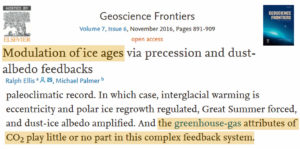
According to the calculations of Dr. James Hansen, the radiative influence derived from the increase in CO2 during the last deglaciation was so negligible that it equated to “a third of energy required to power a honey bee in flight” (Ellis and Palmer, 2016).


Image Source: Ellis and Palmer, 2016

Vilifying People Who Question Global Warming Is Anti-Science

by Todd Royal, April 17, 2019 in ClimateChangeDispatch


When pollsters realized that the public and elected officials weren’t buying global warming as a concept or policy, in a brilliant political move, they came up with the phrase “climate change.”

This helped sell the theory of man-made global warming. Weather is politicized, and computer models are only predictions that have been used as pawns in elections and justifying increased government budgets.

The global warming/climate change (GWCC) narrative has made Al Gore a rich man peddling unrealized fear.

In January 2012, sixteen eminent scientists published an article in the Wall Street Journal, titled, “No Need to Panic About Global Warming.” If mankind is causing global warming, then how do you explain this?

Today’s CO2 concentrations worldwide average about 380 parts per million. This level of CO2 concentration is trivial compared with the concentrations during earlier geologic periods.

For example, 460 million years ago, during the Ordovician Period, CO2 concentrations were 4,400 ppm, and temperatures then were about the same as they are today. With such high levels of CO2 the Earth should have been boiling.

It seems more reasonable to be agnostic based upon this fact:

Biofuels: a long-standing illusion

by Prof. S. Furfari, April 4, 2019 in EuropeanScientist


The idea of replacing petroleum products with alternative fuels produced from agriculture dates back to the 1973 and 1979 oil crises. But apart from the development of bioethanol from cane sugar in Brazil, the idea had not come to fruition because it was not economically viable. It was the frenzy for some kind of sustainable development in the mid-2000s, combined with a perfect storm of realities, that led to the emergence of a political interest in biofuels.

Le CO2 belge : que représente-il vraiment ?

by Jean N., 17 avril 2019 in Science-Climat-Energie


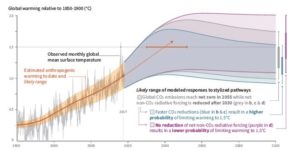
Cet article s’inscrit dans le cadre de l’activité actuelle médiatique tout azimut en Belgique, notamment relayée par les marches hebdomadaires des étudiants pour le climat. Comme vous le savez peut-être si vous êtes un lecteur fidèle de SCE, nous avons démontré dans plusieurs articles que l’hypothèse de l’effet de serre radiatif ne tient pas la route (ici, ici et ici) et n’explique pas le léger réchauffement actuel de la basse atmosphère. Les fins connaisseurs savent également qu’il existe de nombreuses publications scientifiques remettant en cause l’hypothèse de l’effet de serre radiatif (plus de 500 publications rien que pour 2018), toutes écrites par des physiciens, des chimistes, des géologues ou des climatologues. Si cette somme d’évidences vous a convaincu, le GIEC aurait alors tort sur toute la ligne et le CO2 d’origine anthropique n’aurait aucun rôle majeur déterminant la température de la basse troposphère. Cependant, admettons un instant que vous ne soyez pas convaincu et admettons donc que le GIEC ait raison. Tout ce qui est écrit dans son dernier rapport spécial devrait alors être vrai… Quelle serait alors la part de la Belgique dans le réchauffement? Asseyez-vous pour ne pas tomber, vous allez être surpris.

Figure 1. Extrait de la Figure SPM.1 du résumé pour décideurs (SPM) du rapport spécial publié par le GIEC fin 2018. Cette figure se trouve en page 8 du rapport du GIEC.

El Niño Conditions Persist in the Pacific Ocean

by A. Watts, April 16, 2019 in WUWT


An El Niño that began to form last fall has matured and is now fully entrenched across the Pacific Ocean. Changes in sea surface temperatures (SSTs) brought about by an El Niño affect the atmosphere, resulting in distinctive changes in the rainfall pattern across the Pacific Basin. These changes show up as anomalies or deviations in NASA’s analysis of climatological rainfall.

As with a traditional El Niño, the effects from a Central Pacific El Niño can still spread to the U.S. Also, clearly visible in the NASA-generated monthly average rainfall was an area of heavy rain over the southeast coast of Africa associated with the passage of Cyclone Idai, which devastated the region with torrential flooding.

For more information about El Nino, visit: https://www.pmel.noaa.gov/elnino/definitions
Learn more about NASA’s Precipitation measurements: http://pmm.nasa.gov/trmm

40-Year Meteorologist Says Public “Being Fed Bill Of Goods” By Climate Alarmists On Hurricanes, Tornadoes

by P. Gosselin, April 14, 2019 in NoTricksZone


At the latest Saturday Summary at Weatherbell Analytics, Joe Bastardi, a well-known 40-year veteran of meteorology, looks at tornadoes and hurricanes.

Although many meteorologists and climatologists confirm that there is no data suggesting global warming is causing more frequent and intense tornado and hurricane activity, there is a small but influential alarmist group who claim otherwise. And it’s no surprise who the click-baiting media parrot at maximum volume.

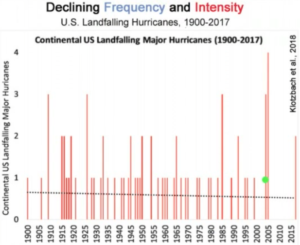
Landfalling hurricanes downward trend

At the 5:45 mark, Joe presents a chart depicting the frequency of US landfalling hurricanes since 1900:


New evidence suggests volcanoes caused biggest mass extinction ever

by University of Cincinnati, April 15, 2019 in ScienceDaily from Nature


Mercury found in ancient rock around the world supports theory that eruptions caused ‘Great Dying’ 252 million years ago.

Researchers say mercury buried in ancient rock provides the strongest evidence yet that volcanoes caused the biggest mass extinction in the history of the Earth.

The extinction 252 million years ago was so dramatic and widespread that scientists call it “the Great Dying.” The catastrophe killed off more than 95 percent of life on Earth over the course of hundreds of thousands of years.

Paleontologists with the University of Cincinnati and the China University of Geosciences said they found a spike in mercury in the geologic record at nearly a dozen sites around the world, which provides persuasive evidence that volcanic eruptions were to blame for this global cataclysm.

The study was published this month in the journal Nature Communications.

The eruptions ignited vast deposits of coal, releasing mercury vapor high into the atmosphere. Eventually, it rained down into the marine sediment around the planet, creating an elemental signature of a catastrophe that would herald the age of dinosaurs.

“Volcanic activities, including emissions of volcanic gases and combustion of organic matter, released abundant mercury to the surface of the Earth,” said lead author Jun Shen, an associate professor at the China University of Geosciences.

Week in review – science edition

by Judith Curry, April 14, 2019 in ClimateEtc.


A few things that caught my eye this past few weeks.

Why did the trend of loss accelerate after about 2000?” Meehl et al. (2018) offer an explanation.

Antarctica’s iceberg graveyard could reveal the ice sheet’s future. [link]

Latif: Decadal Atlantic Meridional Overturning Circulation slowing events in a climate model [link]

Koutsoyiannis: Extreme-oriented selection and fitting of probability distributions. [link]

Strengthened linkage between midlatitudes and Arctic in boreal winter [link]

Scientists discover evidence of long ocean memory [link]

Less ice in Arctic Ocean 6000-7000 years ago [link]

We now know how insects and bacteria control ice

by University of Utah, April 14, 2019 in WUWT


Proteins help organisms form or inhibit ice crystals

Contrary to what you may have been taught, water doesn’t always freeze to ice at 32 degrees F (zero degrees C). Knowing, or controlling, at what temperature water will freeze (starting with a process called nucleation) is critically important to answering questions such as whether or not there will be enough snow on the ski slopes or whether or not it will rain tomorrow.

Nature has come up with ways to control the formation of ice, though, and in a paper published today in the Journal of the American Chemical Society University of Utah professor Valeria Molinero and her colleagues show how key proteins produced in bacteria and insects can either promote or inhibit the formation of ice, based on their length and their ability to team up to form large ice-binding surfaces. The results have wide application, particularly in understanding precipitation in clouds.

“We’re now able to predict the temperature at which the bacterium is going to nucleate ice depending on how many ice-nucleating proteins it has,” Molinero says, “and we’re able to predict the temperature at which the antifreeze proteins, which are very small and typically don’t work at very low temperatures, can nucleate ice.”

Predicting heat waves? Look half a world away

University of California – Davis, April 12, 2019 in ScienceDaily


When heavy rain falls over the Indian Ocean and Southeast Asia and the eastern Pacific Ocean, it is a good indicator that temperatures in central California will reach 100°F in four to 16 days, according to a collaborative research team from the University of California, Davis, and the Asia-Pacific Economic Cooperation (APEC) Climate Center in Busan, South Korea.

The results were published in Advances in Atmospheric Scienceson April 12.

FROM PREDICTION TO PROTECTION

Heat waves are common in the Central California Valley, a 50-mile-wide oval of land that runs 450 miles from just north of Los Angeles up to Redding. The valley is home to half of the nation’s tree fruit and nut crops, as well as extensive dairy production, and heat waves can wreak havoc on agricultural production. The dairy industry had a heat wave-induced economic loss of about $1 billion in 2006, for instance. The ability to predict heat waves and understand what causes them could inform protective measures against damage.


The Disturbing Walrus Scene in Our Planet

by Ed Yong, April 8 , 2019 in TheAtlantic


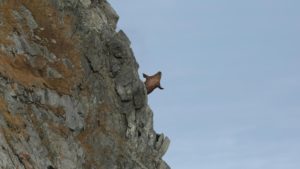
In the autumn of 2017, about 250 walruses in Russia, having climbed up to rocky slopes overlooking a beach, just walked over the edge.

Usually, gravity is no enemy of the walrus. When these animals encounter hard surfaces, they rise up to meet them, hauling their two-ton bulks onto floating pieces of ice. When they fall, they flop off those low platforms into the accommodating water. So you might imagine that a walrus, peering off a tall cliff, doesn’t really understand what will happen to it when it steps off. It doesn’t expect to plummet for 260 feet, cartwheel through the air, bounce off the rocks, and crash abruptly. Climb, plummet, cartwheel, bounce: These are not walrus-associated verbs.

A walrus falls down a 60m cliff face, from where it has been resting in the absence of sea-ice. Hundreds of walrus died falling from these cliffs in 2017.

A walrus falls from a cliff overlooking a Russian beach.SOPHIE LANFEAR

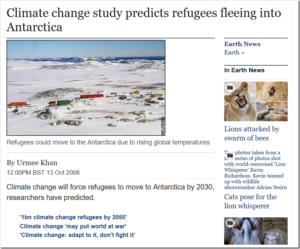
Flashback 2008 – Climate change study predicts refugees fleeing into Antarctica

by P. Homewood, April 13, 2019 in NotaLotofPeopleKnowThat


Climate change will force refugees to move to Antarctica by 2030, researchers have predicted.

Among future scenarios are the Olympics being held in cyberspace and central Australia being abandoned, according to the think tank report.

Forum for the Future, a research body committed to sustainable development, said they wanted to stir debate about how to avert the worst effects of global warming by presenting a radical set of ‘possible futures’.
There will be a shift towards greater energy efficiency, where desalination plants will run on solar power will turn the Sahara green.

Refugees are expected to move to Antarctica because of the rising temperatures that will see the population of the continent increase to 3.5 million people by 2040.

As the world fails to act on climate change, researchers predict that global trade will collapse as oil prices break through $400 a barrel and electrical appliances will get automatically turned off when households exceed energy quotas.

Science-Climat-Energie (SCE) a un an

by Science-Climat-Energie, 10 avril 2019


SCE fête son premier anniversaire avec 70 articles, près de 300 commentaires publiés (questions et réponses) et plus de 260 000 visiteurs.

Ce succès, il le doit à ses lecteurs car nous pensons qu’ils y trouvent une analyse critique des thèmes qui ne cessent d’occuper le devant de la scène médiatique nous montrant une dérive climatique tous azimuts symboliquement illustrée par la marche des lycéens, cautionnée par le monde politique et hélas aussi scientifique.

Notre site ne veut pas attiser la polémique mais bien susciter le débat car notre ligne directrice est l’argumentation et la discussion constructive en dehors de tous propos haineux, injurieux ou fantaisistes. Pas besoin de faire une dessin sur ce genre de propos que nous nous appliquons à ‘filtrer’ pour éviter les dérives qui sont monnaie courante sur les réseaux sociaux, mais finalement seulement moins de 5 % des commentaires sont refusés. Les commentaires argumentés qui contestent notre analyse sont bien entendu aussi publiés et c’est ainsi l’occasion de développer un débat serein, de mise au point réciproque. Tout le monde y gagne en clarté et compréhension. Nous ne prétendons pas détenir la vérité mais nos compétences nous permettent de discuter des problèmes climatiques et souvent de fournir un autre point de vue que celui relayé dans les médias.

L’hystérie climatique, vous l’aurez remarqué est hors norme, elle a récemment atteint des sommets que personne n’avait imaginé il y a seulement quelques années, et le ‘politiquement correct’ est devenu la règle de base pour qui ne veut pas d’ennuis. Combien de lycéens, de politiques, parfois même de scientifiques ont-ils lu les rapports du GIEC ? Connaissent-ils seulement les concentrations actuelle et passées du CO2, la composition de l’atmosphère… ? On peut en douter.

Why California burns — its forests have too many trees

by T.M. Bonnicksen, November 12, 2018 in San FranciscoChronicle


The reason wildfires are burning California with unprecedented ferocity this year is because our public forests are so thick. It is our fault. We don’t manage our forests, we just let them grow. That is the simple truth. However, it is easier to deny the truth and blame a warming climate instead of admitting our guilt and taking action to prevent wildfires.

Hot, dry weather doesn’t cause catastrophic wildfires. It only makes them worse. In order for any fire to burn, it must have fuel. To spread wildly, it must have abundant fuel. Efforts in the 20th century to prevent fire and preserve forests have been too successful — they have disrupted the ecological balance and allowed more and more trees to grow.

Skeptic German Geologist Interview Goes Viral: Greta Demos “Emotional, Not Based On Fact”…”Selective Media”

by P. Gosselin, April 12, 2019 in NoTricksZone


German climate skepticism may have awakened, and ironically it may in large part be an unintended consequence of the “Greta demonstrations”. Germans may be finally getting fed up with the hysteria that has emptied out schools and turned into an ambush on their industrial jobs.

German geologist Dr. Sebastian Lüning, who together with Prof. Fritz Vahrenholt runs German climate skeptic site Die kalte Sonne, was recently interviewed by the conservative Junge Freiheit TV in Berlin (In German).

While the mainstream media focus almost exclusively on the ultra-alarmist climate scenarios, Lüning takes a far more moderate, non-alarmist view of climate and  man’s impact on it.

In Lüning’s view, natural factors play an as big, or even bigger. role on climate than humans do.

Recent warming “not unusual”

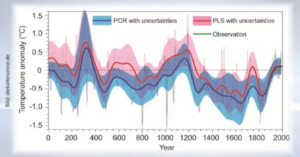
In the interview, Lüning explains how the assumptions made by the CO2 alarmists fall apart when tested against the observations of the past. The experienced German geologist explains why the modern 20th century warming is nothing unusual and that the same has already occurred numerous times over the past 10,000 years.

Start of industrialization coincided with end of Little Ice Age

One problem, Lüning says, is that scientists like to begin their temperature charts right before industrialization began in earnest, which happens to coincide near the temperature low point of the Holocene. He says that the term “pre-industrial” has been the source of “lots of confusion”.

End Of Snow Postponed

by Tony Heller, April 12, 2019 in ClimateChangeDispatch


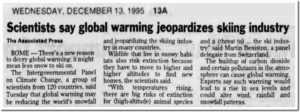
A quarter-century ago, the world’s leading climate experts predicted the end of skiing.

The exact opposite has occurred. Ski areas are receiving record snow and some are staying open all year round.

It wasn’t always like this though.  In 1932, the Winter Olympics almost had to be canceled because of a lack of snow.

13 Dec 1995, Page 13 – The Times at Newspapers.com

Netflix Series ‘Our Planet’ Accused Of Fake Climate Change Claims

by Graham Lloyd, April 10, 2019 in ClimateChangeDispatch


Netflix’s acclaimed Our Planet series has come under fire for “tragedy porn” over images of walruses falling to their deaths from cliff tops, allegedly because of climate change.

The Our Planet footage, narrated by David Attenborough, showed dozens of the animals climbing up 80-meter-high outcrops in northeast Russia because of a lack of sea ice.

They were shown plunging onto the rocks below, with hundreds of dead animals piled on the shoreline. A voice-over by Attenborough claimed their poor eyesight made it hard for them to return safely to the ocean.

But a Canadian zoologist has dismissed the claims as “contrived nonsense” and said the walruses were most likely driven over the cliffs by polar bears.

Susan Crockford, of the University of Victoria in British Columbia, Canada, told The Telegraph UK: “This powerful story is fiction and emotional manipulation at its worst.”

The polar bear expert said that at the time the footage was shot in 2017 at Kozhevnikova Cape, Ryrkaypiy, in eastern Russia, the town was being besieged by polar bears.

According to The Siberian Times, 20 bears had surrounded the town, attracted by 5,000 walruses that had appeared at a local protection zone.

Peak Ghawar: A Peak Oiler’s Nightmare

by David Middleton, April 10, 2019 in WUWT


Alternate title:

No… “The biggest Saudi oil field is [NOT] fading faster than anyone guessed”… Part Trois: Why Peak Oil Is Irrelevant and the Perpetually Refilling Abiotic Oil Field Is Abject Nonsense


Saudi Aramco’s recent bond prospectus has generated a lot of media buzz, particularly regarding the production from Ghawar, the largest oil field in the world. Reaction has ranged from “The biggest Saudi oil field is fading faster than anyone guessed,” (not even wrong) to more subdued reactions from Ellen Wald and Robert Rapier, that the prospectus doesn’t really tell us much Ghawar’s decline rate. One thing that the bond prospectus did do, is to paint a picture of the most profitable company in the world and one that is serious when it says it will produce the last barrel of oil ever produced on Earth.

How big is Ghawar? Has it peaked? Is it “fading faster than anyone guessed”? The answer to the first question is: FRACKING YUGE. The answer to the second question was not easily answerable before Saudi Aramco began the process of becoming a publicly traded company. The answer to the third question is: Of course not.

As Saudi Aramco proceeds towards a 2021 IPO, it has had to embrace transparency. This involved an audit of the proved reserves in their largest fields, comprising about 80% of the company’s value. The audit was conducted by the highly respected DeGolyer and MacNaughton firm (D&M). The audit actually determined that the proved reserves are slightly larger than Aramco’s internal estimate.

2019 ENSO forecast

by  J. Curry and J. Johnstone, April 9, 2019 in WUWT


CFAN’s 2019 ENSO forecast is for a transition away from El Niño conditions as the summer progresses. The forecast for Sept-Oct-Nov 2019 calls for 60% probability of ENSO neutral conditions, with 40% probability of weak El Niño conditions. – Forecast issued 3/25/19

Introduction

CFAN’s early season ENSO forecast is motivated by preparing our seasonal forecast for Atlantic hurricane activity. ENSO forecasts made in spring have traditionally had very low skill owing to the ENSO ‘spring predictability barrier.’

During fall 2018, there was warming in the Central Equatorial Pacific, leading to a weak El Niño Modoki pattern, which impacted the latter part of the Atlantic hurricane season. This transitioned to a weak (conventional) El Niño in February 2019 and the atmospheric anomalies became more consistent with a conventional El Niño pattern.

NOAA’s latest forecast: Weak El Niño conditions are likely to continue through the Northern Hemisphere spring 2019 (~80% chance) and summer (~60% chance).

CFAN’s ENSO forecast analysis is guided by the ECMWF SEAS5 seasonal forecast system and a newly developed statistical forecast scheme based on global climate dynamics analysis.

ENSO statistics

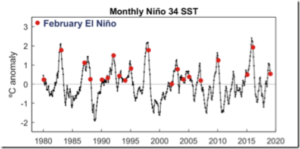
Figure 1 illustrates the recent ENSO history as depicted by monthly Niño 3.4 anomalies from 1980 to February 2019.

Less Ice In Arctic Ocean 6000-7000 Years Ago

by Geological Survey of Norway, October 20, 2008 in ScienceDaily


Recent mapping of a number of raised beach ridges on the north coast of Greenland suggests that the ice cover in the Arctic Ocean was greatly reduced some 6000-7000 years ago. The Arctic Ocean may have been periodically ice free.

”The climate in the northern regions has never been milder since the last Ice Age than it was about 6000-7000 years ago. We still don’t know whether the Arctic Ocean was completely ice free, but there was more open water in the area north of Greenland than there is today,” says Astrid Lyså, a geologist and researcher at the Geological Survey of Norway (NGU).

Global Energy & CO2 Status Report

by IEA, March 2019 (.pdf)


Key Findings 2018

Global energy consumption in 2018 increased at nearly twice the average rate of growth since 2010, driven by a robust global economy and higher heating and cooling needs in some parts of the world. Demand for all fuels increased, led by natural gas, even as solar and wind posted double-digit growth. Higher electricity demand was responsible for over half of the growth in energy needs. Energy efficiency saw lacklustre improvement.

Energy-related CO2 emissions rose 1.7% to a historic high of 33.1 Gt CO2. While emissions from all fossil fuels increased, the power sector accounted for nearly two-thirds of emissions growth. Coal use in power alone surpassed 10 Gt CO2, mostly in Asia. China, India, and the United States accounted for 85% of the net increase in emissions, while emissions declined for Germany, Japan, Mexico, France and the United Kingdom.

Oil demand rose by 1.3% in 2018, led by strong growth in the United States. The start-up of large petrochemical projects drove product demand, which partially offset a slowdown in growth in gasoline demand. The United States and China showed the largest overall growth, while demand fell in Japan and Korea and was stagnant in Europe.

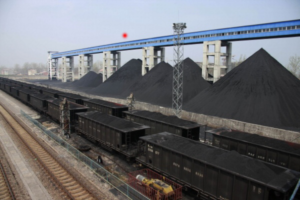
Natural gas consumption grew by an estimated 4.6%, its largest increase since 2010 when gas demand bounced back from the global financial crisis. This second consecutive year of strong growth, following a 3% rise in 2017, was driven by growing energy demand and substitution from coal. The switch from coal to gas accounted for over one-fifth of the rise in gas demand. The United States led the growth followed by China.

Coal demand grew for a second year, but its role in the global mix continued to decline. Last year’s 0.7% increase was significantly slower than the 4.5% annual growth rate seen in the period 2000- 10. But while the share of coal in primary energy demand and in electricity generation slowly continues to decrease, it still remains the largest source of electricity and the second-largest source of primary energy.

Nuclear Power Can Save the World

by J.S. Goldstein et al., April 6, 2019


As young people rightly demand real solutions to climate change, the question is not what to do — eliminate fossil fuels by 2050 — but how. Beyond decarbonizing today’s electric grid, we must use clean electricity to replace fossil fuels in transportation, industry and heating. We must provide for the fast-growing energy needs of poorer countries and extend the grid to a billion people who now lack electricity. And still more electricity will be needed to remove excess carbon dioxide from the atmosphere by midcentury.