Archives de catégorie : climate-debate

ALL-TIME COLD RECORDS FALL IN AUSTRALIA; + SOLAR ACTIVITY CONTROLS THE CLIMATE

by Cap Allon, Jul 5, 2022 in Electroverse


ALL-TIME COLD RECORDS FALL IN AUSTRALIA

Following its best start to a ski season ever, conditions have anomalously cold and snowy across swathes of Australia.

June 2022 finished with a temperature anomaly of -0.1C below the multidecadal average, according to data supplied by the Australian Bureau of Meteorology–whatever that’s worth.

The unusual chill has extended into July, too, and hundreds of monthly low temperature records have fallen over the past two days alone–particularly across the northeastern state of Queensland, where even a number of all-time benchmarks have been toppled.


Senior meteorologist Harry Clark said the combination of rain and cold temperatures was “extremely unusual” for July.

“Both in terms of the amount of rainfall and the extent of it, for what is one of our driest months of the year, but also for the extremely low maximum temperatures we’ve seen,” said Clarke. “Temperatures are looking more into what you might expect in Melbourne, or some of those southern capital cities where it’s the typical winter weather.”

Clarke confirmed that “many” cold weather records were broken across Queensland this week, with the standouts for him being Rockhampton peaking at only 12.5C (54.5F) yesterday, and Toowoomba struggling to just 7.6C (45.7F).

Other locales registered equally impressive readings: The Gold Coast Seaway set its coldest day of any month ever yesterday with 14C (57.2F); while further north, in Townsville, residents there suffered their coldest July day ever with a high of 15C (59F).

And most recently, Brisbane, the capital of Queensland –which had already registered its coldest start to a winter since 1904— has, today (July 5), gone and logged its coldest daily high in 22 years, reaching only 12.4C (54.3F).

For reference, Brisbane’s lowest-ever maximum remains the 12C (53.6F) set in July 2000; with the city’s third-coldest July maximum actually being yesterday’s 14.2C (57.6F) … but ‘catastrophic global warming’, you know … ?

SOLAR ACTIVITY CONTROLS THE CLIMATE

The global temperature record since 1880 is highly correlated to solar activity, and solar activity is highly correlated to the harmonics of planetary motion.

The below chart is NASA’s Historical Total Solar Irradiance Reconstruction, Time Series.

And looking ahead, Australia’s Antarctic blast isn’t forecast to abate anytime soon — quite the opposite, in fact:


LinkedIn Bans Scientist for Presenting Inconvenient Truths About CO2

by C. Rotter, Jul 9, 2022 in WUWT


“The big-tech censors are at it again: the CO2 Coalition’s Executive Director Gregory Wrightstone has been permanently banned from LinkedIn. What did Wrightstone do to earn the banishment? His ‘crime’ consisted of posting charts from peer reviewed research supported by official sources demonstrating that current global average CO2 levels are well within the natural range of concentrations throughout the Earth’s history. LinkedIn’s moderators sent Wrightstone an email informing him that his violations have been so numerous and/or so severe that they couldn’t allow him to continue to use the platform.”

Originally published here at Climate Realism on 6 July 2022.

Since 2000 The Arctic’s Hudson Bay Has Cooled -0.35°C With 10 Of 15 Sites Gaining Sea Ice

by Gupta et al.,  July 7, 2022 in NoTricksZone


A new study (Gupta et al., 2022) indicates that from 2000-2019 73% of the 15 sites considered have been cooling and 67% have experienced a lengthening of sea ice duration.

Canada’s Hudson Bay extends into the Arctic Ocean and its coasts are teeming with polar bears.

Scientists report 11 of 15 Hudson Bay sites have been cooling since 2000. The average cooling for these 11 sites is -0.34°C per decade.

…IPCC Summary Report, Part 2…

by D. Dears, July 2022 in PowerForUsa


Conclusion

The politicians changed the report written by the scientists so that it would be consistent with the SPM written by the politicians.

The report now reads:

“The body of statistical evidence in chapter 8 … now points towards a discernible human influence on global climate.”

Whereas it originally read:

“No study to date has positively attributed all or part (of the climate warming observed) to (manmade) causes.”

As a result, the pubic was told there is a discernible human influence on global climate when the scientists said none had been positively identified.

A legitimate scientific organization wouldn’t allow politicians to overrule scientists.

Why would our country rely on such an organization?

Link to Amicus Curiae https://bit.ly/3QSuyCn

Use this link in an email to let others know about this article https://bit.ly/3AqFm53 

The Truth About Cold- And Heat-Related Deaths

by H.S. Sterling, Jul 6, 2022 in ClimateChangeDispatch


In a refreshingly honest article in the Logan Daily News, author Bud Simpson cites data from research showing deaths from non-optimal temperatures are declining amid climate change.

Simpson is right and he and the Logan Daily News are to be congratulated for discussing this important truth about climate change. [bold, links added]

In a Logan Daily News article, titled “My last global warming column?”, Simpson describes how after examining the facts over time, he went from being a firm believer that human activities were causing dangerous climate change to realizing no climate catastrophe is in the offing.

Carbon dioxide was, and is, bandied about as if it were the biggest demon on the face of the earth,” writes Simpson. “In truth, it is one of the most valuable of gases and contributes hugely to a better life for us earthlings. … Proponents of this group even tried to get carbon dioxide labeled as a toxic gas! If that were true, we’d all be dead by now. And without any warming.”

Among the research Simpson discovered that convinced him climate change was not, in fact, threatening human survival was a study published in the prominent peer-reviewed journal, The Lancet, which firmly established:

“…that worldwide, cold kills about 17 times more people than heat does. A group of 22 scientists studied over 74 million deaths in the U.S., China, Brazil, and ten other countries. The findings showed that cold caused 7.29 percent of the deaths while heat caused 0.42 percent.”

New Study: Greenland ‘Must Have Been At Least 3°C Warmer’ Than Today During The Early Holocene

by K. Richard, Jul 4, 2022 in NoTricksZone


These much warmer Greenland temperatures imply that the elevation of the ice sheet was 400 meters lower than it is today from about 6,000 to 10,000 years ago.

Scientists (Westhoff et al., 2022) report that the two largest Greenland melt events in the last few hundred years occurred in 2012 and in 1889 CE – when atmospheric CO2 levels were still under 300 ppm.

The “melt events around the Holocene Climate Optimum were more intense and more frequent” than has been observed during the modern period. And the most prominent melt events of the last 10,000 years centered around the Medieval Warm Period, 986 CE.

Overall, the elevation of the Greenland ice sheet has grown by 0.4 km since the Early Holocene, as “summer temperatures must have been at least 3 ± 0.6°C warmer during the Early Holocene compared to today.”

“We Live In The Coldest Period Of The Last 10.000 Years”

by P. Homewood, Jul 5, 2022 in NotaLotofPeopleKnowThat


Jørgen Peder Steffensen is an Associate Professor at the University of Copenhagen and one of the world’s leading experts on ice cores. Using ice cores from sites in Greenland, he has been able to reconstruct temperatures there for the last 10000 years. So what are his conclusions?

  • Temperatures in Greenland were about 1.5 C warmer 1000 years ago than now.

  • It was perhaps 2.5 C warmer 4000 years ago.

  • The period around 1875, at the lowest point of the Little Ice Age, marked the coldest point in the last 10,000 years.

  • Other evidence from elsewhere in the Northern Hemisphere confirms this picture.

Climate Change Weekly #439: Hurricanes Not Increasing, Despite Warming

by H.S. Burnett, Jul 1, 2022 in WUWT


Pielke notes five points of fact about hurricanes:

  1. The Intergovernmental Panel on Climate Change (IPCC) finds “no consensus” on the relative role of human influences on Atlantic hurricane activity, quoting the IPCC as follows: “there is still no consensus on the relative magnitude of human and natural influences on past changes in Atlantic hurricane activity, … and it remains uncertain whether past changes in Atlantic TC activity are outside the range of natural variability.”
  2. “The IPCC has concluded that since 1900 there is ‘no trend in the frequency of USA landfall events.’ This goes for all hurricanes and also for the strongest hurricanes, called major hurricanes.”
  3. “Since at least 1980, there are no clear trends in overall global hurricane and major hurricane activity.”
  4. “There are many characteristics of tropical cyclones that are under study and hypothesized to be potentially affected by human influences, … but at present there is not a unified community consensus on these hypotheses, as summarized by the World Meteorological Organization,” as to whether any of the factors are affected by human greenhouse gas emissions.
  5. “Hurricanes are common, incredibly destructive and will always be with us. Even so, we have learned a lot about how to prepare and recover.”

Pielke points out that some of the costliest hurricanes occurred in the early part of the twentieth century when average global temperatures were cooler than at present.

G7 Abandons Climate Agenda, Will Turn To Fossil Fuels Amid Energy Crisis

by J. MCEVOY, Jul 1, 202 in CimateChangeDispatch


World leaders at the G7 summit in Germany signaled they will turn back to fossil fuels despite their commitments to a green energy transition thanks to the ongoing energy crisis.

The war in Ukraine is heavily restricting fuel imports, with Russia cutting off European access to the Nord Stream pipeline and the US imposing a fuel embargo on Putin. [bold, links added]

As a result, the U.S. and European countries are abandoning their climate agenda to return to fossil fuels.

Amid skyrocketing fuel prices, the Biden administration has been forced to abandon certain planks of its climate agenda.

Biden called for a temporary increase in domestic fuel production two weeks ago and also asked Congress to suspend the federal per-gallon gas tax for three months last week.

“The G7 leaders are pretending that nothing has happened to the green agenda,” Benny Peiser, director of the Global Warming Policy Forum, told The Daily Caller News Foundation. “In reality, if you look at individual member states… it’s quite obvious that the green agenda will be sunk.

The New Pause Lengthens to 7 Years 10 Months

by C. Monckton of Brenchley, July 2, 2022 in WUWT


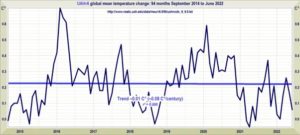
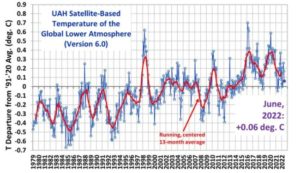
The New Pause paused last month because I was ill. Many apologies for the interruption. Now, however, it resumes – and it has lengthened from 7 years 7 months to the end of April 2022. To the end of June 2022, the New Pause is now 7 years 10 months in length:


This Pause, like its predecessor, which was an impressive 18 years 8 months (UAH), or 18 years 9 months (HadCRUT4), is, as always, not cherry-picked. It is derived from the UAH monthly global mean lower-troposphere temperature anomalies as the period from the earliest month starting with which the least-squares linear-regression trend to the most recent month for which data are available does not exceed zero. Whatever the data show, I show. Or, in the immortal words of Dr Roy Spencer, speaking of his dataset, “It is what it is”. In that splendid dictum speaks all true science.

The least-squares trend, which Professor Jones at the University of East Anglia used to recommend as the simplest and most robust method of deriving global-temperature trends, takes due account of all monthly values, not merely of the starting and ending values.


See also here

The NOT melting glacier

by T. Ciccone & J. Lehr, May 31, 2022 in CFact

beautiful white icy hill with cave in antarctic


Could Antarctica’s ‘Doomsday Glacier’ meet its doom within 3 years?

Time is melting away for one of Antarctica’s biggest glaciers, and its rapid deterioration could end with the ice shelf’s complete collapse in just a few years,” alarmist researchers warned at a virtual press briefing on Dec. 13, 2021 at the annual meeting of the American Geophysical Union (AGU)–a once outstanding professional society, but now a shill for the left.

Above is the first sentence of the article titled Antarctica’s ‘Doomsday Glacier’ could meet its doom within 3 years,not what we would expect to see from a once reputable source, the AGU. It warns us that in a few years, the world’s largest glacier, about the size of Florida, will melt and raise ocean levels by up to 3 meters (about 10 ft). It then tells us that the glacier is melting from below because the surrounding ocean waters have been warmed thanks to human-induced climate change.Finally, it tells us that a team of more than 100 scientists from the USA and the UK have been studying the Thwaites glacier and sharing their findings with scientists worldwide.

The article then explains that the Thwaites is not melting from above, but the melting is coming from below,from the warmed-up oceans that have been warmed by human-made CO2 and the greenhouse effect. The bulk of the article then proceeds to detail the forecasted consequences around the world:

This team may not have even been communicating with each other. Almost a decade earlier, geologists were seeing evidence of volcanoes in a known active tectonic plate boundary, buried under the glacier and the oceans. Before 2017, at least 47 volcanoes were found in western Antarctica and around the area of the Thwaites glacier. In 2017 the Guardian reported that an additional 91 volcanoes had been found along the western shores of Antarctica, with some sitting under the Twaites glacier itself. See the article Scientists discover 91 volcanoes below Antarctic ice sheet.

New Study Affirms Temperatures Determine Greenhouse Gas Forcing Trends, Not The Other Way Around

by Singh H  & Polvani L, Jun 30, 2022 in NoTricksZone


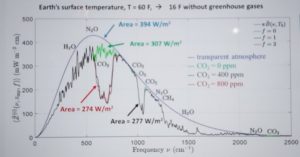
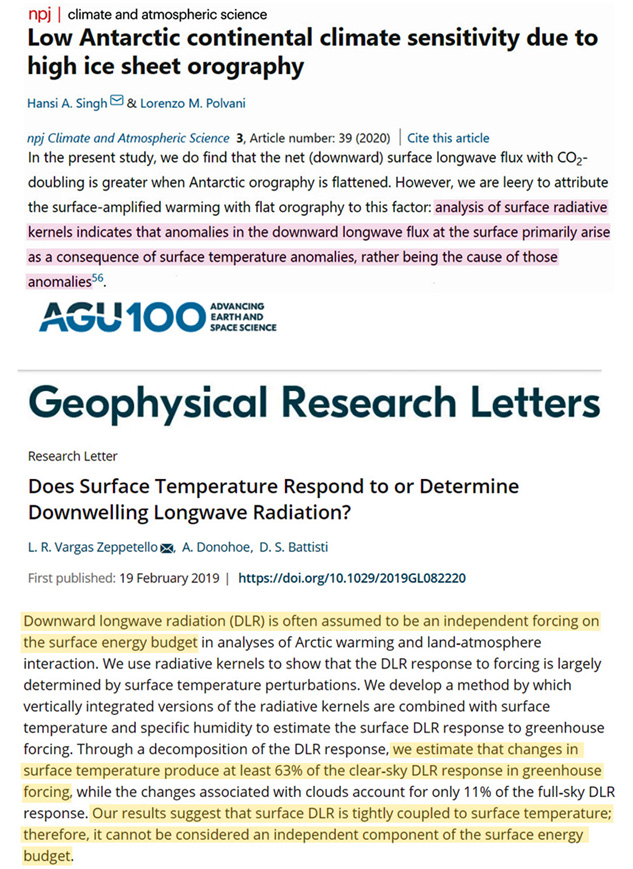
CO2 and water vapor greenhouse effect impacts are not independent climate forcings . A new study affirms the “variance in the radiance in these channels is primarily controlled by…temperature” and “atmospheric absorption is strongly saturated in these [CO2, water vapor] channels”.

It has previously been established that greenhouse gas (water vapor, CO2) forcing “cannot be considered an independent component of the surface energy budget” because “anomalies in the downward longwave flux at the surface primarily arise as a consequence of surface temperature anomalies, rather than being the cause of those anomalies” (Singh and Polvani, 2020, Zeppetello et al., 2019).

Image Source: Singh and Polvani, 2020, Zeppetello et al., 2019

Feldman et al. (2015) admit they had to “construct” model-based spectra to simulate a CO2 signal in their seminal paper purporting to show CO2 changes cause temperature changes. This is because the temperature and water vapor levels primarily determine the overall longwave forcing (clear-sky) trends.

Code Red For Sanity – The Credibility Crisis At The IPCC

by R. Barmby, Jun23, 2022 in ClimateChangeDispatch


When speaking about the Intergovernmental Panel on Climate Change (IPCC) report Climate Change 2021: The Physical Sciences Basis, UN Secretary-General António Guterres declared it a “code red for humanity.”

He further stressed, “The alarm bells are deafening, and the evidence is irrefutable.” [bold, links added]

But a person who reads the report dispassionately and thoroughly will recognize that there is no code red for humanity and that the evidence is indeed refutable. It would be more accurate to say the report is a code red for sanity.

Classical science observes what is; that’s the evidence. A political agenda persuades what should be done; that’s the alarm bells.

Let’s turn off the alarm the IPCC pulled by examining Climate Change 2021: The Physical Science Basis (referred to from this point as “the report”).

You’ll discover that while the report contains some scientific evidence, much of it is hidden, manipulated, or contradicted.

Because of this, we’ll refute the so-called evidence in the report by explaining how the science has been misrepresented.

Let’s bring sanity back to science.

The report has four major themes where the political agenda has overrun classical science.

Theme 1: Climate history was altered.

The IPCC would like you to believe that the Earth’s temperature has been constant for thousands of years and that the approximate 1°C of warming is unprecedented.

The report offers this figure to support that view:

Study: Tropical Cyclone Frequency Decreasing As Earth Mildly Warms

by S. Chand et al., Jun 28, 2022 in ClimateChangeDispatch


Assessing the role of anthropogenic warming from temporally inhomogeneous historical data in the presence of large natural variability is difficult and has caused conflicting conclusions on the detection and attribution of tropical cyclone (TC) trends. [bold, links added]

Here, using a reconstructed long-term proxy of annual TC numbers together with high-resolution climate model experiments, we show robust declining trends in the annual number of TCs at global and regional scales during the twentieth century.

The Twentieth Century Reanalysis (20CR) dataset is used for reconstruction because, compared with other reanalyses, it assimilates only sea-level pressure fields rather than utilizing all available observations in the troposphere, making it less sensitive to temporal inhomogeneities in the observations.

It can also capture TC signatures from the pre-satellite era reasonably well.

The declining trends found are consistent with the twentieth-century weakening of the Hadley and Walker circulations, which make conditions for TC formation less favorable.

Human activities are estimated to have caused ~1.0 °C of global warming above pre-industrial levels, with most of the warming occurring since the mid-twentieth century1.

‘A Significant And Robust Cooling Trend’ In The Southern Ocean From 1982–2020 Defies Climate Models

by K. Richard, June 27, 2022 in NoTricksZone


A new study reports there has been a -0.3°C cooling in the Southern Ocean since 1982 per multiple observational data sets. The authors detail the “failure of CMIP5 models in simulating the observed SST cooling in the Southern Ocean.”

The Southern Ocean is today about 1-2°C colder than it has been for nearly all of the last 10,000 years (Shuttleworth et al., 2021, Civel-Mazens et al., 2021, Ghadi et al., 2020).

Image Source: Shuttleworth et al., 2021

ON SATURDAY, GREENLAND’S SURFACE MASS BALANCE GAINED A RECORD-SMASHING 7 GIGATONS…

by Cap Allon, June 20, 2022 in Electroverse


If you want proof of mainstream media manipulation and agenda driving drivel, you need look no further than the “official” reporting of the Greenland ice sheet–the poster child for anthropogenic global warming. If today’s intensifying energy crisis wasn’t rooted in said obfuscations, all of this would be laughable.

Impressive surface mass balance (SMB) readings –a calculation to determine the ‘health’ of a glacier– have been posted across the Greenland ice sheet all season. But the cherry, at least for me, is taken by Saturday’s record-smashing 7 Gigaton GAIN–particularly when you consider the glacier should be losing mass at this time of year.

The MSM appears to love dumb, decontextualized headlines to advance their AGW narrative. So here’s one for them:

Greenland’s Recent SMB Gains Enough To Bury Central Park, New York City Under 7,833 Feet Of Ice… (it’s true, do the math).

Cheers! ‘Climate backtracking’: Germany Pushes for G-7 Reversal on Fossil Fuels in Climate Blow – ‘U-turn in global efforts to fight climate change’

by Bloomberg, June 25, 2022 in Climate Depot


Germany is pushing for Group of Seven nations to walk back a commitment that would halt the financing of overseas fossil fuel projects by the end of the year, according to people familiar with the matter. That would be a major reversal on tackling climate change as Russia’s war in Ukraine upends access to energy supplies.

A draft text shared with Bloomberg would see the G-7 “acknowledge that publicly supported investment in the gas sector is necessary as a temporary response to the current energy crisis.”

The caveat in the proposal is that such funding is done “in a manner consistent with our climate objectives and without creating lock-in effects.”

The text remains under debate and could change before G-7 leaders hold their summit in the Bavarian Alps starting Sunday hosted by Chancellor Olaf Scholz. The UK opposes the proposal, two of the people said. A German government spokesman declined to comment.

EU Leaders Brace for Hard Winter as Russia Tightens Gas Grip

A person familiar with the discussions said Italy wasn’t actively opposing the German proposal. Italy, like Germany, is highly dependent on Russian gas. On Friday, speaking during a press conference in Brussels, Prime Minister Mario Draghi said Italy has managed to reduce Russian gas imports from 40% last year to 25% at the moment. This has been possible also by signing new gas deals in countries including Congo, Algeria and Angola.

Germany has responded to the cuts by reviving coal plants and providing financing to secure gas supplies, while continuing with plans to phase out nuclear energy. The World Nuclear Association, an industry lobby group, is urging the G-7 to boost access to nuclear technologies.

What the media won’t tell you about U.S. heat waves

by R. Pielke Jr, June 16, 2022 in TheHonestBroker


It’s hot. Real hot. Heat waves in the United States surely must be the most visible and impactful sign of human caused climate change, right? Well, actually no. Let’s take a look at what the U.S. National Climate Assessment and the Intergovernmental Panel on Climate Change say about heat waves in the United States. What they say may surprise you.

Before proceeding, let me emphasize that human-caused climate change is real and significant. Aggressive policies focused on both adaptation and mitigation make very good sense. So too does being accurate about current scientific understandings. The importance of climate change does not mean that we can ignore scientific integrity — actually the opposite, it makes it all the more important. So let’s take a close look at recent assessment reports and what they say about U.S. heat waves.

The figure below comes out of the most recent U.S. National Climate Assessment(NCA). It shows the frequency (top) and intensity (bottom) of heat waves in the U.S. since 1900. The bottom figure is actually based on a paper that I co-authored in 1999, which serves as the basis for an official indicator of climate change used by the Environmental Protection Agency.

..

German Physicist: Human CO2 Emissions Responsible For 0.05°C Of The Global Warming Since 1750

by H. Harde, June 20,2022 in NoTricksZone


Professor Herman Harde, an environmental physicist, has authored a new position paper on the follies of assuming humans significantly impact the climate.

As detailed in his 2017 paper, Dr. Harde concludes the “anthropogenic contribution to the actual CO2 concentration is found to be 4.3% [a figure derived from IPCC AR5], its fraction to the CO2 increase over the Industrial Era is 15% and the average residence time 4 years.”

The IPCC overestimates the thermal effect of doubling CO2 by a factor of 5, as the consequent surface air temperature increase for a 120 ppm increase in CO2 is less than 0.3°C.

“Since only about 15% of the global CO2 increase is of anthropogenic origin, just 15% of 0.3°C, i.e., less than 0.05°C remains, which can be attributed to humans in the overall balance.”

“Changes of our climate can be traced back to natural interaction processes that exceed our human influence by orders of magnitude.”

As Climate Screamers Spread Alarm, Germany’s Long-Term Forest Fire Trend Has Declined

by P.   Sommer, June 22, 23022 in NoTricksZone


It’s become an annual ritual. Every summer, when there has been little rain for a long time and unreasonable people set fire to forests, whether through intent or negligence, a solution comes into play: wind turbines.

There are people who obstruct wind turbines, supposedly in order to protect forests. But the opposite is true. Every obstructed wind turbine fires up the climate crisis with heat, drought and forest fires.”

(Image: Screenshot Twitter)

Old military grounds pose huge hazard to fire fighters

Of course, this is exactly what is happening with the current forest fire in Treuenbrietzen in Brandenburg, alarmists like Quaschning say. But, if you look very closely you will see that once again a forest area burned that had previously served as a military training area for several decades. Such areas are not easy to extinguish because firefighters put themselves in serious danger as remnants of ammunition are lying around everywhere. So the fire has an easy time when it can only be extinguished from a distance. Or, to put it another way, in forests without remnants of ammunition, firefighters would have fires under control quickly.

Nothing to do with temperature

What would help the forest is precipitation. Temperature is not the determining factor for forest fires, but the absence of rain. The forest would also be helped if people stopped handling fire in the forest during times of drought.

Yet we will read and hear the call for more wind power in the forests every time there is a forest fire from the likes of Big Wind lobbyists Volker Quaschning – and of course, without them addressing the forest floor contaminated with munitions. This has always been the case in recent years and has also been a topic in this blog. By the way, with the same protagonist as this year and almost word-same tweets.

Long-term downward trend


There are people who obstruct wind turbines, supposedly in order to protect forests. But the opposite is true. Every obstructed wind turbine fires up the climate crisis with heat, drought and forest fires.”

Old military grounds pose huge hazard to fire fighters

Of course, this is exactly what is happening with the current forest fire in Treuenbrietzen in Brandenburg, alarmists like Quaschning say. But, if you look very closely you will see that once again a forest area burned that had previously served as a military training area for several decades. Such areas are not easy to extinguish because firefighters put themselves in serious danger as remnants of ammunition are lying around everywhere. So the fire has an easy time when it can only be extinguished from a distance. Or, to put it another way, in forests without remnants of ammunition, firefighters would have fires under control quickly.

Nothing to do with temperature

What would help the forest is precipitation. Temperature is not the determining factor for forest fires, but the absence of rain. The forest would also be helped if people stopped handling fire in the forest during times of drought.

Yet we will read and hear the call for more wind power in the forests every time there is a forest fire from the likes of Big Wind lobbyists Volker Quaschning – and of course, without them addressing the forest floor contaminated with munitions. This has always been the case in recent years and has also been a topic in this blog. By the way, with the same protagonist as this year and almost word-same tweets.

Long-term downward trend

The Guardian: Global Warming is GOOD for Rare Coral?

by E. Worall, May 28, 2022 in WUWT


A rare Guardian good news climate change story.

One of UK’s rarest corals set to expand its range as climate change warms seas

Pink sea fan, at risk from bottom-trawling, predicted to spread northwards around coast up to Scotland as sea temperatures rise

Karen McVeigh @karenmcveigh1 Fri 27 May 2022 21.00 AEST

It is one of Britain’s rarest and most threatened species, primarily due to bottom-trawling fishing, but researchers have found that the pink sea fan coral could expand its range in the climate crisis.

A slow-growing coral found in shallow waters from the western Mediterranean to north-west Ireland and south-west England and Wales, the pink sea fan (Eunicella verrucosa) is classified as vulnerable by the International Union for Conservation of Nature.

But a study by researchers from Exeter University found that the species is likely to spread northwards – including further around the British coast as far as Scotland – by 2100 as global temperatures rise.

Dr Tom Jenkins, from Exeter University, said: “We built models to predict the current and future habitat of pink sea fans across an area covering the Bay of Biscay, the British Isles and southern Norway.”

Using a global heating model called RCP 8.5, the researchers predicted that by 2100 there would be suitable habitats for pink sea fans north of the current range. Successful colonisation, the study found, would depend on several factors, including dispersal and competition.

Read more: https://www.theguardian.com/environment/2022/may/27/one-of-uks-rarest-corals-set-to-expand-its-range-as-climate-change-warms-seas

Bringing order to the chaos of sea level projections

by Royal Netherlands Institute for Sea Research, May 18, 2022 in ScienceDaily


In their effort to provide decisionmakers with insight into the consequences of climate change, climate researchers at NIOZ, Deltares and UU are bringing order to the large amount of sea level projections, translating climate models to expected sea level rise. Their new overview study was published in the scientific journal Earth’s Future. “These results offer tools for decision making on the shorter and longer term.”

Aimée Slangen is a climate scientist at NIOZ and co-author of the IPCC climate report. Together with climate adaptation experts Marjolijn Haasnoot and Gundula Winter from Deltares and Utrecht University, both also IPCC authors, Slangen investigated the similarities and differences between the many sea level projections published in recent years.

Eight families of projections

“We found that the set of more than 80 different projections can be reduced to eight ‘families’,” says Slangen. “Within each of the families of projections that we identified, researchers have often used similar data, but they have for instance used different model approaches. As a result, every new publication resulted in different amounts of projected sea level rise, depending on whether the publication focused on the shorter term or the longer term, or depending on the models used to estimate the processes causing a potentially large contribution of accelerated melting of the Antarctic ice sheet.”

These details are interesting for scientists, but make it more difficult for users to maintain overview. Slangen: “This can be an issue when you have to decide as a government what you are going to do to protect your coasts from rising sea levels. Decision makers can’t adjust their policies with every new publication.”

Half a meter rise before the end of the century

The researchers hope to dispel this doubt, as all families paint a similar picture for the first 50 cm of sea level rise. Slangen: “We will see the first half-meter rise before the end of this century, even if we start reducing greenhouse gas emissions on a large scale. For this period, it therefore makes little difference which family you use for sea level projections.”

According to adaptation expert Haasnoot, this therefore means that we can already start adapting to the consequences of sea level rise now. “Those who have to make the climate-proof decisions can already get started. However, it is important to take into account the uncertainty of the future. If you plan cleverly, you make sure that what you are doing now for a half meter sea level rise can be adjusted later for one meter. That will save a lot of money and effort.”

Models and emission scenarios

Radiosonde Temps Show Northern Hemisphere, Tropical Warming Has Mostly Paused Since 1998

by K. Richard, May 22, 2022 in NoTricksZone


A new study indicates nearly all the Northern Hemisphere and Tropical warming in the last 40 years occurred by the late 1990s.

CO2 has risen by about 50 ppm since 1998 (367 to 418 ppm).

Interestingly, upper-air measurements of temperature from balloon-borne sensor radiosonde data, shown below in the image from a new study (Madonna et al., 2022), suggest there was more warming from the early 1980s to late 1990s – when CO2 only rose about 25 ppm (341 to 367 ppm) – than there has been this century.

Radiosonde measurements appear to depict mostly flat temperatures trends since 1998 in both the Northern Hemisphere (25°N to 70°N) and tropics (25°S to 25°N).


….

Image Source: Madonna et al., 2022