Archives de catégorie : climate-debate

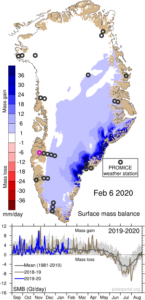
The Insignificance of Greenland’s Ice Mass Loss in Five Easy Charts…

by David Middleton, February 5, 2020 in WUWT


This is a sort of a spin-off of Rutgers University Global Snow Lab and “the Snows of Yesteryear” and A Geological Perspective of the Greenland Ice Sheet. And, yes, there are a lot more than five charts in this post… And, none of them were all that easy.

Introduction

There is a general scientific consensus that the Greenland Ice Sheet (GrIS) has been losing ice mass since the Little Ice Age (LIA). This should come as no surprise, since the LIA was quite likely the coldest climatic episode of the Holocene Epoch. Although it does appear that the GrIS may have gained ice mass during the mid-20th century global cooling crisis.

According to Mouginot et al, 2019, the GrIS was gaining an average of +47 ± 21 Gt/y from 1972–1980, then began to lose ice mass after 1980:

  • -51 ± 17 Gt/y from 1980–1990

  • -41 ± 17 Gt/y from 1990–2000

  • -187 ± 17 Gt/y from 2000–2010

  • -286 ± 20 Gt/y from 2010–2018


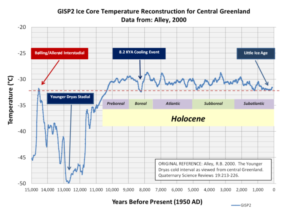
Figure 4. Central Greenland temperature reconstruction (Alley, 2000).

Japan Races to Build New Coal-Burning Power Plants, Despite the Climate Risks

by Hiroko Tabuchi, February 5, 2020 in TheNewYorkTimes


It is one unintended consequence of the Fukushima nuclear disaster almost a decade ago, which forced Japan to all but close its nuclear power program. Japan now plans to build as many as 22 new coal-burning power plants — one of the dirtiest sources of electricity — at 17 different sites in the next five years, just at a time when the world needs to slash carbon dioxide emissions to fight global warming.

Earth about to enter 30-YEAR ‘Mini Ice Age’ with -50C temperatures in coldest regions, scientists warn

by Harry Pettit, February 2, 2020 in TheSun


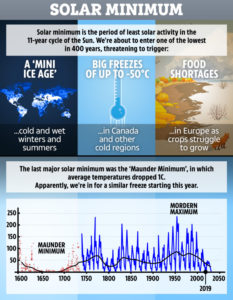
Earth is bracing for a solar minimum: a quiet period in which the Sun fires less energy – or, heat – at our planet than usual.

According to Nasa, the Sun will reach its lowest activity in over 200 years in 2020.

This could cause average temperatures to drop as much as 1C in a cold spell lasting 12 months, according to Northumbria University expert Valentina Zharkova.

That might not sound like much, but a whole degree is very significant for global average temperatures.

However, Professor Zharkova warned icy spells and wet summers could persist until solar activity picks up again in 2053.

She listed recent unusual chills in Canada and Iceland as evidence of the Grand Solar Minimum (GSM) already taking hold.

“The reduction in temperature will results in cold weathers on Earth, wet and cold summers, cold and wet winters,” she told The Sun.

“We will possibly get big frosts as is happening now in Canada where they see [temperatures] of -50C.

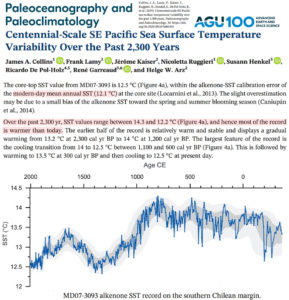
Longest-Ever S. Hemisphere Tree-Ring Reconstruction Finds The 1700s-1800s Were Warmer Than Today

by  K. Richard, February 3, 2020  in NoTricksZone


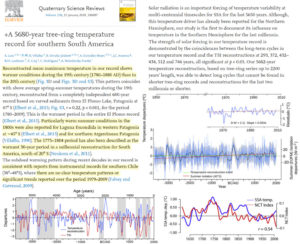
A new 5680-year tree-ring temperature reconstruction for southern South America (Lara et al., 2020) reveals (a) no clear warming trend in recent decades, and (b) the 18th and 19th centuries (and many centennial-scale periods from the last 5680 years) had much warmer temperatures than today.

In addition to finding modern temperature changes in southern South America fall well within the range of natural variability in the context of the last 5680 years, Lara et al. (2020) assess solar forcing to have contributed to climate variations for this region of the Southern Hemisphere.

Will Humanity Ever Reach 2XCO2? Possibly Not

by Dr. Roy Spencer, February 2, 2020 in WUWT


Summary

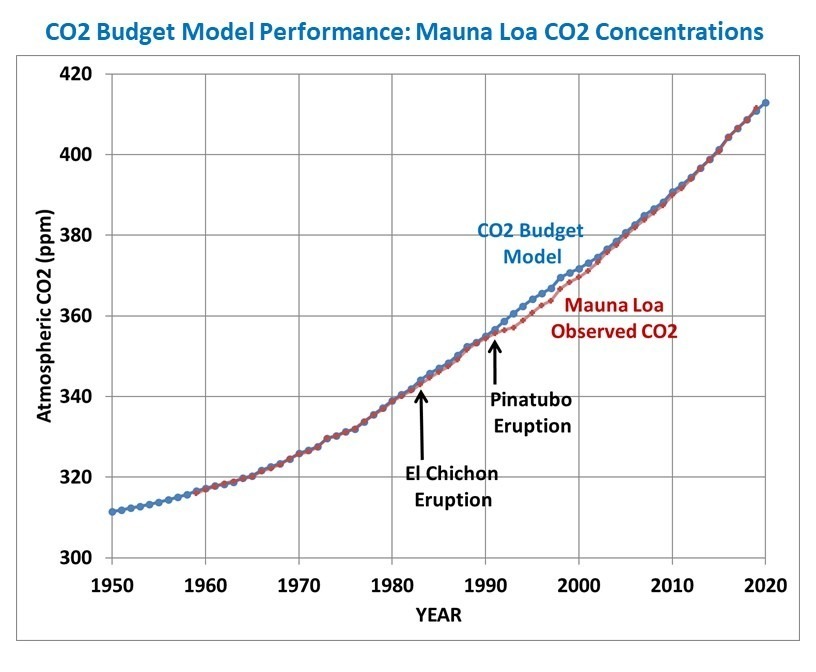
The Energy Information Agency (EIA) projects a growth in energy-based CO2 emissions of +0.6%/yr through 2050. But translating future emissions into atmospheric CO2 concentration requires a global carbon budget model, and we frequently accept the United Nations reliance on such models to tell us how much CO2 will be in the atmosphere for any given CO2 emissions scenario. Using a simple time-dependent CO2 budget model forced with yearly estimates of anthropogenic CO2 emissions and optimized to match Mauna Loa observations, I show that the EIA emissions projections translate into surprisingly low CO2 concentrations by 2050. In fact, assuming constant CO2 emissions after 2050, the atmospheric CO2 content eventually stabilizes at just under 2XCO2.

Introduction

I have always assumed that we are on track for a doubling of atmospheric CO2 (“2XCO2”), if not 3XCO2 or 4XCO2. After all, humanity’s CO2 emissions continue to increase, and even if they stop increasing, won’t atmospheric CO2 continue to rise?

It turns out, the answer is probably “no”.

The rate at which nature removes CO2 from the atmosphere, and what controls that rate, makes all the difference.

Even if we knew exactly what humanity’s future CO2 emissions were going to be, how much Mother Nature takes out of the atmosphere is seldom discussed or questioned. This is the domain of global carbon cycle models which we seldom hear about. We hear about the improbability of the RCP8.5 concentration scenario (which has gone from “business-as-usual”, to “worst case”, to “impossible”), but not much about how those CO2 concentrations were arrived at from CO2 emissions data.

So, I wanted to address the question, What is the best estimate of atmospheric CO2 concentrations through the end of this century, based upon the latest estimates of future CO2 emissions, and taking into account how much nature has been removing from the atmosphere?

As we produce more and more CO2, the amount of CO2 removed by various biological and geophysical processes also goes up. The history of best estimates of yearly anthropogenic CO2 emissions, combined with the observed rise of atmospheric CO2 at Mauna Loa, Hawaii, tells us a lot about how fast nature adjusts to more CO2.

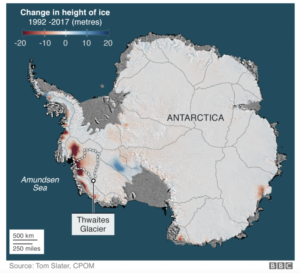
Thwaites Glacier: Why Did The BBC Fail To Mention The Volcanoes Underneath?

by D. Whitehouse, January 29, 2020 in GWPF


Scientists have known for years that subglacial volcanoes and other geothermal “hotspots” are contributing to the melting of the Thwaites Glacier. Why did the BBC fail to mention these facts in its recent report?


The International Thwaites Glacier Collaboration is performing some magnificent science, conducting the most ambitious fieldwork ever undertaken at the tip of what is one of the most significant glaciers on Earth. Its melting already contributes 4% of global sea level rise and there are fears that it could become unstable and contribute many metres to global sea level.

The reason for its vulnerability lies in its geology. While most of the glacier is on ground and making its way into the West Antarctic seas, Thwaites lip floats on water allowing warm water to weaken and melt it from beneath. Being one of the most difficult places in the world to reach the scientific collaboration planned for years to transport many tonnes of equipment to the glaciers front. Two weeks ago they announced they had carried out the first warm water borehole through the ice at the point where it lifts off the land and starts to be suspended by the ocean. Image courtesy British Antarctic Survey.

Fungal decisions can affect climate

by American Society of Agronomy, January 31, 2020 in WUWT


But fungi don’t just release carbon. They can also store it. For example, environmental stress can cause fungi to strengthen their cell walls. They do so by using organic compounds that contain carbon. These carbon compounds can stay in soils for years to decades or even longer.

“We found that where drought stress increased, the amount of fungi that invested more in strengthening cell walls and less in decomposition tended to increase,” says Treseder. In contrast, in more moderate conditions, the reverse occurred. Fungi that decomposed more efficiently became more common.

These findings suggest that fungi might store more carbon as global climate becomes more extreme. On the other hand, they might release more carbon dioxide in moderate climates. “These opposing feedbacks would not have been apparent without examining trade-offs among fungal traits,” says Treseder.

Analysis of a carbon forecast gone wrong: the case of the IPCC FAR

by J. Curry, January 31, 2020 in WUWT-C. Rotter


The IPCC’s First Assessment Report (FAR) made forecasts or projections of future concentrations of carbon dioxide that turned out to be too high.

From 1990 to 2018, the increase in atmospheric CO2 concentrations was about 25% higher in FAR’s Business-as-usual forecast than in reality. More generally, FAR’s Business-as-usual scenario expected much more forcing from greenhouse gases than has actually occurred, because its forecast for the concentration of said gases was too high; this was a problem not only for CO2, but also for methane and for gases regulated by the Montreal Protocol. This was a key reason FAR’s projections of atmospheric warming and sea level rise likewise have been above observations.

Some researchers and commentators have argued that this means FAR’s mistaken projections of atmospheric warming and sea level rise do not stem from errors in physical science and climate modelling. After all, emissions are for climate models an input, not an output. Emissions depend largely on economic growth, and can also be affected by population growth, intentional emission reductions (such as those implemented by the aforementioned Montreal Protocol), and other factors that lie outside the field of physical science. Under this line of reasoning, it makes no sense to blame the IPCC for failing to predict the right amount of atmospheric warming and sea level rise, because that would be the same as blaming it for failing to predict emissions.

Readers who have made it to this part of the article probably want a summary, so here it goes:

  • Hausfather estimates that FAR’s Business-as-usual scenario over-projected forcings for the 1990-2017 period by 55%. This would mean a difference of 0.59 w/m2 between FAR and reality.
  • Lower-than-expected concentrations of Montreal Protocol gases explain about 0.19 w/m2 of the difference. With the big caveat that Montreal Protocol accounting is a mess of CFCs, HCFCs, HFCs, stratospheric ozone, and perhaps other things I’m not even aware of.
  • FAR didn’t account for tropospheric ozone, and this ‘unexplains’ about 0.07 w/m2. So there’s still 0.45-0.5 w/m2 of forcing overshoot coming from something else, if Hausfather’s numbers are correct.
  • N2O is irrelevant in these numbers
  • CO2 concentration was significantly over-forecasted by the IPCC, and that of methane grossly so. It’s safe to assume that methane and CO2 account for most or all of the remaining difference between FAR’s projections and reality.

Again, this is a rough calculation. As mentioned before, an exact calculation has to take into account for many issues I didn’t consider here. I really hope Hausfather’s paper is the beginning of a trend in properly evaluating climate models of the past, and that means properly accounting for (and documenting) how expected forcings and actual forcings differed.

Over 440 Scientific Papers Published In 2019 Support A Skeptical Position On Climate Alarm

by K. Richard, January 30, 2020 in NoTricksZone


In 2019,  more than 440 scientific papers were published that cast doubt on the position that anthropogenic CO2 emissions function as the climate’s fundamental control knob…or that otherwise serve to question the efficacy of climate models or the related “consensus” positions commonly endorsed by policymakers and mainstream media sources.


CLINTEL Group Blasts Climate Doomsters; There Is No ‘Emergency’

by D. Wojick, Jan 29, 2020 in ClimateChangeDispatch


There is NO climate emergency. Preaching doom and gloom is a crime against the young generation. These are the key points of a new manifesto from the Climate Intelligence Group or CLINTEL.

CLINTEL is a rapidly growing international group, led by prominent scientists, that opposes the ill-founded attempts to scare people into hasty climate policy actions.

They also oppose the terrorizing of children as part of the false climate alarm. CLINTEL recently issued a World Climate Declaration denouncing scaremongering and this new manifesto provides detailed scientific backup for the WCD for a wide public.

The manifesto is authored by Professor Guus Berkhout, the President of CLINTEL.

The focus of the Berkhout manifesto is on climate-related modeling, which it says is “unfit for purpose.” The purpose, in this case, is predicting future climate change. Modeling dominates climate science.

It also provides the scary scenarios that drive hugely expensive and disruptive climate emergency action policies. That the models are faulty is a very important finding.

The manifesto says there are at least four strong reasons why today’s models are no good.

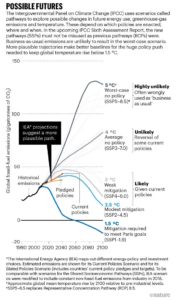
Emissions – the ‘business as usual’ story is misleading

by Z. Hausfather & G. Peters, January 29, 2020 in Nature


Stop using the worst-case scenario for climate warming as the most likely outcome — more-realistic baselines make for better policy.

More than a decade ago, climate scientists and energy modellers made a choice about how to describe the effects of emissions on Earth’s future climate. That choice has had unintended consequences which today are hotly debated. With the Sixth Assessment Report (AR6) from the Intergovernmental Panel on Climate Change (IPCC) moving into its final stages in 2020, there is now a rare opportunity to reboot.


Patterns of thinning of Antarctica’s biggest glacier are opposite to previously observed

by University of Bristol, January 27, 2020 in ScienceDaily


Using the latest satellite technology from the European Space Agency (ESA), scientists from the University of Bristol have been tracking patterns of mass loss from Pine Island — Antarctica’s largest glacier.

They found that the pattern of thinning is evolving in complex ways both in space and time with thinning rates now highest along the slow-flow margins of the glacier, while rates in the fast-flowing central trunk have decreased by about a factor of five since 2007. This is the opposite of what was observed prior to 2010.

Pine Island has contributed more to sea level rise over the past four decades than any other glacier in Antarctica, and as a consequence has become one of its most intensively and extensively investigated ice stream systems.

However, different model projections of future mass loss give conflicting results; some suggesting mass loss could dramatically increase over the next few decades, resulting in a rapidly growing contribution to sea level, while others indicate a more moderate response.

Identifying which is the more likely behaviour is important for understanding future sea level rise and how this vulnerable part of Antarctica is going to evolve over the coming decades.

The results of the new study, published in the journal Nature Geoscience, suggest that rapid migration of the grounding line, the place where the grounded ice first meets the ocean, is unlikely over that timescale, without a major change in ocean forcing. Instead, the results support model simulations that imply that the glacier will continue to lose mass but not at much greater rates than present.

Lead author Professor Jonathan Bamber from the University of Bristol’s School of Geographical Sciences, said: “This could seem like a ‘good news story’ but it’s important to remember that we still expect this glacier to continue to lose mass in the future and for that trend to increase over time, just not quite as fast as some model simulations suggested.

“It’s really important to understand why the models are producing different behaviour in the future and to get a better handle on how the glacier will evolve with the benefit of these new observations.

“In our study, we didn’t make projections but with the aid of these new data we can improve model projections for this part of Antarctica.”

World Leading Alps Glaciologist Shows “Today’s Climate, Vegetation And Glacier Situation Nothing Special”

by H.J. Lüdecke & K.E. Puls, January 25, 2020 in NoTricksZone


Prof. Gernot Patzelt is an internationally renowned glaciologist with numerous publications and lectures. Now he has, as it were, presented his life’s work with the book “Gletscher: Klimazeugen von der Eiszeit bis zur Gegenwart“ (Glaciers: Climate Witnesses from the Ice Age to the Present” (Hatje Cantz-Verlag, Berlin, 2019, 266 pages). It combines the overwhelming artistic aesthetics of Alpine glaciers in painting with scientific glaciology.

Gernot Patzelt, Professor of High Altitude Research at the University of Innsbruck and Head of the Alpine Research Centre Obergurgl in Tyrol, was not and is not retired after his retirement in 2004. His lectures, especially those at EIKE climate conferences (here, here) and his writings, which are listed here, bear witness to this. He was also co-author of the book “A. Fischer und G. Patzelt: Gletscher im Wandel: 125 Jahre Gletscher-Meßdienst des Alpenvereins, Springer, 2018″.

His book “Klimazeugen von der Eiszeit bis zur Gegenwart” (Climate Witnesses from the Ice Age to the Present), which is discussed here, breaks new ground by making the otherwise rarely attempted connection between natural aesthetics and scientific description. The Austrian glaciologist  has convincingly succeeded in this attempt, namely the connection of painting history with Ice Age history, glacier history, landscape history, vegetation history, climate history, cultural history … and more!

Jakarta is not an Exemplar of Sea Level Rise

by K. Hansen, January 25, 2020 in WUWT


Ted Nordhaus has an excellent article in the Wall Street Journal titled “Ignore the Fake Climate Debate”.

[  It may or may not be pay-walled for you — if it is, try searching the title in your search engine and use the link provided by Google/Bing/whatever — it may let you in or see here. ]


Jakarta, Indonesia, is not an exemplar of rising sea levels    

 Jakarta is a good proxy for many of the problems that Asian cities are having with sea levels — relative sea levels.   Is Relative Sea Level a problem specific to Asian cities?  No, but it is a common problem to Asian mega-cities as can be seen in this figure:

Negative CO2 Emissions

by Kevin Kilty, January 24, 2020 in WUWT


An article in the January 2020 Issue of Physics Today (1) presents an interesting and very readable overview of methods to capture and store away CO2 emissions. The purpose of this guest blog is to summarize a few key points the paper makes, and add some commentary. WUWT has covered some of this same territory recently here and here.

Motivation

Of course, the motivation for negative emissions technologies (NETs), or CO2 capture, is to bring atmospheric CO2 back to safe levels. Although the article fails to mention what safe means in this context, and what levels are unsafe, it alludes to melting polar ice and methane escaping from melting permafrost as consequences of unsafe climate. Nothing unusual here. Despite relegating its case for an unsafe future to such enterprises as the IPCC, the article does provide some insight into the cause of what seems to be the current “crisis” mentality. It is 1.5°C temperature rise goal of the 2015 Paris agreement. As readers of WUWT already know, this is not a 1.5°C increase from now, but rather from an estimated pre-industrial level — meaning that two-thirds of that margin is already gone and we have but 0.5°C left to work with. I suspect most people do not understand this subtle point.

Eventually the article makes a brief excursion into more phenomena by which climate change would become unsafe — forest fires, droughts, and sea level rise. All of this is also familiar to WUWT readers.


Technologies Involved

Extreme Arctic melting has a new suspect: The same powerful gases screwing over the ozone

by B.L. Beckman, January 21, 2020 in Mashable/Nature


They were once abundant, in our hairsprays, bug sprays, and refrigerators. And then scientists figured out these substances ripped a hole in the ozone layer, leading to a 1987 plan to phase them out that over time would be agreed to by every country in the world.

More than three decades later, researchers have made a new discovery.

Ozone-depleting substances do more than just gnaw at Earth’s protective layer. They’re also greenhouse gases, so they contribute to the planet’s overall warming by trapping heat, too. And now we may know just how much these substances have contributed to Arctic warming, thanks to a study published in the science journal Nature on Monday.

Between 1955 and 2005, ozone-depleting gases caused half of Arctic climate change (and a third of overall global warming), the study finds. This is primarily due to their heat-trapping qualities, not their ozone munching. The Arctic has seen rapidly melting sea ice for years and is warming faster than the rest of the world.

HISTORICAL DATA DESTROYS THE GLOBAL WARMING MYTH, AND PEOPLE ARE WAKING TO IT…

by Cap Allon, January 22, 2020 in Electroverse


According to NOAA’s own historical data, of the 50 U.S. state all-time record high temperatures, 23 were set during the 1930s, while 36 occurred prior to 1960 — climate change proponents are feeding us a fairy tale, and I’m sick of it…

The maniacal sociopaths of the world may have won control of the narrative, but they seemingly have little sway over the will of the people. You need only browse the comment section below any “climate change” article or social media post to see the wave of folks resoundingly rejecting the scam-of-a-world-view assembled before them (one of the few positives of SM).

The man-made global warming rejection is likely down to two things: the first being that the so called “scientific consensus” has been failing for far too long — you can’t start warning people in the 1980s that we have 10 years left to save the planet, only to keep repeating that prophecy for the next 4 decades. This is probably the reason our youth have become the new target — kids don’t have this history of failure to draw-upon when browsing the bullet points of the latest IPCC report -for example- meaning they’re far easier to manipulate.


Learning The Lessons From The Waroona Bushfires

by P. Homewood, January 22, 2020 in NotaLotofPeopleKnowThat


It has surely now been established beyond any possible doubt the major role that poor fire hazard management has played in the severity of recent Australian bushfires, despite disinformation campaigns from the BBC/Guardian/Met Office.

Back in 2016, a Special Inquiry was held following the catastrophic Waroona bushfire, just south of Perth that year. Their report not only reemphasised the crucial role of controlled burning, but also gives an insight into the evolution of such practices in recent decades:

Below is the key segment of the report. [The data relates to Western Australia, and P&W refers to the Department of Parks and Wildlife].

North Atlantic Sea Levels Have Been Falling At A Rate Of 7.1 mm/yr Since 2004…In Tandem With 2°C Cooling

by K. Richard/Chafik et al. 2019, January 20, 2020 in NoTricksZone


Rapid cooling in the North Atlantic has reversed regional sea level changes and has apparently spread to the Greenland ice sheet

Image Source: Chafik et al. (2019)

Despite stressing global sea level rise is worrisome and due to anthropogenic warming, Chafik et al. (2019) report a distinct cooling trend in the North Atlantic that coincides with a transition to falling regional sea levels since 2004.

Doomsday Climate Predictions: Wrong Then, Wrong Now

by CFACT, January 20, 2020, in ClimateChangeDispatch


How many doomsday predictions about the Earth’s climate must fail before they finally get broadly ignored and dismissed out of hand?

Considering the track record of climate predictions that turned out to be false, we are well passed the moment of ridicule.

The latest climate prediction fiasco, about glaciers disappearing in Glacier National Park by 2020, is the latest reminder of the falsity of the man-made global warming movement.  It’s 2020; the glaciers remain.

Predictions of climate catastrophe drone on, and get more hysterical, including many from the same people whose credibility was destroyed long ago.

Yet, the climate alarmists remain undaunted and impervious to embarrassment.

Instead, they simply move the goalposts by predicting more planetary weather Armageddon in the future and proposing more insanely expensive solutions to “address” it (notice they rarely promise to reverse assumed man-made warming).

It is not just actors like Ted Danson or Jane Fonda who make absurd climate predictions, but scientists, government bureaucrats and especially politicians continue this longstanding racket.

In the years leading up to the first “Earth Day” in 1970, there were so many climate predictions that ended up being laughably wrong, it’s hard to pick favorites.

Stanford University biologist, Paul Ehrlich, author of The Population Bomb, is perhaps the best-known alarmist of that period.


Continuer la lecture de Doomsday Climate Predictions: Wrong Then, Wrong Now

2019 Science Refutes Climate Alarm On Every Front… Shrinking Deserts, Growing Islands, Crumbling Consensus, Weaker Storms, Cooler Arctic Etc. Etc. Etc.

by P. Gosselin, December 31, 2019 in NoTricksZone


2019 science: Absolutely no climate alarm 

No alarm on every aspect: stable polar ice, normal sea level rise, no consensus, growing snow cover, less tropical storms, tornadoes, shrinking deserts, global greening, predictions wrong, models flawed, climate driven by sun, ocean cycles, biodiversity, warmer 1000 years ago…etc…


2019 saw a great amount of new science emerge showing that there’s nothing alarming or catastrophic about our climate. 

Some 2019 scientific findings

Need to make a presentation showing there is no climate alarm? The following findings we reported on in 2019 will put many concerns to rest.

Hundreds of peer-reviewed papers ignored by media

What follows are some selected top science-based posts we published here at NoTricksZone in 2019. These new findings show there is absolutely no climate alarm.

Hundreds of new peer-reviewed papers, charts, findings, etc – which the IPCC, activists and media ignore and even conceal. No wonder they’ve gotten so shrill.


Comprehensive Data, Recent Studies In Top Journals: Antarctica Stable, Temps Falling, Ice Mass Growing!

by P. Gosselin, January 14, 2020 in NoTricksZone


The ice in Antarctica, how is it doing? Is it melting, is it growing? In the following we wishto present the latest literature on the subject. There is a lot to report.

Fasten your seat belt, there’s a lot to cover.

Let’s start with the temperature development because along with snowfall, this is the most important control factor for Antarctic inland ice.

At NoTricksZone, Kirye shows ten coastal stations of Antarctica. None have been warming over the past 10 years. An example follows:


And here’s the temperature development of the entire Antarctic according to UAH and RSS satellite measurements (from Climate4You, via NoTricksZone):

NASA: 2020 Will Mark the Lowest Solar Activity in 200 Years

by James Murphy, January 16, 2020 in NewAmerican


With all of the pseudo-scientific propaganda being peddled about anthropogenic climate change, people sometimes forget that there are other, far more important drivers of the Earth’s climate than mankind’s carbon dioxide emissions. For example, that big ball of yellow light in the sky (aka the sun) has a huge effect on climate. And according to NASA, this year will mark the lowest level of solar activity in 200 years.

“Research now underway may have found a reliable new method to predict this solar activity. The Sun’s activity rises and falls in an 11-year cycle. The forecast for the next solar cycle says it will be the weakest of the last 200 years. The maximum of this next cycle — measured in terms of sunspot number, a standard measure of solar activity level — could be 30-50 percent lower than the most recent one. The results show that the next cycle will start in 2020 and reach its maximum in 2025.”

According to a growing number of scientists, the coming lower solar cycle — number 25 — may simply be a precursor to a period of prolonged solar minima such as the Maunder and Spörer minimums of the past millennium.


Major Greenland Glacier Is Growing

by NASA (Earth Observatory), June 6, 2019 in NASA.E.Observ.


Jakobshavn Glacier in western Greenland is notorious for being the world’s fastest-moving glacier. It is also one of the most active, discharging a tremendous amount of ice from the Greenland Ice Sheet into Ilulissat Icefjord and adjacent Disko Bay—with implications for sea level rise. The image above, acquired on June 6, 2019, by the Operational Land Imager (OLI) on Landsat 8, shows a natural-color view of the glacier.

Jakobshavn has spent decades in retreat—that is, until scientists observed an unexpected advance between 2016 and 2017. In addition to growing toward the ocean, the glacier was found to be slowing and thickening. New data collected in March 2019 confirm that the glacier has grown for the third year in a row, and scientists attribute the change to cool ocean waters.

“The third straight year of thickening of Greenland’s biggest glacier supports our conclusion that the ocean is the culprit,” said Josh Willis, an ocean scientist at NASA’s Jet Propulsion Laboratory and principal investigator of the Oceans Melting Greenland (OMG) mission