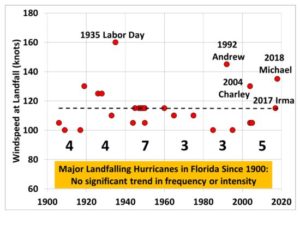
I’ve updated a plot of Florida major hurricane strikes since 1900 with Hurricane Michael, and the result is that there is still no trend in either intensity or frequency of strikes over the last 118 years:
The significance of course is that the warming of the oceans began long before any impact from CO2 emissions.
HH Lamb has written extensively about how sea temperatures in the Atlantic fell radically during the LIA. Is the warming trend since then merely a return to earlier conditions?
Steve McIntyre has a look at the “revised” PAGES2K temperature proxy dataset that includes tree rings and river sediments. He finds the usual ridiculous problems from the past, such as upside down data and river sediment accumulations that have more to do with building a dam than climate.
The following description of the climate system contains nothing that is in the least controversial, and I expect that anyone with a scientific background will readily follow the description. I will also try, despite Snow’s observations, to make the description intelligible to the non-scientist.
…
…
Conclusion
So there you have it. An implausible conjecture backed by false evidence and repeated incessantly has become politically correct ‘knowledge,’ and is used to promote the overturn of industrial civilization. What we will be leaving our grandchildren is not a planet damaged by industrial progress, but a record of unfathomable silliness as well as a landscape degraded by rusting wind farms and decaying solar panel arrays. False claims about 97% agreement will not spare us, but the willingness of scientists to keep mum is likely to much reduce trust in and support for science. Perhaps this won’t be such a bad thing after all – certainly as concerns ‘official’ science.
There is at least one positive aspect to the present situation. None of the proposed policies will have much impact on greenhouse gases. Thus we will continue to benefit from the one thing that can be clearly attributed to elevated carbon dioxide: namely, its effective role as a plant fertilizer, and reducer of the drought vulnerability of plants. Meanwhile, the IPCC is claiming that we need to prevent another 0.5◦C of warming, although the 1◦C that has occurred so far has been accompanied by the greatest increase in human welfare in history. As we used to say in my childhood home of the Bronx: ‘Go figure’.
Media Matters scrutinized the top 50 U.S. newspapers between 9 AM and noon ET on Monday and found most did not mention on their website homepages the Intergovernmental Panel on Climate Change’s Sunday release of its report on the devastating impacts of a global temperature increase of 1.5-degree Celsius (2.7-degree Fahrenheit) above the temperature of the pre-industrial era.
by Bjorn Lomborg, October 10, 2018 in ClimateChangeDispatch
…
The IPCC report significantly underestimates the costs of getting to zero emissions. Fossil fuels provide cheap, efficient power, whereas green energy remains mostly uncompetitive.
Switching to more expensive, less efficient technology slows development. In poor nations that means fewer people lifted out of poverty.
In rich ones, it means the most vulnerable are hit by higher energy bills.
The IPCC says carbon emissions need to peak right now and fall rapidly to avert catastrophe.
Models actually reveal that to achieve the 2.7-degree goal the world must stop all fossil fuel use in less than four years.
Yet the International Energy Agency estimates that in 2040 fossil fuels will still meet three-quarters of world energy needs, even if the Paris agreement is fully implemented.
by JC Maurin, 4 octobre 2018 in Science,Climat,Energie
Pour les derniers millénaires, les proxies archives glaciaires montrent une corrélation entre rapport isotopique (« température ») et taux de CO2 subsistant dans les microbulles. Toutefois les valeurs numériques de taux de CO2 doivent être prises avec précaution: l’enregistrement comporte à minima un biais « passe bas » qui efface les extremums. Si la corrélation est bien réelle, en revanche des affirmations telles que « les taux de CO2 des derniers millénaires sont toujours inférieurs aux taux après 1958 », ou bien « une variation de 1°C entraîne une variation de 12 ppm » ne sont pas démontrées.
Le CO2 ne précède jamais l’augmentation de la température, et cela depuis au moins le Pléistocène (240 000 ans) où la démonstration a bien été établie (cf. Fig. 8). Le CO2 n’est donc pas le ‘bouton’ contrôlant l’évolution de la température.
Les concentrations anciennes de CO2 atmosphérique sont sous-estimées et les données de Vostok non seulement donnent un ‘ background’ plus faible que les données fournies par l’analyse des stomates (Fig.10,) mais ne voient pas les pics de concentrations plus élevés de CO2. Ainsi affirmer que les teneurs actuelles en CO2n’ont jamais été aussi élevées, même à une échelle géologique très restreinte (telle que Quaternaire) est trompeur.
Pour les dernières décennies, les mesures contemporaines montrent une corrélation entre température de surface des océans sous les tropiques et variation annuelle du taux de CO2. La variation annuelle c’est aussi la différence entre entrées et sorties. Les mesures contemporaines montrent également une corrélation entre température des océans sous les tropiques et variation annuelle du δ13C. Ces 2 corrélations sont nettes lors des forts épisodes El Niño de 1998 et 2016.
Nous exploiterons ces corrélations dans la troisième partie qui montrera que le modèle anthropique du GIEC n’est pas en accord avec les mesures du δ13C et ne peut rendre compte des évolutions récentes du CO2 .
by B. Peiser, October 10, 2018 in ClimateChangeDispatch
So the very first sentence of the SR15 Summary for Policy Makers, after the Introduction, consists of a statement which is not well supported by the totality of the available scientific literature and which is at odds with the IPCC’s own findings in the AR5 Working Group 1 Report of just 5 years ago! Not a good start. —Climate Scepticism, 9 October 2018
by P. Homewood, October 10, 2018 in NotaLotofPeopleKnowThat
Contrary to recent press reports that the oceans hold the still-undetected global atmospheric warming predicted by climate models, ocean warming occurs in 100-year cycles, independent of both radiative and human influences.
At a press conference in Washington, D.C., on March 24, 2000, Dr. James Baker, Administrator of the U.S. National Oceanic and Atmospheric Administration (NOAA), announced that since the late 1940s, there “has been warming to a depth of nearly 10,000 feet in the Atlantic, Pacific, and Indian Oceans.” “In each ocean basin, substantial temperature changes are occurring at much deeper depths than we previously thought,” Dr. Baker said, as indicated by research conducted at NOAA’s Ocean Climate Laboratory. He was referring to a paper published in Science magazine that day, prepared by Sydney Levitus, John Antonov, Timothy Boyer, and Cathy Stephens, of the NOAA Center.
For 15 years, modellers have tried to explain their lack of success in predicting global warming. The climate models had predicted a global temperature increase of 1.5°C by the year 2000, six times more than that which has taken place. Not discouraged, the modellers argue that the heat generated by their claimed “greenhouse warming effect” is being stored in the deep oceans, and that it will eventually come back to haunt us. They’ve needed such a boost to prop up the man-induced greenhouse warming theory, but have had no observational evidence to support it. The Levitus, et al. article is now cited as the needed support.
The fate of the planet is at stake, but the key temperature data set used by climate models contains more than 70 different sorts of problems. Trillions of dollars have been spent because of predictions based on this data – yet even the most baby-basic quality control checks have not been done.
Thanks to Dr John McLean, we see how The IPCC demands for cash rest on freak data, empty fields, Fahrenheit temps recorded as Celsius, mistakes in longitude and latitude, brutal adjustments and even spelling errors.
Why. Why. Why wasn’t this done years ago?
So much for that facade. How can people who care about the climate be so sloppy and amateur with the data?
The following description of the climate system contains nothing that is in the least contro- versial, and I expect that anyone with a scientific background will readily follow the descrip- tion. I will also try, despite Snow’s observations, to make the description intelligible to the non-scientist.
by P. Homewood, October 9, 2018 in NotaLotofPeopleKnowThat
Some of my initial thoughts:
The topic of climate change is not a simple black and white one, and there are many areas where there is substantial disagrement among scientists. However the official party line pretends this is not the case.
It is generally accepted that there has been some warming since the end of the little ice age in the 19thC. But how much is natural, and how much man made?
The LIA is reckoned to be the coldest era since the ice age, so it is reasonable to assume that at least part of the warming since is natural.
The Nongovernmental International Panel on Climate Change (NIPCC) is what its name suggests: an international panel of nongovernment scientists and scholars who have come together to understand the causes and consequences of climate change. Because we are not predisposed to believe climate change is caused by human greenhouse gas emissions, we are able to look at evidence the Intergovernmental Panel on Climate Change (IPCC) ignores. Because we do not work for any governments, we are not biased toward the assumption that greater government activity is necessary.
NIPCC traces its roots to a meeting in Milan in 2003 organized by the
Science and Environmental Policy Project (SEPP), a nonprofit research and education organization based in Arlington, Virginia. SEPP, in turn, was founded in 1990 by Dr. S. Fred Singer, an atmospheric physicist, and incorporated in 1992 following Dr. Singer’s retirement from the University of Virginia. NIPCC is currently a joint project of SEPP, The Heartland Institute, and the Center for the Study of Carbon Dioxide and Global Change.
The Intergovernmental Panel on Climate Change (IPCC) issued a press release today. It tells us the IPCC assesses “thousands of scientific papers published each year,” and that its latest report relies on “more than 6,000 references.”
…
We therefore have no earthly reason to imagine that climate science is exempt from these kinds of problems.
If half of the scientific literature is untrue, it therefore follows that half of climate research is also untrue.
This means that 3,000 of the IPCC’s 6,000 references aren’t worth the paper they’re written on.
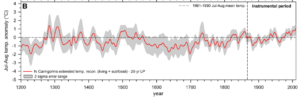
How do today’s temperatures fit into the climate-historical context?
This is one of the main tasks of today’s climate research. A group of researchers led by Milos Rydval have presented a reconstruction of summer temperatures in Scotland over the past 800 years. The results were produced from tree ring examinations.
Surprisingly, the scientists found that the current level of heat in Scotland had been reached and even exceeded several times in the past. These heat spells occurred in the 14th, 16th, and 18th centuries and each spanned over several decades (Figure 1). In between there were cold phases that fit well into the context of the Little Ice Age.
What follows is the abstract of the study published in November 2017 in the journalClimate Dynamics:
Today with press releases, live TV coverage and some media fanfare, the IPCC SR15 report was published. Without comment, here are the press release and “headline statements” as the IPCC sees them.
HadCRUT4 is the primary dataset used by the Intergovernmental Panel on Climate Change (IPCC) to make its dramatic claims about “man-made global warming”, to justify its demands for trillions of dollars to be spent on “combating climate change” and as the basis for the Paris Climate Accord.
But according to a groundbreaking analysis by Australian researcher John McLean it’s far too sloppy to be taken seriously even by climate scientists, let alone a body as influential as the IPCC or by the governments of the world.
“It’s very careless and amateur,” he says. “About the standard of a first-year university student.”
Among the many errors found by McLean were:
Large gaps where there is no data and where instead averages were calculated from next to no information. For two years, the temperatures over land in the Southern Hemisphere were estimated from just one site in Indonesia.
Almost no quality control, with misspelled country names (‘Venezuala” “Hawaai” “Republic of K” (aka South Korea) and sloppy, obviously inaccurate entries.
Adjustments – “I wouldn’t be surprised to find that more than 50 percent of adjustments were incorrect,” says McLean – which artificially cool earlier temperatures and warm later ones, giving an exaggerated impression of the rate of global warming.
Methodology so inconsistent that measurements didn’t even have a reliable policy on variables like Daylight Saving Time.
Sea measurements, supposedly from ships, but mistakenly logged up to 50 miles inland.
A Caribbean island – St Kitts – where the temperature was recorded at 0 degrees C for a whole month, on two occasions (somewhat implausibly for the tropics)
A town in Romania which in September 1953, allegedly experienced a month where the average temperature dropped to minus 46 degrees C (when the typical average for that month is 10 degrees C).
by James Temple, October 4, 2018 in MITTechnologyReview
Wind power is booming in the United States.
It’s expanded 35-fold since 2000 and now provides 8% of the nation’s electricity. The US Department of Energy expects wind turbine capacity to more than quadruple again by 2050.
But a new study by a pair of Harvard researchers finds that a high amount of wind power could mean more climate warming, at least regionally and in the immediate decades ahead. The paper raises serious questions about just how much the United States or other nations should look to wind power to clean up electricity systems.
…
Highlights
Wind power reduces emissions while causing climatic impacts such as warmer temperatures
Warming effect strongest at night when temperatures increase with height
Nighttime warming effect observed at 28 operational US wind farms
Wind’s warming can exceed avoided warming from reduced emissions for a century
More than 100 leading scholars from 12 countries have issued a report contending “the global war on fossil fuels … was never founded on sound science or economics” and urging the world’s policymakers to “acknowledge this truth and end that war.”
The Nongovernmental International Panel on Climate Change (NIPCC), an independent organization founded in 2003 to fact-check the work of the United Nations on the issue of climate change, today released the Summary for Policymakers of Climate Change Reconsidered II: Fossil Fuels. The 27-page Summary provides an early look at a 1,000-page report expected to be released on December 4 at a climate science symposium during the United Nations Conference of the Parties (COP-24) in Katowice, Poland.
…
Among the findings reported in the Summary for Policymakers:
…
Reducing fossil fuel use to achieve dramatic reductions in carbon dioxide emissions would inflict tremendous economic hardship. Reducing greenhouse gases to 90 percent below 1990 levels by 2050 would require a 96% reduction in world GDP, reducing per-capita GDP to $1,200 from $30,600 now forecast. Per-capita income would be at about the level it was in the United States and Western Europe in about 1820 or 1830, before the Industrial Revolution.
95% of the model runs predicted more warming than the RSS data since 1988… And this is the Mears-ized RSS data, the one in which the measurements were influenced to obtain key information (erase the pause and more closely match the surface data).
Their “small discrepancy” would be abject failure in the oil & gas industry.
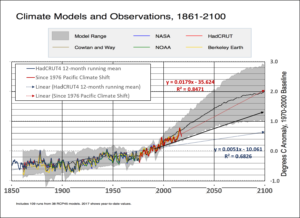
The observed warming has been less than that expected in a strong mitigation scenario (RCP4.5).
Output of 38 RCP4.5 models vs observations. The graph is originally from Carbon Brief. I updated it with HadCRUT4, shifted to 1970-2000 baseline, to demonstrate the post-El Niño divergence.
by Anne Dolhein, 2 october 2018 in Reinformation.TV
La NASA – peu suspecte de climato-scepticisme – s’appuie sur de nouveaux résultats d’observations de température aux confins de l’atmosphère terrestre pour annoncer un refroidissement notable dans ces zones, lié à l’un des minima solaires les plus importants de l’ère spatiale. Il s’agit très clairement d’un refroidissement climatique entraîné par la baisse de l’activité solaire, confirmant le rôle important sinon prépondérant du soleil sur les variations de température de la planète.
« Nous constatons une tendance au refroidissement », vient ainsi de déclarer Martin Mlynczak, chercheur principal associé du centre de recherches Langley de la NASA. « Très loin de la surface de la terre, près du bord de l’espace, notre atmosphère perd de l’énergie calorifique. Si les tendances actuelles se poursuivent, on pourrait bientôt atteindre un record de froid pour notre ère spatiale », a-t-il affirmé.
by Uzbek, 11 septembre 2018 in Climat,Environnemen,Energie
Trois nouvelle études publiées en août 2018 apportent un éclairage nouveau sur le cycle du carbone. La première, publiée dans la revue Nature [1] montre que le taux de croissance du CO2 dans l’atmosphère est très sensible aux changements observés dans le stockage de l’eau terrestre. Les deux autres publiées respectivement dans Nature Geoscience [2] et dans Nature [3] montrent une tendance à l’augmentation du puits de carbone terrestre grâce notamment aux modifications de l’usage des sols sous l’influence des activités humaines.
by Indriani Roy, September28, 2018 in FrontiersinEarthScience
College of Engineering, Mathematics and Physical Sciences, University of Exeter, Exeter, United Kingdom
The puzzle of recent global warming trend slowdown has captured enough attention, though the underlying cause is still unexplained. This study addresses that area segregating the role of natural factors (the sun and volcano) to that from CO2 led linear anthropogenic contributions. It separates out a period 1976–1996 that covers two full solar cycles, where two explosive volcanos erupted during active phases of strong solar cycles. The similar period also matched the duration of abrupt global warming. It identifies that dominance of Central Pacific (CP) ENSO and associated water vapor feedback during that period play an important role. The possible mechanism could be initiated via a preferential alignment of NAO phase, generated by explosive volcanos. Inciting extratropical Rossby wave to influence the Aleutian Low, it has a modulating effect on CP ENSO. Disruption of Indian Summer Monsoon and ENSO during the abrupt warming period and a subsequent recovery thereafter can also be explained from that angle. Interestingly, CMIP5 model ensemble, and also individual models, fails to comply with such observation. It also explores possible areas where models miss important contributions due to natural drivers.