Archives de catégorie : climate-debate

Carbon emissions in African savannas triple previous estimates

by Edinburgh University, August 24, 2018 in ScienceDaily


The findings highlight the extent to which humans are impacting one of the world’s major ecosystems — the Miombo woodlands, which cover 2.5 million square kilometres, across countries including Angola, Zambia, Tanzania and Mozambique.

At the same time, however, the growing number of trees in remote parts of these woodlands is helping to offset the emissions, researchers say.

The study is the first to provide an in-depth analysis of areas gaining carbon while also losing it through degradation — a process where some, but not all, trees are removed, usually as a result of logging and fire.

See original article in Nature

Arctic Summer Sea Ice Growth Trend Extends Another Year …Greenland Summer One Of Coldest In 30 Years!

by P. Gosselin, August 24, 2018 in NoTricksZone


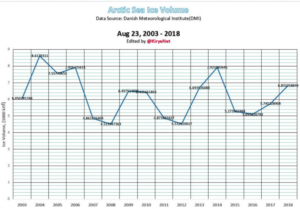
As the Arctic summer ice melt approaches its peak, we can say with high certainty that this year’s ice melt will extend the trend of a rebounding Arctic ice mass by another year.

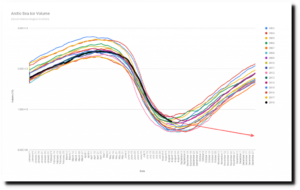
Arctic summer sea ice now growing 12 years

Our Japanese skeptic blogger and good friend Kirye reports using the data from the Danish Meteorological Institute (DMI) that peak summer Arctic sea ice volume upward growth trend has been extended yet another year – now 12 years.

Chart by Kirye. Data source: Danish Meteorology Institute (DMI).

NASA alarmism headline: ‘A World On Fire’

by Anthony Watts, August 23, 2018 in WUWT


The world is on fire. Or so it appears in this image from NASA’s Worldview. The red points overlaid on the image designate those areas that by using thermal bands detect actively burning fires. Africa seems to have the most concentrated fires. This could be due to the fact that these are most likely agricultural fires. The location, widespread nature, and number of fires suggest that these fires were deliberately set to manage land. Farmers often use fire to return nutrients to the soil and to clear the ground of unwanted plants. While fire helps enhance crops and grasses for pasture, the fires also produce smoke that degrades air quality.

Scientists discover that the world contains dramatically more trees than previously thought

by Chris Money, September 2, 2015 in TheWashingtonPost


In a blockbuster study released Wednesday in Nature, a team of 38 scientists finds that the planet is home to 3.04 trillion trees, blowing away the previously estimate of 400 billion. That means, the researchers say, that there are 422 trees for every person on Earth.

However, in no way do the researchers consider this good news. The study also finds that there are 46 percent fewer trees on Earth than there were before humans started the lengthy, but recently accelerating, process of deforestation.

“We can now say that there’s less trees than at any point in human civilization,” says Thomas Crowther, a postdoctoral researcher at the Yale School of Forestry and Environmental Studies who is the lead author on the research. “Since the spread of human influence, we’ve reduced the number almost by half, which is an astronomical thing.”

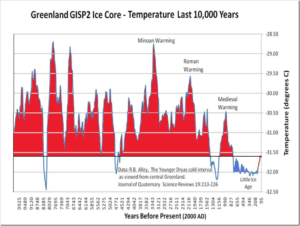
Greenland Temperatures In 2017

by P. Homewood, July 1, 2018 in NotaLotofPeopleKnowThat


As we all know, Greenland is warming up rapidly, causing the ice sheet to melt faster and faster.

Well, according to the BBC and New York Times, at least.

Only one slight problem – the temperature record shows quite a different story.

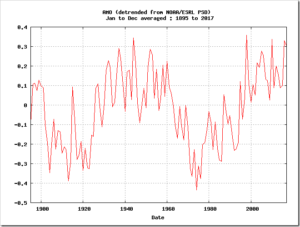
There is certainly no evidence of rising temperature trends, and every likelihood that temperatures will plummet again when the AMO turns cold again.

Holocene Sea Level Trends

by P. Homewood, August 22, 2018 in NotaLotofPeopleKnowThat


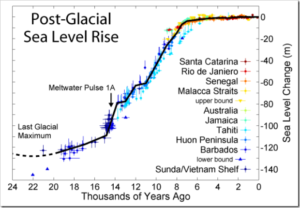
There seems to be a general acceptance about overall sea level trends during the Holocene.

There was naturally a very rapid rise in sea levels at the end of the ice age, until 6000 years ago, since when the rise has been much more gradual. Some research puts the rate of rise in the last 2000 years at 0.07mm/yr, and this reflects the fact that ice caps left over from the ice age are still melting, rather than that the world is warmer than before.

However, the impression is often given that, until the 20thC, this rate of rise has been pretty steady. This is despite the fact some of the authors of the above studies have warned of the existence of significant short-term fluctuations in sea level such that the sea level curve might oscillate up and down about this ~1 kyr mean state. [The above graph is based around 1000 year averages].


HH Lamb looked carefully at many expert studies in his day, and wrote about the very significant fluctuations they found. The following excerpts come from “Climate, History and the Modern World”:

1) The most rapid phases [of sea level rise] were between 8000 and 5000 BC, and that the rise of general water level was effectively over by about 2000 BC, when it may have stood a metre or two higher than today.

2) …

….

https://commons.wikimedia.org/wiki/File:Holocene_Sea_Level.png


Observing glaciers in “real time”

by Anthony Watts, August 20, 2018 in WUWT


From ETH Zurich and the “slow as molasses in winter” department.

Hot summers cause glaciers to melt. That not only changes the makeup of the landscape and hence the maps of Switzerland, it also affects every area of society. A new, dynamic glacier inventory makes the impact of climate change and the changing landscape visible.

The last time Swiss glaciers managed to grow at all was in 2001. Since then, the country’s 1,500 glaciers – as well as others elsewhere – have been suffering a slow but inexorable death. Until now, though, we have understood only partially how quickly they are really disappearing, and what effect that has on the landscape, people and animals. That is about to change, thanks to the Glacier Monitoring in Switzerland (GLAMOS) project. GLAMOS is working on behalf of various Swiss federal offices to put together a comprehensive inventory of the country’s glaciers – at an unprecedented level of detail.

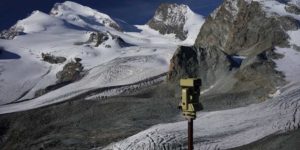
Glacier observation under the spell of several Valais four-thousand-metre peaks. (Photograph: GLAMOS)

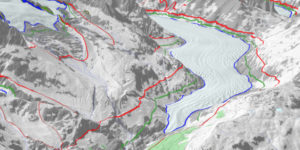
The coloured lines show where the edge of the Aletsch glacier once was (red line 1850, green=1973, blue=2010). (Graphic: Swisstopo/GLAMOS)

America Had Lower CO2 Emissions Than Paris Climate Accord Signatories

by Stephen Moore, August 20, 2018 in ClimateChangeDispatch


Take a wild guess what country is reducing its greenhouse gas emissions the most? Canada? Britain? France? India? Germany? Japan? No, no, no, no, no and no.

The answer to that question is the United States of America. Wow! How can that be? This must be a misprint. Fake news. America never signed the Kyoto Protocol some two decades ago.

Climate4you update July 2018

by Ole Humlum, August 20, 2018 in Climate4You


.pdf (49pages)

CONTENTS

July 2018 global surface air temperature overview

Comments to the July 2018 global surface air temperature overview Temperature quality class 1: Lower troposphere temperature from satellites Temperature quality class 2: HadCRUT global surface air temperature Temperature quality class 3: GISS and NCDC global surface air temperature Comparing global surface air temperature and satellite-based temperatures Global air temperature linear trends
Global temperatures: All in one, Quality Class 1, 2 and 3
Global sea surface temperature
Ocean temperature in uppermost 100 m
North Atlantic heat content uppermost 700 m
North Atlantic temperatures 0-800 m depth along 59N, 30-0W
Global ocean temperature 0-1900 m depth summary
Global ocean net temperature change since 2004 at different depths
La Niña and El Niño episodes
Troposphere and stratosphere temperatures from satellites
Zonal lower troposphere temperatures from satellites
Arctic and Antarctic lower troposphere temperatures from satellites Temperature over land versus over oceans
Arctic and Antarctic surface air temperatures
Arctic and Antarctic sea ice
Sea level in general
Global sea level from satellite altimetry
Global sea level from tide gauges
Northern Hemisphere weekly and seasonal snow cover
Atmospheric specific humidity
Atmospheric CO2
The phase relation between atmospheric CO2 and global temperature
Global air temperature and atmospheric CO2
Latest 20-year QC1 global monthly air temperature change
Sunspot activity and QC1 average satellite global air temperature
Climate and history: 1728: Vitus Bering and the non-discovery of Bering Strait


The Holocene Climate Optimum

by P. Homewood, August 19, 2018 in NotaLotofPeopleKnowThat


Booker commented the other day how one scientist claimed last week that we now have “the highest temperatures on Earth since the last ice age”. The BBC failed to even challenge this statement.

This certainly is not the first time I have heard claims (presented as fact) to this effect.

We have already seen concerted attempts to disappear the MWP, so it is time to reclaim the Holocene Optimum (so named for good reason), which is generally accepted to have run from about 9000 to 5000 years ago

Obviously we had no thermometers around in those days, so nobody knows what the average temperature of the Earth was then. There again, nobody really knows now either.

But there is plentiful evidence that many places were significantly warmer than now. I present some of this evidence below, though this is probably only skimming the surface: …

See also here

RSS Suspected Of “Serious Data Doping”, German Scientists Say…”Values Fudged To Fit Models”!

by  Dr. S. Lüning and Prof. F. Vahrenholt, August 19, 2018 in NoTricksZone


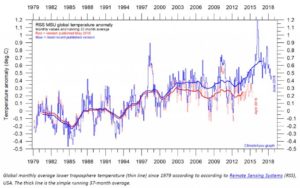
Temperatures can be measured from the ground and from satellites. Satellite data have two versions, UAH and RSS. The version of UAH (University of Alabama, Huntsville) makes a solid impression. The RSS version shows larger deviations and suggests a stronger warming.

How come?

Doping the data

Both datasets surely get their data from similar satellites. The explanation lies in a “post-processing” of the measured values ​​by the RSS group. In the chart below you can see the old version in red.

Global temperature based on RSS satellite measurements. From Climate4You Newsletter June 2018.

Weather and Climate in the Real World

by Tim Ball, August 18, 2018 in WUWT


All the trillions of dollars spent on AGW have not improved forecasting one bit. Instead, it diverted money that could have helped those large, primary sectors of society and economy that need better and more appropriate information. It is time to close all government weather offices or at least reduce their function to data collection determined by the end users.

Sécheresses (Grandes), étés caniculaires à travers les siècles

by La France Pittoresque, 1 août 2013


Quel est le degré de température de nos grands étés ? Ici revient l’insurmontable difficulté de fixer au juste, avant l’usage du thermomètre, l’intensité du froid ou de la chaleur. Un artifice fondé sur les rapports reconnus entre certains phénomènes naturels et les mouvements du thermomètre, fournit les mesures approximatives de nos grandes chaleurs et sécheresses.

De Humboldt a posé en principe que la végétation des arbres exige au moins une température moyenne égale à 11°. Le chiffre de cette température répond encore au point où la chaleur de l’air commence à devenir sensible. Ce degré assez fixe peut être pris pour le premier terme d’une échelle de nos grandes chaleurs. Messier a quant à lui constaté que le maximum de la chaleur à Paris, le 8 juillet 1793, a marqué 40°. C’est à peu près la plus haute température, excepté celle de l’été 1705 à Montpellier, observée en France, le thermomètre au nord, isolé, à l’ombre, à l’abri des réverbérations et à l’air libre.

DATES DE NOS GRANDS ÉTÉS ET GRANDES SÉCHERESSES :

* VIe siècle : 580, 582, 584, 585, 586, 587, 589, 591
* VIIe siècle : 675, 700
* VIIIe siècle : 783
* IXe siècle : 874, 892
* Xe siècle : 921, 987, 994
* XIe siècle : 1078, 1094
* XIIe siècle : 1137, 1183, 1188
* XIIIe siècle : 1204, 1212, 1226, 1287
* XIVe siècle : 1305, 1306, 1325, 1331, 1334, 1361, 1384, 1392
* XVe siècle : 1473
* XVIe siècle : 1540, 1553
* XVIIe siècle : 1632, 1674, 1684, 1694
* XVIIIe siècle : 1701, 1712, 1718, 1719, 1726, 1727, 1767, 1778, 1793
* XIXe siècle : 1803, 1811, 1817, 1825, 1842, 1858, 1875, 1893

Drought Proofing a Dry Continent

by Viv Forbes, August 16, 2018 in WUWT


Sensible drought-proofing policies for Australia are simple –

  1. Stop wasting water
  2. Build more dams, pipelines and pumps
  3. Build power stations capable of delivering cheap reliable electricity for pumping water and energising desalination plants.

To view this whole article plus images click:
http://carbon-sense.com/wp-content/uploads/2018/08/build-more-dams.pdf

A Warm Period by Any Other Name – The Climatic Optimum

by Tim Ball, July 31, 2016 in WUWT


Hypsithermal, Altithermal, Holocene Optimum, Holocene Thermal Maximum, Holocene Megathermal, Anthropogene;

There is frustration and reward when an article appears on the same topic of an article you are completing – in this case the Holocene. Such was the case this week with Andy May’s article “A Review of temperature reconstructions.” Andy points out the basic problems of reconstruction using proxy data for the most recent half of the Holocene – an issue central to historical climate and climate change studies. His paper did not alter my paper except as it reinforces some arguments.

This article examines the entire Holocene and illustrates the history that influenced the studies. There are two distinct parts to the studies, the pre and post Intergovernmental Panel on Climate Change (IPCC). The former is a genuine scientific struggle with issues of terminology and reconstruction, and the latter a scientific struggle to impose a political perspective regardless of the evidence. Because of the damage done to climatology by the proponents of anthropogenic global warming (AGW), both parts require explanation.

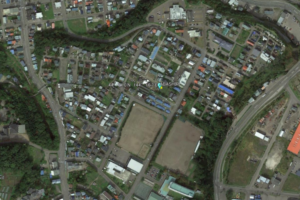
Japan’s JMA Claim Of “Relatively Small” Urbanization Effect Likely An Understatement Of Multiple Degrees

by Kirye and P. Gosselin, August 17, 2018 in NoTricksZone/JapanMeteorologicalAgency


Aerial photos show that the 15 temperature observation stations the JMA is using to determine mean temperature anomalies are likely impacted far more by urbanization than the agency claims.


Abashiri is in the middle of buildings and streets.

Why does climate sensitivity increase over time in models? A look at two possibilities

by A. Zaragoza Comendador, August 16, 2018 in WUWT


Note: if the terms used in this article seem confusing, check out the previous one.

Introduction

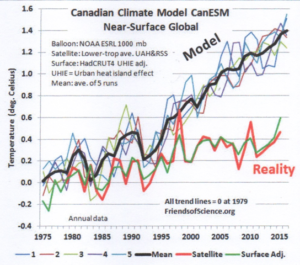
It’s well known that climate models show increasing sensitivity over time: for a given forcing, the true long-term temperature increase (ECS) is higher than what you’d estimate if you simply extrapolated from the past (ECS_hist). In other words, the ECS-to-ECS_hist ratio is above 1. This article tries to work out why climate models behave like that; that is to say, the variable I’m trying to explain is the ECS-to-ECS_hist ratio.

Now, there’s probably too many hyphens and underscores in the text. So it will be more readable if I clarify that, every time I talk simply about ‘correlation’, I mean the correlation of thing X with the ECS-to-ECS_hist ratio. If other kind of correlation is mentioned, I’ll say so explicitly.

Nature Unbound IX – 21st Century Climate Change

by Javier, June 28, 2018


A conservative outlook on 21st century climate change

Summary: For the past decade anthropogenic emissions have slowed down, and continuation of current trends suggests a peak in emissions by 2050. Atmospheric CO2levels should reach 500 ppm but might stabilize soon afterwards, as sinks increase their CO2uptake. Solar activity is expected to continue increasing after the present minimum, as the millennial cycle works its way towards a late 21st century peak. The reduction in the rate of warming might continue until ~ 2035 followed by renewed warming, and temperature stabilization at about +1.5°C above pre-industrial. The pause in summer Arctic sea ice melting might also continue until ~ 2035. Renewed melting is probable afterwards, but it is unlikely that Arctic summers will become consistently ice free even by 2100.

Spiegel Science Journalist Takes Climate Heat-Hysteria Head On: “Speculation”…”Time For A Cool Examination”

by A. Bojanowski, August 4, 2018 in NoTricksZone/Der Spiegel


Geology major, science journalist Axel Bojanowski just penned a commentary at Spiegel Online on the recent hot weather hype we witnessed in the wake of Europe’s warm and unusually dry summer.

The title of his commentary: “Overheated – Forest Fires, Drought, Heat – Has The Climate Catastrophe Already Arrived? Time For A Cool Examination.”

See also here

Glacier depth affects plankton blooms off Greenland

by Helmholtz Centre for Ocean Research Kiel (GEOMAR), Auhsut 14, 2018 in ScienceDaily


The unusual timing of highly-productive summer plankton blooms off Greenland indicates a connection between increasing amounts of meltwater and nutrients in these coastal waters. Researchers now show that this connection exists, but is much more complex than widely supposed. Whether increasing meltwater has a positive or negative effect on summertime phytoplankton depends on the depth at which a glacier sits in the ocean.

“So, the study shows that further melting of Greenland’s glaciers only leads to stronger summer plankton blooms under very specific conditions, an effect that will ultimately end with very extensive further melting,” Hopwood summarizes the results of the study.

Trees and climate change: Faster growth, lighter wood

by Technical University of Munich (TUM), August 14, 2018


Wood density of European trees decreasing continuously since 1870

Trees are growing more rapidly due to climate change. This sounds like good news. After all, this means that trees are storing more carbon dioxide from the atmosphere in their wood and hence taking away the key ingredient in global warming. But is it that simple? A team analyzed wood samples from the oldest existing experimental areas spanning a period of 150 years — and reached a surprising conclusion.

But the most important finding for practical and political aspects is that the current climate-relevant carbon sequestration of the forests is being overestimated as long as it is calculated with established but outdated wood densities. “The accelerated growth is still resulting in surplus carbon sequestration,” says Pretzsch. “But scaling up for the forests of central Europe, the traditional estimate would be to high by about ten million metric tons of carbon per year.”

Blow to warmists, the proposed ‘Anthropocene’ epoch has been denied by ICS

by Anthony Watts, August 13, 2018 in WUWT


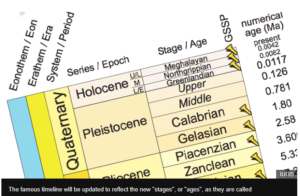
The global body tasked with naming geological eras, the International Commission on Stratigraphy, has rejected the proposed Anthropocene epoch,  the controversial ‘geological’ epoch in which mankind allegedly dominates natural processes. The international commission has now rejected the proposal and has instead split the Holocene Epoch into three different geological ages, all of which were primarily shaped by natural, not human factors.

See also here