Voici quelques réflexions sur la théorie de l’acidification des océans. Selon cette théorie, le pH des océans diminuerait inlassablement, en raison du CO2 qui ne cesse de s’accumuler dans l’atmosphère.
• Les mesures directes de pH sont récentes et nous n’avons aucun recul. Selon les médias et les ONG écologistes, qui se basent sur le GIEC et sur certaines publications (e.g., Caldeira & Wickett 2003), le pH des océans aurait été de 8.25 en 1750. Cependant, il faut savoir que personne n’a jamais mesuré le pH des océans en 1750, puisque le concept de pH n’a été inventé qu’en 1909 (par le danois Søren P.L. Sørensen), et que les premiers appareils fiables pour mesurer le pH ne sont apparus qu’en 1924… Nous ne sommes donc pas certains de cette valeur de 8.25 pour 1750… La valeur de 8.25 est donc obtenue par des mesures indirectes et n’est donc pas certaine.
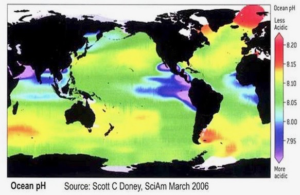
• A l’heure d’aujourd’hui, tous les pH sont possibles. Lorsqu’on dit que les océans actuels sont à un pH de 8.1, de quel océan parle-t-on? S’agit-il du pH moyen global? Si c’est de cela qu’on parle, quelle est l’incertitude sur la mesure? (i.e., l’écart-type?). Ceci n’est jamais indiqué. Il faut savoir que si l’on prend un jour de la semaine, tous les pH sont possibles dans les océans, comme l’illustre très bien la figure suivante.
When if comes to debunking Gorebal Warming, Chicken Little of the Sea (“ocean acidification”) and other Warmunist myths, my favorite starting points are my old college textbooks.
Way back in the Pleistocene (spring semester 1979) in Marine Science I, our professor, Robert Radulski, assigned us The Oceans by Sverdrup (yes, that Sverdrup), Johnson and Fleming. Even though it was published in 1942, it was (and may still be) considered the definitive oceanography textbook. I looked up “ocean acidification” in the index… It wasn’t there.
The notion that CO2 partial pressure influences the pH of seawater isn’t a new concept, *surely* ocean acidification must have been mentioned in at least one of my college textbooks.
A small asteroid hit Earth on Saturday, June 2nd, exploding in the atmosphere over Botswana before it could reach the ground. The Catalina Sky Survey in Arizona had discovered the space rock only hours earlier as it hurtled toward our planet from inside the orbit of the Moon. Sensors used to monitor rogue nuclear explosions detected the asteroid and estimated its yield near ~500 tons of TNT.
SPOTLIGHT: Whether the predictions in Paul Ehrlich’s 50-year-old bestseller, The Population Bomb, were right or wrong matters. Because scientists and environmentalists continue to follow in his footsteps.
BIG PICTURE: Ehrlich is an important case study. His conviction that humanity is a blight on the planet is shared by many ordinary people, as well as by many influential ones (…)
BIG PICTURE: The Population Bomb was first published in May 1968 – 50 years ago this month. Page one of my copy, printed in 1970, describes its author as “a qualified scientist.” The back cover provides further detail: (…)
Al Gore wrote in the Huffington Post (August 28, 2014) that the need for “bold action” to curtail “old dirty sources of energy … is obvious and urgent.” The proper scientific response to an assertion like that is why? How can I test this idea? Science is not a belief, it is a method of testing ideas. We use an idea to make predictions and then we gather data to see if the predictions are correct. If the predictions are accurate, the idea survives. If any of the predictions fail, the idea is disproven, and it must be modified or simply rejected.
Thanks to GWPF for publishing posthumously Bill Gray’s understanding of global warming/climate change. The paper was compiled at his request, completed and now available as Flaws in applying greenhouse warming to Climate Variability This post provides some excerpts in italics with my bolds and some headers. Readers will learn much from the entire document (title above is link to pdf).
The Fundamental Correction
The critical argument that is made by many in the global climate modeling (GCM) community is that an increase in CO2 warming leads to an increase in atmospheric water vapor, resulting in more warming from the absorption of outgoing infrared radiation (IR) by the water vapor (…)
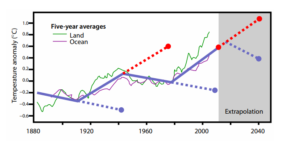
Figure 14: Global surface temperature change since 1880. The dotted blue and dotted red lines illustrate how much error one would have made by extrapolating a multi-decadal cooling or warming trend beyond a typical 25-35 year period. Note the recent 1975-2000 warming trend has not continued, and the global temperature remained relatively constant until 2014.
by M. Shellenberger, President, Env. Progr., May 16, 2018 in WUWT
Over the last year, the media have published story after story after story about the declining price of solar panels and wind turbines.
People who read these stories are understandably left with the impression that the more solar and wind energy we produce, the lower electricity prices will become.
And yet that’s not what’s happening. In fact, it’s the opposite.
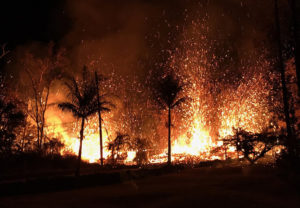
Puna Geothermal Venture has removed 60,000 gallons of flammable Pentane from a geothermal plant in the path of the Hawaii volcanic eruption. But concerns remain that if the geothermal wells break, they could flood the neighbourhood with toxic volcanic gasses.
(…)
Kilauea eastern rift zone fissure eruption May 2018. By United States Geological Survey [Public domain], via Wikimedia Commons
Eurostat estimates that in 2017 carbon dioxide (CO2) emissions from fossil fuel combustion increased by 1.8% in the European Union (EU), compared with the previous year. CO2 emissions are a major contributor to global warming and account for around 80% of all EU greenhouse gas emissions. They are influenced by factors such as climate conditions, economic growth, size of the population, transport and industrial activities.
It should also be noted that imports and exports of energy products have an impact on CO2 emissions in the country where fossil fuels are burned: for example if coal is imported this leads to an increase in emissions, while if electricity is imported, it has no direct effect on emissions in the importing country, as these would be reported in the exporting country where it is produced.
This information on early estimates of CO2 emissions from energy use for 2017 is published by Eurostat, the statistical office of the European Union.
Largest falls in CO2 emissions in Finland and Denmark, highest increases in Malta and Estonia
According to Eurostat estimates, CO2 emissions rose in 2017 in a majority of EU Member States, with the highest increase being recorded in Malta (+12.8%), followed by Estonia (+11.3%), Bulgaria (+8.3%) Spain (+7.4%) andPortugal (+7.3%). Decreases were registered in seven Member States: Finland (-5.9%), Denmark (-5.8%), theUnited Kingdom (-3.2%), Ireland (-2.9%), Belgium (-2.4%), Latvia (-0.7%) and Germany (-0.2%)..
The report (.pdf, 11 pages), by eminent epidemiologist Mikko Paunio, says that international bodies and NGOs are trying to prevent poor countries from expanding their use of conventional fuels, have abandoned the so-called “energy ladder” — the gradual shift to cleaner types of fuel that underpinned the clean up of air quality in industrialised nations.
As Dr Paunio explains, this will have devastating consequences:
“Indoor air pollution from domestic fires kills millions every year. But instead of helping poor people to climb the energy ladder and clean the air in their communities, the poorest people are being given gimmicks like cookstoves, which make little difference to air quality, and solar panels, which are little more than a joke.”
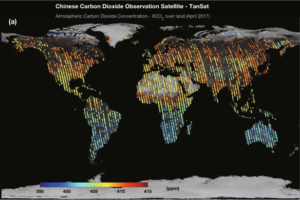
Scientists at the Chinese Academy of Sciences have put together the first global carbon dioxide maps based on data from the Chinese satellite TanSat. The satellite also measures what lead researcher Yang Dongxu calls “carbon dioxide flux,” changes in its behavior on Earth and in the Earth’s atmosphere.
In the May 2000 issue of Reason Magazine, award-winning science correspondent Ronald Bailey wrote an excellent article titled “Earth Day, Then and Now” to provide some historical perspective on the 30th anniversary of Earth Day. In that article, Bailey noted that around the time of the first Earth Day in 1970, and in the years following, there was a “torrent of apocalyptic predictions” and many of those predictions were featured in his Reason article. Well, it’s now the 48th anniversary of Earth Day, and a good time to ask the question again that Bailey asked 18 years ago: How accurate were the predictions made around the time of the first Earth Day in 1970? The answer: “The prophets of doom were not simply wrong, but spectacularly wrong,” according to Bailey.
Here are 18 examples of the spectacularly wrong predictions made around 1970 when the “green holy day” (aka Earth Day) started
The famous Oxford Dodo died after being shot in the back of the head, according to new research. Using revolutionary forensic scanning technology and world-class expertise, researchers have discovered surprising evidence that the Oxford Dodo was shot in the neck and back of the head with a shotgun.
The significant and unexpected findings, made by Professor Paul Smith, director of the Museum of Natural History, and Professor Mark Williams from WMG at the University of Warwick, only became apparent when mysterious particles were found in the specimen during scans carried out to help analyse its anatomy.
COP21 does not define the scientific basis of the agreement for the warming effects of the anthropogenic emissions, but it refers to a scenario. This scenario has not been defined in the COP21, but it can be found. The scientific resource of United Nations as well as of the COP21 is IPCC. The exact specification of IPCC is (Summary for Policymakers. In: Climate Change 2014. Mitigation of Climate Change”): “Baseline scenarios, those without additional mitigation, result in global mean surface temperature increases in 2100 from 3.7 °C to 4.8 °C compared to pre-industrial levels (range based on median climate response; the range is 2.5 °C to 7.8 °C when including climate uncertainty)”. Even though IPCC refers to multiple scenarios in the text above, the surface temperature increase to the average value of 4.25 ⁰C means one scenario only.
Yes, islands are disappearing — most recently the five Solomon Islands lost to rising sea levels. But don’t despair just yet. For every island that goes the way of the dodo bird, the Earth is busy creating new islands.
Some erupt into being through volcanic activity. Others grow from ocean sandbars. Still others reveal themselves after glaciers retreat. A few are only temporary, while some materialize and erode on a regular basis. However they’re birthed and however long they last, island-building is part of the amazing mystery of our living, breathing planet.
Here are 10 of Mother Nature’s newest islands formed in the past two decades (and one still in the embryonic stage).
A recent study published in an esteemed academic journal indicates that volcanic eruptions in the mid 500s resulted in an unusually gloomy and cold period. A joint research project of the Chronology Laboratory of the Finnish Museum of Natural History and Natural Resources Institute Finland (Luke) suggests that the years 536 and 541-544 CE were very difficult for many people.
In a recent New York Times column, Nicholas Kristof misleads us about the awful history of Easter Island (2,300 miles west of Chile), whose vegetation disappeared in the cold drought of the Little Ice Age. In doing so, he blinds modern society to the abrupt, icy climate challenge that lies in our own future.
Kristof repeats the archaeological myth that Easter Island’s natives committed “ecological suicide,” by cutting down all their palm trees. They supposedly used the logs as rollers to move their famous huge statues. Afterward, they could no longer build canoes to catch the fish that were their key protein source. Worse, he says, clearing the trees resulted in so much soil erosion that most of the population starved and/or killed each other in famine-driven desperation (…)
The New York Times recently published an article penned by Erica Goode on the controversial Harvey et al paper, where 14 scientists (sophomorically) attacked polar bear researcher Susan Crockford and climate science skeptics.
Sloppy biased journalism
So it is no surprise that Erica Goode at the New York Times sided up with the 14 scientists of the Harvey publication to attack the so-called climate “denialists” in her most recent article. Unfortunately Goode made the fatal journalistic error of failing to keep a healthy distance from the alarmist side and as a result was blinded from seeing the glaring mountain of scientific research showing polar bears are in fact doing fine.
There are still some kinks to be worked out. The process to generate hydrogen from coal produces a monstrous amount of CO2 – far more CO2 per unit of useful energy than simply burning the coal would produce. But with hydrogen production, unlike hydrocarbon combustion, all the CO2 is produced in one place. This creates an opportunity for carbon sequestration, when technologies to sequester carbon on such an impressive scale are developed.
La géologie, une science plus que passionnante … et diverse