by P. Homewood, April 7, 2018 in NotaLotofPeopleKnowThat
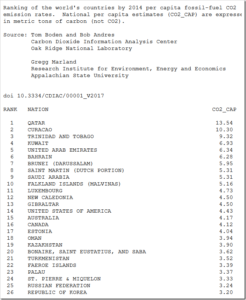
Nick Dekker raised the question of CO2 emissions per capita.
The latest official figures come from the now defunct CDIAC, and are for 2014
(…)
(…)
by P. Homewood, April 7, 2018 in NotaLotofPeopleKnowThat
Nick Dekker raised the question of CO2 emissions per capita.
The latest official figures come from the now defunct CDIAC, and are for 2014
(…)
(…)
by Anthony Watts, April 6, 2018 in WUWT
Huge hole over 400,000 miles long (700,000 kilometers) is 55 times wider than the Earth A wide hole in the sun’s atmosphere is facing Earth and spewing a stream of solar wind toward our planet. Estimated time of arrival: April 9th. In this extreme ultraviolet image from NASA’s Solar Dynamics Observatory, we see not only the […]
by Catherine Philp, April 5, 2018 in TheTimes
Sheikh Mohammed bin Khalifa al-Khalifa said it was not yet known how much of the oil could be extracted. The scale of the find, however, is about to make it a big player in the global market, significantly boosting its economy and raising its profile in the region, where it plays a smaller fiddle to its giant neighbour, Saudi Arabia.
See also here
by Donna Laframboise, April 4, 2018 in ClimateChangeDispatch
SPOTLIGHT: As the influence of religion has waned, we’ve placed science on a pedestal – mistaking it for an oracle of truth.
BIG PICTURE: Richard Harris has written a startling book about the state of medical research. The preface to Rigor Mortis: How Sloppy Science Creates Worthless Cures, Crushes Hope, and Wastes Billions
includes a warning about scientific naivety:
Most of science is built on inference rather than direct observation…Science progresses by testing ideas indirectly, throwing out the ones that seem wrong…Gradually, scientists build stories that do a better job of approximating the truth.
by Anthony Watts, April 3, 2018 in WUWT
Theories about the early days of our planet’s history vary wildly. Some studies have painted the picture of a snowball Earth, when much of its surface was frozen. Other theories have included periods that would be inhospitably hot for most current lifeforms to survive.
New research from the University of Washington suggests a milder youth for our planet. An analysis of temperature through early Earth’s history, published the week of April 2 in the Proceedings of the National Academy of Sciences, supports more moderate average temperatures throughout the billions of years when life slowly emerged on Earth. (…)
by Bjorn Lomborg, April 2, 2018 in ClimateChangeDispatsch
CCD Editor’s Note: In 1920, CO2 levels were 303 PPM or 0.03%. Last year they were 406 PPM or 0.04%. Despite our global population quadrupling, climate deaths have actually gone down as CO2 levels have gone up. Lomborg explains why with the now-standard, often-by-rote “this does not mean that there is no global warming” caveat.
by P. Homewood, April 1, 2018 in NotaLotofPeopleKnowThat
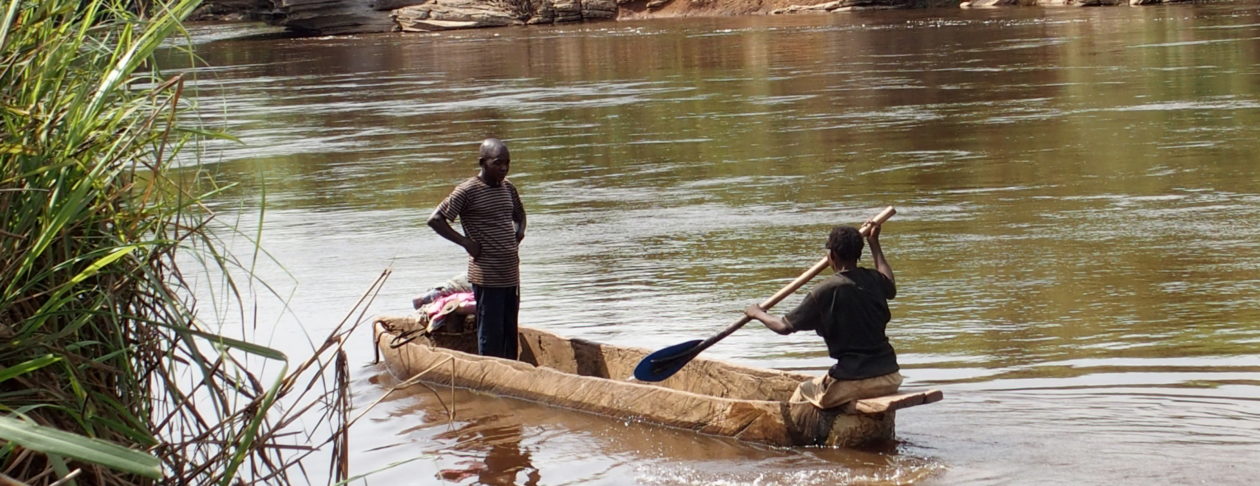
Lake Chad – a source of water to millions of people in West Africa – has shrunk by nine-tenths due to climate change, population growth and irrigation. But can a scheme dating back to the 1980s save it?
“It’s a ridiculous plan and it will never happen.” That’s the reaction many people have to the idea of trying to fill up Lake Chad and restore it to its former ocean-like glory by diverting water from the Congo river system 2,400km (1,500 miles) away.
by Eric Worrall, April 1, 2018 in WUWT
Huffington Post has noticed that many university academics are utter climate hypocrites, that many of them rate their personal importance by how many professional air miles they can accumulate every year (…)
by U. of California – Santa Barbara, March 29, 2018 in SciencedDaily
To borrow from a philosophical thought experiment: If a volcano erupts in a remote part of the world and no one hears it, does it still make a sound?
Indeed, it does. And not only does the sound occur, but it also can tell scientists about the timing and duration of the eruption itself (…)
by D.C. McLaren et al., 2018 in PLOS.ONE
Little is known about the ice age human occupation of the Pacific Coast of Canada. Here we present the results of a targeted investigation of a late Pleistocene shoreline on Calvert Island, British Columbia. Drawing upon existing geomorphic information that sea level in the area was 2–3 m lower than present between 14,000 and 11,000 years ago, we began a systematic search for archaeological remains dating to this time period beneath intertidal beach sediments (…)
by Jo Moreau, 25 mars 2018 in Belgotopia
Suite n° 18. (anno 1800-1849)
“Le contenu de la mémoire est fonction de la vitesse de l’oubli”
Désormais, chaque inondation quelque peu catastrophique, chaque tornade, chaque anomalie météorologique est rattachée au réchauffement climatique qui parait-il nous menace, mais dont en plus l’homme serait responsable !
Pourtant, la consultation de chroniques ou récits anciens est révélatrice de précédents tout aussi apocalyptiques, et relativise la notion même de “changements climatiques”, ainsi que la définition d’un “climat stable” qui n’a jamais existé mais qu’on voudrait instaurer à tout prix.
by Kip Hansen, March 20, 2018 in WUWT
What Exactly is Relative Sea Level (rise or fall)?
Tide stations measure Local (Relative) Sea Level, which refers to the height of the water as measured along the coast relative to a specific point on land
There are three possible combinations of relative sea level rise under current geological conditions (…)
by Jo Moreau, 19 mars, 2018 in Belgotopia
La question est posée dans un excellent article de Pierre Gosselin paru en juin 2017 sur son site incontournable (1).
Personnellement, et je ne suis évidemment pas le seul, je n’accorde aucun crédit aux annonces tonitruantes d’ “année la plus chaude”, de “record de température” dont sont si friands nos médias, et je conserve un scepticisme identique pour la détermination de la température globale moyenne de la planète. En effet, pour qui s’intéresse à l’actualité climatique, les contradictions et manipulations dans les relevés de température terrestre sont monnaie courante, sous prétexte bien souvent d’ajustements et de mise à niveau, que ce soit pour les relevés actuels ou “l’actualisation” de données anciennes…
“L’avenir est connu, il suffit de modifier le passé“.(…)
by Willis Eschenbach, March 16, 2018 in WUWT
Finally, we have the IPCC Likelihood Scale:
Virtually certain – “All my cool scientist friends agree”.
Very likely – “We really hope this is true”.
Likely – “Two climate models out of three agree”.
About as likely as not – “Nobody has a clue”.
Unlikely – “This outcome offends us”.
Very unlikely – “We really don’t want you going down that path”.
Exceptionally unlikely – “Stephen McIntyre said it first so it can’t possibly be true.”
by Ohio State University, March 13, 2018 in ScienceDaily
Scientists have revised an estimate of snow volume for the entire continent, and they’ve discovered that snow accumulation in a typical year is 50 percent higher than previously thought. Researchersplace the yearly estimate at about 1,200 cubic miles of snow. If spread evenly across the surface of the continent from Canada to Mexico, the snow would measure a little over 7.5 inches deep.
In the journal Geophysical Research Letters, researchers at The Ohio State University place the yearly estimate at about 1,200 cubic miles of snow accumulation. If spread evenly across the surface of the continent from Canada to Mexico, the snow would measure a little over 7.5 inches deep. If confined to Ohio, it would bury the state under 150 feet of snow.
by P. Hockenos, November 13, 2017 in FPNews
Yet Germany’s image as selfless defender of the climate, which was once largely deserved, is now a transparent fiction. Germany has fallen badly behind on its pledges to sink its own greenhouse gas pollutants. In fact, Germany’s carbon emissions haven’t declined for nearly a decade and the German Environment Agency calculated that Germany emitted 906 million tons of CO2 in 2016 — the highest in Europe — compared to 902 million in 2015. And 2017’s interim numbers suggest emissions are going to tick up again this year.
by P. Moore, March 13, 2018 in A. Watts, WUWT
Patrick Moore is a Canadian activist, and former president of Greenpeace Canada. Since leaving Greenpeace, which he helped to found, Moore has criticized the environmental movement for what he sees as scare tactics and disinformation, saying that the environmental movement “abandoned science and logic in favor of emotion and sensationalism.” He has sharply and publicly differed with many policies of major environmental groups, including Greenpeace itself on other issues including forestry, biotechnology, aquaculture, and the use of chemicals for many applications. (…)
by B. Friedlander, January 25, 2018 in CornellChronicle
“Plastics make ideal vessels for colonizing microscopic organisms that could trigger disease if they come into contact with corals,” Lamb said. “Plastic items – commonly made of polypropylene, such as bottle caps and toothbrushes – have been shown to become heavily inhabited by bacteria. This is associated with the globally devastating group of coral diseases known as white syndromes.”
When plastic debris meets coral, the authors say, the likelihood of disease increases from 4 to 89 percent – a 20-fold change. The scientists estimate that about 11.1 billion plastic items are entangled on reefs across the Asia-Pacific region, and that this will likely increase 40 percent over the next seven years.
by Jo Moreau, 9 mars 2018, in Belgotopia
Complémentairement à l’article de Donna Laframboise, il semblerait que les différents groupes de travail du GIEC n’aient pas la même définition d’un conflit d’intérêt. On peut identifier deux formes principales de conflit d’intérêt : soit l’utilisation d’une étude rédigée par un auteur ou coauteur du GIEC, ce qui revient à publier des études qu’on utilisera ensuite dans une auto-justification, (voir aussi à ce sujet un billet précédent : http://belgotopia.blogs.lalibre.be/archive/2013/01/03/methodes-interpellantes-au-sein-du-giec.html ), soit la présence en ses rangs d’un salarié de l’industrie ou d’un membre ou d’un proche d’une ONG militant dans le domaine idéologico-politique.
On se rappelle que des contributeurs du GIEC, salariés de l’industrie chimique, avaient été accusés par diverses sources de conflit d’intérêt en 2016, que dire alors de membres ou proches d’ONG militantes, qui semblent de plus en plus se substituer aux organes démocratiques dans la direction de nos sociétés…
by Douglas Fox, February 16, 2018 in NationalGeographic
Scientists have peered into one of the least-explored swaths of ocean on Earth, a vast region located off the coast of West Antarctica. It is locked beneath a crust of ice larger than Spain and more than 1,000 feet thick, making its waters perpetually dark—and extremely difficult for humans to access. Now, a team of researchers has bored a hole through the ice and sampled the ocean beneath it. Their work could shed light on a poorly understood, but ominous episode in Antarctica’s recent past… (…)
by P. Gosselin, March 9, 2018 in NoTricksZone
Schellnhuber is often worshipped by the fringe-element climate alarmists as a sort of Climate Pope, whose every uttered word is to be regarded as infallible. Now he may be paying the price for his entrenched, radical positions on climate change.
“We now seriously need a Schellnhuber timeout. […] We do hope the new PIK leadership will correct the extreme direction the institute is currently on and rapidly puts an end to the flow of climate-alarmist press releases.“
by A. Watts, March 8, 2018 in WUWT
From the “Snowfalls are now just a thing of the past” by climate scientist Dr. David Vinerdepartment comes this news from NOAA/NWS:
With 156 inches between December 2017 and February 2018, Erie, Pennsylvania, set a new record for most winter snowfall (…)
by M. Bastach, March 3, 2018 in DailyCaller
A group of prominent scientists are calling for a global network of advanced weather stations that don’t need to go through controversial data adjustments, and it’s vindication for global warming skeptics.
Seventeen climate scientists co-authored a research article published in the International Journal of Climatology calling for a global climate station network modeled after the United States Climate Reference Network (USCRN) to use as a baseline for data quality.
by Dartmouth College, March 1, 2018 in ScienceDaily
In Africa, food abundance may be driving violent conflict rather than food scarcity, according to a new study. The study refutes the notion that climate change will increase the frequency of civil war in Africa as a result of food scarcity triggered by rising temperatures and drought.
by Wildlife Conservation Society, February 26, 2018 in ScienceDaily
With over 80 percent of forests already degraded by human and industrial activities, today’s findings underscore the immediate need for international policies to secure remaining intact forests — including establishing new protected areas, securing the land rights of indigenous peoples, regulating industry and hunting, and targeting restoration efforts and public finance. Absent specific strategies like these, current global targets addressing climate change, poverty, and biodiversity may fall short, including the United Nations’ Sustainable Development Goals to sustainably manage forests, combat desertification, halt and reverse land degradation and halt biodiversity loss.