Archives par mot-clé : 2025

2025 Hurricane Forecast Was Overly Alarmist (Again)…Atlantic Season Ending Near Normal

by P. Gosselin, Nov 08, 2025 in NoTricksZone


The US National Oceanic and Atmospheric Administration (NOAA) predicted that an above average Atlantic huricane seacon for 2025.

Now that the season is winding down, we are able to start concluding and summarizing the season: it’s going to come in as near normal activity. The forecast made earlier this year was a bit on the hyped side.

Huricane season forecasts have not really improved, despite all the claims that models are better than ever:

“In my 30 years at the National Weather Service, we’ve never had more advanced models and warning systems in place to monitor the weather,” said NOAA’s National Weather Service Director Ken Graham. “This outlook is a call to action: be prepared. Take proactive steps now to make a plan and gather supplies to ensure you’re ready before a storm threatens.”

NOAA’s outlook for the 2025 Atlantic hurricane season, which goes from June 1 to November 30, predicted a 60% chance of an above-normal season, and a 10% chance of a below-normal season. The agency forecast a range of 13 to 19 total named storms (winds of 39 mph or higher). Of those, 6-10 were forecast to become hurricanes (winds of 74 mph or higher), including 3-5 major hurricanes (category 3, 4 or 5; with winds of 111 mph or higher).

Near average season

Jan. 2025 Climate Fact Check: NASA Data Shreds ‘Hottest January Ever’ Claim

by S. Millay, Feb 13, 2025 in ClimateChangeDispatch


This summary serves as a fact check on the most egregious false claim about climate change made in the media in January 2025. [emphasis, links added]

Counter-Narrative Reality vs. Counter-Reality Narrative

It was a busy January keeping track of President Trump’s first steps toward dismantling the federal government’s Climate Leviathan. It was also a very cold January and that’s what this edition of Climate Fact Check will cover.

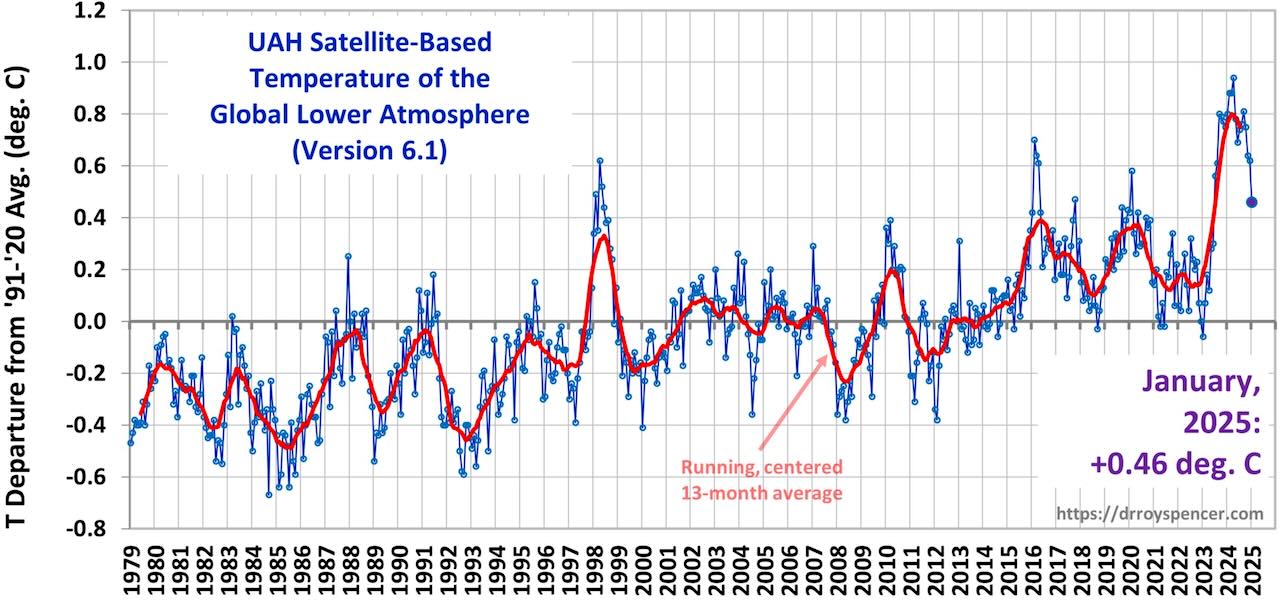
Per the relatively unmanipulated NASA satellite data, January 2025 is estimated to have witnessed a substantial drop of 0.34°C from last January concerning the made-up metric of “average global temperature.”

This is despite that atmospheric carbon dioxide increased from about 422 parts per million (ppm) in January 2024 to 426 parts per million in January 2025.

That 4 ppm increase in carbon dioxide is worth about 78 billion tons of emissions. Therefore, 78 billion more tons of carbon dioxide in the atmosphere resulted in a January that was 0.34°C cooler than the previous January.

February is typically the coldest average month in the Northern Hemisphere. January 2025 was cooler than February 2016 and about the same as January 2016 and February 1998, hundreds of billions of tons of CO2 and a decade of “warming,” ago.

Faced with the counter-narrative reality of the NASA satellite data, the desperate climate hoax machine produced a counter-reality narrative, claiming that January was the hottest ever as in this Associated Press report.

Hottest January? Latest BBC Lies!

by P. Homewood, Feb 6, 2025 in NotaLotofPeopleKnowThat


Last month was the world’s warmest January on record raising further questions about the pace of climate change, scientists say.

January 2025 had been expected to be slightly cooler than January 2024 because of a shift away from a natural weather pattern in the Pacific known as El Niño.

But instead, last month broke the January 2024 record by nearly 0.1C, according to the European Copernicus climate service.

https://www.bbc.co.uk/news/articles/cwyjk92w9k1o

The reality is somewhat different, as satellites show that global temperatures have been in freefall in recent months. Since September 2024, they have fallen by a full half a degree celsius.

Last month was not even the hottest January, as January 2024 was 0.4C hotter


https://www.drroyspencer.com/latest-global-temperatures/

Scientists have now said that much of the recent spike in temperatures has been caused by reduced sulfate emissions from shipping, thanks to new clean air regulations.

Wildfires

The BBC lead their article with a photo of the LA wildfires. The impression, which they clearly want to create, is that these fires are connected to global temperatures.

It proves that their whole article cannot be taken seriously.