The DOE climate report: a scientific milestone that Europe does not want to see

by Clintel Foundation, Aug 13, 2025


In July, the U.S. Department of Energy (DOE) published a groundbreaking document: A Critical Review of Impacts of Greenhouse Gas Emissions on the U.S. Climate. At the request of Energy Secretary Chris Wright, five leading scientists provided a clear and well-founded overview of climate science, finally paying explicit attention to uncertainties, alternative insights, and factual observations. The authors are not bloggers or activists, but internationally recognized researchers with decades of expertise in climate science, meteorology, economics, and physics. [See the box at the bottom of this article for their credentials].

Sober, well-founded, and without alarmism

Energy Secretary Chris Wright gave the researchers complete freedom in writing this report: “I exerted no control over their conclusions.” The report stands out for its clarity, objectivity, and scientific integrity.

Some key points of the report are:

  • CO₂ should no longer be seen as ‘pollution’: the report advocates a scientific review of this US position (since 2009), including recognition of the positive effect of CO₂ on crop growth.
  • Global greening: satellite images show greening of the Earth due to higher CO₂ levels.
  • Models vs. observations: the discrepancies between model results and actual observations are shown. There is also more emphasis on natural climate variability.
  • Weather extremes: there is no alarming increase in extreme weather conditions in the US.
  • Economic consequences: interventions on CO₂ emissions have little climate impact in the short term, but can entail high economic costs.

Reactions from Europe

The report has certainly been noticed within the US. Among others, researcher Roger Pielke Jr. devoted a widely read article to it on his Substack channels. Pielke describes the DOE report as a serious scientific text that has carefully processed sources.

This report should also have shaken Europe awake, but what happened? Complete silence. No news bulletins, no parliamentary questions, no editorial commentary. While alarmist reports are spreading like wildfire across Europe, this report is being ignored. This is not only remarkable, it is downright shocking. It casts a shadow over the intellectual honesty of the European climate debate.

Two articles on the Dutch blog Klimaatgek.nl endorse this. On August 8, DoE report and media silence (in the Netherlands) was published, noting that the report was widely discussed in US circles, but remained unseen in the Netherlands, despite its importance for the automotive, energy, and agricultural sectors, among others. Earlier, on July 30, Klimaatgek headlined: Breakthrough: revision of CO₂ vision in the US. The report is called a potential turning point in the American climate vision, something that Europe cannot ignore.

Why this is so essential for Europe

Europe is guided by a single narrative: the climate crisis is urgent and catastrophic. Those who think differently are ignored or denounced. This report does the opposite: it acknowledges human influence, puts it in context, highlights uncertainties, identifies the benefits of CO2, and advocates for balanced policy considerations. As mentioned, the European silence is distressing. It is not only journalistically inappropriate; it is a democratic and scientific shortcoming. The consequences are:

  • A limited public debate – the public only hears one side.
  • Democratic deficit – policy-making based on incomplete information.
  • Scientific impoverishment – essential uncertainties and alternatives disappear from view.

Time to wake up

The DOE report deserves open debate, not silence. Europe should be proud of space for scientific diversity. Anyone who truly trusts science cannot ignore this report. Clintel remains committed to increasing the visibility of this and similar contributions – not to prove itself right, but to make the conversation complete. Only with all the facts, uncertainties, and perspectives can sensible choices be made.

The Weather Stations We Never Had

by Dr M. Wielicki, Aug 11, 2025 in Clintel


A central pillar of the climate-crisis narrative is simple enough to fit on a bumper sticker… today is the hottest in human history. That line only works if you accept, without question, that we have reliable, global temperature data before satellites. We do not. What we have is a patchwork of land stations concentrated in a few developed regions, a lot of ocean guesses from ship tracks, and then, later, generous statistical infilling.

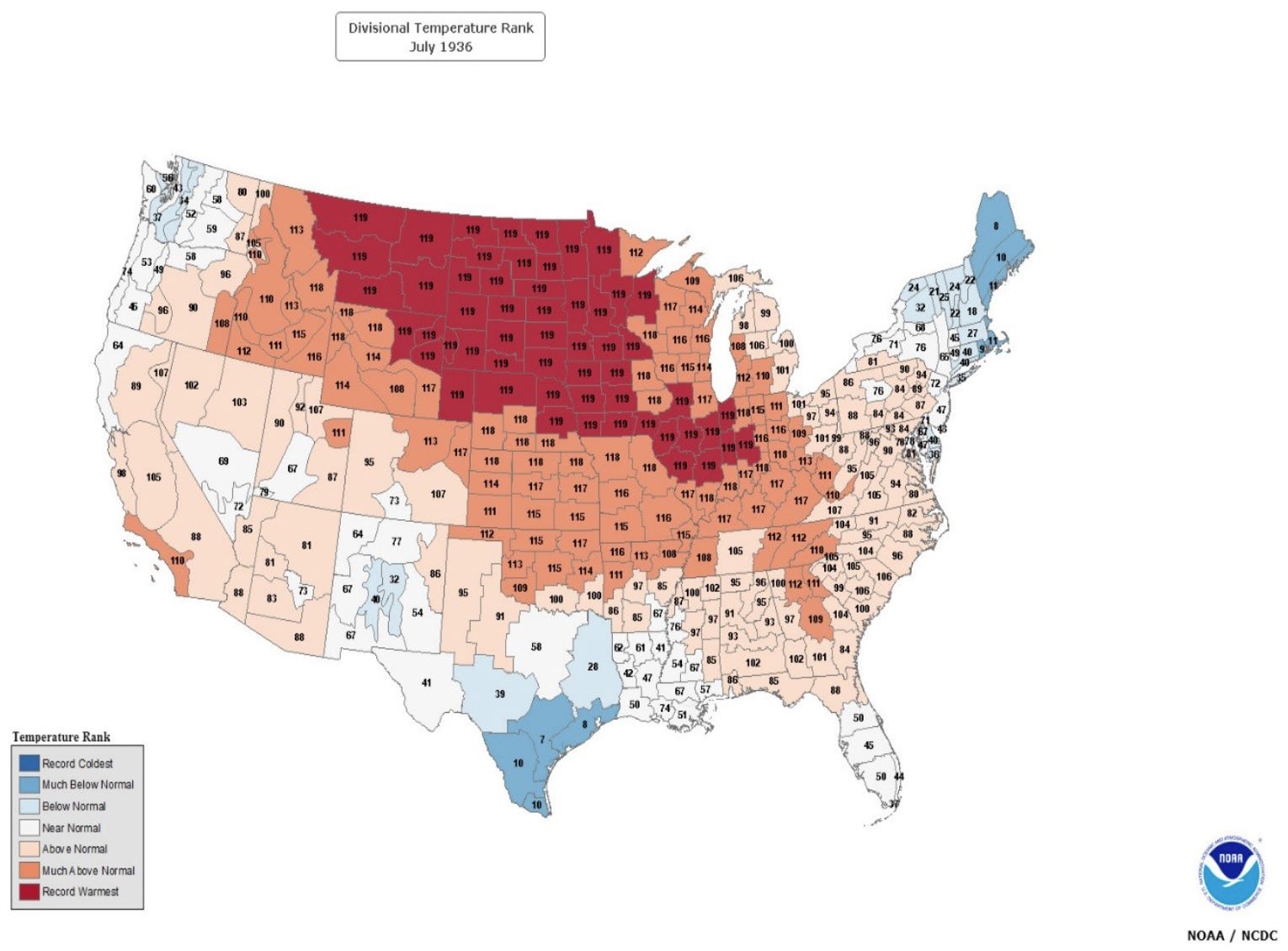
Everyone agrees the 1930s were brutally hot across the United States… the Dust Bowl was a humanitarian and ecological disaster. Crops failed, soils blew away, and heat waves killed thousands. NOAA’s own retrospectives still call out 1936 as a benchmark summer, and July 1936 remains a singular month in the U.S. record.

https://www.weather.gov/arx/heat_jul36?utm

The global map we never measured

Before 1950, most thermometers were in the United States, Europe, and parts of the British Commonwealth. Large parts of Africa, South America, the Arctic, and the Southern Ocean had little to no routine coverage. Even the NOAA-led overview of GHCN-Daily notes how the core database is a collage of many sources with varying periods of record… that is the raw material modern analyses inherit.

Now the uncomfortable part. When there are no thermometers, you either leave grid boxes blank, or you paint numbers in from far away. HadCRUT historically left many boxes blank, explicitly avoiding interpolation, which means the “global” mean depends on where you have observations. NASA’s GISTEMP goes the other direction and spreads anomalies up to twelve hundred kilometers from a station, filling the gaps with 1200 km smoothing. Those are not trivial choices, they are the ballgame.

If you overlay the 1930s anomaly map with the station density maps, you see something obvious… warm where the thermometers were numerous, cool or neutral where coverage was threadbare. A compilation of historical station distribution between 1921 and 1950 makes the same basic point… the network was sparse and badly unbalanced.

Meteorologist Debunks False Stories On Climate Change Fueling Western Washington Megafires

by C. Mass, Aug 14, 2025 in ClimateChangeDispatch 


NY Times and Seattle Times falsely claim Western Washington megafires are rising; history shows only one since 1902.

Western Washington State fire
[Last week], The New York Times ran a blatantly false story, with The Seattle Times featuring it as well.
 [some emphasis, links added]

The claim: that Western Washington will experience more “megafires” due to human-caused global warming (climate change).

Unfortunately, the writer of this story (a Washington State stringer for the NY Times) failed to examine the historical record or the best science, getting the essential facts wrong.

How do I know the writer got it wrong?

Because for the past two years, I have researched this very issue and just published a paper on this topic in the peer-reviewed literature (here). I have read every paper and report on this issue.

So exactly what did the NY Times (and the Seattle Times) get wrong?

The article defines megafires as ones that involve hundreds of thousands of acres.

How many such fires have occurred since 1900 in western Washington?

Die Welt’ Journalist Axel Bojanowski: Apocalypticism Is “A Code Of Belonging” Among Journalists

by P. Gosselin, Aug 13, 2025 in NoTricksZone 


The world is better than what the media think.

‘Die Welt’ science journalist Axel Bojanowski was recently interviewed by the online “BauerWilli” (BW) and discussed his recently released book

33 Amazing Glimmers of Hope – Why the world is better than we think,”


Bojanowski argues there is an overly negative and apocalyptic style of reporting in the media, particularly concerning climate and environmental issues.

Cult-like behavior

According to Bojanowski, predicting the end of the world has become a sign of belonging among journalists. He sees this as a counter-movement to the post-war prosperity.

Scientists Warn About Scientists’ Warnings

by W. Eschenbach, Aug 19 2025, in WUWT


Only a journalist truly committed to the ancient art of panic-clickbait could squeeze all the world’s existential dread into a headline like, “A Giant, Destructive Volcanic Eruption Is Set to Shake the World in the Coming Months, Bringing About the End of Mankind, Scientists Warn.” They’ve accompanied it with the following graphic, in case you weren’t adequately terrified.

The dead giveaway? “Scientists Warn.” Whenever you see those two words sandwiched together above the fold, you know you’re about to step into a wonderland of wild extrapolation, qualified maybes, and models run so far into the future they boomerang back with “robots take over” as the y-axis.

They start out as follows:

Study: Corals Thrived 6,000–10,000 Years Ago Amid Much Higher Seas And Warmer Temps

by K. Richard, Aug 19, 2025 in ClimateChangeDispatch 


coral reef
New research from Indonesia indicates that from about 6,000 to 10,000 years ago, when the ocean was warmer than today, coral reef growth was rapid, averaging ~6 mm per year. [emphasis, links added]

Sea levels rose rapidly from the Early to Mid-Holocene in this region, as they were up to two meters higher than today 6,000 years ago. The higher sea levels meant there was more room for coral reef growth.

As the ocean cooled and sea levels fell ~2 meters from the Mid-Holocene highstand, coral growth slowed to ~2-3 mm per year.

Today, corals are only growing at rates of ~1 mm per year, as the water depths are too low to accommodate reef expansion.

In fact, coral coverage “has declined on the flats over the last few decades,” as the “accommodation space is less than a meter at points.”

Research from the Great Barrier Reef region (e.g., Leonard et al., 2020) also indicates coral growth experienced “turn-off” periods during cold centuries (such as the Little Ice Age) with falling sea levels.

When the ocean was “~1-2°C warmer than present” and sea levels were “~1.0 meter higher than present,” this “allowed reefs to accrete uninhibited.”