
Charted: Global Crude Oil Trade Flows in 2024

by D. Neufeld, Aug 20, 2025 in VisualCapitalist
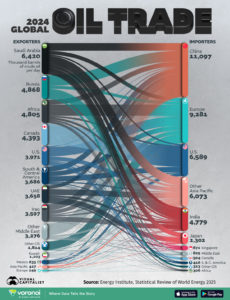

Global Crude Oil Trade Flows in 2024

This was originally posted on our Voronoi app. Download the app for free on iOS or Android and discover incredible data-driven charts from a variety of trusted sources.

Key Takeaways

  • China imported 11.1 million barrels of crude oil per day in 2024, with Russia standing as its largest supplier of oil.
  • Meanwhile, the U.S. imported 6.6 million barrels per day (mb/d), with Canada accounting for 62% of the total.

In 2024, global oil trade patterns continued to evolve, shaped by geopolitics and changing regional demand.

From Asia to the Middle East and the Americas, oil remains a cornerstone of the global economy. The vast scale of daily trade underscores not only the world’s reliance on energy but also intricate, global alliances.

This infographic shows the largest crude oil importers and exporters by daily volume, based on data from the Energy Institute.

China Leads in Global Oil Imports

Below, we show daily oil import and export volumes for major global players:

“Wake-Up Call” For Europe… German Professor, Fritz Vahrenholt, On U.S. Climate Report

by F. Vahrenholt, Aug 20, 2025 in NoTricksZone


A recent report from the U.S. Department of Energy, commissioned by the Trump administration and authored by five scientists, is making waves.

German energy expert Prof. Fritz Vahrenholt has weighed in, suggesting its findings could be a crucial “wake-up call” for Europe, especially Germany, to rethink its current climate policies.

The report, titled “A Critical Review on Impacts of Greenhouse Gas Emissions on the US Climate” challenges a core assumption of mainstream climate science. It argues that the negative impacts of CO2 have been exaggerated, while its benefits are often overlooked.

According to Vahrenholt, the report highlights that CO2 isn’t just a pollutant; it’s essential for life and photosynthesis. It’s a key ingredient for a “greener earth” and has contributed to a reported 15% increase in global crop yields for staples like rice and wheat. This perspective directly contradicts the idea of CO2 as solely a harmful substance.

Another major point raised by Vahrenholt is the report’s finding that climate models “run too hot.”

The report suggests these models primarily focus on CO2 as the sole driver of warming, neglecting other significant natural factors. Vahrenholt points to measurements that show a substantial portion of recent warming can be attributed to cloud thinning and increased solar radiation, a topic he and Nobel laureate John Clauser have researched.

The Battery Storage Delusion.. what 35 million tons of industrial effort buys you

by Dr L. Schernikau, Aug 21, 2025 in WUWT


Details inc Blog at www.unpopular-truth.com

As someone who has spent most my professional life in the global energy and commodities space both as an economist and as a trader, I have grown increasingly concerned about the way grid-scale battery storage is portrayed in public discourse. If you have paid any attention to the headlines, you would have heard that battery technology is “on the verge of solving” the intermittency problem of wind and solar energy. According to this narrative, all we need to do is build more battery storage, and the path to “net zero” will unfold automatically… magically.

If only it were that simple…

In my latest blog post Pros and Cons of Utility-Scale Battery Storage I unpack the many assumptions behind this belief. The facts I present may be unpopular, but they are grounded in physics, not politics.

Here a couple of key points that I feel might spark some interest.

35 million tons of raw materials for a couple of hours…

To build a 50 GWh utility-scale lithium-ion battery system (approx. annual output of a Gigafactory), which has the ability to store electricity, for a city like New York, for only a few hours, you need ~ 35 million tons of raw materials (~ 700,000 t per GWh). That roughly covers the mining, upgrading, transport, and processing of ores like lithium, cobalt, nickel, graphite, iron ore, bauxite, and others.

Think about it like this…a 1-ton utility-scale battery has a storage capacity of around 100 kWh and requires ~ 70 tons of mined, processed, and manufactured raw materials to be manufactured. This is the energy equivalent of about ~40 kg of coal or ~20 litres of oil.

Let that sink in: 70 tons of mining and industrial processing to store what coal already provides in a (40kg) bag, small enough to be carried by hand.

Media Championed Study Overstating Climate Damages, Went Radio Silent As Major Flaws Emerged

by K. Killough, Aug 20, 2025 in ClimateChangeDispatch


Typhoon flooding aftermath
When a study published last year in the peer-reviewed journal Nature found that climate change would cost the globe $38 trillion per year by 2050 — ultimately reducing GDP by 19% over the next 24 years — many media outlets were quick to jump on it. [emphasis, links added]

“Climate change will make you poorer,” CNN warned. The Guardian reported on the study under the headline, “Climate crisis: average world incomes to diminish by nearly a fifth by 2050.”

Reuters and Forbes also carried articles on the study, and the Associated Press reported that “New study calculates climate change’s economic bite will hit about $38 trillion a year by 2049.”

According to the activist publication Carbon Brief, only one other study received more mentions in the media in 2024.

However, the study — referred to as “the Potsdam study” — has since been found to have serious flaws.

When these are corrected, according to the researchers who uncovered the problems, it reduces the study’s estimate of climate “damages” through 2100 by two-thirds. This means the estimates aren’t statistically different from zero.

The study has been cited by organizations influencing policy across the globe, including the World Bank, the Organization for Economic Co-operation and Development, and the U.S. Congressional Budget Office. Sen. Sheldon Whitehouse, D-R.I., cited the study last yearand again in July — both times entering the study into the Congressional Record.

While The Washington Post reported on the errors, none of the other outlets have so far revisited the story.

Flaws called “devastating” to the paper’s conclusions