
Two of Greece’s most dangerous volcanoes share an underground link

by C. Graling, Sept 24, 2025 in ScienceNews


A January earthquake swarm exposed shared plumbing between Santorini and Kolumbo.


An intense swarm of earthquakes around Greece’s Santorini Island in January has revealed a fiery underground link between two neighboring and historically explosive volcanoes.

Analyses of seismic activity from June 2024 through February 2025, along with changes in the island’s surface elevation, suggest that the same well of magma feeding the Santorini volcano may also supply the submerged Kolumbo volcano, just seven kilometers away, researchers report September 24 in Nature.

Complex, shared magma plumbing systems can complicate the interpretation of earthquakes and signs of imminent eruptions, say Marius Isken, a geophysicist at the GFZ Helmholtz Centre for Geosciences in Potsdam, Germany, and colleagues. This study, they say, highlights the need for real-time, high-resolution monitoring to improve volcano warnings.

Santorini is known for a catastrophic volcanic eruption around 1560 B.C. that contributed to the end of the Minoan civilization and caused widespread devastation, including earthquakes, tsunamis and possibly a volcanic winter. Kolumbo is no slouch either, erupting most recently in A.D. 1650.

When a swarm of over 1,200 earthquakes rattled the region early this year, Greece declared a state of emergency, fearing an imminent eruption. Although no eruption ensued, the abundant quakes allowed Isken and colleagues to examine the subsurface and better understand how and where magma moved.

New Study: Modern Warmth Is Merely Part Of A Natural Cycle

by K. Richard, Sep 22, 2025 in NoTricksZone 


Throughout the last 10,000 years there have globally been much warmer and more extensive iceless periods than observed in the modern era.

“There is reliable geological evidence that the temperature of most warming phases in the Holocene were globally higher or similar to that of the current warming period, Arctic sea ice was less extensive, and most mountain glaciers in the northern hemisphere either disappeared or were smaller.”

Cold periods – like warm periods – are driven by natural solar forcing mechanisms. The last of which was manifested in the 19th century.

“A solar forcing mechanism has steered Holocene climate change, expressed by 9 cooling phases known as Bond events.”

The recent warming is part of a natural cycle, not a consequence of human activity.

“The modern warming is part of a climatic cycle with a progressive warming after the Little Ice Age, the last cold episode of which occurred at the beginning of the 19th century.”

There is thus nothing unprecedented or even unusual about the modern climate state. Any claims to the contrary are “not supported by the geological data.”


Ses Marks, 2025

“But you said the ice was going to disappear in 10 years!”

by Gavin, Sep é&, 2025 in RealClimate


Almost two decades ago, some scientists predicted that Arctic summer sea ice would ‘soon’ disappear. These predictions were mentioned by Al Gore and got a lot of press. However, they did not gain wide acceptance in the scientific community, and were swiftly disproven. Unsurprisingly, this still comes up a lot. Time for a deeper dive into what happened and why…

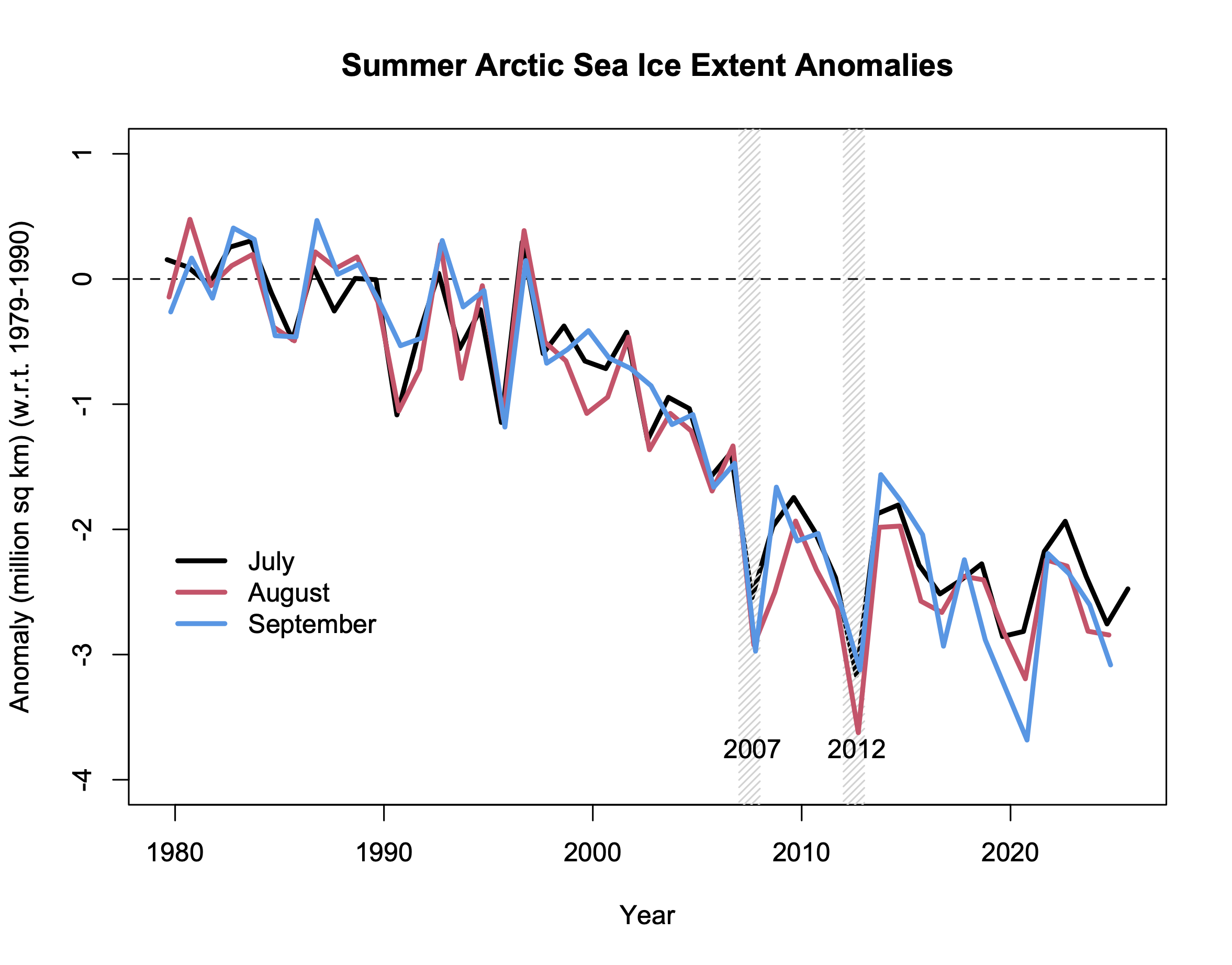
It is unsurprising that climate contrarians bring up past ‘failed predictions’ to bolster their case that nothing need be done about climate change. [It is equally unsurprising that they don’t bother to mention the predictions that were skillful, but let’s not dwell on that!]. For a long time, their favorite supposed ‘failed prediction’ was that there was a consensus about the imminence of a new ice age in the 1970s (a topic we have covered many times), but more recently it has turned to the supposed prediction of Al Gore that “Arctic summer sea ice would disappear” in a short number of years. This has everything – the ‘But Al Gore!’ knee-jerk, a conflation of Al Gore with the scientific community, it’s sounds suitably apocalyptic and, of course, Arctic summer sea ice has not disappeared (it’s only down 40% or so):

Arctic summer sea ice extent anomalies from NSIDC, with the exceptional years of 2007 and 2012 highlighted (data through July 2025).

What did Al Gore actually say?

If we go back to Dec 2007, in the immediate aftermath of the shocking decrease in sea ice that summer, Gore gave his acceptance speech for the Nobel Peace Prize he’d received jointly with the IPCC. In it he said:

Last September 21, as the Northern Hemisphere tilted away from the sun, scientists reported with unprecedented distress that the North Polar ice cap is “falling off a cliff.” One study estimated that it could be completely gone during summer in less than 22 years. Another new study, to be presented by U.S. Navy researchers later this week, warns it could happen in as little as 7 years.

What was he reporting on?

Earthquakes release blistering heat that can melt rock in an instant

by Massachusetts Institute of Technology, Sep 19 in ScienceDaily


Based on mini “lab-quakes” in a controlled setting, MIT findings could help researchers assess the vulnerability of quake-prone regions.
MIT scientists have unraveled the hidden energy balance of earthquakes by recreating them in the lab. Their findings show that while only a sliver of energy goes into the shaking we feel on the surface, the overwhelming majority is released as heat—sometimes hot enough to melt surrounding rock in an instant

The ground-shaking that an earthquake generates is only a fraction of the total energy that a quake releases. A quake can also generate a flash of heat, along with a domino-like fracturing of underground rocks. But exactly how much energy goes into each of these three processes is exceedingly difficult, if not impossible, to measure in the field.

Now MIT geologists have traced the energy that is released by “lab quakes” — miniature analogs of natural earthquakes that are carefully triggered in a controlled laboratory setting. For the first time, they have quantified the complete energy budget of such quakes, in terms of the fraction of energy that goes into heat, shaking, and fracturing.

Europe: AI Development or Net Zero?

by  S. Goreham, Sep 18, 2025 in CornwallAlliance


This year, European nations announced plans to pursue artificial intelligence. National leaders announced AI spending goals totaling hundreds of billions of euros in efforts to catch up to the United States. But AI requires huge amounts of electrical power, conflicting with Europe’s commitment to achieve a Net Zero power grid.

Since ChatGPT released their AI chatbot in November of 2022, artificial intelligence has exploded. In only two years, the AI revolution became the driving force in the US high-tech industry. Amazon, Google, Meta, Microsoft, and other firms will spend over $100 billion this year building and upgrading data centers to run AI. Nvidia, the dominant supplier of AI graphics processor units (GPUs), became the most valuable company in the world, its market capitalization soaring from $300 billion to $4.3 trillion in less than three years.

Artificial intelligence requires vast amounts of electricity. AI processors run 24 hours a day, enabling computers to think like humans. When servers are upgraded to support AI, they consume 6 to 10 times more power than when used for cloud storage and the internet. Data centers consumed 4% of US power at the start of 2024 but are projected to consume 20% within the next decade.

The need for new generating capacity for AI now drives US electricity markets. Coal-fired power plant closures have been postponed in Georgia, Indiana, Illinois, Tennessee, Utah, West Virginia, and other states. Nuclear plants are restarting in Iowa, Michigan, and Pennsylvania. Dozens of small modular reactors are on the drawing board. More than 200 gas-fired plants are in planning or under construction, including more than 100 in Texas. Companies building AI data centers are constructing their own on-site power plants, unwilling to wait for grid power. The pursuit of artificial intelligence is rapidly replacing obsolete US Net Zero policies.

Lomborg: Environmental Doomsday Predictions Collapse As World Becomes Richer And Greener

by B. Lomborg, Sep 16, 2025 in ClimateChangeDispatch 


Fearmongering climate change forecasts keep falling apart.

Climate protest
Over the past half-century, environmentalists have predicted countless calamities. Their extreme predictions were typically wrong, their draconian countermeasures turned out to be mostly misguided, and we should be grateful we didn’t follow their harmful advice. [emphasis, links added]

We need to keep this history in mind as we are inundated with stories of climate Armageddon.

This summer, headlines about the Great Barrier Reef painted a dire picture of climate-driven devastation, with environmental journalists claiming the reef was on the brink of collapse.

In reality, data shows the reef has its fourth-highest coral cover since records began in 1986, revealing these alarmist narratives to be vastly misleading.

Truth and Scares

Sensible, life-improving environmental policies over recent decades were rarely sold with fearmongering. Rich countries have dramatically reduced air and water pollution through technological advances and then through regulation.

Poorer countries are starting to do the same thing, as they emerge from poverty and can afford to be more environmentally concerned. Forests have expanded globally, with this growth clear in rich countries and increasingly across the world.

This isn’t the scary future environmentalists promised us.

A recent peer-reviewed study counts almost a hundred environmental doomsday predictions that environmentalists have made over the past half-century.

Two-thirds of them predicted doom before August 2025, and all of these have turned out to be false.

Koonin: DOE Climate Report Finally Brings Clarity, Challenges Alarmist Narrative

by S.E. Koonin, Sept 09, 2025 in ClimateChangeDispatch 


Empirical data shows CO2 boosts growth, extreme weather events are overblown, and policy costs outweigh any benefits.

Protest on a dead planet
A recent Energy Department report challenged the widespread belief that greenhouse-gas emissions pose a serious threat to the nation. It likely soothed Americans irked by forced energy transitions, but you would be wrong to assume it reassured many alarmed by hypothetical climate catastrophes. [emphasis, links added]

There is a disconnect between public perceptions of climate change and climate science—and between past government reports and the science itself.

Energy Secretary Chris Wright understands this. It’s why he commissioned an independent assessment by a team of five senior scientists, including me, to provide clearer insights into what’s known and not about the changing climate.

Collectively, our team brought to the task more than 200 years of research experience, almost all directly relevant to climate studies.

The resulting peer-reviewed report is entirely our work, free from political influence—a departure from previous assessments.

It draws from United Nations and U.S. climate reports, peer-reviewed research, and primary observations to focus on important aspects of climate science that have been misrepresented to nonexperts.

Among the report’s key findings:

■ Elevated carbon dioxide levels enhance plant growth, contributing to global greening and increased agricultural productivity.

■ Complex climate models provide limited guidance on the climate’s response to rising carbon dioxide levels. Overly sensitive models, often using extreme scenarios, have exaggerated future warming projections and consequences.

■ Data aggregated over the continental U.S. show no significant long-term trends in most extreme weather events. Claims of more frequent or intense hurricanes, tornadoes, floods, and dryness in America aren’t supported by historical records.

■ While global sea levels have risen about eight inches since 1900, aggregate U.S. tide-gauge data don’t show the long-term acceleration expected from a warming globe.

■ Natural climate variability, data limitations, and model deficiencies complicate efforts to attribute specific climate changes or extreme events to human CO2 emissions.

■ The use of the words “existential,” “crisis,” and “emergency” to describe the projected effects of human-caused warming on the U.S. economy finds scant support in the data.

■ Overly aggressive policies aimed at reducing emissions could do more harm than good by hiking the cost of energy and degrading its reliability. Even the most ambitious reductions in U.S. emissions would have little direct effect on global emissions and an even smaller effect on climate trends.

Our report is the first from Washington in years that deviates from the narrative of a climate headed for catastrophe. That these findings surprised many speaks to a governmental failure to communicate climate science accurately to the public.

The UK is going back to coal

by A. Montford, Sept 12,2025 in NetZeroWatch


When the wind isn’t blowing and the sun isn’t shining, we rely on so-called ‘firm capacity’ to step in and keep the lights on. In the UK, that means gas-fired and nuclear power stations and pretty much nothing else – the giant wood-burner at Drax is the only significant exception.

Unfortunately, both the gas-fired and nuclear fleets are now very old, and much of the capacity is nearing the end of its life. Regulators have granted extensions to some of the nuclear units, but after 2028 permanent closures are likely. Meanwhile, as much as a third of our gas-fired capacity is expected to retire over the next five years.

Unless these units can be replaced, or their lives extended, we face a capacity crunch by 2030 at the latest. At best that means sky-high prices, and at worst, brownouts – electricity rationing in other words. That is a horrific prospect. As the Spanish found out to their cost during the recent Iberian blackout, when the power supply goes down, people die.

However, replacement is currently looking unlikely. With so much wind and solar on the grid, nobody wants to put money into new power stations, either gas-fired or nuclear. The financial numbers simply don’t add up any longer, either for new units or for overhauls of existing ones.

In theory, we could subsidise our way out of this. Although little or no new capacity has emerged from the government’s capacity market auctions, if caps on prices were removed, in theory someone might take the risk.

However, in practice this won’t happen. That’s because a surge in power demand from new datacentres means that the lead time for a new gas turbine is now eight years. Lead times for nuclear are mostly even longer – the Koreans have delivered in as little as eight years, but everyone else takes much longer. And this is the United Kingdom, where building anything takes an eternity.

Either way, new gas turbines or nuclear will arrive too late to help the UK avoid a capacity crunch.

UK Poll Shows Rising Climate Skepticism, Opposition to Net-Zero Policies

by O. Wright et al., Sept 12, 2025 in ClimateChangeDispatch 


New research finds a sharp rise in climate change skepticism as Brits reject net-zero policies

Ed Miliband's wind farm fantasy
The number of Britons who think the dangers of global warming have been exaggerated has jumped by more than 50 percent in the past four years, new research for The Times reveals today. [emphasis, links added]

One in four voters now believes that concerns over climate change are not as real as scientists have said, amid growing public concern about the cost of the government’s net-zero policies.

Less than a third of the public (30 percent) are in favor of banning new petrol and diesel cars — down from 51 percent in 2021.


Only 16 percent of voters said they would be prepared to pay higher gas bills to encourage the switch to electricity.

Experts said the findings showed that growing climate skepticism within mainstream politics in both Britain and the US was cutting through with voters, as the broad consensus on climate action breaks down.

“Climate change is being politicised [in the UK] in the same way that has been done in the United States,” said Professor Wouter Poortinga, an environmental psychologist at the University of Cardiff.

New Study: ‘CO2 Does Not Precede Temperature, Nor Does It Control Temperature’

by K. Richard, Sept 5, 2025 in NoTricksZone 


More evidence is unleashed undermining the CO2-drives-climate narrative.

A comprehensive correlation analysis (Grabyan, 2025) utilizing the last 2000 years of temperature and CO2 data affirms CO2 changes lag temperature changes by ~150 years throughout the 1 to 1850 C.E. era.

This Common Era (C.E.) lead-lag sequencing – with temperature changes leading and CO2 changes lagging by centuries to millennia – is wholly consistent with the paleo CO2 and temperature proxy (ice core, stomata, borehole, etc.) record spanning the last 20,000 years (Demezhko and Gornostaeva, 2014), 400,000 years (Fischer et al., 1999, Mudelsee et al., 2001, Monnin et al., 2001, Uemura et al., 2018), 66 million years (Frank, 2024), and 420 million years (Koutsoyiannis, 2024).

It is notable that the CO2 changes can be shown to be driven by temperature changes over not only the long-term (centuries), but over short-term periods (months, years) as well (Koutsoyiannis et al., 2023, Humlum et al., 2013).