Archives par mot-clé : Temperarure

Another New Study Links Modern And Past Global Warming To Natural Changes In Cloud Clover, Not CO2

by K. Richard, Aug 12, 2026  in NoTricksZone


Cloud cover changes are a “top-down dynamical driver” of Earth’s climate.

A July 2026 Environmental Research Letters paper authored by Bellocchi et al.attributes ~80% of the rise in Earth’s absorbed solar radiation since 2000 to declining high-reflectivity cloud cover, primarily from circulation-driven contraction of storm-cloud zones.

The study highlights the climate’s “albedo governance,” suggesting a 1% shift in Earth’s albedo corresponds to a 1°C surface temperature change.

With more cloud cover, more solar radiation is reflected and the surface cools. With declining cloud albedo, which has been observed since 1980, less solar radiation is reflected and the surface warms.

Cloud cover changes are driven by natural atmospheric circulation modes and internal variability. This is supported by reconstruction data showing cloud cover decline has for centuries occurred independently from “greenhouse-gas forcing.”

Defining Temperature

by A. May, Aug 9, 2026 in WUWT


Local temperature

This is the temperature used in climate and meteorological studies. It is the foundation of heat conduction, and hydrodynamics. One assumes local thermodynamic equilibrium over some volume and measures or assumes a local temperature for the volume. This is the logic used in the famous Navier-Stokes equations. This assumed “local equilibrium” is valid over small volumes (for example an “air parcel”) for short time periods. The problem with some climate models is that they assume “local equilibrium” for volumes and time periods that are too large and too long.

Discussion

Temperature is not a primitive mechanical property like mass; it is an emergent statistical property that characterizes the distribution of energy among degrees of freedom (Landau & Lifshitz, 1980). Mass can be measured independently of the rest of the universe or system and does not change as the system around it changes. Temperature follows from the 0th law of thermodynamics, which says:

If system A is in thermal equilibrium with system B,

and system B is in thermal equilibrium with system C,

then A is in thermal equilibrium with C.

The 0th law establishes that “temperature” is a meaningful physical quantity because thermal equilibrium is transitive. It does not define temperature, but it guarantees that temperature is meaningful and measurable. We often hear that temperature is transitive, but this is only true in laboratory settings or at equilibrium. Outside equilibrium, temperature can lose transitivity and different degrees of freedom can produce different temperatures. Transitivity is the basis of equilibrium temperature, but not all temperature measurements.

In summary, the thermodynamic definition of temperature applies only to equilibrium states, but physics uses many other temperature concepts like kinetic, effective, local, and generalized that are essential for describing real systems far from equilibrium. Restricting “temperature” to its equilibrium definition ignores the vast range of physical systems where temperature is well-defined and indispensable.

New Study: ‘CO2 Does Not Precede Temperature, Nor Does It Control Temperature’

by K. Richard, Sept 5, 2025 in NoTricksZone 


More evidence is unleashed undermining the CO2-drives-climate narrative.

A comprehensive correlation analysis (Grabyan, 2025) utilizing the last 2000 years of temperature and CO2 data affirms CO2 changes lag temperature changes by ~150 years throughout the 1 to 1850 C.E. era.

This Common Era (C.E.) lead-lag sequencing – with temperature changes leading and CO2 changes lagging by centuries to millennia – is wholly consistent with the paleo CO2 and temperature proxy (ice core, stomata, borehole, etc.) record spanning the last 20,000 years (Demezhko and Gornostaeva, 2014), 400,000 years (Fischer et al., 1999, Mudelsee et al., 2001, Monnin et al., 2001, Uemura et al., 2018), 66 million years (Frank, 2024), and 420 million years (Koutsoyiannis, 2024).

It is notable that the CO2 changes can be shown to be driven by temperature changes over not only the long-term (centuries), but over short-term periods (months, years) as well (Koutsoyiannis et al., 2023, Humlum et al., 2013).

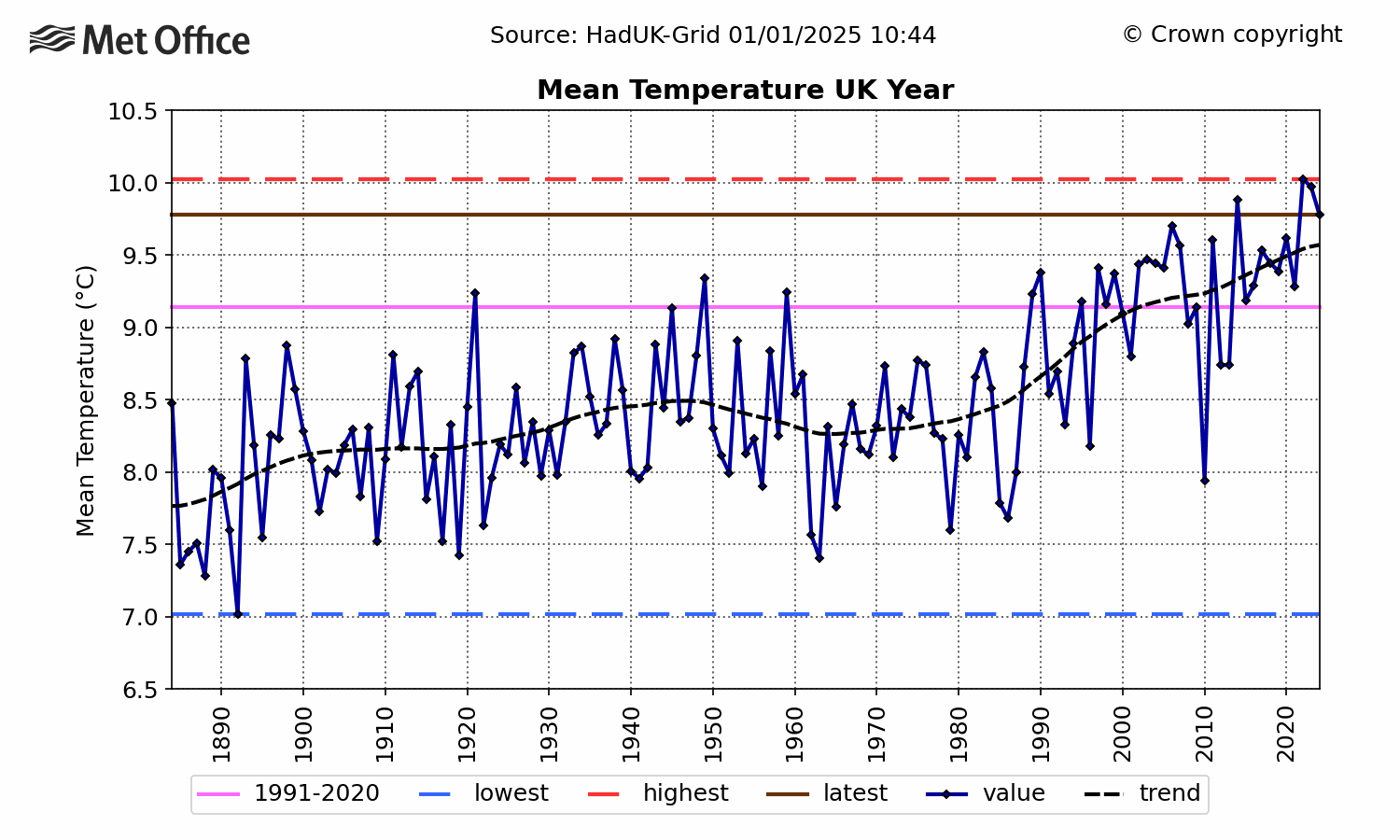
UK Temperatures In 2024

by P. Homewood, Jan 5, 2025 in NotaLotofPeopleKnowThat


UK annual temperatures have dropped for the second year running, though the Met Office will emphasise what they claim is a remorseless upwards trend. However they don’t show error margins in their graphs, and as we know, nine out of ten of the weather stations used for their UK temperature dataset are junk or near junk sites, where poor siting can mean temperatures may be overstated by as much as five degrees for Class 5 and two degrees for Class 4: