Full-time professor at the Free University of Brussels, Belgium
apreat@gmail.com
apreat@ulb.ac.be
• Department of Earth Sciences and Environment
Res. Grp. - Biogeochemistry & Modeling of the Earth System
Sedimentology & Basin Analysis
• Alumnus, Collège des Alumni, Académie Royale de Sciences, des Lettres et des Beaux Arts de Belgique (mars 2013). http://www.academieroyale.be/cgi?usr=2a8crwkksq&lg=fr&pag=858&rec=0&frm=0&par=aybabtu&id=4471&flux=8365323
• Prof. Invited, Université de Mons-Hainaut (2010-present-day)
• Prof. Coordinator and invited to the Royal Academy of Sciences of Belgium (Belgian College) (2009-
present day)
• Prof. partim to the DEA (third cycle) led by the University of Lille (9 universities from 1999 to 2004) - Prof. partim at the University of Paris-Sud/Orsay, European-Socrates Agreement (1995-1998)
• Prof. partim at the University of Louvain, Convention ULB-UCL (1993-2000)
• Since 2015 : Member of Comité éditorial de la Revue Géologie de la France http://geolfrance.brgm.fr
• Since 2014 : Regular author of texts for ‘la Revue Science et Pseudosciences’ http://www.pseudo-sciences.org/
• Many field works (several weeks to 2 months) (Meso- and Paleozoic carbonates, Paleo- to Neoproterozoic carbonates) in Europe, USA (Nevada), Papouasia (Holocene), North Africa (Algeria, Morrocco, Tunisia), West Africa (Gabon, DRC, Congo-Brazzaville, South Africa, Angola), Iraq... Recently : field works (3 to 5 weeks) Congo- Brazzaville 2012, 2015, 2016 (carbonate Neoproterozoic).
Degree in geological sciences at the Free University of Brussels (ULB) in 1974, I went to Algeria for two years teaching mining geology at the University of Constantine. Back in Belgium I worked for two years as an expert for the EEC (European Commission), first on the prospecting of Pb and Zn in carbonate environments, then the uranium exploration in Belgium. Then Assistant at ULB, Department of Geology I got the degree of Doctor of Sciences (Geology) in 1985. My thesis, devoted to the study of the Devonian carbonate sedimentology of northern France and southern Belgium, comprised a significant portion of field work whose interpretation and synthesis conducted to the establishment of model of carbonate platforms and ramps with reefal constructions.
I then worked for Petrofina SA and shared a little more than two years in Angola as Director of the Research Laboratory of this oil company. The lab included 22 people (micropaleontology, sedimentology, petrophysics). My main activity was to interpret facies reservoirs from drillings in the Cretaceous, sometimes in the Tertiary. I carried out many studies for oil companies operating in this country.
I returned to the ULB in 1988 as First Assistant and was appointed Professor in 1990. I carried out various missions for mining companies in Belgium and oil companies abroad and continued research, particularly through projects of the Scientific Research National Funds (FNRS).
My research still concerns sedimentology, geochemistry and diagenesis of carbonate rocks which leads me to travel many countries in Europe or outside Europe, North Africa, Papua New Guinea and the USA, to conduct field missions.
Since the late 90's, I expanded my field of research in addressing the problem of mass extinctions of organisms from the Upper Devonian series across Euramerica (from North America to Poland) and I also specialized in microbiological and geochemical analyses of ancient carbonate series developing a sustained collaboration with biologists of my university. We are at the origin of a paleoecological model based on the presence of iron-bacterial microfossils, which led me to travel many countries in Europe and North Africa. This model accounts for the red pigmentation of many marble and ornamental stones used in the world. This research also has implications on the emergence of Life from the earliest stages of formation of Earth, as well as in the field of exobiology or extraterrestrial life ...
More recently I invested in the study from the Precambrian series of Gabon and Congo. These works with colleagues from BRGM (Orléans) are as much about the academic side (consequences of the appearance of oxygen in the Paleoproterozoic and study of Neoproterozoic glaciations) that the potential applications in reservoir rocks and source rocks of oil (in collaboration with oil companies).
Finally I recently established a close collaboration with the Royal Institute of Natural Sciences of Belgium to study the susceptibility magnetic signal from various European Paleozoic series. All these works allowed me to gain a thorough understanding of carbonate rocks (petrology, micropaleontology, geobiology, geochemistry, sequence stratigraphy, diagenesis) as well in Precambrian (2.2 Ga and 0.6 Ga), Paleozoic (from Silurian to Carboniferous) and Mesozoic (Jurassic and Cretaceous) rocks. Recently (2010) I have established a collaboration with Iraqi Kurdistan as part of a government program to boost scientific research in this country.
My research led me to publish about 180 papers in international and national journals and presented more than 170 conference papers. I am a holder of eight courses at the ULB (5 mandatory and 3 optional), excursions and field stages, I taught at the third cycle in several French universities and led or co-managed a score of 20 Doctoral (PhD) and Post-doctoral theses and has been the promotor of more than 50 Masters theses.
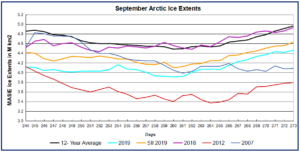
MASIE daily results for September show 2019 early melting followed by an early stabilizing and refreezing.
Note that 2019 started the month about 800k km2 below the 12 year average (2007 through 2018 inclusive). There was little additional loss of ice, a rise then a dip below 4 M km2, and a sharp rise ending the month. Interestingly, 2019 matched the lowest year 2012 at the start, but ended the month well ahead of both 2012 and 2007.
The table for day 273 shows distribution of ice across the regions making up the Arctic ocean.
“Après avoir travaillé pendant plus de 40 ans dans le domaine, mon expérience me pousse à plaider pour une analyse factuelle et objective de la situation, même si elle peut paraître iconoclaste dans le climat actuel…’
Les feux des projecteurs de l’Assemblée générale de l’ONU s’étant éteints, il est temps de voir plus sereinement la situation en matière de politique climatique — et donc énergétique – qui menace dangereusement notre démocratie. Après avoir travaillé pendant plus de 40 ans dans le domaine, mon expérience me pousse à plaider pour une analyse factuelle et objective de la situation, même si elle peut paraître iconoclaste dans le climat actuel.
Malgré l’opinion générale, et de certains scientifiques, la science du climat est très jeune. Affirmer que “tout est connu et qu’il n’y a plus qu’à agir” est donc prématuré. Le rapport du GIEC est rempli de conditionnels. Pas de certitudes, mais des hypothèses loin d’être irrécusables, puisque le système climatique possède “une signature chaotique“.
Lorsque durant la vague de chaleur de cet été, le climatologue français Jean Jouzel annonce que la température augmentera de “trois ou quatre” degrés, il omet d’ajouter que le GIEC assortit cette hypothèse d’une probabilité de 1% et que c’est pour un maximum de 3°C et non de 4°C ou de 7°C comme on l’entend parfois.
by P. Homewood, October 2, 2019 in NotaLotofPeopleKnowThat
Lost amid the coverage of Swedish teen activist Greta Thunberg at last week’s U.N. Global Climate Summit were the 500 international scientists, engineers and other stakeholders sounding a very different message: “There is no climate emergency.”
The European Climate Declaration, spearheaded by the Amsterdam-based Climate Intelligence Foundation [CLINTEL], described the leading climate models as “unfit” and urged UN Secretary-General Antonio Guterres to pursue a climate policy based on “sound science.”
“Current climate policies pointlessly and grievously undermine the economic system, putting lives at risk in countries denied access to affordable, reliable electrical energy,” said the Sept. 23 letter signed by professionals from 23 countries.
Most of the signers hailed from Europe, but there were also scientists from the United States, Canada, Australia, New Zealand and South America.
“We urge you to follow a climate policy based on sound science, realistic economics and genuine concern for those harmed by costly but unnecessary attempts at mitigation,” the letter said.
The Eocene was, on average, 4–15 °C warmer than today.
Atmospheric CO2 was very likely in the 450-600 ppm range.
Modern climate models would require 4,500 ppm CO2 to simulate the Eocene temperature range;
And/or a climate sensitivity of 4-8 °C per doubling;
And/or “that other climate forcings were stronger than previously assumed”.
They totally missed the most obvious reason why just about every effort to gin up a paleo example of CO2-driven climate change falls apart: Atmospheric CO2 is not a primary driver of climate change over geologic time. This wouldn’t mean that it isn’t a greenhouse gas or that it has no effect on temperature. It would simply mean that it was a relatively minor climate driver, like volcanic eruptions.
At some point over the past 30 years or so, the assumption that CO2 drives modern climate change has become a paradigm. And I think we have seen a rare failure in the application of the geologic principle of Uniformitarianism.
Uniformitarianism is often incorrectly cited as the reason geologists were slow to accept plate tectonics, the impact theory of the K-Pg extinction and why the hypotheses for a Younger Dryas impact and abiotic oil are generally unaccepted. However, Uniformitarianism may be why a CO2-driven climate paradigm appears to have come into wide acceptance, at least in academia.
…
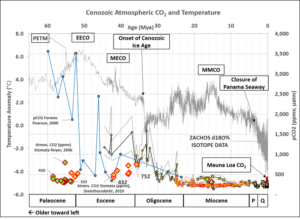
Figure 3a. Marine pCO2 (foram boron δ11B, alkenone δ13C), atmospheric CO2 from plant stomata (green and yellow diamonds with red outlines), Mauna Loa instrumental CO2 (thick red line) and Cenozoic temperature change from benthic foram δ18O (light gray line).
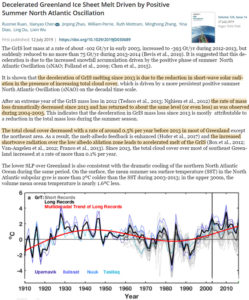
A new reconstruction of Arctic (NW Greenland) sea ice cover (Caron et al., 2019) reveals modern day sea ice is present multiple months longer than almost any time in the last 8000 years…and today’s summer sea surface temperatures s are among the coldest of the Holocene.
Yet another new study (Caron et al., 2019) shows today’s Arctic sea ice cover is still quite extensive when compared to the last several thousand years, when CO2 concentrations ranged between 260 and 270 ppm.
…
Other new Arctic sea ice reconstructions from the north of Iceland (Harning et al., 2019) and Barents Sea (Berben et al., 2019) regions indicate a) modern sea ice extent has changed very little in the last several hundred years, or since the Little Ice Age, and b) the Early Holocene had millennial-scale periods of sea-ice-free and open water conditions, which is in stark contrast to “modern conditions” – the “highest value” or furthest extent of the sea ice record.
“[T]he PBIP25 values [proxy for sea ice presence] reach their highest value (0.87) of the record at ca. 0 cal yr BP. An increase in PBIP25 suggests a further extension in sea ice cover, reflecting Arctic Front conditions (Müller et al., 2011), most similar to modern conditions.” (Berben et al., 2019)
by P. Homewood, 28 Sep. 2019 in NotaLotofPeopleKnowThat
Andrew Bolt is not afraid to tell the truth about our Greta. It is a pity that the media here have not got the courage to do the same…
…
16-year-old climate change activist Greta Thunberg has quickly risen to become one of the world’s most prominent political leaders, inspiring a mass movement of millions seemingly out of thin air to combat the problem of global warming.
However, the young girl’s sudden ascent to prominence is not happening by chance. She has deep connections to the globalist elite and activist parents who are supporters of the far-left domestic terrorist group ANTIFA.
Thunberg’s frequent handler is Luisa-Marie Neubauer, an operative from the ONE Movement. Neubauer can be seen behind Thunberg at many of her public events.
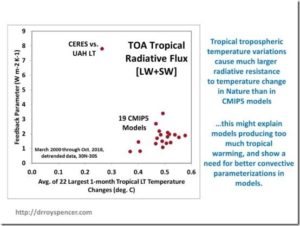
The radiative resistance to global temperature change is what limits the temperature change in response to radiative forcing from (say) increasing CO2, or the sun suddenly deciding to pump out a 1 percent more sunlight.
If the climate system sheds only a little extra energy with warming, it warms even more until radiative energy balance is restored. If it sheds a lot of energy, then very little warming is required to restore global energy balance. This is the climate sensitivity holy grail, and it will determine just how much warming results from increasing CO2 in the atmosphere.
John Christy and I are preparing a paper based upon Dept. of Energy-sponsored research explaining why the tropical troposphere hasn’t warmed as much in nature as in climate models. (The discrepancy exists for surface temperature trends; for both RSS and UAH tropical tropospheric trends; as well as for global reanalysis datasets). Danny Braswell and I did a lot of research on this subject about 5-10 years ago, and published several papers.
Without going into the gory details of why it is so difficult to measure “feedbacks” (how strong the climate system radiatively resists a temperature change in response to radiative forcing), I’m going to present one graph of new results from our work that suggests where the problem with the models might be.
by Alain Préat, 25 septembre 2019 in Science-Climat-Energie
Résumé : L’oxygène n’est pas apparu aussi brutalement qu’on le pensait sur notre planète (nb: première partie 1/2, ici).
Malgré un apport en oxygène lié aux cyanobactéries dès l’Archéen, ce ne se sont pas ces microorganismes qui sont à la base de la première grande ‘révolution’ de l’oxygène qui a eu lieu à la limite Archéen/Paléoprotérozoïque (il y a 2,5 milliards d’années) dans l’atmosphère, lors du Grand Evénement d’Oxydation. Ce sont les processus liés au cycle de la tectonique des plaques (activité mantellique et périodes intenses d’érosion/altération) qui ont contribué de manière déterminante à l’augmentation de la concentration de l’oxygène atmosphérique vers 2,5 milliards d’années. Les deux principaux processus responsables de cette augmentation sont liés à l’enfouissement de la matière organique et de la pyrite (= FeS2). L’altération des séries riches en ces deux composants conditionnera ensuite pendant près d’un milliard d’années la composition chimique des océans en oxygène, soufre et fer. Au cours du temps, l’oxygène proviendra de l’activité des cyanobactéries et l’atmosphère réductrice du début de l’Archéen sera remplacée par une atmosphère oxydante à la fin du Précambrien.
Abstract : Oxygen did not appear as abruptly as we thought on our planet.
Despite an oxygen supply related to cyanobacteria, since the Archean, it is not these microorganisms that are at the base of the first great oxygen revolution that took place at the Archean/Paleoproterozoic boundary (2.5 billion years) in the atmosphere during the Great Oxidation Event. Two processes related to the cycle of plate tectonics (mantle activity and intense periods of erosion/weathering) were mostly involved in the increase of the of atmospheric oxygen concentration 2.5 billion years ago. These two main processes are related to the burial of organic matter and those of pyrite(= FeS2) The alteration of series with high contents of the two elements will then condition for nearly a billion of years the oxygen, sulfur and iron chemical composition of the oceans. The oxygen will finally come from the activity of cyanobacteria and the early Archean reducing atmosphere will be replaced by an oxidizing atmosphere at the end of the Precambrian.
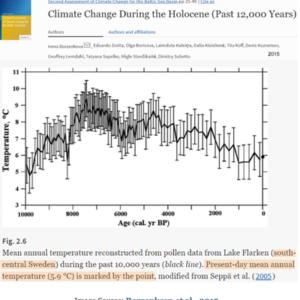
Greta Thunberg lives in Sweden. According to peer-reviewed science, Sweden was at least 3°C warmer than it is today about 6000 to 9000 years ago, when CO2 concentrations lingered around 265 ppm. At 410 ppm CO2, 21st century Sweden is colder now than almost any time in the last 9000 years.
…
A Much Warmer Northern Hemisphere
During the Medieval Warm Period, wine vineyards flourished in Scandinavia and Russia at the same latitude (55°N) where polar bears roam today.
London, 27 September: The UK’s key climate indicators have barely changed for 20 years. That’s according to a new paper from the Global Warming Policy Foundation, which rebuts claims that the weather is getting worse.
According to author Paul Homewood, the Met Office’s Central England Temperature Record shows that temperatures have barely changed in 20 years and that there has been no increase in extremely hot days either: “The summer of 2018 had just one day over 30 degrees, while 1976 had six. The Met Office’s data show that hot days are just not becoming more common.”
And there seems to be little to worry about on bad weather front either. There has been a gentle decline in storminess, and in most of the UK, there has been no change in either average rainfall or rainfall extremes: “Only in Scotland has there been a noticeable increase”, says Homewood. “Climate hysteria is entirely overdone.” Paul Homewood: Plus Ça Change: The UK Climate in 2018 (pdf)
by L. Goldstein, Sep. 22, 2019 in ClimateChangeDispatch
Canadians already suspicious of Prime Minister Justin Trudeau’s carbon tax will likely be even more suspicious given a report by Ottawa-based Blacklock’s Reporter that Environment Canada omitted a century’s worth of observed weather data in developing its computer models on the impacts of climate change.
The scrapping of all observed weather data from 1850 to 1949 was necessary, a spokesman for Environment Canada told Blacklock’s Reporter, after researchers concluded that historically, there weren’t enough weather stations to create a reliable data set for that 100-year period.
“The historical data is not observed historical data,” the spokesman said. “It is modeled historical data … 24 models from historical simulations spanning 1950 to 2005 were used.”
These computer simulations are part of the federal government’s ClimateData.ca website launched by Environment Minister Catherine McKenna on Aug. 15.
She described it as “an important next step in giving our decision-makers even greater access to important climate data for long-term planning. The more each of us uses this type of information, the more it will help.”
Blacklock’s Reporter, which describes itself as “the only reporter-owned and operated newsroom in Ottawa” focusing on intensive reporting of government documents, notes that in many cases the observed temperatures scrapped by Environment Canada in creating its computer models were higher in the past than today.
For example, Vancouver had a higher record temperature in 1910 (30.6C) [87.08F] than in 2017 (29.5C) [85.1F].
Cooling August trends and stunningly early snows in Europe contradict global catastrophist warming claims.
Recently we heard reports of the earliest snowfall in Greta Thunberg’s Sweden in 20 years, and “stunning” snowfall in Norway. So it’s been strange to hear during these hysterical days of Fridays for Future (FFF) how snowfall is supposed to disappear even in the dead of winter.
Yet, Sweden’s and Norway’s early snowfall really should not come as a surprise when we look at the temperature trends for late summer in Sweden and elsewhere. The data are telling us that the opposite is happening: In reality autumn seems to be arriving earlier in Scandinavia.
Fall arriving sooner in Scandinavia
Using the untampered data from the Japan Meteorological Agency (JMA) from the 6 Swedish stations that offer close to complete datasets, we see that August has been seeing a late summer cooling trend across the Nordic country:
We are told the Arctic is warming twice as fast as anywhere else in the world, yet as the internet reverberates with shrill, almost-the-lowest-ice-extent-ever stories, polar bears, Pacific walrus, and the most common ice seal species (ringed and bearded seals, as well as harp seals), are all thriving. Two new videos published by the GWPF on polar bears and walrus confront this conundrum and the conclusion is clear: if there is no climate emergency for polar bears, there is no climate emergency anywhere.
…
Polar bears have survived several periods of less ice than there is now as well as periods with more ice. Most ice seal species and walrus, which have existed in the Arctic much longer than polar bears, have lived through many of these extreme sea ice cycles. The low ice extent this year – whether it ends up being second-lowest or third-lowest since 1979 – is merely a blip compared to what these species have experienced during the Pleistocene.
This new video explains that polar bears are important ecosystem indicators that are taking reduced summer sea ice in their stride. My new book, The Polar Bear Catastrophe That Never Happened, explains why this has caught polar bear specialists off guard.
Greta, the Swedish teenage activist is calling for radical cuts in CO2 emissions – on a scale that would have profound impacts on the world’s market system. Moreover, Lomborg calls the demands immoral. Lomborg says it would be far wiser to invest money in bringing the world’s poor out of grinding poverty rather than to try to mitigate climate change.
Fear based on 30 years of lies and exaggerations
“Rich countries that tell poor countries not to use fossil energy for the benefit of the environment are acting immorally,” Lomborg told the BZ.
Lomborg also sharply criticized Thunberg, telling BILD news daily: “Greta Thunberg fears the end of the world due to climate change. This fear is the result of three decades of alarmist rhetoric based on exaggerations and lies.”
€43 billion for 0.00001°C of temperature reduction yearly
Lomborg also called Germany’s “Energiewende” – transition to green energies – “the best example of a failed climate policy” which has proven to be “incredibly costly and ineffective.”
“Global warming will be reduced by 0.001 degrees at most by 2100 for 43 billion euros a year,” he told the BZ. Lomborg blames the adults for panicking Ms Thunberg and using her “to push through an agenda that costs trillions but brings almost no benefits.”
Rather, for the trillions we will likely get us far graver problems. What a deal.
by Alain Préat, 20 septembre 2019, in ScienceClimatEnergie
Résumé : L’oxygène n’est pas apparu aussi brutalement qu’on le pensait sur notre planète.
Malgré un apport en oxygène lié aux cyanobactéries dès l’Archéen, ce ne se sont pas ces micro-organismes qui sont à la base de la première grande ‘révolution’ de l’oxygène qui a eu lieu à la limite Archéen/Paléoprotérozoïque (il y a 2,5 milliards d’années) dans l’atmosphère, lors du Grand Evénement d’Oxydation. Ce sont les processus liés au cycle de la tectonique des plaques (activité mantellique et périodes intenses d’érosion/altération) qui ont contribué de manière déterminante à l’augmentation de la concentration de l’oxygène atmosphérique vers 2,5 milliards d’années. Les deux principaux processus responsables de cette augmentation sont liés à l’enfouissement de la matière organique et de la pyrite (= FeS2). L’altération des séries riches en ces deux composants conditionnera ensuite pendant près d’un milliard d’années la composition chimique des océans en oxygène, soufre et fer. Au cours du temps, l’oxygène proviendra de l’activité des cyanobactéries et l’atmosphère réductrice du début de l’Archéen sera remplacée par une atmosphère oxydante à la fin du Précambrien.
Abstract : Oxygen did not appear as abruptly as we thought on our planet.
Despite an oxygen supply related to cyanobacteria, since the Archean, it is not these microorganisms that are at the base of the first great oxygen revolution that took place at the Archean/Paleoproterozoic boundary (2.5 billion years) in the atmosphere during the Great Oxidation Event. Two processes related to the cycle of plate tectonics (mantle activity and intense periods of erosion/weathering) were mostly involved in the increase of the of atmospheric oxygen concentration 2.5 billion years ago. These two main processes are related to the burial of organic matter and those of pyrite (= FeS2). The alteration of series with high contents of the two elements will then condition for nearly a billion of years the oxygen, sulfur and iron chemical composition of the oceans. The oxygen will finally come from the activity of cyanobacteria and the early Archean reducing atmosphere will be replaced by an oxidizing atmosphere at the end of the Precambrian.
…
OLYMPUS DIGITAL CAMERA
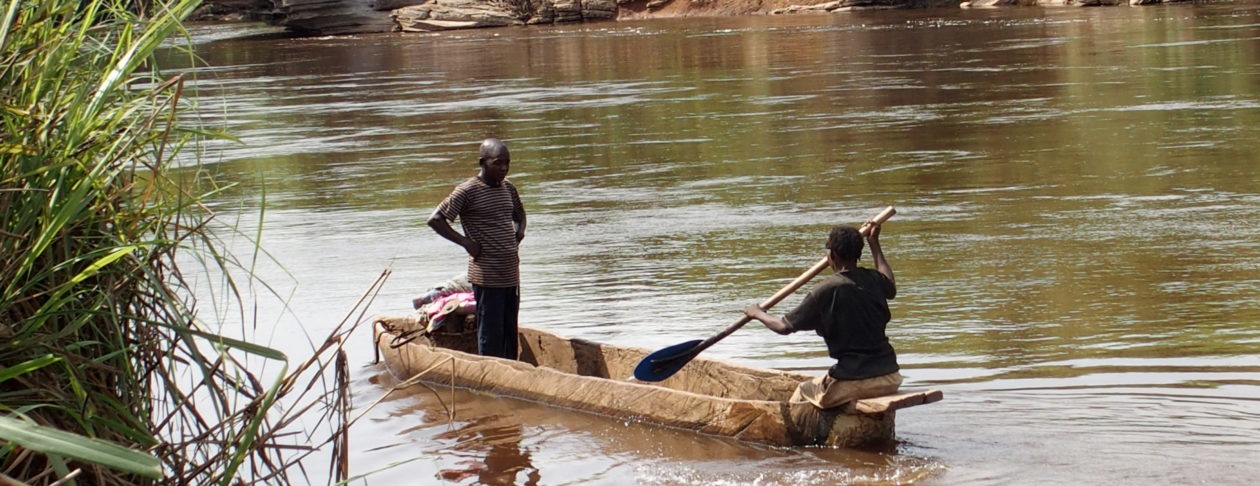
Figure 2a( en haut). Stromatolithe columnaire, Néoprotérozoïque, (Formation SC1c in Préat et al. 2018), Bassin du Niari, République du Congo (Brazzaville), photo A. Préat, 2016.
SHANGHAI (REUTERS) – China’s total planned coal-fired power projects now stand at 226.2 gigawatts (GW), the highest in the world and more than twice the amount of new capacity on the books in India, according to data published by environmental groups on Thursday (Sept 19).
The projects approved by China amount to nearly 40 per cent of the world’s total planned coal-fired power plants, according to the Global Coal Exit List database run by German environmental organisation Urgewald and 30 other partner organisations.
The new China projects would be more than Germany’s existing installed power capacity of around 200 GW by the end of 2018.
The environmental groups said in a press release on Thursday that worldwide 400 of the 746 companies in their database were still planning to expand their coal operations.
The companies include miners and power generators, and account for 89 per cent of the world’s thermal coal production and nearly 87 per cent of the world’s installed coal-fired power capacity. Of the total, 161 are Chinese.
Global decarbonisation efforts will need to be seven times greater if the world is to stand a fair chance of limiting global warming to 1.5C, according to a new PwC report which found decarbonisation has slowed to its lowest level since 2011. EURACTIV’s media partner edie.net reports.
PwC UK’s latest Low Carbon Economy Index (LCEI), published today (19 September), found that reaching the Paris Agreement’s 2C limit for global warming would require the global economy to reduce its carbon intensity by 7.5% every year up to 2100. The report notes that this is five times faster than the current decarbonisation rate of 1.6% – less than half the decarbonisation rate witnessed in 2015 (of 3.3%), when the Paris Agreement was introduced.
In order to meet the more ambitious target of the Paris Agreement – limiting global warming to 1.5C which has been requested by the Intergovernmental Panel on Climate Change (IPCC’s) special report – decarbonisation rates must reach 11.3% annually. That is seven times greater than the current rate, which has slowed to its lowest level since 2011.
Rep. Alexandria Ocasio-Cortez recently suggested Miami would disappear in “a few years” due to climate change. The United Nations is convening a “Climate Action Summit” next week. And climate activist Greta Thunberg is on Capitol Hill this week telling lawmakers they must act soon.
But while data from NASA and other top research agencies confirms global temperatures are indeed rising, a newly compiled retrospective indicates the doomsday rhetoric is perhaps more overheated.
The dire predictions, often repeated in the media, warned of a variety of impending disasters – famine, drought, an ice age, and even disappearing nations – if the world failed to act on climate change.
An Associated Press headline from 1989 read “Rising seas could obliterate nations: U.N. officials.” The article detailed a U.N. environmental official warning that entire nations would be eliminated if the world failed to reverse warming by 2000.
Then there were the fears that the world would experience a never-ending “cooling trend in the Northern Hemisphere.” That claim came from an “international team of specialists” cited by The New York Times in 1978.
German climate scientist Professor Werner Kirstein was interviewed by alternative media outlet NuoViso, and since the video was released early this month on Youtube, it has been viewed over 130,000, times.
Politics commissioning reports for money
In the interview Professor Kirstein tells moderator Robert Stein that CO2 emissions have no effect on the climate and that “politicians commission climate scientists to produce expert reports for money.”
“Public is being deceived”
Prof. Kirstein talks about the “conscious deception” of the public and how all research projects and publications by “climate scientists” only have the goal of confirming “man-made climate change” and that different scientific views are not welcome.
According to Kirstein, the public is being deceived with the false information and that the aim of politics is to find a way to collect further taxes and to collect levies.
“We currently see this with the climate tax, which is to be introduced soon,” Kirstein says.
by P. Homewood, Sep. 16, 2019 in NotaLotofPeopleKnowThat
Protests by groups such as Extinction Rebellion, the recent fires in the Amazon and apocalyptic warnings by the teenage activist Greta Thunberg have prompted a “tsunami” of young people seeking help.
A group of psychologists working with the University of Bath says it is receiving a growing volume of enquiries from teachers, doctors and therapists unable to cope.
The Climate Psychology Alliance (CPA) told The Daily Telegraph some children complaining of eco-anxiety have even been given psychiatric drugs.
by Egbert Egberts, 12 septembre 2019, in ScienceClimatEnergie
ATTENTION ! Cet article pourrait permettre d’économiser des milliards d’euros…
Après un été avec des températures au-dessus de 40°C, les prédictions de catastrophes sont allé bon train. “Si on ne fait rien, …” Nos politiques, pressés par une (petite) partie de leur électorat, proposent des mesures à faire pâlir les contribuables impuissants que nous sommes. Pensez aux mille milliards d’euros que veut dépenser la nouvelle présidente de la Commission européenne pour juguler le climat et limiter le réchauffement climatique.
Dans l’ensemble, on traite cette question sans aucun regard en arrière. Comme si le changement climatique était un phénomène nouveau, qui nous est tombé dessus parce qu’on roule en voiture. Cependant, il ne s’agit pas d’un phénomène nouveau et le monde francophone est particulièrement bien placé pour le savoir. Nous possédons un livre fouillé sur l’évolution du climat entre l’an 58 avant Jésus-Christ et 1842 A. D., un véritable trésor ! Pourquoi ? Parce que cela nous donne le recul indispensable pour mieux comprendre ce qui nous arrive aujourd’hui. En 1845, Joseph-Jean-Nicolas Fuster a publié son livre de 503 pages Des changements dans le climat de la France : histoire de ses révolutions météorologiques aux éditions Capelle à Paris.[1] Son livre nous résume ainsi l’évolution du climat pendant presque deux millénaires.
Ross McKitrick and John Christy have published a new paper in the Journal of Hydrology.
Abstract : We estimate trends in US regional precipitation on multiple time spans and scales relevant to the detection of changes in climatic regimes. A large literature has shown that trend estimation in hydrological series may be affected by long-term persistence (LTP) and selection of sample length. We show that 2000-year proxy-based reconstructions of the Palmer Modified Drought Index for the US Southeast (SE) and Pacific Coast (PC) regions exhibit LTP and reveal post- 1900 changes to be within the range of longer-term natural fluctuations. We also use a new data base of daily precipitation records for 20 locations (10 PC and 10 SE) extending back in many cases to the 1870s. Over the 1901–2017 interval upward trends in some measures of average and extreme precipitation appear, but they are not consistently significant and in the full records back to 1872 they largely disappear. They also disappear or reverse in the post-1978 portion of the data set, which is inconsistent with them being responses to enhanced greenhouse gas forcing. We conclude that natural variability is likely the dominant driver of historical changes in precipitation and hence drought dynamics in the US SE and PC.
Summary: After years of tacit cooperation with climate activists, the first major climate agency may have begun to turn against their misuse of climate science. If so, this would be a big event in the climate debate. As seen in this interview with the head of the WMO. He has much to say that we need to hear.
Scientists are turning against climate activists and their scare tactics.
Interview with Petteri Taalas, Secretary General of the WMO.
By Pekka Lähteenmäki in the Finnish weekly magazine Talouselämä, Sept 6.
From Finnish to English via Google Translate, so only roughly accurate!
WHO = World Meteorological Organization (their website).
{Taalas has five children.} Many people wonder if we should even have children. Will the offspring live as adults on a ruined planet? Every child and adult is a source of emissions. …
Anyone who still thinks green/renewable energy is the answer is invited to click over to a web page that monitors Germany’s celebrated Energy Transition (English translation here). The most recent six-month update has just been published. Despite a multi-billion-euro price tag, Germany’s attempts to ditch fossil fuels isn’t going well. At all.
Only six of the transition’s 14 goals (43%) appear achievable by 2020. Here are the two absolutely critical data points:
#1 – Germany’s CO2 emissions reduction targets won’t be met.
#2 – Its previously robust electricity grid is now vulnerable and insecure.
The story of Germany’s energy transition boils down to this: Something that used to work well has been deliberately broken, undermined, degraded, and crippled. A ton of money has been spent. To make things worse.
Over at Forbes, Michael Shellenberger discusses how this latest report card is being covered in the German press. In his words:
Frost-fighting efforts have shifted into overdrive on New Zealand’s South Island as a brutal Antarctic blast rips through the region — the first blast of many, according to NIWA forecasts.
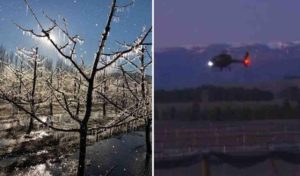
Otago, a southeastern region of NZ’s South Island, is home to the buds of millions of dollars worth of stone-fruit. Forecasters say temperatures in central Otago plummeted to a bruising -5C (23F) on Tues morning, Sept 10.
Sprinklers were turned-on so as to deliberately encase the tender fruit in a protective clear-ice casing — an age-old method of frost-fighting. While helicopters and wind machines were also drafted-in to blow warm air over the orchards.
“It’s all hands on deck,” said Tim Jones, chief executive of 45 South Orchard and Packhouse in Cromwell, who expects the cold to stick around for at least another month.
“NIWA has got some news out there that this could be a challenging spring,” Jones added.
New Zealand has a higher-than-usual risk of sharp cold snaps and unsettled weather during the first half of the season, according to the National Institute of Water and Atmospheric Research (NIWA).
A rare sudden stratospheric warming (SSW) event is occurring 30-50 km above Antarctica which is already leading to unusual and extreme weather in parts of the Southern Hemisphere.
…
La géologie, une science plus que passionnante … et diverse