Archives de catégorie : climate-debate

The Global CO2 lockdown problem

by Sherrington G., May 22, 2020 in WUWT


The global problem.

In response to the threat of a global viral epidemic, countries announced lockdowns at various times near 25th March 2020. https://en.wikipedia.org/wiki/COVID-19_pandemic_lockdowns

This caused a reduction of industrial activity and hence a lower rate of emission of anthropogenic carbon dioxide to the atmosphere. An example of reduction from aircraft is given at https://en.wikipedia.org/wiki/Impact_of_the_COVID-19_pandemic_on_aviation

Numerous sources asked if the reduction in CO2 emission could be detected in analysis of air for CO2 content, which had been done for decades. Early questions and speculative answers came from many sources including –

https://www.esrl.noaa.gov/gmd/ccgg/covid2.html

https://www.aljazeera.com/news/2020/03/coronavirus-lockdown-leads-improved-air-quality-200322094404592.html

By late May 2020, the emerging consensus was that the reduction would be too small to show at the main measuring stations such as Mauna Loa, Hawaii.

What You Should Know About Ice Ages & Climate Change

by D.W. Euring, May 20, 2020 in PrincipiaScientificInternational


It became apparent from investigation of the Variability of the Gravitational Constant that Jupiter’s orbit is affecting the Sun’s surface temperature and driving the Sunspot Cycle which appear to be triggered at its Aphelion and suppressed at Perihelion.

Saturn has even greater eccentricity than Jupiter and it is noted that it was at Perihelion at the end of 1972 which seems to account for the Low Solar Maximum at that time and a particular dip after the main peak. So, whilst cycle periods are not influenced by Saturn, it does impact on their magnitude, and it seems likely that it will have augmented in 1957-58 as well as 1990.

Earth’s Mean Temperature Falling, Planetary Alignment Suspected As Driver Of The 11-Year Solar Cycle

by F. Vahrenholt, May 9, 2020 in NoTricksZone


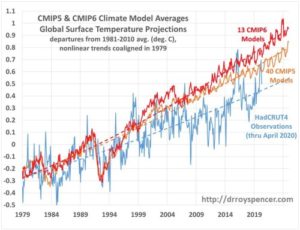
The global mean temperature in April 2020 was again significantly lower than in February and March, at 0.38°C above the average from 1981 to 2010. The average temperature increase on the globe from 1981 to February 2020 was 0.14°C per decade. The further development promises to be interesting, especially since a number of research institutes expect a higher probability of a cooling La Nina in the Pacific towards the end of the year. March’s solar activity was very low with a sunspot number of 1.5.  Activity in April rose slightly to 5.4. The first sunspots of the new cycle are showing.

What causes the sun to have an 11-year cycle?

Since the Dessau pharmacist Heinrich Samuel Schwabe discovered in 1843 that the sunspots of the sun increase and decrease in an 11-year cycle, science has been puzzling over the reason why this cycle lasts 11 years and why the solar magnetic field also changes its polarity in this rhythm: the north pole becomes the south pole and vice versa.

In July last year, scientists at the Helmholtz Centre in Dresden Rossendorf made a little-noticed but exciting discovery. Every 11.07 years, the planets Venus, Earth and Jupiter are aligned quite precisely. At this point in time, their gravitational force acts jointly in one direction on the Sun.

Image: NASA Earth Observatory. Public Domain

Why the Current Economic Slowdown Won’t Show Up in the Atmospheric CO2 Record

by Rotter, from Spencer, May 15, 2020 in WUWT


May 15th, 2020 by Roy W. Spencer, Ph. D.

[UPDATE: MISSING IMAGES INSERTED]

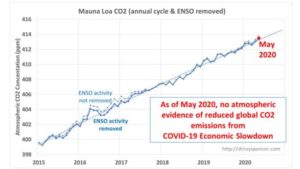
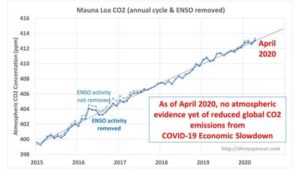
Summary: Atmospheric levels of carbon dioxide (CO2) continue to increase with no sign of the global economic slowdown in response to the spread of COVID-19. This is because the estimated reductions in CO2 emissions (around -11% globally during 2020) is too small a reduction to be noticed against a background of large natural variability. The reduction in economic activity would have to be 4 times larger than 11% to halt the rise in atmospheric CO2.

Changes in the atmospheric reservoir of CO2 occur when there is an imbalance between surface sources and sinks of CO2. While the global land and ocean areas emit approximately 30 times as much CO2 into the atmosphere as humans produce from burning of fossil fuels, they also absorb about an equal amount of CO2. This is the global carbon cycle, driven mostly by biological activity.

Fig. 2. Monthly CO2 data since 2015 from Mauna Loa, HI after the average seasonal cycle is statistically removed.

ADDENDUM: How much of a decrease in CO2 emissions would be required to stop the atmospheric rise in CO2?


Continuer la lecture de Why the Current Economic Slowdown Won’t Show Up in the Atmospheric CO2 Record

The Sun Has Entered ‘Very Deep’ Solar Minimum

by Unilad/GWPF, May 15, 2020


The lack of any sunspots suggests the current solar minimum is one of the ‘deepest’ in 100 years.

The sun has been reported to have a ‘very deep’ solar minimum with 100 days of 2020 not seeing any sunspots on its surface.

Astronomer Dr Tony Phillips says the current lack of sunspot counts suggests the current solar minimum is one of the ‘deepest’ of the past century.

A sunspot is an area of magnetic activity on the surface of the sun – also known as storms – and appear in areas of darkness. They play a huge part in the sun’s activity, including birthing solar flares and coronal mass ejections.

A solar minimum occurs when zero sunspots are spotted, but, before you start panicking and thinking this is a bad thing, solar minimums are all part of the sun’s cycle and occur every 11 years or so.

NASA first recorded no activity on the sun last summer and it is thought to have continued to be without sunspots ever since. Solar minimums usually consist of 12 months of little sunspot activity.

PARTS OF UK AND US SUFFER THEIR LOWEST MAY TEMPERATURES ON RECORD

by  Cap Allon, May 14, 2020 in Electroverse


Parts of the UK and US have suffered their lowest May temperatures on record of late, according to data from filthy warm-mongers & partners-in-crime the Met Office and NOAA.

While the official li(n)e coming out of these agencies is that our World Is On Fire, thermometer stations the length and breadth of both Europe and North America are telling a rather different story.

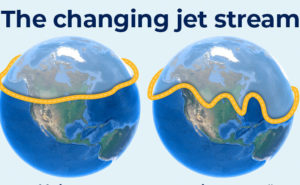
Overnight Wednesday (May 13-14), the mercury in Katesbridge and Castlederg, N. Ireland, plummeted to an extra-duvet-grabbing -6.1C (21F) and -3.9C (25F), respectively, as a wave of brutal Arctic air rode anomalously-far south on the back on a meridional (wavy) jet stream flow.

Wednesday night followed what had been a record-chilly day — a minimum temperature of -5C (23F)was observed in Tulloch Bridge, Scotland.

The wave of record cold actually engulfed much of Northern Europe overnight Wednesday, as visible in coolwx.com‘s temperature animation:


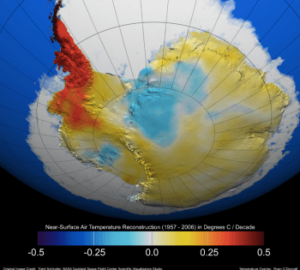
Antarctic Avery Ice Shelf “Prograding Considerably In Last 2 Decades”, Team Of Scientists Find

by P. Gosselin, May 6, 2020 in NoTricksZone


A newly released paper by Kumar et al looks at the changes and prediction of the Amery Ice Shelf (AIS) of East Antarctica using remote sensing data.

The scientists found that the ice shelf is prograding (expanding), and not breaking apart like some alarmist scientists feared earlier.

Image: cropped from Wikipedia

Continuer la lecture de Antarctic Avery Ice Shelf “Prograding Considerably In Last 2 Decades”, Team Of Scientists Find

Record Cold May Weather Hits the U.S. — Climate Alarmists Blame Global Warming

by J. Murphy, May 11, 2020 in NewAmerican


Almost a full two months after the season officially ended, winter reared its ugly head in much of the United States over the weekend. A winter-type Polar Vortex has caused record cold and extremely late season snow from the Rockies to the Atlantic Ocean. What’s responsible for this late season cold? If you listen to climate alarmists, the answer is simple: global warming.

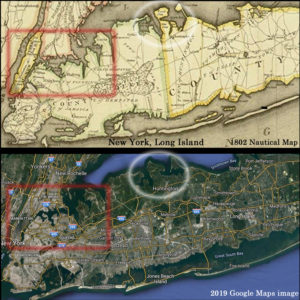
In the Northeast, higher elevation areas reported snowfalls of up to 10 inches over the weekend. New York City received a trace of snow on May 9, tying the city’s record for the latest snowfall. In Islip, New York, a town of the southern shore of Long Island, the month of May was officially snowier than the month of February. Mother’s Day celebrations across the Midwest and Northeast were ruined by cold and windy conditions in the regions. Near record cold temperatures were reported from the Dakotas stretching down Texas and across most of the eastern United States.


Continuer la lecture de Record Cold May Weather Hits the U.S. — Climate Alarmists Blame Global Warming

Manufacturing consensus: the early history of the IPCC

by J. Curry, January 3, 2018 in ClimateEtc.


Short summary: scientists sought political relevance and allowed policy makers to put a big thumb on the scale of the scientific assessment of the attribution of climate change.

Bernie Lewin has written an important new book:

SEARCHING FOR THE CATASTROPHE SIGNAL:The Origins of The Intergovernmental Panel on Climate Change

The importance of this book is reflected in its acknowledgements, in context of assistance and contributions from early leaders and participants in the IPCC:

This book would not have been possible without the documents obtained via Mike MacCracken and John Zillman. Their abiding interest in a true and accurate presentation of the facts prevented my research from being led astray. Many of those who participated in the events here described gave generously of their time in responding to my enquiries, they include Ben Santer, Tim Barnett, Tom Wigley, John Houghton, Fred Singer, John Mitchell, Pat Michaels . . . and many more.

You may recall a previous Climate Etc. post Consensus by Exhaustion, on Lewin’s 5 part series on Madrid 1995: The last day of climate science.

Read the whole book, it is well worth reading.  The focus of my summary of the book is on Chapters 8-16 in context of the theme of ‘detection and attribution’, ‘policy cart in front of the scientific horse’ and ‘manufacturing consensus’. Annotated excerpts from the book are provided below.

Cold Air Rises – How Wrong Are Our Global Climate Models?

by University of California Davis,  May 6, 2020 in WUWT


The lightness of water vapor buffers climate warming in the tropics.

Conventional knowledge has it that warm air rises while cold air sinks. But a study from the University of California, Davis, found that in the tropical atmosphere, cold air rises due to an overlooked effect — the lightness of water vapor. This effect helps to stabilize tropical climates and buffer some of the impacts of a warming climate.

The study, published today (May 6, 2020) in the journal Science Advances, is among the first to show the profound implications water vapor buoyancy has on Earth’s climate and energy balance.


Abstract

Moist air is lighter than dry air at the same temperature, pressure, and volume because the molecular weight of water is less than that of dry air. We call this the vapor buoyancy effect. Although this effect is well documented, its impact on Earth’s climate has been overlooked. Here, we show that the lightness of water vapor helps to stabilize tropical climate by increasing the outgoing longwave radiation (OLR). In the tropical atmosphere, buoyancy is horizontally uniform. Then, the vapor buoyancy in the moist regions must be balanced by warmer temperatures in the dry regions of the tropical atmosphere. These higher temperatures increase tropical OLR. This radiative effect increases with warming, leading to a negative climate feedback. At a near present-day surface temperature, vapor buoyancy is responsible for a radiative effect of 1 W/m2 and a negative climate feedback of about 0.15 W/m2 per kelvin.

Influence of landscape structure on local and regional climate

by RA. Pielke and R. Avissar, 1990 in LandscapeEcology


Abstract

This paper discusses the physical linkage between the surface and the atmosphere, and demonstrates how even slight changes in surface conditions can have a pronounced effect on weather and climate. Observational and modeling evidence are presented to demonstrate the influence of landscape type on the overlying atmospheric conditions. The albedo, and the fractional partitioning of atmospheric turbulent heat flux into sensible and latent fluxes is shown to be particularly important in directly affecting local and regional weather and climate. It is concluded that adequate assessment of global climate and climate change cannot be achieved unless mesoscale landscape characteristics and their changes over time can be accurately determined.

Michael Moore Ditches Green Movement For Climate Commies

by C. Toto, May 8, 2020 in ClimateChangeDispatch


Michael Moore has had enough of the modern green movement.

The Oscar-winning director made it official late last month by unleashing his new project, for free, on YouTube.

“The Planet of the Humans,” which Moore executive produced and shared via his Rumble Media platform, excoriates some of the green movement’s sacred cows:

  • Wind Energy
  • Solar Power
  • Electric Cars
  • Al Gore

The documentary shreds all of the above, albeit from a decidedly progressive perspective. Solar and wind, no matter how well-intentioned those who support them, can’t power the planet. Electric cars require fossil fuels, a non-starter for saving the world.

 …
SEE THE VIDEO HERE (in text)

Claim: Antarctic Sea Ice Growth Caused by Meltwater

by Eric Worrall, May 7, 2020 in WUWT


According to climate scientists, less dense meltwater on the surface of the Antarctic ocean reduced convection between the surface and ocean depths, leaving heat trapped in the depths.

A

Don’t you love climate science? When sea ice accumulates, scientists adjust the models until they get the right result. When the sea ice melts, well that is what you would expect from global warming.

NOAA Satellite records second largest 2-month temperature drop in history

by Anthony Watts, May 1, 2020 in WUWT


UPDATE: Changed emphasis from Northern Hemisphere extratropics to entire Northern Hemisphere (h/t John Christy)

In April, 2020, the Northern Hemisphere experienced its 2nd largest 2-month drop in temperature in the 497-month satellite record.

The Version 6.0 global average lower tropospheric temperature (LT) anomaly for April, 2020 was +0.38 deg. C, down from the March, 2020 value of +0.48 deg. C.

The Northern Hemisphere temperature anomaly fell from +0.96 deg. C to 0.43 deg. C from February to April, a 0.53 deg. C drop which is the 2nd largest 2-month drop in the 497-month satellite record. The largest 2-month drop was -0.69 deg. C from December 1987 to February 1988.

The linear warming trend since January, 1979 has now increased to +0.14 C/decade (but remains statistically unchanged at +0.12 C/decade over the global-averaged oceans, and +0.18 C/decade over global-averaged land).

Global Mean Temperature Flattens the Past

by Andy May, May3, 2020 in WUWT


Introduction

There have been recent discussions about ‘flattening the curve’ and some curves are easier to flatten than others. The Pages 2K Consortium calculates global mean temperature in a manner that flattens the long-term trend and makes present day temperatures appear warmer relative to past temperatures. Across the globe, temperature reconstructions show cooling millennial temperature trends with one exception, the Pages 2K global mean.

Millennial Temperature Trends Show Global Cooling

Global mean surface temperature anomalies were recently calculated by the Pages 2K Consortium led by Nuekom, 2019. Their statistical means are a conglomeration of seven different averaging methods for 7000 proxy records over the past 2000 years. The median across all global mean methods is plotted as a dashed line in Figure 1 and compared to Pages 2K’s published regional reconstructions. All means demonstrate similar trends as the median and will be simply be referred to as the global mean(s).

Regional temperature reconstructions are chosen that utilize similar proxy datasets used in the global mean calculation. The Arctic reconstruction by McKay incorporates a balance of proxy records consisting of ice cores, tree rings, lake and marine sediments north of 60 deg N. The Northern Hemisphere (NH) European reconstruction by Luterbacher is tree ring proxy based. And Stenni’s Antarctic reconstruction uses predominantly ice core isotopes.

The Pages 2K global mean appears to be reasonable compared to regional reconstructions from Present through the Little Ice Age (LIA) until about 1250 AD. Although it is difficult to see how the mean compares to regional reconstructions during the Present when using a 1961-1990 baseline as all reconstructions converge creating the “hockey stick” effect. Pre-1250 AD, the global mean appears to parallel NH Europe temperatures largely ignoring the Antarctic.


Figure 1: Top graph are surface temperature reconstructions with a 50-year loess filter plotted with Pages 2K global mean of the 7000-member ensemble across all methods. Bottom graph shows linear trends over the past 2000 years.

GLOBAL TEMPERATURES SUFFER SECOND LARGEST TWO MONTH DROP IN RECORDED HISTORY

by Cap Allon, May 6, 2020 in Electroverse


The Temperature of the Global Lower Atmosphere plunged 0.38C through March and April, halving its February above baseline high of 0.76C to 0.38C — the second-largest two-month drop in the UAH temperature dataset.

The largest two month drop remains the 0.69C observed back in 1987. And note how the global average temperature back in 1987 –before both the drop AND the inception of the global warming scare is EXACTLY the same as it is now:


A continuation of this sharp downward plunge (seen in March and April, 2020) is highly probable over the coming months (with the odd bump on the way), and we can now consider a reading below baseline by the end of the year “likely”.

For a more in-depth look at the data check out this video from the Oppenheimer Ranch Project:


Rural Northern US Stations Showed No Warming – Before NASA Rewrote The Data

by P. Gosselin, May 03, 2020 in NoTricksZone


The northern hemisphere surface temperature was expected to drop substantiallyaccording to NCEP, but this of course will not keep global warming alarmists from sounding the warming alarms.

But a look at the unadjusted data from some rural US stations tells us that there has been no warming.

Today we look at temperature data from NASA of some stations along the northern US with a Brightness Index (BI) of 0, meaning rural locations with no urban heat island effects. We want to see the trend over the past 100 or so years.

Plotted are the USHCN Version 4 versus Version 4 adjusted.

The first plots are the data from Lincoln, Nebraska going back to 1901:

Modest cooling changed to warming. Data: NASA

Note how a modest cooling trend was changed to a warming trend. Very ealy temperatures were cooled by 2°C!

Next we move to the Livingston, Montana station, where here as well a modest cooling trend was transformed into warming by massively adjusting past temperatures downward also by more than 2°C:

Study: CO2 Emissions From Dry Inland Waters Much Higher Than Thought

by Ufz, Mau 1, 2020 in ClimateChangeDispatch


Inland waters such as rivers, lakes, and reservoirs play an important role in the global carbon cycle.

Calculations that scale up the carbon dioxide emissions from land and water surface areas do not take account of inland waters that dry out intermittently.

This means that the actual emissions from inland waters have been significantly underestimated—as shown by the results of a recent international research project led by scientists at the Helmholtz Centre for Environmental Research (UFZ) in Magdeburg and the Catalan Institute for Water Research (ICRA).

The study was published in Nature Communications.


“The interaction of local conditions like temperature, moisture, and the organic matter content of the sediments is crucial, and it has a bigger influence than regional climate conditions,” Keller explains.

So what do the results of the study mean for the future assessment of carbon dioxide emissions from inland waters? “Our study shows that carbon dioxide emissions from inland waters have been significantly underestimated up until now,” says Koschorreck.

Chinese Scientists: It Was Warmer In China During Medieval Warm Period Than Today

by Hao et al. , January  2, 2020  in GWPF


For China as a whole, the longest warm period during the last 2000 years occurred in the 10th–13th centuries’

Abstract: The Medieval Climate Anomaly (MCA, AD950-1250) is the most recent warm period lasting for several hundred years and is regarded as a reference scenario when studying the impact of and adaptation to global and regional warming. In this study, we investigated the characteristics of temperature variations on decadal-centennial scales during the MCA for four regions (Northeast, Northwest, Central-east, and Tibetan Plateau) in China, based on high-resolution temperature reconstructions and related warm-cold records from historical documents. The ensemble empirical mode decomposition method is used to analyze the time series. The results showed that for China as a whole, the longest warm period during the last 2000 years occurred in the 10th–13th centuries, although there were multi-decadal cold intervals in the middle to late 12th century. However, in the beginning and ending decades, warm peaks and phases on the decadal scale of the MCA for different regions were not consistent with each other. On the inter-decadal scale, regional temperature variations were similar from 950 to 1130; moreover, their amplitudes became smaller, and the phases did not agree well from 1130 to 1250. On the multi-decadal to centennial scale, all four regions began to warm in the early 10th century and experienced two cold intervals during the MCA. However, the Northwest and Central-east China were in step with each other while the warm periods in the Northeast China and Tibetan Plateau ended about 40–50 years earlier. On the multi-centennial scale, the mean temperature difference between the MCA and Little Ice Age was significant in Northeast and Central-east China but not in the Northwest China and Tibetan Plateau. Compared to the mean temperature of the 20th century, a comparable warmth in the MCA was found in the Central-east China, but there was a little cooling in Northeast China; meanwhile, there were significantly lower temperatures in Northwest China and Tibetan Plateau.

L’Antarctique géologique (2/2)

by A. Préat, 1 mai 2020 in ScienceClimatEnergie


Cet article fait suite aux trois récents articles publiés par le Prof. Maurin sur SCE (1/3, 2/3,  3/3), et traite de l’évolution géologique de la plaque Antarctica.
Voir également L’Antarctique géologique (1/2).

3/ Situation récente à l’échelle géologique

3.1. Isolation de la plaque Antarctique

Nous arrivons ainsi à la situation actuelle avec l’Arctique et l’Antarctique, situation décrite dans les parties 1 à 3 des articles de M. Maurin (parties 1/3, 2/3 et 3/3). D’où proviennent les glaciations actuelles ? Pour les comprendre il faut remonter au début de l’ère cénozoïque en considérant l’Antarctique qui était en position polaire (Scotese, 2001).

La plaque antarctique, partie intégrante de l’ensemble des continents formant le Gondwana est entourée dès le Jurassique (Figs. 7 et 12, inL’Antarctique géologique 1/2) de rides médio-océaniques (excepté la péninsule antarctique qui provient d’une limite de plaque convergente active avec failles transformantes séparant la plaque Antarctique et la plaque Scotia). En conséquence, la plaque Antarctique est actuellement en expansion par rapport aux plaques adjacentes, et fut particulièrement stable et isolée par rapport aux événements tectoniques du Mésozoïque et du Cénozoïque (ici).

Dans ce contexte, et en remontant le temps, il faut noter l’individualisation, dès l’Ordovicien, de la péninsule antarctique avec des montagnes de plus de 3200 m d’altitude constituant aujourd’hui la région la plus au nord de l’Antarctique occidental et s’étendant au-delà du cercle polaire. Cette chaîne de montagnes prolonge les Andes de l’Amérique du Sud dans la continuité d’une dorsale sous-marine caractérisée par un gradient géothermique élevé (voir plus loin). Ainsi on voit que l’Antarctique, depuis longtemps et encore aujourd’hui, participe à un jeu de tectonique des plaques encore active avec des effets locaux (notamment variations du  gradient géothermique).Ce gradient géothermique est un élément important à prendre en considération dans la dynamique glaciaire car il favorise la fonte et ensuite le glissement des glaces.

Notons que Arctowski (in Fogg 1992) avait déjà suggéré en 1901 que les Andes étaient présentes dans la pointe nord de la péninsule antarctique (Graham Land) .

3.2. Englacement de la plaque Antarctique

Fig. 16 : Image des fonds marins d’une chaîne de 800 km de long de plusieurs volcans actifs de 1000 m de haut situés à proximité de la partie nord du continent antarctique. D’après Kamis, 2016.

POLAR COLD TO GRIP ALL OF AUSTRALIA: FORECASTS CALL FOR COLDEST APRIL DAYS IN A QUARTER OF A CENTURY

by Cap Allon , April 27, 2020 in Electroverse


The mainstream media won’t give a toss, but the ENTIRE Aussie continent is set for an early, bone-chilling taste of winter as a meridional jet stream flow (brought on by historically low solar activity) kicks brutal Antarctic air anomalously far north.

On Thursday and Friday this week, the maximum temperature in Melbourne –for example– is forecast to plummet to the lowest recorded level in April since 1996 (solar minimum of cycle 22) — a chilly 13C (55.3F)

Don’t fall for bogus, warm-mongering political agendas — the COLD TIMES are returning in line with historically low solar activitycloud-nucleating Cosmic Rays, and a meridional jet stream flow.

Even NASA agrees, in part at least, with their forecast for this upcoming solar cycle (25) revealing it will be “the weakest of the past 200 years,” with the agency correlating previous solar shutdowns to prolonged periods of global cooling here.

Solar Cycle 25 Has Started

by D Archibald, April 22, 2020 in WUWT


The heliospheric current sheet has flattened meaning that Solar Cycle 24 is over and we are now in Solar Cycle 25.

Figure 1: Heliospheric current sheet tilt angle 1976 -2020

The solar cycle isn’t over until the heliospheric current sheet has flattened. The data is provided by the Wilcox Solar Observatory at Stanford University. There were no observations from about 19 December to 5 February; so the values in between have been interpolated from the rotations before and after.