Archives de catégorie : climate-debate

Extreme weather is the most likely and severe threat facing humanity!

by P. Homewood, November 8, 2018 in NotaLotofPeopleKnowThat


My very first foray into climate blogging was an analysis of extreme weather events in 1971. (I wrote it in 2011, so it was not a cherrypicked year, merely a nice round 40 years before.)

I won’t bore you with it again, as it was basically just a very long list. You can see it here though.

But here is a summary, which goes to show that extreme weather is the norm, not the exception:


Role of atmospheric carbon dioxide in climate change

by M. Hertzberg & H. Scheruder, 2016 in EnergyEnvironment


Abstract

The authors evaluate the United Nations Intergovernmental Panel on Climate Change (IPCC) consensus that the increase of carbon dioxide in the Earth’s atmosphere is of anthropogenic origin and is causing dangerous global warming, climate change and climate disruption. The totality of the data available on which that theory is based is evaluated. The data include: (a) Vostok ice-core measurements; (b) accumulation of CO2 in the atmosphere; (c) studies of temperature changes that precede CO2 changes; (d) global temperature trends; (e) current ratio of carbon isotopes in the atmosphere; (f) satellite data for the geographic distribution of atmospheric CO2; (g) effect of solar activity on cosmic rays and cloud cover. Nothing in the data supports the supposition that atmospheric CO2 is a driver of weather or climate, or that human emissions control atmos- pheric CO2.

Solar forcing and climate variability during the past millennium as recorded in a high altitude lake: Lake Salda (SW Anatolia)

by I.B. Bauhi & S. Akçer-Ön, August 30, 2018 in QuaternaryInternational


Abstract

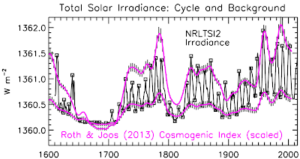
Climate variability is a well-known phenomenon and has been frequently, though complex, linked to solar forcing on different time scales. The importance of solar forcing related climate variability is crucial in our understanding of paleoclimate and future climate changes, as well as building climate models. Here in, we present the late Holocene (last ca 1400) climate records from Lake Salda in SW Anatolia using high-resolution micro X-ray Fluorescence (μ-XRF), magnetic susceptibility (MS), stable isotopes13C and δ18O) and TOC-TIC measurements. The age model is constructed by using radionuclide (210Pb, 137Cs and 14C) dating methods. The lake’s high-resolution multiproxy results revealed lake water level fluctuations associated with humid and dry spells during the last 1400 years. Periods of higher lake levels are consistent with solar maxima in total solar irradiance and vice versa. Moreover, the Lake Salda records clearly show dry Dark Ages Cold Period (DACP), humid Medieval Climatic Anomaly (MCA), dry Little Ice Age (LIA), and humid Modern Warm Period (MoWP). These records suggest that the solar forcing, through its influence on the atmospheric circulation, is the main mechanism of climate change during the DACP, MCA, LIA and MoWP in this region.

Earth’s upper atmosphere cooling off dramatically and cosmic rays continue to increase as deep solar minimum approaches

by Paul Dorian, November 5, 2018 in PerspectaWeather


Overview

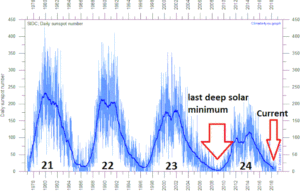
The sun is blank again today and has been without sunspots about 60% of the time this year as the current historically weak solar cycle heads towards the next solar minimum. Solar cycle 24 is currently on pace to be the weakest sunspot cycle with the fewest sunspots since cycle 14 peaked in February 1906. Solar cycle 24 continues a recent trend of weakening solar cycles which began with solar cycle 21 that peaked around 1980. The last time the sun was this blank in a given year on a percentage basis was 2009 during the last solar minimum when 71% of the time was spotless. That last solar minimum actually reached a nadir in 2008 when an astounding 73% of the year featured a spotless sun – the most spotless days in a given year since 1913. All indications are that the fast-approaching next solar minimum may be even quieter than the last one which was the deepest in nearly a century.

One of the natural consequences of a solar minimum is for the upper part of the Earth’s atmosphere to cool down. Another natural impact of decreasing solar activity is the weakening of the ambient solar wind and its magnetic field which, in turn, allows more cosmic rays to penetrate the solar system. The intensification of cosmic rays can have important consequences on such things as the safety of airline passengers and astronauts in space, Earth’s cloud cover and climate, and possibly even on lightning.

Daily observations of the number of sunspots since 1 January 1977 according to Solar Influences Data Analysis Center (SIDC). The thin blue line indicates the daily sunspot number, while the dark blue line indicates the running annual average. The recent low sunspot activity is clearly reflected in the recent low values for the total solar irradiance. Compare also with the geomagnetic Ap-index. Data source: WDC-SILSO, Royal Observatory of Belgium, Brussels. Last day shown: 31 October 2018. Last diagram update: 1 November 2018.

The phase relation between atmospheric carbon dioxide and global temperature

by O. Humlum et al., 2013 in Global&PlanetaryChange


Highlights

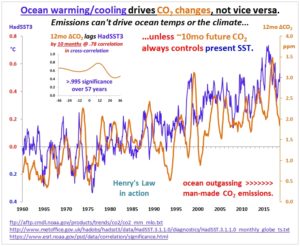
► Changes in global atmospheric CO2 are lagging 11–12 months behind changes in global sea surface temperature. ► Changes in global atmospheric CO2 are lagging 9.5–10 months behind changes in global air surface temperature. ► Changes in global atmospheric CO2 are lagging about 9 months behind changes in global lower troposphere temperature. ► Changes in ocean temperatures explain a substantial part of the observed changes in atmospheric CO2 since January 1980. ► Changes in atmospheric CO2 are not tracking changes in human emissions.

Also this graph

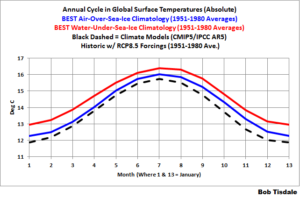
Do Doomsters Know How Much Global Surface Temperatures Cycle Annually

by Bob Tisdale, November 5, 2018 in WUWT


Alternate Title: The Annual Cycle in Global Land+Ocean Surface Temperature IS Far Greater Than 1.5 Deg C, AND Much-Much-MUCH Greater Than 1.5 Deg C Annually for Global Land Air Surface Temperatures

We all were taught early in school that the Earth orbits the Sun…that its path is elliptical…that because of the tilt in Earth’s axis of rotation, we have seasons as the Earth orbits our star annually. Because of the elliptical orbit, and because the ratios of land to ocean are different between the Northern and Southern Hemispheres, we might expect that global average surface temperatures would vary over the course of a year.

Later in life we’ve been brow beaten with alarmism about human-induced global warming and climate change…that the Earth will become a literal—not figurative—hell if global surface temperatures rise—formerly 2-deg C—now 1.5 deg C above pre-industrial levels. But does the average person know much global surface temperatures vary annually as it orbits the Sun? It’s unlikely, because I’ve never before seen graphs that are similar to what’s presented in this post or seen it discussed in any of the global warming literature. Am I expecting most persons to find this information to be of any interest? Nope. I simply find it noteworthy that, as I mentioned before, I’ve never seen it presented anywhere. In fact, I just Googled, in quotes, “How Much Do Global Surface Temperatures Cycle Annually?” and Google replied (their boldface), “No results found for “How Much Do Global Surface Temperatures Cycle Annually?”.

Remarkable, is it not, in these times of global warming interest?

Enough with the preamble and on to the meat of the post:

How the Greenland ice sheet fared in 2018

by R. Mottram et al.  (DMI), October 27, 2018 in ScienceNordic


The end of August traditionally marks the end of the melt season for the Greenland ice sheet as it shifts from mostly melting to mostly gaining snow.

As usual, this is the time when the scientists at DMI and our partners in the Polar Portal assess the state of the ice sheet after a year of snowfall and ice melt. Using daily output from a weather forecasting model combined with a model that calculates melt of snow and ice, we calculate the “surface mass budget” (SMB) of the ice sheet.

This budget takes into account the balance between snow that is added to the ice sheet and melting snow and glacier ice that runs off into the ocean. The ice sheet also loses ice by the breaking off, or “calving”, of icebergs from its edge, but that is not included in this type of budget. As a result, the SMB will always be positive – that is, the ice sheet gains more snow than the ice it loses.

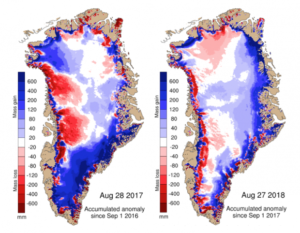
For this year, we calculated a total SMB of 517bn tonnes, which is almost 150bn tonnes above the average for 1981-2010, ranking just behind the 2016-17 season as sixth highest on record.

By contrast, the lowest SMB in the record was 2011-2012 with just 38bn tonnes, which shows how variable SMB can be from one year to another.

Maps show the difference between the annual SMB in 2017 (left) and 2018 (right) compared with the 1981-2010 period (in mm of ice melt). Blue shows more ice gain than average and red shows more ice loss than average. (Credit: DMI Polar Portal)

Examination of space-based bulk atmospheric temperatures used in climate research

by J.R. Christy et al., March 8, 2018 in InternJournRemoteSensing


The Intergovernmental Panel on Climate Change Assessment Report 5 (IPCC AR5, 2013) discussed bulk atmospheric temperatures as indicators of climate variability and change. We examine four satellite datasets producing bulk tropospheric temperatures, based on microwave sounding units (MSUs), all updated since IPCC AR5. All datasets produce high correlations of anomalies versus independent observations from radiosondes (balloons), but differ somewhat in the metric of most interest, the linear trend beginning in 1979. The trend is an indicator of the response of the climate system to rising greenhouse gas concentrations and other forcings, and so is critical to understanding the climate. The satellite results indicate a range of near-global (+0.07 to +0.13°C decade−1) and tropical (+0.08 to +0.17°C decade−1) trends (1979–2016), and suggestions are presented to account for these differences. We show evidence that MSUs on National Oceanic and Atmospheric Administration’s satellites (NOAA-12 and −14, 1990–2001+) contain spurious warming, especially noticeable in three of the four satellite datasets.

Comparisons with radiosonde datasets independently adjusted for inhomogeneities and Reanalyses suggest the actual tropical (20°S-20°N) trend is +0.10 ± 0.03°C decade−1. This tropical result is over a factor of two less than the trend projected from the average of the IPCC climate model simulations for this same period (+0.27°C decade−1).

UAH global temperature – little change in October

by Anthony Watts, November 3, 2018 in WUWT


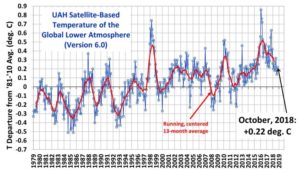
UAH Global Temperature Update for October, 2018: +0.22 deg. C

The Version 6.0 global average lower tropospheric temperature (LT) anomaly for October, 2018 was +0.22 deg. C, up a little from +0.14 deg. C in September. The linear temperature trend of the global average lower tropospheric temperature anomalies from January 1979 through October 2018 remains at +0.13 C/decade.

Accord de Paris sur le climat : aucun pays de l’UE n’a tenu parole, pas un

by Dominique Dewitte, 31 octobre 2018 in ExpressBusiness


Pas un seul État membre de l’UE ne figure parmi les 16 pays sur 197 qui, selon une étude réalisée par un centre de recherche américain et deux centres de recherche britanniques, ont pris les mesures politiques appropriées promises dans le cadre de l’accord de Paris sur le climat.

La Norvège, le Monténégro et la Macédoine sont les seuls pays européens à avoir pris les mesures politiques appropriées pour réduire les émissions de gaz à effet de serre correspondant aux promesses faites lors de la signature de l’accord de Paris sur le climat.

L’étude du think tank américain World Ressources Institute et de deux centres de recherche britanniques (le Grantham Research Institute et le Center for Climate Change Economics and Policy), qui font partie de la London School of Economics, en apporte la preuve .

À Paris, plus de 197 pays se sont portés volontaires pour réduire leurs émissions de gaz à effet de serre lors de la conférence COP21 en décembre 2015.

‘It’s a ghost page’: EPA site’s climate change section may be gone for good

by Oliver Milman, November 1, 2018 in TheGuardian


More than a year after the US Environmental Protection Agency took down information on climate change from its website for an “update”, it now seems uncertain whether it will ever reappear.

In April last year, the EPA replaced its online climate change section with a holding page that said the content was being updated to “reflect the agency’s new direction under President Donald Trump”.

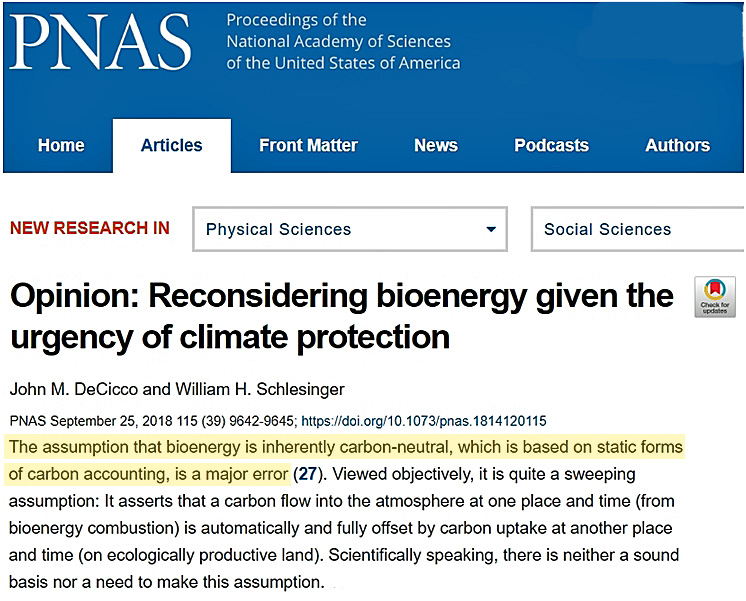
Paradigm Shift? The ‘Belief’ That Bioenergy Is Climate-Friendly Is Now Recognized As A ‘Major Error’

by K. Richard, November 1, 2018 in NoTricksZone/PNAS


Governments vociferously promote bioenergy as renewable, sustainable, and carbon-neutral. But scientists are increasingly characterizing this “belief” as a “major error”, as bioenergy generates more CO2 emissions per kWh than burning coal does, and the projected rapid growth in bioenergy will serve to ‘increase atmospheric CO2 for at least a century’ as well as clear forests and destroy natural ecosystems.

The Millennial Turning Point – Solar Activity and the Coming Cooling

by Norman Page, November 2, 2018 in WUWT


When analyzing complex systems with multiple interacting variables it is useful to note the advice of Enrico Fermi who reportedly said “never make something more accurate than absolutely necessary”.

My recent paper presented a simple heuristic approach to climate science which plausibly proposed that a Millennial Turning Point (MTP) and peak in solar activity was reached in 1991.

Zharkova et al 2015 DOI:10.10381/srep15683 says ” Dynamo waves are found generated with close frequencies whose interaction leads to beating effects responsible for the grand cycles (350-400 years) superimposed on a standard 22 year cycle. This approach opens a new era in investigation and confident prediction of solar activity on a millenium timescale. ”
Svalgaard concluded in his essay on WUWT 10/27 2018:

The temperature increase since about 1650 is clearly chiefly due to the up- leg in the natural solar activity millennial cycle as shown by Lean 2018 “Estimating Solar Irradiance Since 850 AD” Fig 5

Hothouse claims from ‘Trajectories of the Earth System in the Anthropocene’ are in a virtual world, not the real world

by Albert Parker, November 2, 2018 in WUWT


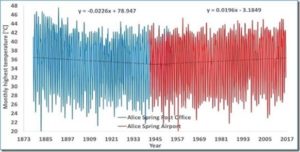
A recent paper Trajectories of the Earth System in the Anthropocene (Ref. [1] below) claims that even if the CO2 emission reductions called for in the Paris Agreement are met, our Earth may still enter what they call “Hothouse Earth” conditions, a long-term stabilization at temperature 4-5 °C-higher than pre-industrial temperatures, and sea-level 10-60 m-higher than today. They conclude calling for an accelerated transition towards a CO2 emission-free-world-economy. There is, however, very little evidence that the apocalyptic prediction is scientific grounded. Where really measured, the temperatures haven’t increased dramatically, and similarly, the sea-levels haven’t risen dramatically. More importantly, any acceleration of the temperature warming, or any acceleration of the rate of rise of the sea-level, are hard to detect.

Figure 1 –sample long-term-trend thermometer results (Alice Spring, NT, Australia). The temperatures were recorded in the Post Office / City and Airport locations. Data downloaded from www.bom.gov.au/climate/data/.


REBUTTAL: IPCC SR15 Climate Change Report is Based on Faulty Premises

by Anthony Watts, October 31, 2018 in WUWT


Friends of Science Society is critical of the IPCC SR15 report, pointing out the following:

  1. We are in the Meghalayan, not the Anthropocene. The IPCC SR15 report claims to view climate change through “the lens of the Anthropocene.” This term is popularly used to describe a modern geological period wherein humans are assumed to have a larger impact on the world than nature. On July 13, 2018, the International Union of Geological Sciences (IUGS) issued a statement that the earth is now in the Meghalayan, a period that began 4,200 years ago.  In response to questions as to why the term “Anthropocene” had not been included, at least for the past 50 years of presumed human influence, the IUGS responded that the term “Anthropocene” has not even been submitted for consideration and that the term has only sociological, not scientific relevance.  The IPCC should not use this ‘lens.’

  2. All climate models (simulations) used by the IPCC run ‘too hot’ versus observations. The computer simulations project future warming (thus being the rationale for global warming climate policies) show significantly higher temperatures than what is being observed. Only the Russian climate model and satellite/weather balloon data closely match present temperatures in the lower troposphere. This suggests that most climate models ascribe too great an effect of warming (climate sensitivity) to carbon dioxide.

    This means the climate models should not be used to set public policy.

  3. No temperature can be accurately measured to a precision of less than ±0.1°C. global temperature data is a metric of averaged and adjusted data from many sources, suggesting that a 0.5°C difference in temperature is moot and an arbitrary figure. It does not reference an actual measurement of earth’s temperature; people are being misled.

BOLSONARO IN, MERKEL OUT: THE PARIS CLIMATE GANG IS BREAKING UP

by GWPF & Climate Home News, October 31, 2018


While Brazil has elected a climate sceptical president, Germany’s ‘climate chancellor’ Angela Merkel has announced that she is gradually stepping down from her political roles. Green news outlets are voicing concern that these and other developments in the Western world are putting the Paris agreement and the entire climate agenda at risk of falling apart.

How Bad is HadCRUT4 Data?

by Renee Hannon, October 29, 2018 in WUWT

Introduction

This post is a coarse screening assessment of HadCRUT4 global temperature anomalies to determine the impact, if any, of data quality and data coverage. There has been much discussion on WUWT about the quality of the Hadley temperature anomaly dataset since McLean’s Audit of the HadCRUT4Global Temperature publication which is paywalled. I purchased a copy to see what all the hub-bub was about, and it is well worth the $8 in my view. Anthony Watts’ review of McLean’s findings and executive summary can be found here.

A key chart for critical study is McLean’s Figure 4.11 in his report. McLean suggests that HadCRUT4 data prior to 1950 is unreliable due to inadequate global coverage and high month-to-month temperature variability. For this post, I subdivided McLean’s findings into three groups shown with added shading: Good data which covers the years post-1950. During this period global data coverage is excellent at greater than 75% and month-to-month temperature variation is low. Questionable data occurs from 1880 to 1950. During this period global data coverage ranged from 40% to 70% with higher monthly temperature variations. Poor data is pre-1880 when global coverage ranged from 14 to 25% with extreme monthly temperature variations.


Climate Study: 90 Percent Of Atolls And Islands Either Stable Or Growing

by J. Delingpole, October 30, 2018 in ClimateChangeDispatch


Another global warming scare story bites the dust: fragile islands and atolls in the Pacific are not sinking beneath the waves because of global warming. In fact, they are doing just fine.

The bad news (only bad for alarmists, of course) comes in a study by Virginie Duvat of the University of La Rochelle-CNRS, France, titled ‘A global assessment of atoll island planform changes over the past decades’.

It surveyed 30 Pacific and Indian Ocean atolls, including 709 islands, and found that 90 percent have either remained stable or have grown in the last few decades.

MOVING THE GOALPOSTS, IPCC SECRETLY REDEFINES ‘CLIMATE’

by David Whitehouse, October 29, 2018 in GWPF


The IPCC appears to have secretly changed the definition of what constitutes ‘climate’ by mixing existing and non-existing data

The definition of ‘climate’ adopted by the World Meteorological Organisation is the average of a particular weather parameter over 30 years. It was introduced at the 1934 Wiesbaden conference of the International Meteorological Organisation (WMO’s precursor) because data sets were only held to be reliable after 1900, so 1901 – 1930 was used as an initial basis for assessing climate. It has a certain arbitrariness, it could have been 25 years.

For its recent 1.5°C report the IPCC has changed the definition of climate to what has been loosely called “the climate we are in.” It still uses 30 years for its estimate of global warming and hence climate – but now it is the 30 years centred on the present.

Une Pensée Unique pour Jacques Duran

by Prof. dr. Paul Berth, 29 octobre 2018 in ScienceClimatEnergie


Le physicien Jacques Duran, fondateur du célèbre site Pensée Unique et pionnier du climato-réalisme en France, est décédé ce vendredi 26 octobre 2018.

Son site internet est toujours online. Si vous ne le connaissez pas, allez vite le voir. Copiez le et diffusez le. Il est vraiment Unique! Il est abondamment documenté et illustré, et représente une véritable mine de connaissances sur le climat. Son site, créé en 2006 sous le pseudonyme de Jean Martin, est dédié à tous ceux qui ont conservé un esprit critique et qui se refusent à absorber sans réfléchir une grande partie des nouvelles de toutes sortes qui nous parviennent chaque jour.

500 Million Years of Unrelatedness between Atmospheric CO2 and Temperature

by Davis W.J., 2017 in CO2Science


Davis, W.J. 2017. The relationship between atmospheric carbon dioxide concentration and global temperature for the last 425 million years. Climate 5: 76; doi: 10.3390/cli5040076.

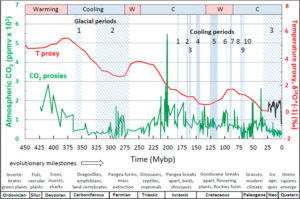
Writing by way of introduction to his work, Davis (2017) notes that “a central question for contemporary climate policy is how much of the observed global warming is attributable to the accumulation of atmospheric CO2 and other trace greenhouse gases emitted by human activities.” If you talk to a climate alarmist, the answer you receive from such an inquiry will likely be “almost all.” A climate skeptic, on the other hand, will likely respond that the answer is “likely none.”

Hoping to provide some crucial information on this topic, Davis analyzed the relationship between historic temperature and atmospheric CO2 using the most comprehensive assemblage of empirical databases of these two variables available for the Phanerozoic period (522 to 0 million years before present; Mybp). In all, 6680 proxy temperature and 831 proxy CO2 measurements were utilized, enabling what Davis described as “the most accurate quantitative empirical evaluation to date of the relationship between atmospheric CO2concentration and temperature.” Multiple statistical procedures and analyses were applied to the proxy records and the resultant relationship is depicted in the figure below.

Egalement voir ici

View From German Scientists On The U Of Arizona’s Coming Release Of The Hockey Stick Chart E-Mails

by P. Gosselin, October 26, 2018 in NoTricksZone


A Piece Of Climate Science History: Hockey Stick Emails Soon To Be Published

By Dr. Sebastian Lüning and Prof. Fritz Vahrenholt
(Text translated by P Gosselin)

The hockey stick controversy over a temperature reconstruction of the past 2000 years represents an important stage in the climate debate. At around the turn of the millennium, the authors of the “hockey stick chart” suggested that the pre-industrial climate was monotonous and uneventful. The Medieval Warm Period and Little Ice Age described in many parts of the world climatically must have been very similar. But that’s hard to understand if you look at the wide variety of case studies.

Cover-up absurdity, then forced to correct

Later, the authors improved and presented a corrected version, which again showed stronger climatic fluctuations. Quite a science story. You can read about it here.

In addition to this scientific rush job, the debate about the hockey stick also showed that climate data really must be made publicly available. This is all the more important if the science is used for far-reaching policies. Data and results obtained thereof must be verifiable. At the time no one wanted the data to be released. Today in retrospect that was quite an absurdity — similar to smoking in a large open office.