All around the world the climate druids are at work.
Show me the error bars
Once upon a time a scientist talked about thirty year trends and anachronistic things like “confidence intervals”. Now, thanks to the discovery of Unscience, any noisy, random short data is fair game to be declared undeniable climate change. Periods of flooding also qualify, as do periods of nice weather, though strangely no one mentions those. Where are the headlines? If climate change caused drought on the East Coast of Australia, it’s also causing average rain and good crops in Western Australia.
In terms of scientific data analysis we don’t get that many droughts or six-day-August-heatwaves to analyze. They’re complex phenomena caused by multiple factors and we only have short records. This makes them ideal to be oversold to hapless folk as a “sign” of climate change.
Somebody said economists try to predict the tide by measuring one wave. This puts them in the same league as climate scientists trying to predict the climate by measuring one variable, CO2. It is no surprise that an amalgam of the two, climate and economics, produces even worse results, but that is what happened early in the anthropogenic global warming (AGW) deception.
Paper Reviewed
Sun, X., Ren, G., Ren, Y., Fang, Y., Liu, Y., Xue, X. and Zhang, P. 2018. A remarkable climate warming hiatus over northeast China since 1998. Theoretical and Applied Climatology133: 579-594.
A prominent feature of all climate model projections is their prediction that temperatures should be rising in response to ever-increasing concentrations of greenhouse gases. However, for the past two decades global surface air temperatures have not warmed to the degree predicted by the models, which lack of warming has been a conundrum to the climate alarmist movement.
De tous temps les hommes se sont intéressés au climat et ont tenté de prévoir son évolution. Dès l’Antiquité il était connu que des caractéristiques géographiques comme la latitude mais aussi l’altitude ou le voisinage de vastes étendues d’eau avaient une grande influence sur le climat. Sur cette base les climatologues ont été amenés à distinguer différents types de climats tels que tropical, désertique, tempéré, polaire, etc. Ensuite, il est progressivement apparu que le climat est un système extrêmement complexe qui dépend de l’activité solaire ainsi que de la distance et de l’orientation de la Terre par rapport au Soleil, facteurs qui varient à des échelles de temps très différentes.
With wildfires engulfing over 620,000 acres of California, there’s been a concerted media campaign to single out man-made global warming as the primary force behind the deadly blazes.
But that’s not what the data suggests, according to University of Washington climate scientist Cliff Mass.
“So there is a lot of misinformation going around in the media, some environmental advocacy groups, and some politicians,” Mass wrote in the first of a series of blog posts analyzing the California wildfires.
by James E. Kamis, August 7, 2018 in ClimateChangeDisatch
In what amounts to dissension from National Aeronautics and Space Administration (NASA) climate change policy, a series of just-released studies by working-level scientists prove that geological and not atmospheric forces are responsible for melting of Earth’s polar ice sheets.
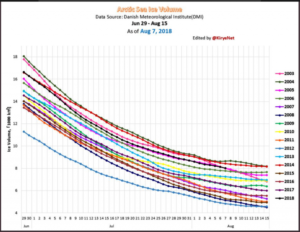
Using data from the Danish Meteorological Institute (DMI), Japanese skeptic blogger Kirye just tweeted how Arctic sea ice volume has surged to the 3rd highest level in 16 years.
…
Data source. Danish Meteorological Institute. Chart source: Kirye.
S’exprimer, sans recul, sur une canicule localisée à l’échelle du climat mondial constitue une erreur déontologique.
Il est regrettable que certains utilisent la vague de chaleur actuelle — qui au demeurant n’a rien d’anormal — afin de faire de nouveau miroiter la catastrophe climatique annoncée depuis 1992.
One of the main difficulties with tornado records is that a tornado, or evidence of a tornado must have been observed. Unlike rainfall or temperature, which may be measured by a fixed instrument, tornadoes are short-lived and very unpredictable. If a tornado occurs in a place with few or no people, it is not likely to be documented. Many significant tornadoes may not make it into the historical record since Tornado Alley was very sparsely populated during the 20th century.
Much early work on tornado climatology in the United States was done by John Park Finley in his book Tornadoes, published in 1887. While some of Finley’s safety guidelines have since been refuted as dangerous practices, the book remains a seminal work in tornado research. The University of Oklahoma created a PDF copy of the book and made it accessible at John Finley’s Tornadoes(link is external)
by P. Homewood, August 7, 2018 in NotaLotofPeopleKnowThat
Climate change: ‘Hothouse Earth’ risks even if CO2 emissions slashed
It may sound like the title of a low budget sci-fi movie, but for planetary scientists, “Hothouse Earth” is a deadly serious concept.
Researchers believe we could soon cross a threshold leading to boiling hot temperatures and towering seas in the centuries to come.
Even if countries succeed in meeting their CO2 targets, we could still lurch on to this “irreversible pathway”.
Their study shows it could happen if global temperatures rise by 2C.
…
The utterly corrupt body of climate science has been getting ever more desperate to scare people about climate change and thereby submit to their radical anti capitalist agenda.
People are not falling for it, so we are now being subjected to ever more absurd announcements like this.
During the 1930s, when the atmospheric CO2 concentration was about 100 ppm lower than today (310 ppm vs. 410 ppm), United States heat waves were just as if not more common than recent decades.
Recently there has been much ado about heat waves and the hottest-ever-recorded-temperatures making their rounds in Northern Hemisphere summer.
Yet scientists have determined that heat waves are largely driven by natural variability, not anthropogenic CO2 emissions.
During the 1930s, when the atmospheric CO2 concentration was about 100 ppm lower than today (310 ppm vs. 410 ppm), United States heat waves were just as if not more common than recent decades.
Recently there has been much ado about heat waves and the hottest-ever-recorded-temperatures making their rounds in Northern Hemisphere summer.
Yet scientists have determined that heat waves are largely driven by natural variability, not anthropogenic CO2 emissions.
But while Scripps is trying to tie the record-high ocean reading to the broader wave of media coverage on global heat waves, there are a few caveats to note about what the scientists found.
First, these measurements are taken from a pier that’s near the shoreline, which would not necessarily make it representative of the entire Pacific Ocean, and therefore easily influenced by local weather events.
The “anomalously warm temperatures for the past week” that Scripps researchers observed at their pier somewhat mirror the temperature pattern in 1931, and indeed, the daily records broken in the past week have been very close to readings from 87 years ago.
There is an upward trend in temperature readings from Scripps’ pier, but the trend seems to also broadly coincide with the flipping of a natural ocean cycle, the Pacific Decadal Oscillation, to its warm phase. That flip occurred around 1976.
Despite all the hysterical “heat wave” and drought reports being put out to the public by the media, the Northern Hemisphere as a whole is in fact not at all that much warmer than the mean since 2000.
According to Dr. Ryan Maue, northern hemisphere temperature anomaly was zero on July 30 and the northern hemisphere land surface anomaly was actually -0.20°C.
It has been for northern Europe a hot summer. Is it climate change as the media would like to have us believe? Or, is it something much simpler? For example, ocean patterns. Off the coast of Africa, water was coldest in the entire record back to 1950. A temperature change in one place of the oceans, means a change elsewhere also.
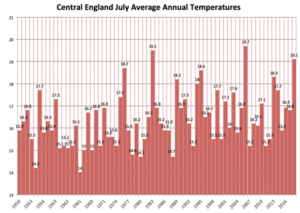
The UK July ranked 3rd warmest since 1950 in the very long term (starting 1659) temperature data-base from Central England.
SPOTLIGHT: The iconic magazine is now a purveyor of propaganda.
BIG PICTURE: On her PolarBearScience.com blog last week, zoologist Susan Crockford called our attention to a startling admission over at National Geographic. It acknowledges publishing fake news. Or, as it more delicately puts it, we “went too far in drawing a definitive connection between climate change and a particular starving polar bear.”
An “Editor’s Note” explains the magazine added a wholly misleading caption to a video of an emaciated polar bear filmed last August. When it published this video on its website in December, National Geographic declared: “This is what climate change looks like.”
Actually, this is what dishonesty looks like. Neither the magazine nor the person who did the filming knew anything about that bear. It might have been stricken with disease. It might have sustained an injury that impeded its ability to hunt. As the Editor’s Note now admits: “there is no way to know for certain why this bear was on the verge of death.”
During 2017, there were 150 graphs from 122 scientific papers published in peer-reviewed journals indicating modern temperatures are not unprecedented, unusual, or hockey-stick-shaped — nor do they fall outside the range of natural variability. We are a little over halfway through 2018 and already 108 graphs from 89 scientific papers undermine claims that modern era warming is climatically unusual.
For the sake of brevity, just 13 (15%) of the 89 new papers are displayed below.
The rest of the non-hockey-stick scientific papers and graphs published thus far in 2018 can be viewed by clicking the link below.
The L. A. Times published a Ca. climate alarmist wildfire story falsely claiming that the states most recent wildfires are result of “heat like the state has never seen”.
As usual with climate fear articles like this one in the L. A. Times the scientific reality present a far different picture. The latest scientific study completed by the Royal Society concludes that global wildfires are in decline.
by P. Homewood, August 1, 2018 in NotaLotofPeopleKnowThat
There have been just seven summers over 20c since 1910:
1911
1933
1947
1976
1995
2003
2006
While we don’t know how this summer will work out (and neither does Bob Ward), since 2006 we have had eleven distinctly average summers.
The hot summers above are still rare events, and are all essentially weather events. There is no evidence that these extreme weather events are becoming more frequent.
This post was inspired by Anthony Watts’ recent post about wildfires and their unwillingness to cooperate with the Gorebal Warming narrative.
…
A Geological Perspective of Wildfires
The Fire Window
Geological evidence for ancient wildfires generally consists of sedimentary charcoal deposits (inertinite). Fossil charcoal is also a key factor in understanding the evolution of Earth’s atmosphere, particularly oxygen content. The first clear evidence of fire is in the Late Silurian.
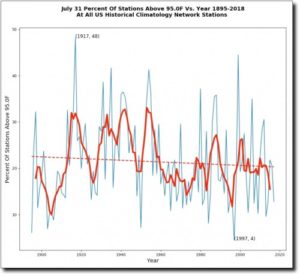
by Tony Heller, July 31, 2018 in ClimateChangeDispatch
July 31 afternoon temperatures have been declining in the US for a century, with the hottest year being 1917 when almost half of the US was over 95 degrees.
Climatologists trying to predict global warming forgot the sunshine in their sums. After correction of this startling error of physics, global warming will not be 2 to 4.5 K per CO2doubling, as climate models imagine. It will be a small, slow, harmless and net-beneficial 1.17 K.
…
La géologie, une science plus que passionnante … et diverse