Periods of extreme cold winter weather and perilous snowfall, similar to those that gripped the UK in a deep freeze with the arrival of the ‘Beast from the East’, could be linked to the solar cycle, pioneering new research has shown.
A new study, led by Dr Indrani Roy from the University of Exeter, has revealed when the solar cycle is in its ‘weaker’ phase, there are warm spells across the Arctic in winter, as well as heavy snowfall across the Eurasian sector.
by P. Homewood, March 23, 2018 in NotaLotofPeopleKnowThat
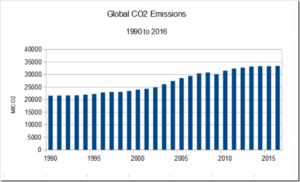
Global carbon dioxide emissions rose 1.4 percent in 2017 to a record-setting 32.5 gigatonnes, according to a report by the International Energy Agency (IEA).
Emissions rose after stalling for three years in a row, IEA reported. The Paris climate accord was signed by nearly 200 countries in 2015, which went into effect a year later. One year into the Paris accord, and emissions are on the rise.
IEA’s report echoes findings published by the Global Carbon Project late last year, predicting global emissions would rise 2 percent. The group projected emissions to rise again in 2018.
Sea ice in the Arctic grew to its annual maximum extent last week, and joined 2015, 2016 and 2017 as the four lowest maximum extents on record, according to scientists at the NASA-supported National Snow and Ice Data Center (NSIDC) and NASA.
On March 17, the Arctic sea ice cover peaked at 5.59 million square miles (14.48 million square kilometers), making it the second lowest maximum on record, at about 23,200 square miles (60,000 square kilometers) larger than the record low maximum reached on March 7, 2017 (…)
I got to thinking about the “hiatus” in warming in the 21st Century, and I realized that the CERES satellite dataset covers the period since the year 2000. So I’ve graphed up a few views of the temperature changes over the period of the CERES record, which at present is May 2000 to February 2017. No great insights, just a good overview and some interesting findings.
Much has been made of the argument that natural forcings alone are not sufficient to explain the 20th Century temperature variations. Here’s the IPCC on the subject:
(…)
I’m sure you can see the problems with this. The computer model has been optimized to hindcast the past temperature changes using both natural and anthropogenic forcings … so of course, when you pull a random group of forcings out of the inputs, it will perform more poorly.
How Does the Recent Melting of the Greenland Ice Sheet Compare to the Early Holocene?
Short answer: Same as it ever was. Vinther et al., 2009 reconstructed the elevations of four ice core sites over the Holocene. There has been very little change in elevation of the two interior ice core sites (NGRIP and GRIP), while the two outboard sites (Camp Century and DYE3) have lost 546 and 342 m of ice respectively.
by P. Homewood, March 22, 2018 in NotaLotofPeopleKnowThat
You may recall the above report by the BBC, which described how bad last year’s Atlantic hurricane season was, before commenting at the end:
A warmer world is bringing us a greater number of hurricanes and a greater risk of a hurricane becoming the most powerful category 5.
As I promised, I fired off a complaint, which at first they did their best to dodge. After my refusal to accept their reply, they have now been forced to back down.
The above sentence now no longer appears, and instead they now say:
Scientists are still analysing what this data will mean, but a warmer world may bring us a greater number of more powerful category 4 and 5 hurricanes and could bring more extreme rainfall.
Correction 29 January 2018: This story has been updated to clarify that it is modelling rather than historical data that predicts stronger and wetter hurricanes.
What Exactly is Relative Sea Level (rise or fall)?
Tide stations measure Local (Relative) Sea Level, which refers to the height of the water as measured along the coast relative to a specific point on land
There are three possible combinations of relative sea level rise under current geological conditions (…)
by tonyheller, March 20, 2018 in TheDeplorableClimSciBlog
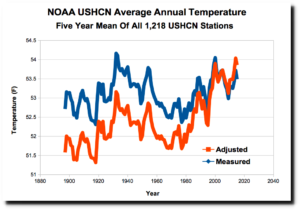
NOAA’s US temperature record shows that US was warmest in the 1930’s and has generally cooled as CO2 has increased. This wrecks greenhouse gas theory, so they “adjust” the data to make it look like the US is warming.
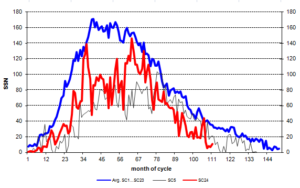
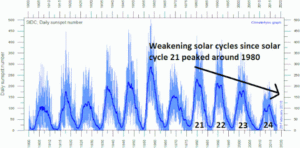
The sunspot number for February 2018 was 10.6 and thus was some 30% below the meanfor this time into the cycle. At the moment solar activity is close to quiet.
Just 10 years ago, all the talk was about the Arctic sea ice “death spiral”, with some of scientists hysterically predicting the sea ice would soon disappear altogether in the summertime. Ten years later the scientists are now scratching their heads as sea ice has stabilized and is showing some clear signs of a rebound.
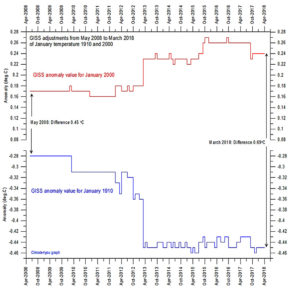
In the last 10 years, overseers of the NASA GISS global temperature data set have been busy utilizing cool-the-past-and-warm-the-present adjustment techniques to alter the slope of the overall warming trend.
For example, as the climate4you graph illustrates above, there was a +0.45°Cdifference between the 1910 temperature anomaly and the 2000 temperature anomaly as of May, 2008.
Today (March, 2018), NASA GISS has tendentiously adjusted up the difference between 1910 and 2000 to +0.69°C, a 53% increase.
Polar bear specialists Andrew Derocher and Steven Amstrup recently spent inordinate energy trying to refute the opinion piece I’d written for the Financial Post in celebration of International Polar Bear Daylast month, ignoring my fully referenced State of the Polar Bear Report for 2017 that was released the same day (Crockford 2018) and the scientific manuscript I’d posted last year at PeerJ Preprints (Crockford 2017). (…)
Well, folks were complaining that my graph of the CET compared to the centennial solar minima was just one location, England. So here are the five European temperature records which start before 1815. Now, if the theory of the solar/temperature connection is correct, the temperatures should start trending downward when the solar minima start, and they shouldn’t start warming back up until the sunspots get numerous again after the end of the minima. Here are the records so you can see if they agree with the theory.
(…) As you can see, there is no obvious sign that the solar minima have caused any change in the temperature. Some go up, some go down, some go nowhere.(…)
See also here Approaching ‘grand solar minimum’ could cause global cooling
La question est posée dans un excellent article de Pierre Gosselin paru en juin 2017 sur son site incontournable (1).
Personnellement, et je ne suis évidemment pas le seul, je n’accorde aucun crédit aux annonces tonitruantes d’ “année la plus chaude”, de “record de température” dont sont si friands nos médias, et je conserve un scepticisme identique pour la détermination de la température globale moyenne de la planète. En effet, pour qui s’intéresse à l’actualité climatique, les contradictions et manipulations dans les relevés de température terrestre sont monnaie courante, sous prétexte bien souvent d’ajustements et de mise à niveau, que ce soit pour les relevés actuels ou “l’actualisation” de données anciennes…
“L’avenir est connu, il suffit de modifier le passé“.
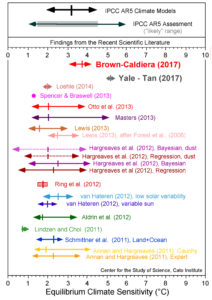
WUWT readers may recall this chart which clearly illustrates just how uncertain climate science really is.
t seems that some climate academics are a bit embarrassed that they haven’t been able to pin down climate sensitivity. From EU Horizon Magazine
Climate sensitivity – reducing the uncertainty of uncertainty
by Jon Cartwright
A study published in January 2018 claims to halve the uncertainty around how much our planet’s temperature will change in response to rising carbon dioxide (CO2) levels, potentially giving governments more confidence to prepare for the future.
This paper deals with the central argument that skeptics bring up about claims of global warming: How do you separate the temperature signal from the base components like natural variation, human land-use influence, micro-site bias, measurement errors and biases, and other factors to get the “true” global warming signal?
The answer is that you can’t, at least not easily.
With the surface temperature record, it’s somewhat easier since you can observe some of those elements directly and separate them (such as we’ve done in our surfacestations project for land-use microsite biases), but in the ocean, everything is homogenized by the ocean itself. All you can look for is patterns, and try to disentangle based on pattern recognition. That’s what they are trying to do here.
Disentangling Global Warming, Multidecadal Variability, and El Niño in Pacific Temperatures
Authors
Robert C. Wills, Tapio Schneider, John M. Wallace, David S. Battisti, Dennis L. Hartmann
by P. Homewood, March 15, 2015 in NotaLotofPeopleKnowThat
According to the heavily adjusted NOAA data, last month was the fifth warmest February on record in the Central Lakes Division of NY State, with an average mean temperature of 31.4F.
Prior to 1981, the warmest was February 1954, which averaged 29.8F. In other words, NOAA claim that February 1954 was 1.6F colder than last month.
Which all looks very suspicious, because the opposite picture is shown at the high quality station of Ithaca Cornell University (…)
In June 23, 1988 the Senate Committee on Energy and Natural Resources held a hearing addressing the Greenhouse Effect and Global Climate Change.
Among the presenters at this hearing was Dr. James Hansen, Director, NASA Goddard Institute for Space Studies who introduced his infamous and now debunked global surface temperature model results with future temperature projections under three different scenarios of CO2 emissions growth that grossly over exaggerated resulting projected global temperature increases.
Exceptionally large amount of winter snow in Northern Hemisphere this year
The new Arctic Now product developed by the Finnish Meteorological Institute shows with one picture the extent of the area in the Northern Hemisphere currently covered by ice and snow. This kind of information, which shows the accurate state of the Arctic, becomes increasingly important due to climate change. The Arctic region will be discussed at the Arctic Meteorological Week which begins in Levi next week.
German skeptic and weather expert ‘Schneefan’ here writes how climate activist Mark C. Serreze recently announced this year’s sea ice extent was at the smallest all-time area. But since then Arctic temperatures have plummeted and sea ice area has grown to over 14 million square kilometers (…)
So, you still don’t believe small changes in solar activity can significantly affect climate? You know a very cold period during the Little Ice Age coincided with the Maunder Minimum, but you have heard that the Little Ice Age could have had other causes, like volcanoes. You have been told repeatedly that since 1980 solar activity has been decreasing while global temperature has been increasing, so it can’t be the Sun.
Not so fast. There is a vested interest in climate change not being due to the Sun, as the Sun can’t be taxed or prevented from doing what it does. A further problem is that solar physicists have no clue about how the Sun can show centennial or millennial periodicities. As they prefer to talk about what they know, they reject such periodicities, even though we have evidence in cosmogenic records (14C in tree rings and 10Be in ice cores).
And if I tell you that little changes in the Sun have a disproportionate effect on climate you won’t believe me. You shouldn’t believe me. You shouldn’t believe anybody. Science is not about believing. Religion is about believing. So, I propose that you prove to yourself what effect little changes in the Sun have on climate.
(…) “A recent aerial survey of the Southern Hudson Bay subpopulation concluded that the abundance of polar bears has remained steady since 1986 (943 bears; SE: 174) (Obbard et al., 2015). The survey included the entire coastal range and offshore island habitat of the Southern Hudson Bay subpopulation, except for the eastern James Bay coast. Taken together, the results of the aerial survey and the participant responses from Wemindji and Chisasibi indicate that the local population has remained stable. However, the unanimous responses from participants in Whapmagoostui/Kuujjuarapik suggest that there has been a localized increase in the number of bears near Whapmagoostui/Kuujjuarapik.”
La géologie, une science plus que passionnante … et diverse