Archives de catégorie : better to know…?

Why California burns — its forests have too many trees

by T.M. Bonnicksen, November 12, 2018 in San FranciscoChronicle


The reason wildfires are burning California with unprecedented ferocity this year is because our public forests are so thick. It is our fault. We don’t manage our forests, we just let them grow. That is the simple truth. However, it is easier to deny the truth and blame a warming climate instead of admitting our guilt and taking action to prevent wildfires.

Hot, dry weather doesn’t cause catastrophic wildfires. It only makes them worse. In order for any fire to burn, it must have fuel. To spread wildly, it must have abundant fuel. Efforts in the 20th century to prevent fire and preserve forests have been too successful — they have disrupted the ecological balance and allowed more and more trees to grow.

End Of Snow Postponed

by Tony Heller, April 12, 2019 in ClimateChangeDispatch


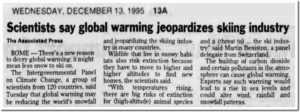
A quarter-century ago, the world’s leading climate experts predicted the end of skiing.

The exact opposite has occurred. Ski areas are receiving record snow and some are staying open all year round.

It wasn’t always like this though.  In 1932, the Winter Olympics almost had to be canceled because of a lack of snow.

13 Dec 1995, Page 13 – The Times at Newspapers.com

Netflix Series ‘Our Planet’ Accused Of Fake Climate Change Claims

by Graham Lloyd, April 10, 2019 in ClimateChangeDispatch


Netflix’s acclaimed Our Planet series has come under fire for “tragedy porn” over images of walruses falling to their deaths from cliff tops, allegedly because of climate change.

The Our Planet footage, narrated by David Attenborough, showed dozens of the animals climbing up 80-meter-high outcrops in northeast Russia because of a lack of sea ice.

They were shown plunging onto the rocks below, with hundreds of dead animals piled on the shoreline. A voice-over by Attenborough claimed their poor eyesight made it hard for them to return safely to the ocean.

But a Canadian zoologist has dismissed the claims as “contrived nonsense” and said the walruses were most likely driven over the cliffs by polar bears.

Susan Crockford, of the University of Victoria in British Columbia, Canada, told The Telegraph UK: “This powerful story is fiction and emotional manipulation at its worst.”

The polar bear expert said that at the time the footage was shot in 2017 at Kozhevnikova Cape, Ryrkaypiy, in eastern Russia, the town was being besieged by polar bears.

According to The Siberian Times, 20 bears had surrounded the town, attracted by 5,000 walruses that had appeared at a local protection zone.

Peak Ghawar: A Peak Oiler’s Nightmare

by David Middleton, April 10, 2019 in WUWT


Alternate title:

No… “The biggest Saudi oil field is [NOT] fading faster than anyone guessed”… Part Trois: Why Peak Oil Is Irrelevant and the Perpetually Refilling Abiotic Oil Field Is Abject Nonsense


Saudi Aramco’s recent bond prospectus has generated a lot of media buzz, particularly regarding the production from Ghawar, the largest oil field in the world. Reaction has ranged from “The biggest Saudi oil field is fading faster than anyone guessed,” (not even wrong) to more subdued reactions from Ellen Wald and Robert Rapier, that the prospectus doesn’t really tell us much Ghawar’s decline rate. One thing that the bond prospectus did do, is to paint a picture of the most profitable company in the world and one that is serious when it says it will produce the last barrel of oil ever produced on Earth.

How big is Ghawar? Has it peaked? Is it “fading faster than anyone guessed”? The answer to the first question is: FRACKING YUGE. The answer to the second question was not easily answerable before Saudi Aramco began the process of becoming a publicly traded company. The answer to the third question is: Of course not.

As Saudi Aramco proceeds towards a 2021 IPO, it has had to embrace transparency. This involved an audit of the proved reserves in their largest fields, comprising about 80% of the company’s value. The audit was conducted by the highly respected DeGolyer and MacNaughton firm (D&M). The audit actually determined that the proved reserves are slightly larger than Aramco’s internal estimate.

2019 ENSO forecast

by  J. Curry and J. Johnstone, April 9, 2019 in WUWT


CFAN’s 2019 ENSO forecast is for a transition away from El Niño conditions as the summer progresses. The forecast for Sept-Oct-Nov 2019 calls for 60% probability of ENSO neutral conditions, with 40% probability of weak El Niño conditions. – Forecast issued 3/25/19

Introduction

CFAN’s early season ENSO forecast is motivated by preparing our seasonal forecast for Atlantic hurricane activity. ENSO forecasts made in spring have traditionally had very low skill owing to the ENSO ‘spring predictability barrier.’

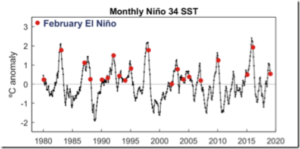
During fall 2018, there was warming in the Central Equatorial Pacific, leading to a weak El Niño Modoki pattern, which impacted the latter part of the Atlantic hurricane season. This transitioned to a weak (conventional) El Niño in February 2019 and the atmospheric anomalies became more consistent with a conventional El Niño pattern.

NOAA’s latest forecast: Weak El Niño conditions are likely to continue through the Northern Hemisphere spring 2019 (~80% chance) and summer (~60% chance).

CFAN’s ENSO forecast analysis is guided by the ECMWF SEAS5 seasonal forecast system and a newly developed statistical forecast scheme based on global climate dynamics analysis.

ENSO statistics

Figure 1 illustrates the recent ENSO history as depicted by monthly Niño 3.4 anomalies from 1980 to February 2019.

Nuclear Power Can Save the World

by J.S. Goldstein et al., April 6, 2019


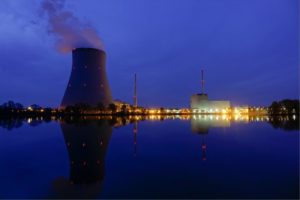
As young people rightly demand real solutions to climate change, the question is not what to do — eliminate fossil fuels by 2050 — but how. Beyond decarbonizing today’s electric grid, we must use clean electricity to replace fossil fuels in transportation, industry and heating. We must provide for the fast-growing energy needs of poorer countries and extend the grid to a billion people who now lack electricity. And still more electricity will be needed to remove excess carbon dioxide from the atmosphere by midcentury.


CO2 Emissions Up As Europeans Switch From Diesel To Gasoline Cars

by K. Oroschakoff, April 6, 2019 in WUWT


The aftermath of the Dieselgate scandal is pushing drivers to switch from diesel to gasoline cars, undermining efforts to cut carbon dioxide emissions from road transport.

Average CO2 emissions from new cars rose in 2017 for the first time since 2010 — largely due to the fuel change, according to final data released by the European Environment Agency (EEA) on Thursday.
That’s bad news for the EU’s efforts to cut emissions by at least 40 percent by 2030. Cars are responsible for around 12 percent of total EU CO2 emissions, according to the European Commission.

The EEA said that average CO2 emissions from new cars sold in 2017 increased by 0.4 grams of CO2 per kilometer to 118.5 grams, up from 118.1 grams in 2016. Under EU rules, carmakers need to meet a fleet-wide target of 95 grams by 2021.

Since 2010, emissions from new cars have fallen by 15.5 percent, or almost 22 grams of CO2 per kilometer; but emission reductions slowed between 2015 and 2016.

The rise in car pollution in 2017 is “stark confirmation that car makers need to achieve further and faster improvements in manufacturing and promoting more efficient cars,” the EEA said.

What would life be like without fossil fuels such as gas and oil?

by Anthony Watts, April 6, 2019 in WUWT


Leftists like Bill McKibben of 350.org suffer from irrational fantasies that lead them to believe that we can move society forward without all the benefits that petroleum brings to our modern society.

They’re dead wrong of course, and this short humorous video illustrates just what life might be like without the many products and energy sources that are derived from petroleum. My favorite is ink, which if we didn’t get from petroleum, we wouldn’t have to see print editions of NYT, WaPo, and the Lost Angeles Times, to name a few.

You also wouldn’t be able to read this article, because the very keyboard I am typing this on is made from plastic, which you guessed it, is derived from petroleum.

According to the US Energy Information Administration (EIA), this is a list of petroleum products and their share of total US petroleum consumption in 2013.

  • Gasoline 46%

  • Heating Oil / Diesel Fuel 20%

  • Jet Fuel ( kerosene) 8%

  • Propane / Propylene 7%

  • NGL / LRG 6%

  • Still Gas 4%

  • Petrochemical Feedstocks 2%

  • Petroleum Coke 2%

  • Residual / Heavy Fuel Oil 2%

  • Asphalt / Road Oil 2%

  • Lubricants 1%

  • Miscellaneous Products / Special Naphthas 0.4%

  • Other Liquids 1%

  • Aviation Gasoline 0.1%

  • Waxes 0.04%

  • Kerosene 0.02%

Nuclear power excluded from EU’s green investment label

by C. Stam & A. Prager, April 3, 2019 in EurActiv


The text voted in Parliament also excludes fossil fuels and gas infrastructure from the EU’s proposed green finance taxonomy, which aims to divert investments away from polluting industries into clean technologies.

In a bid to prevent “green-washing”, the Parliament text also requires investors to disclose whether their financial products have sustainability objectives, and if they do, whether the product is consistent with the EU’s green assets classification, or taxonomy.

While activists applauded the move, they said the classification voted by the European Parliament was too narrow and applies only to a limited set of recognisable green assets, such as wind and solar power companies.

“Brown list” rejected

An amendment to publish a “brown list” to name and shame investments seen as damaging for the environment was rejected by Parliament.

2019 Hurricane season forecast: below average

by Anthony Watts, April 4, 2019 in WUWT


Dr. Philip Klotzbach of Colorado State University writes on Twitter:

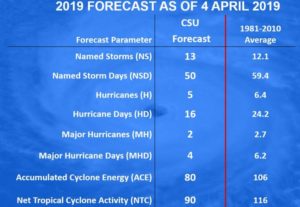
Seasonal #hurricane forecast from @ColoradoStateU predicts slightly below-average season: 13 named storms, 5 hurricanes & 2 major (Cat 3+, >=111 mph) hurricanes. Primary reason for slightly below-avg forecast is anticipated continuation of weak #ElNino.

We anticipate that the 2019 Atlantic basin hurricane season will have slightly belownormal activity. The current weak El Niño event appears likely to persist and perhaps even strengthen this summer/fall. Sea surface temperatures averaged across the tropical Atlantic are slightly below normal, and the far North Atlantic is anomalously cool.

Our Atlantic Multi-decadal Oscillation index is below its long-term average. We anticipate a slightly below-average probability for major hurricanes making landfall along the continental United States coastline and in the Caribbean. As is the case with all hurricane seasons, coastal residents are reminded that it only takes one hurricane making landfall to make it an active season for them. They should prepare the same for every season, regardless of how much activity is predicted.

PROBABILITIES FOR AT LEAST ONE MAJOR (CATEGORY 3-4-5) HURRICANE LANDFALL ON EACH OF THE FOLLOWING COASTAL AREAS:

1) Entire continental U.S. coastline – 48% (average for last century is 52%)

2) U.S. East Coast Including Peninsula Florida – 28% (average for last century is 31%)

3) Gulf Coast from the Florida Panhandle westward to Brownsville – 28% (average for last century is 30%)

PROBABILITY FOR AT LEAST ONE MAJOR (CATEGORY 3-4-5) HURRICANE TRACKING INTO THE CARIBBEAN

(10-20°N, 88-60°W) 1) 39% (average for last century is 42%)

La voiture à hydrogène est un miroir aux alouettes de la transition énergétique

by Olivier Daniélo, 2 avril 2019 in Reporterre


Il y a urgence à agir pour réduire les émissions de CO2. La marche et le vélo sont certes préférables à la voiture particulière. Mais parmi les différents types de voitures, quelle est la solution la plus efficace pour réduire les émissions de CO2 ?

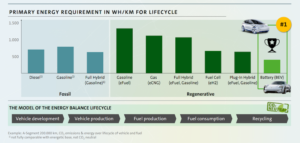
Il existe un indicateur particulièrement intéressant pour tenter d’y répondre : la quantité d’énergie consommée pour réaliser par exemple 200.000 kilomètres. Energie non seulement pour propulser la voiture, mais aussi pour fabriquer la voiture elle-même et extraire dans les mines les matières premières nécessaires. Le bilan carbone est bien entendu corrélé au bilan énergétique. Les experts du groupe Volkswagen (VW) ont fait le calcul et ont présenté les résultats le 12 mars 2019 à l’occasion de la conférence de presse annuelle de ce mastodonte dont les décisions influencent l’industrie automobile mondiale.


Verdict : la voiture aux carburants synthétiques (eFuel et eCNG) consomme trois fois plus d’énergie primaire que la voiture électrique. Et celle à l’hydrogène, 1,7 fois plus. Ces 70 % supplémentaires représentent un impact à la fois économique et carbonique. La fabrication de la pile à combustible et du réservoir capable de résister à une pression de 700 atmosphères est énergivore. La voiture à hydrogène la plus vendue au monde (quelques milliers d’exemplaires) pèse 1.850 kg, soit 3 kilos de plus que la Tesla Model 3 Long Range (100 % batterie), qui a la même autonomie. Mais, c’est surtout le mauvais rendement de la chaîne hydrogène qui plombe le bilan global.

Fabricating A Warming: NASA Now Altering ‘Unadjusted” Data To Create New, Warmer ‘Unadjusted’ Data

by P. Gosselin, March 31, 2019 in NoTricksZone


By Kirye

and Pierre Gosselin

One fellow climate blogger recently wrote on how he’s been been looking at GHCN ‘unadjusted’ data and noticed that scientists at NASA appear to have been altering them: “This is a fairly disturbing development,” he wrote.

Heating up Reykjavik and Nuuk

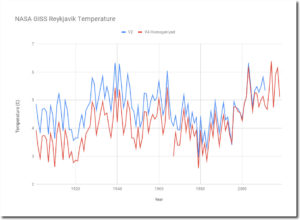
Cited as an example is Reykyavik, Iceland. According to Tony Heller here, “The current version V4 has massively cooled the past, to make it look like Iceland is warming.”

Heller then posted a chart showing the difference between v2 unadjusted and the new v4 ‘unadjusted’ for the Reykjavik station.


Spreadsheet

Heller also found here that the same appears to be the case for Nuuk, Greenland as well.

Methane warming exaggerated by 400%

by Barry Brill, March 30, 2019 in WUWT


The IPCC’s AR5 estimated the global warming caused by a tonne of livestock methane would be 28 times that of a tonne of carbon dioxide. New research destroys that estimate.

The war on meat has been gathering pace amongst our Western elites. The Economist makes a detailed case for “plant-based food” in the interests of quelling climate change –

The FAO calculates that cattle generate up to two-thirds of the greenhouse gases from livestock, and are the world’s fifth largest source of methane. If cows were a country, the United Herds of Earth would be the planet’s third largest greenhouse-gas emitter.

These calculations are based on figures supplied by the IPCC’s AR5, which contends that the global warming potential (GWP) of methane over 100 years is no less than 28 times the global warming it expects to be caused by an equivalent weight of carbon dioxide. This estimate is up from the GWP of 21 put forward in the IPCC’s previous report.

All this is now challenged by a new and authoritative research paper, Allen et al (2017): “A solution to the misrepresentations of CO2-equivalent emissions of short-lived climate pollutants, under ambitious mitigation”. This paper finds that conventional GWPs misrepresent the impact of short-lived gases (such as methane) on global temperature – and recommends the adoption of a new metric, denoted as GWP*.

REPORT: GREEN ENERGY ECONOMY IS SIMPLY ‘IMPOSSIBLE’

by Mark P. Mills, March 23, 2019 in GWPF


Hydrocarbons—oil, natural gas, and coal—are the world’s principal energy resource today and will continue to be so in the foreseeable future. Wind turbines, solar arrays, and batteries, meanwhile, constitute a small source of energy, and physics dictates that they will remain so. Meanwhile, there is simply no possibility that the world is undergoing—or can undergo—a near-term transition to a “new energy economy.”

see the .pdf

EIA AEO shows U.S. CO2 emissions 1 billion metric tons below 2007 peak in 2050

by Larry Hamlin,  March 23, 2019 in WUWT


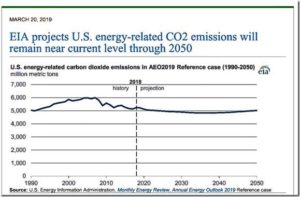
The Energy Information Administration (EIA) has released its 2019 Annual Energy Outlook(AEO) report for the U.S. showing that the nations year 2050 CO2 emissions will be just over 1 billion metric tons per year lower than its peak year 2007 CO2 emissions of 6.021 billion metric tons which retains and sustains the CO2 reductions achieved because of market driven increased use of natural gas while reducing coal fuel use.

During this same time period the world’s developing nations are forecast to increase their CO2 emissions by more than 14.5 billion metric tons per year bringing their CO2 emissions levels to a total of about 6 times those of the U.S.

Le “Changement climatique global’ ne cause pas de disparitions d’espèces

by Prof. Paul Berth, 22 mars 2019 in ScienceClimateEnergie


Contrairement à ce que les médias tentent de vous faire croire, le changement climatique global n’est pas une cause majeure de disparition d’espèces. Une récente étude publiée en mars 2019 dans le journal Frontiers in Ecology and the Environment vous le démontre : la cause majeure d’extinction est l’introduction d’espèces exotiques envahissantes (EEE) dans les écosystèmes. Ce phénomène, bien connu des biologistes et confirmé par l’IUCN(Union Internationale pour la Conservation de la Nature), est malheureusement peu connu du grand public.

1. Introduction

En se déplaçant d’un continent à l’autre, l’être humain a toujours emmené avec lui toute une série de plantes et d’animaux qui se retrouvaient ainsi en dehors de leurs limites biogéographiques habituelles. Avec le développement du commerce international ce phénomène ne fait que s’amplifier. Par exemple, à l’intérieur de l’Union Européenne, le nombre d’EEE aurait augmenté de 76% entre 1970 et 2007. Bien que l’impact écologique de la plupart des espèces introduites est inconnu ou semble négligeable, il est démontré que certaines introductions d’espèces ont provoqué des changements substantiels dans des écosystèmes[1]. Ces changements incluent souvent la disparition d’espèces locales[2]. On a d’abord pensé que ces phénomènes d’extinction étaient exagérés et que des espèces locales pouvaient également être à la base d’extinctions[3], et certains auteurs pensent même que les efforts déployés pour contrôler ou éradiquer les espèces étrangères introduites ne seraient pas nécessaires[4]. Cependant, personne n’a jamais vraiment testé si les espèces introduites provoquaient plus ou moins d’extinctions par rapport aux espèces locales ou aux autres causes d’extinctions. Cette question a donc été étudiée par l’équipe de Tim Blackburn (University College London, UK) dans une récente publication de mars 2019[5]. Ils ont pour cela utilisé la base de données des extinctions globales fournie par l’IUCN.

Figure 1. Nombre d’extinctions animales récentes (catégories IUCN “extinct” [EX] et “extinct in the wild” [EW]) pour différents groupes d’animaux (chiffres issus de la Table 3a de l’IUCN). Les couleurs renseignent sur les causes des extinctions (“Driver”); par exemple le mauve foncé est employé pour les EEE (“Alien”), les extinctions causées par des espèces locales (“Native”) sont en mauve clair. La catégorie “Neither” comporte les autres causes d’extinction ou alors des causes inconnues (source, Blackburn et al. 2019).


Bjørn Lomborg on ‘climate strikes’ – normalization of extreme language reflects decades of climate-change alarmism

by Anthony Watts, March 19, 2019 in WUWT


It is little wonder that kids are scared when grown-ups paint such a horrific picture of global warming.

For starters, leading politicians and much of the media have prioritized climate change over other issues facing the planet. Last September, United Nations Secretary-General António Guterres described climate change as a “direct existential threat” that may become a “runaway” problem. Just last month, The New York Times ran a front-page commentary on the issue with the headline “Time to Panic.” And some prominent politicians, as well as many activists, have taken the latest report from the United Nations Intergovernmental Panel on Climate Change (IPCC) to suggest the world will come to an end in just 12 years.

NOAA : “among the eight warmest Februarys on record”

by Tony Heller, March 19, 2019 in TheDeplorableClimSciBLog


NOAA says last month was “among the eight warmest Februarys on record” in much of the Earth.

According to NCEI’s Regional Analysis, South America, Europe and Oceania had a February temperature that ranked among the eight warmest Februarys on record.

There is no such word as “Februarys” – plural for February is Februaries. But besides the fact they are illiterate, they are also lying

It looks like the world is burning up, with just a few slightly cool areas. It has an official government seal on it, so it must be accurate, right?

The map below shows where NOAA actually had surface temperatures in February.

The Green New Deal’s Weak Chain Of Logic

by Daniel G. Jones, March 18, 2019 in ClimateChangeDispatch


Reagan observed: “It isn’t so much that liberals are ignorant. It’s just that they know so many things that aren’t so.”

So it is with the Green New Deal. Most liberals regard it as a simple proposition: Global warming is a really big problem, and it’s our fault, so let’s fix it.

But closer analysis reveals that the argument for the Green New Deal rests upon a long chain of interdependent assertions, every one of which must be believed for the problem to be of sufficient peril to warrant their drastic solution.

Here are links in their chain of logic. If you doubt the truth of any single step, you must discard the entire argument.

An Analysis of the Recent Climate Change Hysteria

by Tim Ball, March 16, 2019 in WUWT


Most people were taken in by the false story of human-caused global warming. We can include all the students participating in the classroom walkout to demand governments stop climate change, organized by 16-year-old Greta Thunberg. Her goal is to keep global temperatures below 2 degrees Celsius above pre-industrial levels. Apparently, she has no idea that the temperature was near or above that level for most of the last 10,000-years in a period known as the Holocene Optimum.

They are taken in by the false claim that a minute amount of human-produced CO2 is effectively controlling the entire atmospheric system since 1950 and causing environmental collapse through global warming. They don’t know that there is an upper limit to the amount that CO2 can increase temperature. They don’t know that the average level of CO2 over the last 250 million years is 1200 ppm. They don’t know that every projection of temperature by the UN Intergovernmental Panel on Climate Change (IPCC) since 1990 was wrong. To paraphrase Winston Churchill, how did so few, fool so many, to such an extent, for so long?

Emails reveal how children become pawns of climate alarmism

by Anthony Watts, March 13, 2019 in WUWT


Genesis of a Shakedown: New Records Expose Children’s Marches as Long-Planned Component of Litigation Campaign

These public records produced mere days after 60 Minutes’s promotional segment, and days before the nationwide children’s climate walkouts, affirm:

  • the climate litigation campaign was expressly grounded in this failure of “conventional approaches” otherwise known as our constitutional system

  • it was to be “linked to youth climate movement (world-wide marches)”;

  • it would be accompanied by a press strategy including documentaries featuring children;

  • the meeting was acknowledged, but this strategy laid out there was “not to be publicized”;

  • the strategy sought both a cooperative federal administration “Consent decrees (would be ideal)” — and to “Bring selected carbon majors to the table, then what?”

Polar bear habitat update: abundant sea ice across the Arctic, even in the Barents Sea

by Polar Bear Science, March 12, 2019


Abundant ice in Svalbard, East Greenland and the Labrador Sea is excellent news for the spring feeding season ahead because this is when bears truly need the presence of ice for hunting and mating. As far as I can tell, sea ice has not reached Bear Island, Norway at this time of year since 2010 but this year ice moved down to the island on 3 March and has been there ever since. This may mean we’ll be getting reports of polar bear sightings from the meteorological station there, so stay tuned.


Monster solar storm that hit Earth discovered in the past

by Anthony Watts, March 12, 2019 in WUWT


Something this big today would surely fry electrical grids, GPS, and communications. It may be bigger than the Carrington Solar event of 1859.

Scientists have found evidence of a huge blast of radiation from the Sun that hit Earth more than 2,000 years ago. The result has important implications for the present, because solar storms can disrupt modern technology.

The team found evidence in Greenland ice cores that the Earth was bombarded with solar proton particles in 660BC. The event was about 10 times more powerful than any since modern instrumental records began.

The Sun periodically releases huge blasts of charged particles and other radiation that can travel towards Earth.

The particular kind of solar emission recorded in the Greenland ice is known as a solar proton event (SPE). In the modern era, when these high-energy particles collide with Earth, they can knock out electronics in satellites we rely on for communications and services such as GPS.

A Month Without Sunspots

by Dr Tony Phillips, March 6, 2019 in SpaceWeatherArchive


March 1, 2019: There are 28 days in February. This year, all 28 of them were spotless. The sun had no sunspots for the entire month of Feb. 2019. This is how the solar disk looked every day:

How does this affect us on Earth? The biggest change may be cosmic rays. High energy particles from deep space penetrate the inner solar system with greater ease during periods of low solar activity. Indeed, NASA spacecraft and space weather balloons are detecting just such an increase in radiation. Cosmic rays can alter the flow of electricity through Earth’s atmosphere, trigger lightning, potentially alter cloud cover, and dose commercial air travelers with extra “rads on a plane.”

As February ended, March is beginning … with no sunspots. Welcome to Solar Minimum!

CLIMATE SCIENTIST NIC LEWIS: ‘EUROPEAN CO2 EMISSIONS DON’T MATTER’

by Edwin Timmer, March 9, 2019 in GWPF


“What really matters is: what happens in developing countries such as China, India, Indonesia, Brazil and Nigeria”, says Lewis, who gave a presentation at De Groene Rekenkamer Foundation this week in Amsterdam. According to him, it is much more important that developing countries quickly become richer and how rising CO2 emissions that this entails can be limited.

“We have a lot of knowledge and expertise in Europe. We can spend our money better than investing billions in subsidies and other climate policies that have virtually no effect on global emissions.”

Lewis would prefer to see investments in the development of clean nuclear energy or techniques to get CO2 out of the air and shut down coal-fired plants. “That could then be rolled out over the rest of the world.”