by P. Homewood, September 3, 2018, in NotaLotofPeopleKnowThat
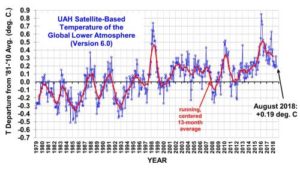
Global temperatures fell back to 0.19C in August. This means the YTD average is 0.23C, putting them back to roughly where they were in 2002.
…
by P. Homewood, September 3, 2018, in NotaLotofPeopleKnowThat
Global temperatures fell back to 0.19C in August. This means the YTD average is 0.23C, putting them back to roughly where they were in 2002.
…
by JC Dupont, 3 septembre 2018
Quelques commentaires sur quelques commentaires
La Lettre d’information 7 sort légèrement du cadre prévu à l’origine pour ces Lettres. Elle se rapporte à des commentaires qu’elles ont suscités et qui sont parus dansL’1Dex. L’1Dex est un média alternatif valaisan, dont le motto est « Pour un Valais
critique et libertaire ». Grâce au libéralisme de son rédacteur en chef, Me Stéphane Riand, et de son équipe dirigeante, les voix discordantes, les pensées de contre-courant, les points de vue tenus pour hérétiques, tout ce qui se heurte aux interdits des presses bien-pensantes, peuvent se faire entendre. De l’air frais sur la « Panurgie ». C’est ainsi que mes Lettres d’information ont connu une diffusion inespérée. L’1Dex offre aussi à ses lecteurs la possibilité de réagir avec des commentaires, qui sont le plus souvent anonymes. L’ignorance générale où l’on est des questions relatives au climat, ajoutée à l’illusion qu’un consensus se serait établi parmi les scientifiques, comme on le laisse entendre dans les milieux de la climatologie officielle, expliquent la cacophonie et la variété ébouriffante de certains de ces commentaires. Pour des raisons que j’expose plus loin, je ne m’y suis guère arrêté jusqu’ici. De par le contexte même, le contenu de la présente Lettre est plus local. Néanmoins, on passe à la généralité par des extrapolations simples.
….
by Judith Curry, July 22, 2018 in ClimateEtc.
A remarkable essay by esteemed oceanographer Carl Wunsch.
While doing a literature survey for my paper on Climate Uncertainty and Risk, I came across a remarkable paper published in 2010 by MIT oceanographer Carl Wunsch, entitled Towards Understanding the Paleocean.
The paper is remarkable for several reasons — not only that it was published but that the paper was apparently invited by journal editor.
The paper is well worth reading in its entirety, for a fascinating perspective on paleo-oceanography and paleoclimatology. Here I provide excerpts of relevance to the sociology of climate science:
…
by F. Sotiropoulos, September 2018, in Stony Brook University/ published in Nature
The use of in-stream flow (or hydrokinetic) energy converters in rivers appears to offer another workable and effective option to expand renewable energy and limit carbon emissions in the United States. While the potential for in-stream flow energy harvesting systems has already been demonstrated for rivers with fixed beds, researchers now developed a scaled demonstration of hydrokinetic energy generated from a river channel with a sandy bed. Their findings, detailed in a new paper published in Nature Energy, showed that the model hydrokinetic power plant can generate energy effectively and safely without undermining the stability of the river geomorphic environment.
…
by Tony Heller, August 0, 2018 in ClimateChangeDispatch
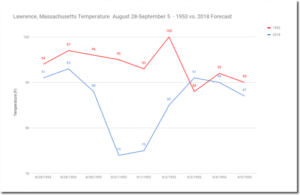
The US had an unprecedented late summer heat wave from August 24 to September 6, 1953. The animation below shows the progression of the heat wave.
…
by Susan J. Crockford, August 29, 2018 in FinancialPost
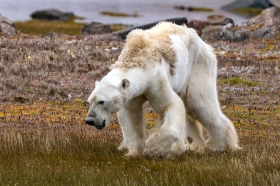
It was tragedy porn meant to provoke a visceral response — the gut-wrenching video of an emaciated polar bear struggling to drag himself across a snowless Canadian landscape made billions of people groan in anguish. Taken in August 2017 by biologist Paul Nicklen, a co-founder of the Canadian non-profit SeaLegacy, the video was posted on Instagram in December 2017, stating “This is what starvation looks like” as part of a discussion about climate change.
…
by Anthony Watts, August 27, 2018 in WUWT
Remember this? The ill-fated “Spirit of Mawson” expedition to Antarctica (in the Akademik Shokalskiy) that set out to bring attention to “global warming” only to be trapped in ice?
It’s deja vu all over again. (with h/t to Yogi Berra)
…
See also here
by Johann Rivalland, 24 août 2018 in Contrepoints
Les nouvelles politiques énergétiques et le choix des énergies renouvelables sont-ils en train de nous mener droit dans le mur ?
Hervé Machenaud a mené toute sa carrière professionnelle dans le secteur de l’énergie, où il a notamment contribué à la création de centrales nucléaires en France et à l’étranger et à la conception de l’EPR, le réacteur franco-allemand.
C’est en spécialiste des questions industrielles liées à l’énergie qu’il tire la sonnette d’alarme, mettant en cause des orientations politiques périlleuses, susceptibles selon lui de causer des dommages colossaux à nos sociétés dans leur ensemble.
UN CONSTAT IMPLACABLE
Au cours de la dernière décennie, ce sont des montants gigantesques de dépréciations qui ont été essuyés par les grands électriciens européens. Plus de 100 milliards d’euros rien qu’en quatre ans depuis 2014. Constat qui se paye par un désengagement préoccupant des grandes compagnies dans la production d’électricité. Au total, ce sont en effet 60 GW de moyens conventionnels d’électricité qui auront été arrêtés en Europe à la fin de la décennie, précise-t-il, soit l’équivalent du parc nucléaire français.
…
by Anthony Watts, August 23, 2018 in WUWT
Napoleon’s defeat at Waterloo caused in part by Indonesian volcanic eruption
Electrically charged volcanic ash short-circuited Earth’s atmosphere in 1815, causing global poor weather and Napoleon’s defeat, says new research.
Historians know that rainy and muddy conditions helped the Allied army defeat the French Emperor Napoleon Bonaparte at the Battle of Waterloo. The June 1815 event changed the course of European history.
Two months prior, a volcano named Mount Tambora erupted on the Indonesian island of Sumbawa, killing 100,000 people and plunging the Earth into a ‘year without a summer’ in 1816.
Now, Dr Matthew Genge from Imperial College London has discovered that electrified volcanic ash from eruptions can ‘short-circuit’ the electrical current of the ionosphere – the upper level of the atmosphere that is responsible for cloud formation.
The findings, published today in Geology, could confirm the suggested link between the eruption and Napoleon’s defeat.
…
by Chris Money, September 2, 2015 in TheWashingtonPost
In a blockbuster study released Wednesday in Nature, a team of 38 scientists finds that the planet is home to 3.04 trillion trees, blowing away the previously estimate of 400 billion. That means, the researchers say, that there are 422 trees for every person on Earth.
However, in no way do the researchers consider this good news. The study also finds that there are 46 percent fewer trees on Earth than there were before humans started the lengthy, but recently accelerating, process of deforestation.
“We can now say that there’s less trees than at any point in human civilization,” says Thomas Crowther, a postdoctoral researcher at the Yale School of Forestry and Environmental Studies who is the lead author on the research. “Since the spread of human influence, we’ve reduced the number almost by half, which is an astronomical thing.”
…
by K. Richard, August 20, 2018 in NoTricksZone
by Anthony Watts, August 17, 2018 in WUWT
From the “science eventually self-corrects” department, new science showing coral bleaching of the Great Barrier Reef is a centuries-old problem, well before “climate change” became a buzzword and rising CO2 levels were blamed.
Marc Hendrickx writes:
New paper shows coral bleaching in GBR extending back 400+ years.
…
by Kirye and P. Gosselin, August 17, 2018 in NoTricksZone/JapanMeteorologicalAgency
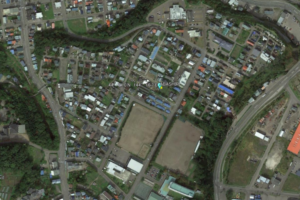
Aerial photos show that the 15 temperature observation stations the JMA is using to determine mean temperature anomalies are likely impacted far more by urbanization than the agency claims.
…
…
Abashiri is in the middle of buildings and streets.
by M. Roffet-Salque et al., August 13, 2018
This study reveals that animal fats preserved in pottery vessels from the United Nations Educational, Scientific and Cultural Organization (UNESCO) World Heritage site of Çatalhöyük recorded the abrupt 8.2-thousand years B.P. climatic event in their hydrogen isotopic compositions. In addition, significant changes are observed in the archaeology and faunal assemblage of the site, showing how the early farming community at Çatalhöyük had to adapt to climate change. Significantly, this contribution shows that individual biomolecules preserved in ancient animal fats can be used to reconstruct paleoclimate records and thus, provides a powerful tool for the detection of climatic events at well-dated onsite terrestrial locations (i.e., at the very settlements where human populations lived).
…
by Ernest Mund, 13 aoüt 2018, in ScienceClimatEnergie
La fourniture d’électricité est essentielle au développement économique d’une nation et à son harmonie politique et sociale. Les profondes mutations subies actuellement par le système électrique dans lequel la part des énergies renouvelables intermittentes ne cesse d’augmenter, présentent des risques pour cette fourniture. Il importe d’en assurer la sécurité. Evaluer le coût d’un blackout est donc un élément d’information essentiel, qui devrait être pris en compte dans toute décision future d’investissement en matière de génération de puissance.
(…)
by Samuele Furfari, 7 août 2018 in Contrepoints
Quelle aubaine pour les doctrinaires du développement durable ! Au moment de leur jour du dépassement il fait chaud, très chaud. Évidement ni l’écologisteHulot, ni France 2, ni France 24, ni la RTBF ni la ribambelle de médias impréparés ne pouvaient rater pareille occasion pour lier les deux évènements et nous culpabiliser pour introduire le contrôle de tous les détails de nos vies.
Ce premier août était donc le jour où, d’après Global Footprint Network (GFN), qui possède l’argent pour employer des dizaines de chercheurs souvent financés par les deniers publics, nous vivons désormais à crédit. À sa suite, toutes les ONG environnementales (ONGE) et nombre de politiciens se font les mégaphones de cette supercherie qui ne repose sur aucune base scientifique. Le jour du dépassement global (earth overshooting day) prétend être un indicateur dont l’objectif est de conscientiser et responsabiliser les pays développés à la notion d’empreinte écologique. Bien entendu, à part les Européens endoctrinés par les ONGE, cette théorie n’a guère d’écho dans le reste du monde.
…
by Tribune de Genève, 5 août 2018 in LesBlogs
Il y a juste un an, l’image d’un ours décharné et titubant avait fait le tour du monde. Elle était supposée représenter la réalité du réchauffement de l’atmosphère. Pourtant cette hypothèse n’était pas plus probable qu’une autre, par exemple: ours vieux, malade, mourant de mort naturelle.
…
by C3Headlines, February 1, 2016
The below is a list of past severe weather events and natural disasters – prior to the consistent 350+ppm CO2 levels attained in the 1990’s. In addition, scattered throughout the list are interesting “expert” climate predictions and observations
…
See alos here
by Donna Laframboise, August 3, 2018 in BigPictureNews
SPOTLIGHT: The iconic magazine is now a purveyor of propaganda.
BIG PICTURE: On her PolarBearScience.com blog last week, zoologist Susan Crockford called our attention to a startling admission over at National Geographic. It acknowledges publishing fake news. Or, as it more delicately puts it, we “went too far in drawing a definitive connection between climate change and a particular starving polar bear.”
An “Editor’s Note” explains the magazine added a wholly misleading caption to a video of an emaciated polar bear filmed last August. When it published this video on its website in December, National Geographic declared: “This is what climate change looks like.”
Actually, this is what dishonesty looks like. Neither the magazine nor the person who did the filming knew anything about that bear. It might have been stricken with disease. It might have sustained an injury that impeded its ability to hunt. As the Editor’s Note now admits: “there is no way to know for certain why this bear was on the verge of death.”
(…)
by Benny Peiser, August 1, 2018 in GWPF
…
by Anthony Watts, July 31, 2018 in WUWT
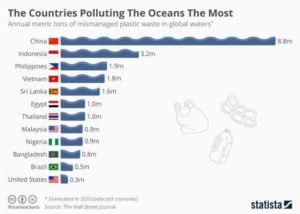
As many WUWT readers know, there’s this push to “save the planet” by banning plastic straws. Like most liberal Earth saving fantasies, it’s rooted in shonky science, or in this case, no science at all, just a guess.
…
by David Middleton, July 31, 1018 in WUWT
This post was inspired by Anthony Watts’ recent post about wildfires and their unwillingness to cooperate with the Gorebal Warming narrative.
…
A Geological Perspective of Wildfires
The Fire Window
Geological evidence for ancient wildfires generally consists of sedimentary charcoal deposits (inertinite). Fossil charcoal is also a key factor in understanding the evolution of Earth’s atmosphere, particularly oxygen content. The first clear evidence of fire is in the Late Silurian.
…
by Tony Heller, July 31, 2018 in ClimateChangeDispatch
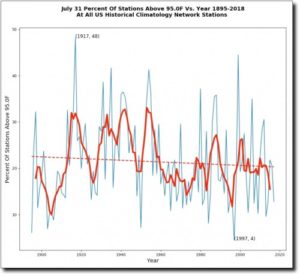
July 31 afternoon temperatures have been declining in the US for a century, with the hottest year being 1917 when almost half of the US was over 95 degrees.
by P. Homewood, July 31, 2018 in NotaLotofPeoppleKnowThat
Within the next few decades, Big Meat and Big Dairy could surpass Big Oil as the world’s biggest climate polluters, a new study by non-profit GRAIN and the Institute for Agriculture and Trade Policy (IATP) showed on Wednesday.
The world’s biggest animal protein producers could soon surpass ExxonMobil, Shell, and BP as the largest contributors to climate pollution, according to the study.
IATP and GRAIN jointly published the study that quantifies emissions from 35 of the world’s largest meat and dairy companies and reviews their plans to fight climate change.
The report found out that the five largest meat and dairy corporations combined – JBS, Tyson, Cargill, Dairy Farmers of America, and Fonterra – are already responsible for more annual greenhouse gas emissions than ExxonMobil, Shell, or BP. According to one figure in the report, the combined emissions of the top five companies are on par with those of Exxon and significantly higher than those of Shell or BP.
by P. Homewood, July 263, 2018 in NotaLotofPeopleKnowThat
Remember that video of an emaciated Baffin Island polar bear that went viral last December? In an unexpected follow-up (“Starving-Polar-Bear Photographer Recalls What Went Wrong“; National Geographic, August 2018 issue), photographer Cristina Mittermeier makes some astonishing admissions that might just make you sick.
…
Susan Crockford uncovers the truth behind that “starving polar bear video”