Archives par mot-clé : Wrong Prediction(s)?

Réchauffement des océans, Tchernobyl, cancer et pesticides, liste bio, QI mondial… une semaine de fake news scientifiques

by J.P. Oury, 11 octobre 2019 in EuropeanScientist


Si le sujet « vérité et connaissance scientifique » est un pilier de la philosophie classique et de l’épistémologie contemporaine, il se pourrait bien que, dans une ère de post-vérité, ce thème soit progressivement remplacé par celui de la chasse aux « fausses informations ». Pour le dire autrement, ce qui compte, ce n’est plus la quête d’un sens métaphysique ou une recherche de cohérence logique, mais qu’un énoncé tienne le plus longtemps possible à la Une de l’actualité avant d’être remis en cause.

En affirmant ceci notre objectif n’est pas de donner un blanc seing au relativisme ou d’abandonner la méthode scientifique, bien au contraire. Il s’agit de réfléchir sur la possibilité de redonner à celle-ci  sa superbe ; d’autant plus qu’elle n’est plus simplement une affaire de scientifiques : les médias, les politiques, les ONG et l’opinion s’emparent immédiatement de la moindre expérience rendue publique et se trouvent engagés de manière quasi instantanée dans le processus de « vérification » qui passe d’abord souvent par l’acceptation. Ce qui montre la nécessité d’éduquer l’opinion pour lui apprendre à détecter les différentes typologies d’erreurs scientifiques. Voici donc une petite grille de lecture que nous avons établie en classant cinq grandes typologies d’informations scientifiques qui se sont révélées fausses…


Rétractation d’un article sur le réchauffement des océans : l’erreur scientifique


Canadian Govt. Scrapped 100 Years Of Inconvenient Data On Climate Change

by L.  Goldstein, Sep. 22, 2019 in ClimateChangeDispatch

Canadians already suspicious of Prime Minister Justin Trudeau’s carbon tax will likely be even more suspicious given a report by Ottawa-based Blacklock’s Reporter that Environment Canada omitted a century’s worth of observed weather data in developing its computer models on the impacts of climate change.

The scrapping of all observed weather data from 1850 to 1949 was necessary, a spokesman for Environment Canada told Blacklock’s Reporter, after researchers concluded that historically, there weren’t enough weather stations to create a reliable data set for that 100-year period.

“The historical data is not observed historical data,” the spokesman said. “It is modeled historical data … 24 models from historical simulations spanning 1950 to 2005 were used.”

These computer simulations are part of the federal government’s ClimateData.ca website launched by Environment Minister Catherine McKenna on Aug. 15.

She described it as “an important next step in giving our decision-makers even greater access to important climate data for long-term planning. The more each of us uses this type of information, the more it will help.”

Blacklock’s Reporter, which describes itself as “the only reporter-owned and operated newsroom in Ottawa” focusing on intensive reporting of government documents, notes that in many cases the observed temperatures scrapped by Environment Canada in creating its computer models were higher in the past than today.

For example, Vancouver had a higher record temperature in 1910 (30.6C) [87.08F] than in 2017 (29.5C) [85.1F].


Alarmist Rhetoric Based On Exaggerations And Lies”

by P. Gosselin, Sep. 18, 2019 in NoTricksZone


In a recent interview with the online Berliner Zeitung (BZ) here, economist Björn Lomborg said that 16-year old Greta Thunberg’s demands “will put people in danger”.

Greta, the Swedish teenage activist is calling for radical cuts in CO2 emissions – on a scale that would have profound impacts on the world’s market system. Moreover, Lomborg calls the demands immoral. Lomborg says it would be far wiser to invest money in bringing the world’s poor out of grinding poverty rather than to try to mitigate climate change.

Fear based on 30 years of lies and exaggerations

“Rich countries that tell poor countries not to use fossil energy for the benefit of the environment are acting immorally,” Lomborg told the BZ.

Lomborg also sharply criticized Thunberg, telling BILD news daily: “Greta Thunberg fears the end of the world due to climate change. This fear is the result of three decades of alarmist rhetoric based on exaggerations and lies.”

€43 billion for 0.00001°C of temperature reduction yearly

Lomborg also called Germany’s “Energiewende” – transition to green energies – “the best example of a failed climate policy” which has proven to be “incredibly costly and ineffective.”

“Global warming will be reduced by 0.001 degrees at most by 2100 for 43 billion euros a year,” he told the BZ. Lomborg blames the adults for panicking Ms Thunberg and using her “to push through an agenda that costs trillions but brings almost no benefits.”

Rather, for the trillions we will likely get us far graver problems. What a deal.

Doomsdays that didn’t happen: Think tank compiles decades’ worth of dire climate predictions

by P. Homewood, Sep. 19, 2019 in NotaLotofPeopleKnowThat


Doomsdays that didn’t happen: Think tank compiles decades’ worth of dire climate predictions

by Paul Homewood

By Paul Homewood


From Fox:


image

Rep. Alexandria Ocasio-Cortez recently suggested Miami would disappear in “a few years” due to climate change. The United Nations is convening a “Climate Action Summit” next week. And climate activist Greta Thunberg is on Capitol Hill this week telling lawmakers they must act soon.

But while data from NASA and other top research agencies confirms global temperatures are indeed rising, a newly compiled retrospective indicates the doomsday rhetoric is perhaps more overheated.

The conservative-leaning Competitive Enterprise Institute has put together a lengthy compilation of apocalyptic predictions dating back decades that did not come to pass, timed as Democratic presidential candidates and climate activists refocus attention on the issue.

The dire predictions, often repeated in the media, warned of a variety of impending disasters – famine, drought, an ice age, and even disappearing nations – if the world failed to act on climate change.

An Associated Press headline from 1989 read “Rising seas could obliterate nations: U.N. officials.” The article detailed a U.N. environmental official warning that entire nations would be eliminated if the world failed to reverse warming by 2000.

Then there were the fears that the world would experience a never-ending “cooling trend in the Northern Hemisphere.” That claim came from an “international team of specialists” cited by The New York Times in 1978.

German Climatologist Werner Kirstein Unloads: “IPCC Is To Deceive People”…Calls Michael Mann’s Chart “A Fake”

by P. Gosselin, Sep.17, 2019  in NoTricksZone


German climate scientist Professor Werner Kirstein was interviewed by alternative media outlet NuoViso,  and since the video was released early this month on Youtube, it has been viewed over 130,000, times.

Politics commissioning reports for money

In the interview Professor Kirstein tells moderator Robert Stein that CO2 emissions have no effect on the climate and that “politicians commission climate scientists to produce expert reports for money.”

“Public is being deceived”

Prof. Kirstein talks about the “conscious deception” of the public and how all research projects and publications by “climate scientists” only have the goal of confirming “man-made climate change” and that different scientific views are not welcome.

According to Kirstein, the public is being deceived with the false information and that the aim of politics is to find a way to collect further taxes and to collect levies.

“We currently see this with the climate tax, which is to be introduced soon,” Kirstein says.

Ruan et al., 2019   

Why CO2 is Not the Control Knob of Global Temperature and Observational Proof it is Not Causing Dangerous Warming

by Institute for the Human Environment,   August 2019


There is no debate as to whether or not atmospheric carbon dioxide, or CO2, is a so-called greenhouse gas. When present in the atmosphere, this one-carbon and two-oxygen molecule indeed has the capacity to absorb infrared radiation and warm the planet. There is also no debate as to whether or not the concentration of atmospheric CO2 is rising; over the past two centuries it has increased from a meager 0.028% of the atmosphere by volume to a still-meager 0.041% today. Furthermore, there is no argument that global temperatures are warmer today than they were 50, 100 or even 200 years ago. However, there is much debate on whether or not the modern increase in atmospheric CO2 has caused, or is presently causing, dangerous global warming, warming so severe that it is threatening life all across the planet.

But how accurate is this narrative?

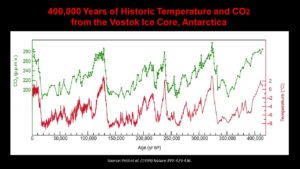
In answering this question, one need only examine the historic temperature and CO2 records illustrated in Figure 1 more critically. Certainly, these two variables experience a fairly high degree of correlation over the time period shown. However, it doesn’t take a Ph.D. scientist to recognize and understand the fact that correlation among two variables does not prove causation. Every textbook on statistics teaches as much, and they also teach that a hypothesis of causation among two variables can be rejected if there is no statistically significant correlation between them, or if the correlation fails to be maintained in a consistent and expected manner across time.

By applying such principles to the case being considered here, it can confidently be argued that if carbon dioxide is indeed the all-important control knob of temperature that climate alarmists claim it to be, then changes in atmospheric CO2 should always precede changes in temperature. And, because CO2 is a greenhouse gas, to prove causation those changes must always be such that a rise in CO2 induces a corresponding rise in temperature, whereas a decline in CO2 must always induce a corresponding drop in temperature. Consistent observations to the contrary, if present in the historic record, would therefore serve to invalidate a causation claim, as well as demonstrate that atmospheric CO2 is nothing more than a bit player among the many factors that drive climate change.

Figure 1. 400,000 years of historic temperature and CO2 from the Vostok Ice Core, Antarctica. Source: Petit et al. (1999) Nature 399: 429-436.

Anchorage “Record” Was Not Actually A Record!

by P. Homewood, July 14, 2019 in NotaLotofPeopleKnowThat


The US state of Alaska, part of which lies inside the Arctic Circle, is sweltering under a heatwave, with record temperatures recorded in several areas, including its largest city.

Temperatures reached 90F (32C) in Anchorage on Thursday, shattering the city’s previous record of 85F.

https://www.bbc.co.uk/news/world-us-canada-48890556

The report clearly implied global warming as the cause, with several references to climate change links throughout the article.

As I pointed out at the time, the all-time record temperature for Alaska was set as long ago as 1915, when an incredible 100F was measured at Fort Yukon.

This story follows the usual BBC recipe for Arctic heatwaves:

  • Record temperatures = global warming
  • Hot weather is unprecedented in the Arctic. Most people would believe that temperatures of 90F simply never used to occur in the Arctic, it just sounds so unimaginable.

Unfortunately for the BBC, it turns out that the Anchorage temperature is not even a record!

I have now had time to check through the NOAA data files, and have discovered that back in June 1931, the temperature actually reached 92C at Anchorage:

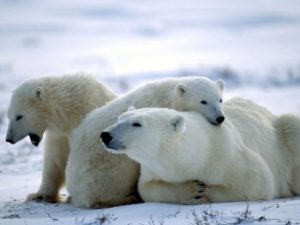
Polar Bears Are Thriving Despite Global Warming: Here’s Why

by Susan J. Crockford, July 11, 2019 in ClimateChangeDispatch


This essay explains in simple terms why so many people still believe that polar bears are in peril when nothing could be further from the truth; it is an essential lesson that shatters the basis of the shameful indoctrination of young school children and undermines the baseless claims of activist protestors.

It was written and translated into French for a special climate change feature issue (July) of the monthly French magazine Valeurs Actuelles (reviewed here) and reprinted by the French hunting magazine Chasses Internationales.

It has also been translated into German for a dedicated climate change issue (11 July) of the Swiss weekly magazine Die Weltwoche.

I have added a couple of figures to illustrate this English version of the essay.

‘Woke’ Climate Scientists Reveal Deep, Hard-Core Biases In New Article

by Judith Curry, July 9, 2019 in ClimateChangeDispatch


It’s getting worse.

About 5 years ago, I wrote two blog posts on climate scientists’ pre-traumatic stress syndrome:

Mother Jones has a new article on the same topic: It’s the end of the world as they know it: The distinct burden of being a climate scientist.

The following scientists were interviewed: Kim Cobb, Priya Shukla, Peter Kalmus, Sarah Myhre, Jacquelyn Gill, Katharine Wilkinson, Eric Holthaus, David Grinspoon, Ken Caldeira.

Lots of ‘trauma,’ read the article to get a flavor. This sentence pretty much sums things up:

“There’s deep grief and anxiety for what’s being lost, followed by rage at continued political inaction, and finally hope that we can indeed solve this challenge. There are definitely tears and trembling voices.”

End of civilization?

The title of the article is: “It’s the end of the world as they know it.” Some selected quotes:

Arctic Sea Ice Surprise Global Warming Experts By Remaining Stable This Decade

by P. Gosselin, June 28, 2019 in NoTricksZone


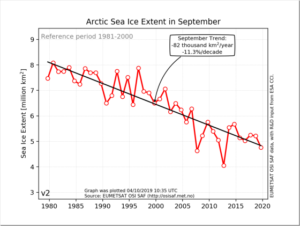
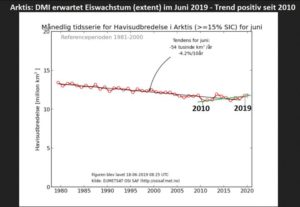
The Danish Meteorological Institute (DMI) expects sea ice extent growth in June 2019:

The DMI plot for the development of Arctic sea ice area (extent) from June 1979 to the PROGNOSE for June, 2019. Since 2010, i.e. 9 years ago, the sea ice areas of the Arctic have been growing in trend. Reports about disappearing sea ice in the Arctic are fake news. See also: No ice melting in the Arctic in this decade. Source: DMI-Plots Ice Cover

May Arctic sea ice trend now stable 15 years

More Failed Predictions: May Was The Second Wettest Month In US History

by Chriss Street, June 28, 2019 in ClimateChangeDispatch


National Oceanic and Atmospheric Administration reported the month of May was the second wettest and temperatures were in the bottom-third for its 125-year US history.

The 2010 publication titled, ‘A Global Overview Of Drought and Heat-Induced Tree Mortality Reveals Emerging Climate Change Risks for Forests’, was accepted by the Obama administration as scientific evidence that climate change had made the Earth:

“…increasingly vulnerable to higher background tree mortality rates and die-off in response to future warming and drought, even in environments that are not normally considered water-limited.”

But NOAA just reported that May US precipitation totaled an average of 4.41 inches, 1.50 inches above average, and ranked second wettest in the 125-year period of record for May as well as second wettest for all months since January 1895.

The only wetter month in US history was May 2015 with 4.44 inches of precipitation.

The 37.68 inches of precipitation across the contiguous U.S. from June 2018 to May 2019 shattered the previous 1982-83 12-month period by 1.48 inches.

Near-record to record precipitation was observed from the West Coast through the central Plains and into the Great Lakes and parts of the Northeast.

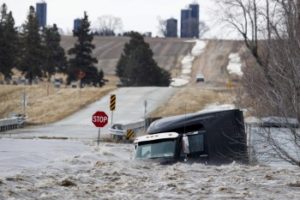
As a result, severe May flooding was observed along the Arkansas, Missouri, and Mississippi rivers. Vicksburg, MS, reported ongoing flooding since mid-February.

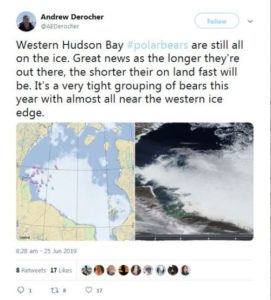
Now 20 years with no trend in ice breakup dates for Western Hudson Bay polar bears

by Polar Bear Science, June  26, 2019


Straight from the horse’s mouth: all polar bear females tagged by researchers around Churchill in Western Hudson Bay last year were still on the ice as of 25 June. With plenty of ice still remaining over the bay, spring breakup will be no earlier this year than it has been since 1999. Contrary to predictions of ever-declining ice cover, the lack of a trend in sea ice breakup dates for Western Hudson Bay is now twenty years long (a hiatus, if you will) and yet these bears are repeatedly claimed to have been seriously harmed in recent years by a loss of sea ice.


Why Climate Models Can’t Predict The Future (And Never Have)

by Jay Lehr, June 11, 2019 in Climate ChangeDispatch


SEE ALSO: Climate Models Of Incompetence

Consider the following: we do not know all the variables that control our climate, but we are quite sure they are likely in the hundreds.

Just take a quick look at ten obviously important factors for which we have limited understanding:

1- Changes in seasonal solar irradiation;

2- Energy flows between ocean and atmosphere;

3- Energy flow between air and land;

4- The balance between Earth’s water, water vapor, and ice;

5- The impacts of clouds;

6- Understanding the planet’s ice;

7- Mass changes between ice sheets, sea level and glaciers;

8- The ability to factor in hurricanes and tornadoes;

9- The impact of vegetation on temperature;

10- Tectonic movement on ocean bottoms.

Yet, today’s modelers believe they can tell you the planet’s climate decades or even a century in the future and want you to manage your economy accordingly.

Dr. Willie Soon of the Harvard-Smithsonian astrophysics laboratory once calculated that if we could know all the variables affecting climate and plugged them into the world’s largest computer, it would take 40 years for the computer to reach an answer.

‘Skeptical Environmentalist’ Bjorn Lomborg sets fire to the scourge of ‘unbridled climate alarmism’

by Charles the moderator , June 7, 2019 in WUWT


Fear’s a great motivator, right? So what better way to motivate people to care about climate change than to scare the crap out of them? Even if you have to leave out some details to do it?

New York Magazine climate columnist David Wallace-Wells seems to be a student at the School of We’re Hurtling Toward Global Environmental Catastrophe and We’re All Gonna Die. Last night, he shared a short piece by James Dyke, a senior lecturer in global systems at the University of Exeter, explaining some of the horrible things humanity is in for:

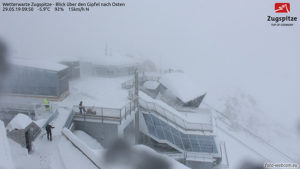
Germany’s Zugspitze Sees Snow Depth Spiral Upward To Highest Level in 38 Years – In Late Spring!

by P. Gosselin, June 2, 2019 in NoTricksZone


May normally is a month that sees rapid snow melt in Alps. But this year May was an unusually cold month across Central Europe and parts of the Alps saw heavy snow accumulation.

A week ago, on May 25, BR public broadcasting reported here how May snow levels at Germany’s tallest peak, Zugspitze, reached a 20-year high at just over 6 meters of depth. The article wrote that experts thought the depth would not rise further.

But that turned out to be wrong.

Highest level since February, 1981

Four days later, on May 29, another 35 cm were added and pushed the depth to 6.40 meters, according to wetteronline.ch here. the website wrote: “Zugspitze: Never so much snow since 1981.” The website added that the snow depth there was “higher than it has been since February 1981.”

What follows is a webcam image of the Zugspitze peak from May 29th:


Climatologist: Climate Models Are Predicting Too Much Warming

by Dr. Benny Peiser, May 23, 2019 in GWPF


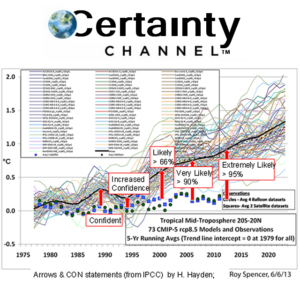
A leading climatologist has said that the computer simulations that are used to predict global warming are failing on a key measure of the climate today and cannot be trusted.

Speaking to a meeting in the Palace of Westminster in London, Professor John Christy of the University of Alabama in Huntsville told MPs and peers that almost all climate models have predicted rapid warming at high altitudes in the tropics:

A paper outlining Dr. Christy’s key findings is published today by the Global Warming Policy Foundation.

U.N. Predicts Disaster if Global Warming Not Checked

by P.J. Spielman, June 30, 1989 in APNews


UNITED NATIONS (AP) _ A senior U.N. environmental official says entire nations could be wiped off the face of the Earth by rising sea levels if the global warming trend is not reversed by the year 2000.

Coastal flooding and crop failures would create an exodus of ″eco- refugees,′ ′ threatening political chaos, said Noel Brown, director of the New York office of the U.N. Environment Program, or UNEP.

He said governments have a 10-year window of opportunity to solve the greenhouse effect before it goes beyond human control.

As the warming melts polar icecaps, ocean levels will rise by up to three feet, enough to cover the Maldives and other flat island nations, Brown told The Associated Press in an interview on Wednesday.


WHAT? NO SIXTH EXTINCTION?

by Andrew Montford, April 23, 2019 in GWPF


Extinction Rebellion seem to be everywhere at the moment. And everywhere their story is the same. We are in the middle of a climate catastrophe. As the Huffington Post put it,

Human-caused climate change is driving sea-level rise, drought, extreme weather and a biodiversity crisis that scientists have declared Earth’s sixth mass extinction event. As many as 150 species die off each day.

Scary eh? Surely that’s enough to justify the odd street protest?

It was therefore interesting to see read some remarks from Richard Betts today. Professor Betts is the head of climate impacts at the Met Office, so his views in this area carry a certain amount of weight. Asked what he thought were the top three negative impacts of climate change that have “absolutely started”, he replied:

  • Sea level rise
  • Increasing risk of high temperatures
  • Changes in phenology and distribution for numerous species

This left me agog. There was nothing about drought or hurricanes or any of the other manifestations of extreme weather that are said to be afflicting us; nothing about floods, or typhoons, or desertification or crashing crop yields or climate refugees, mass extinctions, skydiving walruses and any of the thousand and one tall tales that climate activists spin and the media faithfully repeat every day. The contrast between this take on currently observed negative impacts and David Attenborough’s risible Climate Change: the Facts programme last week is startling. The take home message is that most of what the “national treasure” told viewers about climate change was grubby insinuation rather than fact: less to do with science than with the BBC’s ongoing eco-campaign.

Another climate lie bites the dust – No, Honolulu’s beaches aren’t going to disappear in 20 years

by Aylin Woodward, April 25, 201 in WUWT


In May 2017, high tides engulfed parts of the iconic Waikiki beach, edging dangerously close to waterfront hotels. This kind of high-tide flooding, often called a king tide or sunny-day flood, occurs when ocean water surges to higher levels than coastal infrastructure was designed to accommodate. In that case, water levels rose 2.5 feet above average in Waikiki, drowning nearby roads and sidewalks.

According to a 2017 report (which was updated in September 2018), Hawaii’s state capital and Waikiki Beach – along with other coastal strips on Hawaii’s five islands – are expected to experience frequent flooding within 15 to 20 years.

“This flooding will threaten $5 billion of taxable real estate; flood nearly 30 miles of roadway; and impact pedestrians, commercial and recreation activities, tourism, transportation, and infrastructure,” Shellie Habel, lead author of the 2017 study, said in a release.

Now, Hawaii state lawmakers are taking steps to shore up the state’s beaches and coastal cities. A new bill that mandates a statewide shore protection program has passed both houses of Hawaii’s state legislature, and will soon makes its way to the governor’s desk for approval.


All well and good that they want to improve beach resilience. But, the claim that ” Hawaii’s iconic Waikiki Beach could be engulfed by the ocean in 20 years ” is totally bogus.

Here is why:


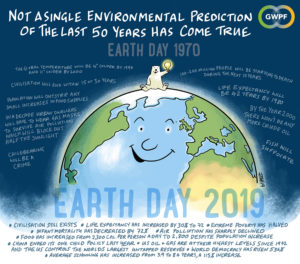
HAPPY EARTH DAY! WHEN WE CELEBRATE EVERY FAILED ALARMIST ECO-PREDICTION

by Nicolas Loris, April 22, 2019 in GWPF/BangorDailyNews


We should be thankful that the gloom-and-doom predictions made throughout the past several decades haven’t come true. Fear-mongering about explosive population growth, food crises and the imminent depletion of natural resources have been a staple of Earth Day events since 1970. And the common thread among them is that they’ve stirred up a lot more emotions than facts.

“By the year 2000, if present trends continue, we will be using up crude oil at such a rate … that there won’t be any more crude oil,” ecologist Kenneth Watt warned around the time of the first Earth Day event. “You’ll drive up to the pump and say, ‘Fill ’er up, buddy,’ and he’ll say, ‘I am very sorry, there isn’t any.’” Watt also warned of global cooling and nitrogen buildup rendering all of the planet’s land unusable.

Isle de Jean Charles & Sea Level Rise

by P. Homewood, April 20, 2019 in NotaLotOfPeopleKKnowThat


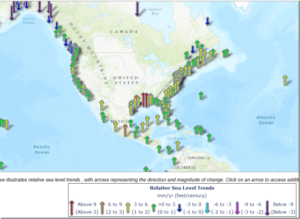
The Isle de Jean Charles, Louisiana. It’s been largely submerged beneath the sea over the last 6 decades. The program gives the definite impression that the main reason for this inundation is sea level rise due to melting ice and thermal expansion of the oceans – driven by man-made climate change. Attenborough does mention oil extraction as a cause but his narrative is lost to the general tone of the messaging that this is a “climate catastrophe” and that the families driven from their homes in this part of Louisiana are some of the world’s first “climate refugees”. This is palpable bullshit.


https://tidesandcurrents.noaa.gov/sltrends/sltrends.html

Native American Wisdom on Polar bears and Kappiananngittuq:

by Jim Steele, April 19, 2019 in WUWT


In 2010 Nunavut’s Minister of Environment Daniel Shewchuk wrote, “Inuit hunters have a close relationship with the land and wildlife. They have observed that the overall population of polar bears in Nunavut is not declining as some suggest, but rather is thriving. No known environmental or other factors are currently posing a significant or immediate threat to polar bears overall. Furthermore, Inuit knowledge and science corroborate that the species can and will adapt to changing and severe climatic conditions, as it has done for centuries.”

The Inuit truly practice the concept of “it takes a village”. Hunters sit down in kappiananngittuq and respectfully share their observations of wildlife and their movements. Kappiananngittuq is the Inuit word for a “safe place to discuss”. Based on community discussions, Inuit have steadfastly claimed it is “The Time of the Most Polar Bears”. Overhunting has been one of the world’s greatest threats to wildlife. And the growing number of polar bears is testimony to wise hunting regulations now honored by the Inuit.

Flashback 2008 – Climate change study predicts refugees fleeing into Antarctica

by P. Homewood, April 13, 2019 in NotaLotofPeopleKnowThat


Climate change will force refugees to move to Antarctica by 2030, researchers have predicted.

Among future scenarios are the Olympics being held in cyberspace and central Australia being abandoned, according to the think tank report.

Forum for the Future, a research body committed to sustainable development, said they wanted to stir debate about how to avert the worst effects of global warming by presenting a radical set of ‘possible futures’.
There will be a shift towards greater energy efficiency, where desalination plants will run on solar power will turn the Sahara green.

Refugees are expected to move to Antarctica because of the rising temperatures that will see the population of the continent increase to 3.5 million people by 2040.

As the world fails to act on climate change, researchers predict that global trade will collapse as oil prices break through $400 a barrel and electrical appliances will get automatically turned off when households exceed energy quotas.

La géologie, une science plus que passionnante … et diverse