Full-time professor at the Free University of Brussels, Belgium
apreat@gmail.com
apreat@ulb.ac.be
• Department of Earth Sciences and Environment
Res. Grp. - Biogeochemistry & Modeling of the Earth System
Sedimentology & Basin Analysis
• Alumnus, Collège des Alumni, Académie Royale de Sciences, des Lettres et des Beaux Arts de Belgique (mars 2013). http://www.academieroyale.be/cgi?usr=2a8crwkksq&lg=fr&pag=858&rec=0&frm=0&par=aybabtu&id=4471&flux=8365323
• Prof. Invited, Université de Mons-Hainaut (2010-present-day)
• Prof. Coordinator and invited to the Royal Academy of Sciences of Belgium (Belgian College) (2009-
present day)
• Prof. partim to the DEA (third cycle) led by the University of Lille (9 universities from 1999 to 2004) - Prof. partim at the University of Paris-Sud/Orsay, European-Socrates Agreement (1995-1998)
• Prof. partim at the University of Louvain, Convention ULB-UCL (1993-2000)
• Since 2015 : Member of Comité éditorial de la Revue Géologie de la France http://geolfrance.brgm.fr
• Since 2014 : Regular author of texts for ‘la Revue Science et Pseudosciences’ http://www.pseudo-sciences.org/
• Many field works (several weeks to 2 months) (Meso- and Paleozoic carbonates, Paleo- to Neoproterozoic carbonates) in Europe, USA (Nevada), Papouasia (Holocene), North Africa (Algeria, Morrocco, Tunisia), West Africa (Gabon, DRC, Congo-Brazzaville, South Africa, Angola), Iraq... Recently : field works (3 to 5 weeks) Congo- Brazzaville 2012, 2015, 2016 (carbonate Neoproterozoic).
Degree in geological sciences at the Free University of Brussels (ULB) in 1974, I went to Algeria for two years teaching mining geology at the University of Constantine. Back in Belgium I worked for two years as an expert for the EEC (European Commission), first on the prospecting of Pb and Zn in carbonate environments, then the uranium exploration in Belgium. Then Assistant at ULB, Department of Geology I got the degree of Doctor of Sciences (Geology) in 1985. My thesis, devoted to the study of the Devonian carbonate sedimentology of northern France and southern Belgium, comprised a significant portion of field work whose interpretation and synthesis conducted to the establishment of model of carbonate platforms and ramps with reefal constructions.
I then worked for Petrofina SA and shared a little more than two years in Angola as Director of the Research Laboratory of this oil company. The lab included 22 people (micropaleontology, sedimentology, petrophysics). My main activity was to interpret facies reservoirs from drillings in the Cretaceous, sometimes in the Tertiary. I carried out many studies for oil companies operating in this country.
I returned to the ULB in 1988 as First Assistant and was appointed Professor in 1990. I carried out various missions for mining companies in Belgium and oil companies abroad and continued research, particularly through projects of the Scientific Research National Funds (FNRS).
My research still concerns sedimentology, geochemistry and diagenesis of carbonate rocks which leads me to travel many countries in Europe or outside Europe, North Africa, Papua New Guinea and the USA, to conduct field missions.
Since the late 90's, I expanded my field of research in addressing the problem of mass extinctions of organisms from the Upper Devonian series across Euramerica (from North America to Poland) and I also specialized in microbiological and geochemical analyses of ancient carbonate series developing a sustained collaboration with biologists of my university. We are at the origin of a paleoecological model based on the presence of iron-bacterial microfossils, which led me to travel many countries in Europe and North Africa. This model accounts for the red pigmentation of many marble and ornamental stones used in the world. This research also has implications on the emergence of Life from the earliest stages of formation of Earth, as well as in the field of exobiology or extraterrestrial life ...
More recently I invested in the study from the Precambrian series of Gabon and Congo. These works with colleagues from BRGM (Orléans) are as much about the academic side (consequences of the appearance of oxygen in the Paleoproterozoic and study of Neoproterozoic glaciations) that the potential applications in reservoir rocks and source rocks of oil (in collaboration with oil companies).
Finally I recently established a close collaboration with the Royal Institute of Natural Sciences of Belgium to study the susceptibility magnetic signal from various European Paleozoic series. All these works allowed me to gain a thorough understanding of carbonate rocks (petrology, micropaleontology, geobiology, geochemistry, sequence stratigraphy, diagenesis) as well in Precambrian (2.2 Ga and 0.6 Ga), Paleozoic (from Silurian to Carboniferous) and Mesozoic (Jurassic and Cretaceous) rocks. Recently (2010) I have established a collaboration with Iraqi Kurdistan as part of a government program to boost scientific research in this country.
My research led me to publish about 180 papers in international and national journals and presented more than 170 conference papers. I am a holder of eight courses at the ULB (5 mandatory and 3 optional), excursions and field stages, I taught at the third cycle in several French universities and led or co-managed a score of 20 Doctoral (PhD) and Post-doctoral theses and has been the promotor of more than 50 Masters theses.
by J.E. Kamis, February 25, 2019 in ClimateChangeDispatch
…
SUMMARY
Research study after research study has now proven beyond any doubt that the 350,000-square-mile subglacial Marie Byrd Mantle Plume and its associated geological features that are emitting massive amounts of ice melting heat and heated fluid onto the base of the Pine Island Glacier and Thwaites Glaciers.
Failure of the media to include in their numerous articles this telling scientific evidence which substantiates the significant and likely dominant role of this subglacial geologically induced heat flow in melting of West Antarctic glaciers is difficult to reconcile with proper scientific methodology.
A methodology which states that new and relevant data should be used to review old supposedly 100% settled theories.
Most of these research studies have been released one by one during the last three years which has led to minimizing their collective importance. Numerous previous Climate Change Dispatch articles written by this author beginning in 2014 have inexplicably been ignored by mainstream media outlets.
It’s time for the media to inform the public that by tying all this information together that a clear picture emerges concerning the significant impact of Antarctic subglacial geologically induced heat flow.
The word “hysteresis” doesn’t immediately seem threatening; it hints at a portmanteau of “history” and “thesis”—a dense read, perhaps, but those never killed anyone. But that’s not what the word means. Hysteresis is a profound behavior some systems can display, crossing a sort of point-of-no-return. Dial things up just one notch, and you can push the system through a radical change. To get back to normal, you might have to dial it down five or six notches.
Earth’s climate system can provide examples. Take the conveyor-belt-like circulation of water in the Atlantic Ocean. Looking back at the past, you can see times that the circulation seems to have flipped into an alternate pattern regarding climatic consequences around the North Atlantic. Switching from one pattern to the other takes a significant nudge, but reversing it is hard—like driving up to the top of a ridge and rolling down into the next valley.
…
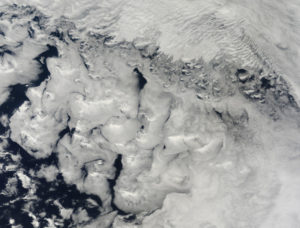
Stratocumulus clouds, like those in the lower two-thirds of this image, are common over the oceans.
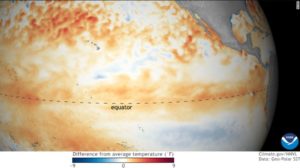
NOAA gives a 55% chance of El Niño conditions persisting through the spring.
Sea surface temperatures in January — orange-red colors are above normal.
“While sea surface temperatures are above average, current observations and climate models indicate that this El Niño will be weak, meaning we do not expect significant global impacts through the remainder of winter and into the spring,” Halpert said.
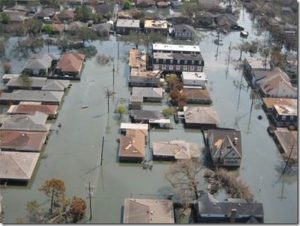
Local sea levels appear to rise when ocean volumes increase, but also when the land sinks. Scientists increasingly warn that coastal cities are sinking much faster than ocean volumes are rising. Pumping out groundwater not only causes lands to sink, it increases the oceans’ volume. China’s Huanghe Delta is sinking 10 inches a year. Southeast Asian cities battle sinking rates of 1.2 to 2.4 inches per year. Regions around Houston, Texas had sunk 10 feet by 1979; a disaster waiting to happen where hurricanes commonly generate 15-foot storm surges. Likewise, New Orleans was doomed by sinking 1.4 inches per year. Built on marshland, San Francisco’s airport sinks 0.4 inches per year.
In contrast, ocean warming plus added glacial meltwater are estimated to have only added 0.06 inches per year to sea level from 1850 to 1990, punctuated by decades that accelerated sea level rise to 0.14 inches a year. Still, that fastest rate of modern sea level rise remains only one-tenth of New Orleans’ sinking rate.
by E. Duvat, October 25, 2018 in WiresClimateChange
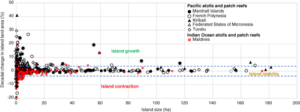
Over the past decades, atoll islands exhibited no widespread sign of physical destabilization in the face of sea‐level rise. A reanalysis of available data, which cover 30 Pacific and Indian Ocean atolls including 709 islands, reveals that no atoll lost land area and that 88.6% of islands were either stable or increased in area, while only 11.4% contracted. Atoll islands affected by rapid sea‐level rise did not show a distinct behavior compared to islands on other atolls. Island behavior correlated with island size, and no island larger than 10 ha decreased in size.
How much impact does the abundance of cloud condensation nuclei (CCN) aerosols above the oceans have on global temperatures? Rosenfeld et al.analyzed how CCN affect the properties of marine stratocumulus clouds, which reflect much of the solar radiation received by Earth back to space (see the Perspective by Sato and Suzuki). The CCN abundance explained most of the variability in the radiative cooling. Thus, the magnitude of radiative forcing provided by these clouds is much more sensitive to the presence of CCN than current models indicate, which suggests the existence of other compensating warming effects.
According to Yuan et al. (2018), “studies examining sea surface temperature variability over the past one century and their influence on climate change in China are seriously lacking.” And therefore, in an effort to remedy this information void, the team of eight Chinese scientists developed “the first tree-ring-based dendroclimatic sea surface temperature (SST) reconstruction for the South China Sea.”
In accomplishing their objective Yuan et al. cored 22 Pinus massoniana trees in the Changting Region of the Fujian Province, China. Analysis of the cores revealed a statistically significant relationship between the tree-ring series and gridded March SSTs (1°C resolution) of the South China Sea (16-20°N, 112-116°E). Ultimately, this relationship enabled them to produce a proxy temperature reconstruction over the period 1893-2011, which reconstruction is shown below.
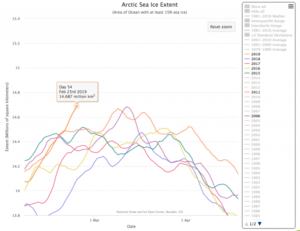
Arctic sea-ice has stubbornly resisted the very warm years between 2015-2017 caused by the big El Niño. Are we going to see an increase in Arctic sea-ice over the next few years? Only time will tell, but the idea cannot be discarded.
by Ph. Laget, 23 février 2019, in MythesManciesMathématiques
En matière climatique, ce que je sais c’est que je ne sais rien. Ou pas grand-chose. Je n’ai rien appris durant mes études sur ce sujet (je suis ingénieur en Mathématiques Appliquées). Mes sources d’information, comme n’importe quel citoyen, se limitent à la lecture de quelques études de spécialistes qui se prétendent experts en climatologie (je n’ai aucun moyen de vérifier le degré de leur expertise), et aux médias qui tentent de vulgariser certaines de ces études. Ces travaux font souvent appel à des calculs sophistiqués que je n’ai pas les moyens ni le temps de vérifier.
Je sais que des scientifiques prétendent avoir démontré qu’il y a un réchauffement climatique global, que sa cause est essentiellement anthropique, et que ses conséquences sont dommageables pour l’homme. Je sais qu’il y a d’autres spécialistes, que les médias appellent climato-sceptiques (certains d’entre eux préfèrent se nommer climato-réalistes), qui disent que c’est faux, et que les causes des perturbations sont surtout naturelles (activité solaire, désynchronisation des champs magnétiques du soleil, modification de l’axe magnétique de la terre, effets des nuages et de la vapeur d’eau, éruptions volcaniques, …).
You know we have overcome the dictatorship of the proletariat here in East Germany, and now we are facing a dictatorship of the climate law. I do not consider this law to be compatible with a market economy. –Andreas Lämmel, CDU member of the German Bundestag, Deutschlandfunk, 23 February 2019
Climate policy is increasingly splitting German’s coalition government of Christian Democrats (CDU/CSU) and Social Democrats (SPD). The coal exit was supposed to be part of a comprehensive climate law. But if and when that comes no one knows. That’s because the coalition committee has actually stopped the far advanced legislative project of Federal Environment Minister Svenja Schulze (SPD), according to the government. —Andreas Mihm, Frankfurter Allgemeine Zeitung, 19 February 2019
Le paysage énergétique du globe et de la France a peu changé durant les siècles antérieurs au 19ème siècle. Napoléon et César se déplaçaient, s’éclairaient, se chauffaient, s’habillaient à peu près de la même façon. Depuis le début du 19ème siècle, en revanche, ce paysage change rapidement et radicalement. Les énergies traditionnelles (hommes, animaux, vent, eau) ont été presque éliminées, et remplacées par des énergies nouvelles (charbon, pétrole, électricité, nucléaire). Dans le domaine des transports, par exemple, la marche à pied, le cheval et le bateau à voile ont été supplantés par le chemin de fer, puis l’automobile, puis l’avion, et par le bateau à moteur. Ces changements ont largement contribués à l’extraordinaire amélioration du niveau de vie enregistrée au cours des deux derniers siècles, dans les pays dits développés d’abord, puis, depuis un demi-siècle dans les pays dits en développement.
Until now, carbon dioxide has been dumped in oceans or buried underground. Industry has been reluctant to implement carbon dioxide scrubbers in facilities due to cost and footprint.
What if we could not only capture carbon dioxide, but convert it into something useful? S. Komar Kawatra and his students have tackled that challenge, and they’re having some success.
Princeton professor emeritus William Happer’s role in forming a White House climate security committee didn’t sit well with a number of media outlets, including The New York Times, which called the eminent physicist a “denialist.”
The headline prompted a backlash from those who object to applying a derogatory label associated with Holocaust disbelief to scientists and others who challenge worst-case climate-change scenarios.
Based on new data published today in the journal Science, it seems increasingly likely that an asteroid or comet impact 66 million years ago reignited massive volcanic eruptions in India, half a world away from the impact site in the Caribbean Sea.
But it leaves unclear to what degree the two catastrophes contributed to the near-simultaneous mass extinction that killed off the dinosaurs and many other forms of life.
The research sheds light on huge lava flows that have erupted periodically over Earth’s history, and how they have affected the atmosphere and altered the course of life on the planet.
by JC Maurin, 22 février 2019 in ScienceCimatEnergie
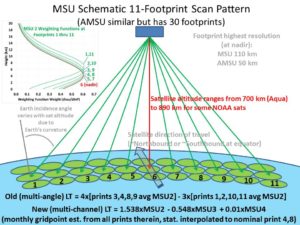
Afin d’élaborer les indicateurs de température, on utilise des radiomètres MSU, AMSU ou ATMS embarqués sur des satellites, puis on construit l’indicateur à partir des mesures et de diverses corrections. On obtient ainsi un indicateur qui concerne la quasi-totalité du globe, contrairement aux indicateurs terrestres basés essentiellement (avant 1980) sur quelques milliers de stations américaines et européennes. Au sujet des mesures par satellites, et sans être spécialiste dans ce domaine, un physicien peut néanmoins donner quelques éléments d’appréciation qu’ignore parfois un lecteur intéressé par la climatologie. Le but de la seconde partie de l’article sera atteint si ce lecteur a appris des éléments nouveaux, il pourra ensuite approfondir la question par lui-même.
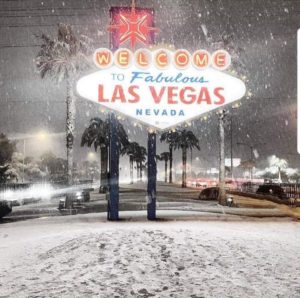
The Las Vegas Valley Snow Event: What happened? Did we see this coming? Yes and no. We had been seeing very small chances for snow in the valley for a few days, but it wasn’t until Sunday afternoon that the hi-resolution models were consistently indicating that western parts of the valley could see up to 3 inches and up to an inch elsewhere. That’s when the decision was made to issue the Winter Weather Advisory.
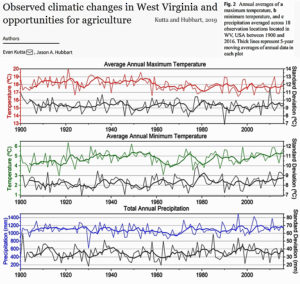
“Between 1900 and 2016, climatic trends were characterized by significant reductions in the maximum temperatures (−0.78°C/century; p = 0.001), significant increases in minimum temperatures (0.44 °C/century; p = 0.017) [overall -0.34°C/century], and increased annual precipitation (25.4 mm/century) indicative of a wetter and more temperate WV climate. Despite increasing trends of growing degree days during the first (p ≤ 0.015) and second half of the period of record, the long-term trend indicated a decrease in GDD [warm growing degree days] of approximately 100 °C/days.”
by P. Homewood, February 21, 2019 NotaLotofPeopleKnowThat
…
Surveys identified 25 coral species in West Hawaiʻi. Lobe coral (Porites lobata), one of the area’s most dominant species, proved to be the most resilient—with only 50% bleaching in 2015. Cauliflower corals (Pocillopora meandrina) were hardest hit—with 98% bleaching—but recent surveys show that they are beginning to recover.
The Medieval Warm Period (MWP) was a time of warm climate from about 900 A.D. to 1300 A.D. when global temperatures were apparently somewhat warmer than at present. Its effects were evident in Europe where grain crops flourished, alpine tree lines rose, many new cities arose, and the population more than doubled. The Vikings took advantage of the climatic amelioration to colonize Greenland, and wine grapes were grown as far north as England where growing grapes is now not feasible and about 500 km north of present vineyards in France and Germany. Grapes are presently grown in Germany up to elevations of about 560 m, but from about 1100 A.D. to 1300 A.D., vineyards extended up to 780 m, implying temperatures warmer by about 1.0–1.4 °C (Oliver, 1973).
by P. Gosselin , February 19, 2019 in NoTricksZone
Readers should note that among climate modelers volcanoes and atmospheric aerosols have been a favorite way of fudging climate models to explain away inconvenient cooling periods that weren’t supposed to happen in a system that is supposed to be dominated by trace gas CO2.
Extratropical volcanoes influence climate more than assumed
Study shows surprisingly strong cooling after volcanic eruptions in mid and high latitudes
The Sun is the primary forcing of Earth’s climate system. Sunlight warms our world. Sunlight drives atmospheric and oceanic circulation patterns. Sunlight powers the process of photosynthesis that plants need to grow. Sunlight causes convection which carries warmth and water vapor up into the sky where clouds form and bring rain. In short, the Sun drives almost every aspect of our world’s climate system and makes possible life as we know it.
Earth’s orbit around and orientation toward the Sun change over spans of many thousands of years. In turn, these changing “orbital mechanics” force climate to change because they change where and how much sunlight reaches Earth. (Please see for more details.) Thus, changing Earth’s exposure to sunlight forces climate to change. According to scientists’ models of Earth’s orbit and orientation toward the Sun indicate that our world should be just beginning to enter a new period of cooling — perhaps the next ice age.
by Rod Liddle, February 17, 2019 in GWPF/SundaTimes
Such a hectic life these kids lead. On Friday, my lovely 13-year-old daughter was out on the streets of Canterbury with her schoolmates demanding something be done, right now, about climate change, because adults are letting us down and it’s our future and it isn’t fair that horrid right-wing old white men are deliberately destroying the planet.
The next day she was at Gatwick with her mum, off for a half-term ski trip to Norway. I hope she got the irony: all those emissions, just so she could have a chance to snap her femur in half. Still, at least she wasn’t going to the Alps, where the wilderness has been murdered by skiers, the mountains stripped of forest and festooned with lifts and blue runs created by snow machines. Is there a more environmentally ruinous pastime than skiing?
Thomas Crowther identifies long-disappeared forests available for restoration across the world. He will describe how there is room for an additional 1.2 trillion new trees around the world that could absorb more carbon than human emissions each year. Crowther also describes data from thousands of soil samples collected by local scientists that reveal the world’s Arctic and sub-Arctic regions store most of the world’s carbon. But the warming of these ecosystems is causing the release of this soil carbon, a process that could accelerate climate change by 17%. This research is revealing that the restoration of vegetation and soil carbon is by far our best weapon in the fight against climate change.
The living parts of the planet make it unique from all other parts of the solar system, and they drive every aspect of biogeochemical cycling. It is essential that we represent these living processes into our understanding of current and future biogeochemical cycles in order to understand and predict climate change.
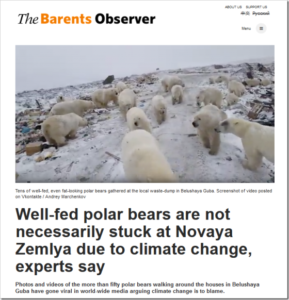
This story could very well be headlined: «When internet came to Novaya Zemlya».
Locals started to post photos and video of the more than 50 polar bears in their neighborhood. Over the last week, social media as well as online newspapers globally have gone mad over the news coming out from one of the remotest towns on the planet, the closed military settlement of Belushaya Guba.
The little-known town on the Russian Arctic archipelago have since last autumn been struggling with polar bears walking the streets and around the corners of apartment- and office buildings. Even walking by a baby-stroller inside an entrance, one of the video-recordings show.
Regional authorities have declared a state of emergency after the bears no longer react to noice- and light signals from guards trying to scare them off.
Belushaya Guba, like the entire Novaya Zemlya, is closed off military area. The newly upgraded air base Rogachevo is just a few kilometers outside of town.
…
La géologie, une science plus que passionnante … et diverse