Archives de catégorie : climate-debate

GREENLAND’S SMB GAINED 6 GIGATONS YESTERDAY + NORTHERN HEMISPHERE SNOW MASS SITTING AT 500 GIGAGTONS ABOVE THE NORM

by Cap Allon, March 29, 2020 in Electroverse


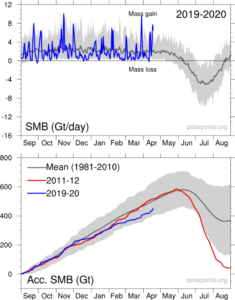
Despite decades of doom-and-gloom prophecies, Greenland’s Ice Sheet is currently GAINING monster amounts of “mass”— 6 gigatons yesterday alone (March 28, 2020).

Crucial to the survival of a glacier is its surface mass balance (SMB)–the difference between accumulation and ablation (sublimation and melting). Changes in mass balance control a glacier’s long-term behavior, and are its most sensitive climate indicators (wikipedia.org).

On the back of substantial SMB gains over the past few years, the Greenland ice sheet looks set to continue that trend in 2019-20. On March 28, 2020, the world’s largest island added a monster 6 gigatons to its ice sheet. According to climate alarmists, this simply shouldn’t be happening in a warming world. In fact, it might as well not be happening–developments like this NEVER receive MSM attention, meaning alarmists are NEVER privy to the full and unalarming picture…

polarportal.dk/

In addition, Total Snow Mass for the Northern Hemisphere continues to track WELL-above average with the latest data point (March 27) seeing NH snow at a staggering 500+ gigatons above the norm—another real-world reality we were told should be an impossibility by now: IPCC 2001: “Milder winter temperatures will decrease heavy snowstorms…”

Continuer la lecture de GREENLAND’S SMB GAINED 6 GIGATONS YESTERDAY + NORTHERN HEMISPHERE SNOW MASS SITTING AT 500 GIGAGTONS ABOVE THE NORM

Les idéologues de l’hystérie climatique vus à l’ombre du Coronavirus

by Samuel Furfari, 26 mars 2020 in LaTribune


OPINION. Il semble morbide et cynique, alors que des milliers de personnes meurent du Coronavirus, d’insister en ce moment sur l’impérieuse nécessité d’agir contre le changement climatique. Pourtant, des idéologues, qui sont aussi et surtout ceux de la remise en cause de l’économie de marché, osent le faire. Ils ne ratent aucune occasion d’essayer de faire croire que le changement climatique cause ou exacerbe cette crise. Il est nécessaire de les dénoncer pour préparer l’avenir. Par Samuel Furfari, Professeur à l’Université Libre de Bruxelles et Président de la Société Européenne des Ingénieurs et Industriels.

Un climatologue français semble regretter que « ce qu’on fait pour le Coronavirus, c’est deux ans de financement climat » car, d’après lui, si on dépense de l’argent pour sauver des vies, on pourrait tout aussi bien redoubler d’effort pour sauver la planète. Un climatologue belge a eu l’outrecuidance de tweeter à la Première ministre belge et à son vice-Premier ministre en charge du budget qu’ils profitent de cette crise pour introduire une taxe sur l’énergie : « #Covid_19 : C’est le bon moment pour instaurer une vraie taxe CO2 sur les carburants, le mazout [fioul en Belgique] et le gaz fossile. Leur prix ayant fortement baissé, ce sera indolore. Cela permettra de dégager des ressources pour compenser les effets de la crise. » Sur Facebook, ce membre éminent du GIEC s’est fait traiter de « charognard », entre autres épithètes. En pleine crise, « presque hilare », un commentateur politique bien connu a apprécié que ce « virus révolutionnaire » empêchait la privatisation des aéroports de Paris et  s’en est pris aux « banques mondiales [qui] échouent lamentablement face à la crise climatique en injectant des billions dans les combustibles fossiles».

Les glaces terrestres, la cryosphère (2/3)

by J.C. Maurin, 27 mars 2020 in ScienceClimatEnergie


Partie 2/3 : Lecture critique du chapitre cryosphère de l’AR5

par J.C. Maurin, Professeur agrégé de physique

Cette deuxième partie de l’article examine la composition du chapitre 4 du 5ème rapport du GIEC (AR5) [1].
Dans ce chapitre, qui concerne les différentes composantes de la cryosphère, les banquises [2] et glaciers [3] sont particulièrement mises en avant par les rédacteurs du GIEC.
A propos de ces 2 composantes mineures (0,65 % du volume de la cryosphère), l’article développe certains éléments d’appréciation que les rédacteurs de l’AR5 n’ont pas mis en exergue.

Continuer la lecture de Les glaces terrestres, la cryosphère (2/3)

Heartland Institute Launches ClimateRealism.com

by P. Homewood, March 24, 2020 in NotaLotofPeopleKnowThat


WUWT has news of a new website launched by the Heartland Institute, to augment the excellent factchecking site, Climate At A Glance:

Nearly every day, the establishment media promotes new climate propaganda themes designed to scare people into believing a climate crisis is at hand. When the Climate Scare goes unrebutted, people are likely to believe by default that the propaganda is true. Yet most of the media’s climate propaganda is misleading or outright false. ClimateRealism.com will address and debunk the media’s most prominent climate-related tall tales.

Absence of evidence for greenhouse warming over the Arctic Ocean-Mark Serreze 1990

by P. Homewood, March 23, 2020 in NotaLotofPeopleKnowThat


We are familiar with the incessant claims that the Arctic is one of the fastest warming regions on Earth, and that this is due to the polar amplification effect of greenhouse gases.

But scientists back in the 1990s found that this theory did not stack up then:

Abstract

ATMOSPHERIC general circulation models predict enhanced greenhouse warming at high latitudes1owing to positive feedbacks between air temperature, ice extent and surface albedo2–4. Previous analyses of Arctic temperature trends have been restricted to land-based measurements on the periphery of the Arctic Ocean5,6. Here we present temperatures measured in the lower troposphere over the Arctic Ocean during the period 1950–90. We have analysed more than 27,000 temperature profiles, measured by radiosonde at Russian drifting ice stations and by dropsonde from US ‘Ptarmigan’ weather reconnaissance aircraft, for trends as a function of season and altitude. Most of the trends are not statistically significant. In particular, we do not observe the large surface warming trends predicted by models; indeed, we detect significant surface cooling trends over the western Arctic Ocean during winter and autumn. This discrepancy suggests that present climate models do not adequately incorporate the physical processes that affect the polar regions.

https://www.nature.com/articles/361335a0

The cooling between 1950 and 1990 is very evident at a whole range of land sites on the fringes of the Arctic, ranging from Greenland right through to eastern Siberia.

ANTARCTICA JUST SET ITS COLDEST MARCH TEMPERATURE ON RECORD: A “GLOBAL WARMING” DESTROYING -75.3C (-103.5F)

by Cap Allon, March 23, 2020 in Electroverse


The MSM has a blatant warm-bias, that’s been clear for years…

A myriad of news outlets were all-too-happy to run with the Antarctic Peninsula’s record warm temperature last month, painting it as further evidence of the coming climate catastrophe (despite the peninsula actually being located closer to Argentina than the South Pole, and the event officially going down as a foehn). But where are those same rags now? Where is their balance? Their credibility? Or is informing the public not the goal anymore, is their mission merely to propagandize?

Last Friday, Antarctica set its coldest EVER March temperature

…somehow, in what we’re to believe is a linearly warming world on the brink of “overheating”, the world’s southernmost continent is currently the coldest its ever been for the time of year.

The Vostok Station clocked a bone-chilling -75.3C (-103.54F) on the morning of Friday, March 20, as spotted by @TempGlobal on Twitter:

Location of Vostok (Wiki).

Continuer la lecture de ANTARCTICA JUST SET ITS COLDEST MARCH TEMPERATURE ON RECORD: A “GLOBAL WARMING” DESTROYING -75.3C (-103.5F)

How much human-caused global warming should we expect?

by Andy May, March 21, 2020 in WUWT


C3S20 asks, how much human-caused warming will occur if we do nothing, that is, continue “business-as-usual?” It’s unfortunate, but the IPCC, for all their work, do not adequately answer that question, their projections are all based on abstract “scenarios.” C3S20 break this overall question into five parts:

  1. What would greenhouse gas emissions (GHG) be, if we did nothing and continued normally?
  2. For each GHG, how do emissions relate to the change in atmospheric concentration?
  3. What would the global temperature be if GHG concentrations were at “preindustrial” levels?
  4. How sensitive are global temperatures to GHG concentrations?
  5. How much warming should we expect if we do nothing?

C3S20 tell us the Paris Agreement conclusion that we need to limit global warming to 2°C above preindustrial levels suffers from several unknowns.

  1. The preindustrial period is not formally defined. The preindustrial temperature and greenhouse gas level are not specified. In fact, several time periods, temperatures and GHG levels are used as “preindustrial” in the latest IPCC AR5 report.

  2. The assumptions that warming is bad and increasing levels of CO2 are bad, are not supported with any data. Numerous studies have concluded that some warming is good for humankind and additional CO2 is good for plants.

  3. The penultimate draft of AR5 identified the period 1850 to 1900 as the preindustrial baseline for CO2 and temperature. This was the end of the Little Ice Age, the coldest periodin the last several thousand years. Why use that period as a baseline (Luning and Vahrenholt 2017)? This is not explained, and the final draft of the report removed the reference to the 1850 to 1900 baseline.

  4. If the UNFCC and the Paris Agreement assume “climate change” and “Human-caused Climate Change” are synonymous, how do they explain that climate has change much quicker and much more dramatically many times in the past 13,000 years before human civilization began and well before industrialization?

Climate At A Glance Factchecks–Coral Reefs

by P. Homewood, March 21, 2020 in NotaLotofPeopleKnowThat


Bullet Point Summary:

  • Coral thrive in warm water, not cold water.
  • Recent warming has allowed coral to expand their range poleward, while still thriving near the equator.
  • Coral has existed continuously for the past 40 million years, surviving temperatures and carbon dioxide levels significantly higher than what is occurring today.
  • The primary causes of coral bleaching include oxybenzone (a chemical found in sunscreen), sediment runoff from nearby coastal lands, and cold temperatures like those recorded in 2010 off the Florida coast.
  •  

Short Summary: Coral require warm water, not cold water, to live. Coral cannot live outside of tropical or subtropical waters. (See Figure 1.) As Earth continues to modestly warm, coral are extending their range toward the poles while still thriving at and near the equator. The primary reasons for bleaching events include sediment pollution from nearby coastal lands, chemicals found in sunscreen, and cold temperature events. Coral have existed continuously for the past 40 million years. Coral survived and thrived when temperatures were significantly warmer than they are today.

Figure 1: Coral Reef Locations

Continuer la lecture de Climate At A Glance Factchecks–Coral Reefs

ALL-TIME RECORD SNOWFALL BURIES PARTS OF SWEDEN — 3.25 M (10.7 FT) — DON’T TELL GRETA…

by Cap Allon, March 19, 2020 in Electroverse


The first flakes of the season in Kiruna, Sweden fell back on Sept 30 and from then on have continued relentlessly, with accumulations now comfortably surpassing the region’s all-time snowfall record.

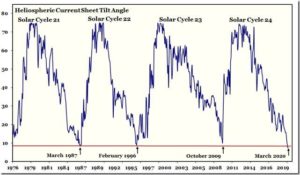
The cold times are returning in line with historically low solar activitycloud-nucleating Cosmic Rays, and a meridional jet stream flow.

NASA has recently revealed this upcoming solar cycle (25) will be “the weakest of the past 200 years,” with the agency correlating previous solar shutdowns to prolonged periods of global cooling here.


https://globalcryospherewatch.org/

North Atlantic Oscillation

by P. Homewood, March 19, in NotaLotofPeopleKnowThat


If you had not noticed (!), it has been a mild and wet start to the year here in the UK, and also across in NW Europe.

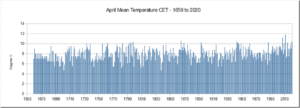
No doubt this will be linked to global warming in due course, but in fact it is simply weather, as the CET chart below proves:

Since the year started, temperatures have consistently been within the normal band. In other the sort of temperatures commonly seen at this time of year.

However, they have also been consistently in the top half of that band, rather than being spread between cold and warm, as would happen most years.

The reason for the weather we have had is, of course, the jet stream, or more precisely the North Atlantic Oscillation (NAO), which has been strongly and stubbornly positive all winter.

The Norwegian Centre for Climate Research CICERO spotted this mild weather coming back in December, and commented on 6th January:

The unusual warm temperatures this winter and forecasts indicating milder winter conditions for January, February and March in Europe are partly due to an atmospheric circulation pattern called the North Atlantic Oscillation, or NAO. This atmospheric circulation pattern explains well the weather we get in Europe, especially in winter.

https://cicero.oslo.no/no/posts/nyheter/unseasonal-temperatures-for-norway#


Our own Met Office explains the NAO phenomenon:


How exactly do they plan to replace fossil fuels?

by P. Driessen, March 16, 2020 in WUWT


They want to ban coal, oil and gas. Exactly how will they replace them? Who wins? Who loses?

Berkeley, CA, Takoma Park, MD and other cities; California, Connecticut, New York, Virginiaand other states; Germany, England and other countries; the European Union – all plan to banish oil, natural gas and coal within 10, 20 or 30 years. A number of US states have joined Regional Greenhouse Gas Initiatives and proudly say We Are Still Inthe Paris climate treaty, no matter what President Trump says or does.

Forget the headlines and models, and look at hurricane, tornado, sea level and other historic records. There is no crisis, no unprecedented warming or weather events, certainly nothing that proves humans have replaced the powerful natural forces that have always driven climate changes and weather events.

But for now, let’s just examine their zero-carbon plans. How exactly will they make this happen? Where do they plan to get the turbines, panels and batteries? the raw materials to manufacture them? How do they plan to function as modern societies with pricey, erratic energy and frequent power disruptions?


Continuer la lecture de How exactly do they plan to replace fossil fuels?

New research first to relate Antarctic sea ice melt to weather change in tropics

by C. Rotter, March 16, 2020 in WUWT


Diminishing sea ice translates to warmer ocean, more rain, and stronger trade winds.
University of California – San Diego

Arctic and Antarctic ice loss will account for about one-fifth of the warming that is projected to happen in the tropics, according to a new study led by Mark England, a polar climate scientist at Scripps Institution of Oceanography at the University of California San Diego, and Lorenzo Polvani, the Maurice Ewing and J. Lamar Worzel Professor of Geophysics at Columbia Engineering, England’s doctoral supervisor.

While there is a growing body of research showing how the loss of Arctic sea ice affects other parts of the planet, this study is the first to also consider the long-range effect of Antarctic sea ice melt, the research team said.

“We think this is a game-changer as it shows that ice loss at both poles is crucial to understanding future tropical climate change,” England said of the study funded by NASA and the National Science Foundation. “Our study will open a hitherto unexplored direction and motivate the science community to study the large effects that Antarctic sea ice loss will have on the climate system.”

Greenhouse Gases Not Behind The End Of The Warming Pause

by Dr A. Ollila, March 16, 2020 in ClimateChange Dispatch


During the years 2000-2014, the global temperature hardly increased, and that period has been called the temperature pause or hiatus.

The debate among the climate community has resulted in more than 200 research studies in some cases with opposite results about the reasons.

This amount of papers can be compared to the research studies of Earth’s energy balance and the greenhouse effect. I have found about 10 publications for both subjects.

During the years 2000-2014, the emissions of carbon dioxide were 126 gigatons carbon (GtC) being 31% of the total emission after 1750, but the greenhouse (GH) gases were not able to increase the temperature.

According to the IPCC, the temperature increase should have been 0.4°C from 2000 to 2014 (Ref. 1).

It looks like that the pause ended to the super El Nino 2015-2016 because the temperature has been thereafter about 0.2 °C above-the-pause average.

Research study about the pause and the ENSO

The impulse for my research study came from a story figure on WUWT that showed shortwave (SW) radiation variations during the pause.

A curve showed increased values around El Nino 2015-16 and thereafter. I decided to find out what could be the impact of this finding on the temperatures.

In Fig. 1, I have depicted the total solar irradiance (TSI), SW radiation and LW radiation from 2000 onward. This data is available from the CERES databank maintained by NASA.

Fig.1. TSI, SW radiation and LW radiation trends normalized to the altitude of 20 kilometers.

The List Grows – Now 100+ Scientific Papers Assert CO2 Has A Minuscule Effect On The Climate

by K. Richard, December 12, 2019 in NoTricksZone


Within the last few years, over 50 papers have been added to our compilation of scientific studies that find the climate’s sensitivity to doubled CO2 (280 ppm to 560 ppm) ranges from <0 to 1°C. When no quantification is provided, words like “negligible” are used to describe CO2’s effect on the climate. The list has now reached 106 scientific papers.

Link: 100+ Scientific Papers – Low CO2 Climate Sensitivity

A few of the papers published in 2019 are provided below.

Krainov and Smirnov, 2019  (2X CO2 = 0.4°C, 2X anthroCO2 = 0.02°C)

“The greenhouse phenomenon in the atmosphere that results from emission of its molecules and particles in the infrared spectrum range is determined by atmospheric water in the form of molecules and microdrops and by carbon dioxide molecules for the Earth atmosphere and by carbon dioxide molecules and dust for the Venus atmosphere. The line-by-line method used the frequency dependent radiative temperature for atmospheric air with a large optical thickness in the infrared spectral range, allows one to separate emission of various components in atmospheric emission. This method demonstrates that the removal of carbon dioxide from the Earth’s atmosphere leads to a decrease of the average temperature of the Earth’s surface by 4 K; however, doubling of the carbon dioxide amount causes an increase of the Earth’s temperature by 0.4 K from the total 2 K at CO2 doubling in the real atmosphere, as it follows from the NASA measurements. The contribution to this temperature change due to injections of carbon dioxide in the atmosphere due to combustion of fossil fuel, and it is 0.02 K. The infrared radiative flux to the Venus surface due to   CO2 is about 30% of the total flux, and the other part is determined by a dust.”

PETITION OF THE CENTER FOR THE STUDY OF CARBON DIOXIDE AND GLOBAL CHANGE …

by EPA, March 9, 2020 in CO2Science


Table of Contents .pdf (138p.)

I. Introduction  4

II. Scientific observations reveal rising greenhouse gases present no imminent threat to human health and welfare . 5

A. There is nothing unusual or unnatural about Earth’s current warmth or rate of warming. Historic and modern records of atmospheric CO2 and temperature violate established principles of causation. Model-based temperature projections since 1979 artificially inflate warming (compered to observations) by a factor of three, invalidating the models and all their ancillary claims associated with greenhouse gas-induced warming5

B. Observations reveal key adverse effects of greenhouse gas-induced warming are not occurring despite EPA predictions they should be worsening16

  1. How to Properly Test for a CO2-induced Influence on Extreme Weather 17
  2. Extreme Weather Observations and Trends 24 (i)Hurricanes 24 (ii)
  3. Storms29 (iii) Floods34 (iv) Drought 37 (v) Fires. 40
  4. Temperature-induced Mortality 45
  5. Sea Level Rise 50

III. CO2 emissions and fossil energy use initiated, and continue to sustain, the industrial revolution and the many human and environmental benefits that have emerged therefrom, which benefits have enhanced human health and welfare 56


Despite Mild Winter, Europe February Mean Temperatures Show No Warming Over Three Decades

by P. Gosselin, March 13, 2020 in NoTricksZone


By Kirye
and Pierre Gosselin

It’s been a particularly mild winter in Europe this year. But that hasn’t changed the long-term trend over the past 30 years.

Now that the February 2020 data have been coming in, we plot the mean February temperatures for some countries in Europe.

Sweden

Three of 5 stations show February mean temperature in Greta Thunberg’s Sweden have had a cooling trend since 1988! The real data will probably make the climate alarmists upset.

More On Earth’s Meaningless Global Temperature, Now And Before

by J. Moseley, March 9, 2020 in ClimateChangeDispatch


Is planet Earth warming, cooling, or staying the same? I often challenge advocates for climate alarmism: what is the temperature of the planet today?

Or we can use any specific day in recent years for which data are available. We cannot know the temperature of the planet thousands or millions of years ago if we cannot even measure it today.

Yes, the question is one single temperature of the entire planet. Not the temperature in Nome, Alaska, or Dallas, Texas, or Sydney, Australia, or in your hometown.

One single temperature reading for the entire globe. To put it that way immediately sounds strange.

But if we don’t have a single temperature reading for the entire planet for today, how can we say if the planet is getting warmer or cooler or not changing at all?

We cannot talk about the temperature in, say, Geneva or London or New York City only. The question is whether the entire planet is getting warmer, not isolated cities.

Some of us have forgotten basic statistics. Some avoided it in school. But most of us are vaguely familiar with the random sampling process used in public opinion surveys.

Met Office Does Not Know What “Extreme Weather” Is.

by P. Homewood, March 9, 2020 in NotaLotofPeopleKnowThat


https://www.metoffice.gov.uk/about-us/press-office/news/weather-and-climate/2019/weather-overview-2019

According to the Met Office, 2019 was a year of weather extremes in the UK. There is actually very little evidence to back this claim up, but this does not stop them ludicrously claiming one mild day in February as “extreme”!

To most people, extreme weather would be the sort of stuff our ancestors experienced in this very week in 1891:

‘HO! FOR THE POLE!’ — DID DUTCH SHIPS REACH THE 89TH LATITUDE IN 1665 AND 1675?

by H. Hardrada, March 8, 2020 in Electroverse


I [Harry Hardrada] recently unearthed an intriguing piece of literature from a 19th century periodical named ‘Ho! For the Pole!’ in Littell’s Living Age, Volume 66 (1860).

The paper highlights various voyages to the North Pole throughout the 17th-18th centuries with meticulous detail. It appears, according to the article, that many wooden ships penetrated as far north as the 89th latitude in ‘open iceless seas’ during this time — as in 1665 and 1675.

A bit far-fetched?

Perhaps, on the face of it… but there is some good evidence out there which may suggest otherwise.

NASA satellite offers urban carbon dioxide insights

by University of Utah, March 8, 2020 in WUWT


CO2 measurements from OCO-2 in parts per million over Las Vegas on Feb. 8, 2018. Credit: Dien Wu/University of Utah

A new NASA/university study of carbon dioxide emissions for 20 major cities around the world provides the first direct, satellite-based evidence that as a city’s population density increases, the carbon dioxide it emits per person declines, with some notable exceptions. The study also demonstrates how satellite measurements of this powerful greenhouse gas can give fast-growing cities new tools to track carbon dioxide emissions and assess the impact of policy changes and infrastructure improvements on their energy efficiency.

Cities account for more than 70% of global carbon dioxide emissions associated with energy production, and rapid, ongoing urbanization is increasing their number and size. But some densely populated cities emit more carbon dioxide per capita than others.

To better understand why, atmospheric scientists Dien Wu and John Lin of the University of Utah in Salt Lake City teamed with colleagues at NASA’s Goddard Space Flight Center in Greenbelt, Maryland and the University of Michigan in Ann Arbor. They calculated per capita carbon dioxide emissions for 20 urban areas on several continents using recently available carbon dioxide estimates from NASA’s Orbiting Carbon Observatory-2 (OCO-2) satellite, managed by the agency’s Jet Propulsion Laboratory in Pasadena, California. Cities spanning a range of population densities were selected based on the quality and quantity of OCO-2 data available for them. Cities with minimal vegetation were preferred because plants can absorb and emit carbon dioxide, complicating the interpretation of the measurements. Two U.S. cities were included–Las Vegas and Phoenix.

Continuer la lecture de NASA satellite offers urban carbon dioxide insights

Arctic Meltdown Latest

by P. Homewood, March 3, 2020 in NotaLotofPeopleKnowThat


Arctic sea ice extent continues to run well ahead of the last few years, as it has done for most of this year so far, and continues to grow at a time of year when it normally begins to stabilise and recede.

Average extent in February was the highest since 2013, and stands greater than 2005 and 2006:

http://ocean.dmi.dk/arctic/icecover_30y.uk.php

Sorry Greta, Climate ‘Experts’ Are 0-41 With Wrong Predictions

by Mark Simone, March 5, 2020 in ClimateChangeDispatch


For more than 50 years, climate alarmists in the scientific community and environmental movement have not gotten even one prediction correct, but they do have a perfect record of getting 41 predictions wrong.

List Of Doomsday Predictions That Climate Alarmist Got Wrong:

Here is the source for numbers 1-27. As you will see, the individual sources are not crackpots, but scientific studies and media reports on “expert” predictions.

The sources for numbers 28 to 41 are linked individually.

  1. 1967: Dire Famine Forecast By 1975
  2. 1969: Everyone Will Disappear In a Cloud Of Blue Steam By 1989 (1969)
  3. 1970: Ice Age By 2000
  4. 1970: America Subject to Water Rationing By 1974 and Food Rationing By 1980
  5. 1971: New Ice Age Coming By 2020 or 2030
  6. 1972: New Ice Age By 2070
  7. 1974: Space Satellites Show New Ice Age Coming Fast
  8. 1974: Another Ice Age?
  9. 1974: Ozone Depletion a ‘Great Peril to Life
  10. 1976: Scientific Consensus Planet Cooling, Famines imminent
  11. 1980: Acid Rain Kills Life In Lakes
  12. 1978: No End in Sight to 30-Year Cooling Trend
  13. 1988: Regional Droughts (that never happened) in the 1990s
  14. 1988: Temperatures in DC Will Hit Record Highs
  15. 1988: The Maldive Islands will Be Underwater by 2018 (they’re not)
  16. 1989: Rising Sea Levels will Obliterate Nations if Nothing Done by 2000
  17. 1989: New York City’s West Side Highway Underwater by 2019 (it’s not)
  18. 2000: Children Won’t Know What Snow Is
  19. 2002: Famine In 10 Years If We Don’t Give Up Eating Fish, Meat, and Dairy
  20. 2004: Britain will Be Siberia by 2024
  21. 2008: The Arctic will Be Ice Free by 2018
  22. 2008: Climate Genius Al Gore Predicts Ice-Free Arctic by 2013
  23. 2009: Climate Genius Prince Charles Says we Have 96 Months to Save World
  24. 2009: UK Prime Minister Says 50 Days to ‘Save The Planet From Catastrophe’
  25. 2009: Climate Genius Al Gore Moves 2013 Prediction of Ice-Free Arctic to 2014
  26. 2013: Arctic Ice-Free by 2015
  27. 2014: Only 500 Days Before ‘Climate Chaos’
  28. 1968: Overpopulation Will Spread Worldwide
  29. 1970: World Will Use Up All its Natural Resources
  30. 1966: Oil Gone in Ten Years
  31. 1970: Urban Citizens Will Require Gas Masks by 1985
  32. 1970: Nitrogen buildup Will Make All Land Unusable
  33. 1970: Decaying Pollution Will Kill all the Fish
  34. 1970s: Killer Bees!
  35. 1972: Oil Depleted in 20 Years
  36. 1977: Department of Energy Says Oil will Peak in the 90s
  37. 1980: Peak Oil In 2000
  38. 1996: Peak Oil in 2020
  39. 2002: Peak Oil in 2010
  40. 2005: Manhattan Underwater by 2015
  41. 2006: Super Hurricanes!

Sorry, Experts… Sorry, Scientific Consensus… Only a fool comes running for the 42nd cry of wolf.

La neige n’est pas prête de disparaître…

by SCE-info, 6 mars 2020 in ScienceClimatEnergie


Depuis le début des mesures satellitaires en 1967, la couverture neigeuse de l’hémisphère nord a augmentée en automne et en hiver. Ce phénomène incontestable a par exemple été illustré en graphiques par un laboratoire spécialisé dans les chutes de neige à la Rutgers University aux Etats Unis, le Global Snow Lab, mais également par l’Organisation Météorologique Mondiale.

Pour l’automne, on est ainsi passé de 18,4 106 km2 de neige en 1967 à environ 20,2 106 km2pour 2019 (Figure 1). Pour l’hiver, la situation est plutôt stable ou en légère augmentation : on est ainsi passé de 45,3 à 46,0 106 km2 de neige dans l’hémisphère nord (Figure 2). Par contre, pour le printemps on constate une diminution de 31,5 à 28,7  106 km2, une chute d’environ 9% (Figure 3).

Les données de l’Institut météorologique finlandais (FMI), présentées sur le site internet d’un organe de l’Organisation Météorologique Mondiale (Global Cryosphere Watch), révèlent également que la masse totale de neige pour l’hémisphère Nord a été constamment supérieure à la moyenne de 30 ans pendant la majeure partie de la saison 2020 et que son taux de croissance est en augmentation (Figure 4).

Conclusion : dire que la neige disparait en automne ou en hiver à cause du réchauffement global est donc une contre-vérité. Cela peut être vrai au niveau local, mais pas pour l’ensemble de l’hémisphère nord. Concernant cet hémisphère, une diminution n’est visible que pour le printemps.

Pour un rappel des épisodes neigeux remarquables en Belgique cliquez ici

….

Figure 4. Masse de neige totale (gigatonnes) pour l’hémisphère nord (montagnes exclues) entre octobre 2019 et mars 2020 (points rouges). La moyenne sur 30 ans est indiquée par le trait pointillé noir (± 1 écart-type). Source : ici.