I kept going back and looking at the graphic from my previous post on radiation and temperature. It kept niggling at me. It shows the change in surface temperature compared to the contemporaneous change in how much energy the surface is absorbing. Here’s that graphic again:
Figure 1. From my previous post. It is a scatterplot showing the dependence of temperature on the total downwelling radiation (longwave plus shortwave) absorbed by the surface.
What I found botheracious were the outliers at the top of the diagram. I knew what they were from, which was the El Nino/La Nina of 2015-2016.
After thinking about that, I realized I’d left one factor out of the calculations above. What the El Nino phenomenon does is to periodically pump billions of cubic meters of the warmest Pacific equatorial water towards the poles. And I’d left that advected energy transfer out of the equation in Figure 1. (Horizontal transfer of energy from one place on earth to another is called “advection”).
And it’s not just advection of energy caused by El Nino. In general, heat is advected from the tropics towards the poles by the action of the ocean and the atmosphere. Figure 2 shows the average amount of energy exported (plus) or imported (minus) around the globe.
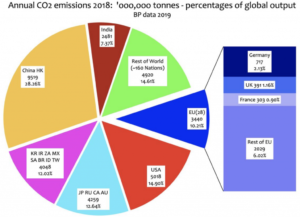
Global primary energy consumption grew rapidly in 2018, led by natural gas and renewables. Nevertheless, carbon emissions rose at their highest rate for seven years
Energy developments
Primary energy consumption grew at a rate of 2.9% last year, almost double its 10-year average of 1.5% per year, and the fastest since 2010.
By fuel, energy consumption growth was driven by natural gas, which contributed more than 40% of the increase. All fuels grew faster than their 10-year averages, apart from renewables, although renewables still accounted for the second largest increment to energy growth.
China, the US and India together accounted for more than two thirds of the global increase in energy demand, with US consumption expanding at its fastest rate for 30 years.
Carbon emissions
Carbon emissions grew by 2.0%, the fastest growth for seven years.
A hydrogen refueling station exploded in Norway on Monday and the company operating the station has suspended operation at its other locations following the explosion.
Now, Toyota and Hyundai are both halting sales of fuel cell vehicles in the country.
Does this spell the end of fuel cell hydrogen vehicles as a “zero-emission” alternative?
The Uno-X hydrogen station in Sandvika in Bærum exploded on Monday and resulted in two injuries in a nearby non-fuel cell vehicle.
According to the police, the explosion was strong enough that it activated the airbags in the vehicle without any impact.
The cause of the explosion is currently unknown and the rest of the refueling network is being shut down.
by Graham Hill, June 13, 2019 in GWPF/TheAustralian
Global coal production (up 4.3 per cent) and consumption (up 1.4 per cent) has increased at their fastest rate for five years.
Average global greenhouse gas emissions are rising at double the rate of Australia’s, exposing the mismatch between the “hope and reality” of meeting Paris Agreement goals, a report has found.
A major report by energy giant BP said the world was returning to coal, and without shale gas from the US and LNG exports from Australia the emissions reduction picture would be much worse.
Massive investments in renewable energy were needed but would not be enough to satisfy increasing demands for power, most notably in China and India.
BP said global emissions overall were up 2 per cent last year as the unexpected return to coal gathered pace.
“…there is no scientific evidence, whatsoever, that domestic livestock could represent a risk for the Earth’s climate” and the “warming potential of anthropogenic GHG [greenhouse gas] emissions has been exaggerated.”
Domestic Livestock and ItsAlleged Role in Climate Change
Abstract:
“Our key conclusion is there is no need for anthropogenic emissions of greenhouse gases (GHGs), and even less so for livestock-born emissions, to explain climate change. Climate has always been changing, and even the present warming is most likely driven by natural factors.
The warming potential of anthropogenic GHG emissions has been exaggerated, and the beneficial impacts of manmade CO2 emissions for nature, agriculture, and global food security have been systematically suppressed, ignored, or at least downplayed by the IPCC (Intergovernmental Panel on Climate Change) and other UN (United Nations) agencies.
Furthermore, we expose important methodological deficiencies in IPCC and FAO (Food Agriculture Organization) instructions and applications for the quantification of the manmade part of non-CO2-GHG emissions from agro-ecosystems.
However, so far, these fatal errors inexorably propagated through the scientific literature.
Finally, we could not find a clear domestic livestock fingerprint, neither in the geographical methane distribution nor in the historical evolution of mean atmospheric methane concentration.”
In what amounts to dissension from National Aeronautics and Space Administration (NASA) climate change policy, a series of just-released studies by working-level scientists prove that geological and not atmospheric forces are responsible for melting of Earth’s polar ice sheets.
…
NASA Greenland Study August 1, 2018
The results of this research study illustrated in Figure 2 confirm the very high geothermal bedrock heat-flow from Greenland’s massive subglacial Mantle Plume, which was originally documented in four previous research studies (see here, here, here, and here).
A geothermal heat-flow cause for the melting of Greenland’s ice sheet has been the focus of numerous Climate Change Dispatch articles (see here, here, here, and here).
World-wide energy demand grew at its fastest rate since 2010
The shale revolution powered U.S. oil and gas production in 2018 to the largest annual increases ever recorded by any country, according to energy giant BP PLC .
Surging global energy demand is fueling the production boom, even as oil and gas prices rise and economic growth slows, said BP’s annual statistical review published Tuesday.
World-wide demand for energy grew 2.9% in 2018, its fastest rate since 2010.
Unusual weather spurred some of the stronger-than-expected growth, as a greater number of extremely hot and cold days drove up air conditioning and heating use around the world, particularly in China, the U.S. and Russia, the company said.
In the U.S., energy consumption rose by 3.5% in 2018, with oil at 20.5 million barrels a day and a total of 817 billion cubic meters of gas consumed during the year.
Ces deux dernières années ont été marquées par une activité cyclonique supérieure aux moyennes statistiques en Atlantique Nord, notamment en 2017 avec des phénomènes puissants tels Irma et Maria dans les Caraïbes. Cette année, alors que la saison démarre officiellement le 1er juin, nos prévisions sont plus rassurantes avec la perspective d’une activité cyclonique légèrement plus faible que la moyenne.
En ce début d’été météorologique, la saison cyclonique débute dans l’Atlantique nord (les ouragans). Cette saison s’étend officiellement du 1er juin au 30 novembre, avec un pic d’activité d’août à octobre. Il est donc l’heure pour les différents organismes météo de la planète et les météorologues et climatologues de La Chaîne Météo de se pencher sur les prévisions de cette saison à venir.
En 2017, la saison dans l’océan Atlantique nord a figuré parmi les plus actives depuis le début des relevés, avec des phénomènes dévastateurs (Harvey, Irma ou encore Maria dans les Caraïbes). Comme 2017, la saison 2018 s’est située au-dessus des moyennes (calculées par la NOAA d’après la période 1981/2010). Cette dernière saison a présenté, pour l’Atlantique nord, 15 phénomènes cycloniques, avec 8 ouragans dont 2 qui ont atteint la catégorie 3 sur 5, qualifiés alors de “majeurs”.
German engineering, as good as it is, has not been able to eliminate the effect of “green” politics, which would replace fossil and nuclear power with renewables. The result is 172,000 localized blackouts in Germany in 2017.
Poverty was a constant companion of humanity until modern times. The proportion of people worldwide living in poverty was cut in half between 1990 and 2010, according to the World Bank, an achievement unprecedented in human history.
It was the result of a rapid boost in global energy production — up 43 percent during that period, according to the U.S. Energy Information Administration. Nearly 81 percent of that power was generated by fossil fuels, such as oil and gas.
A billion people around the globe still suffer extreme energy poverty, with no access to electricity. Everyone gets a hint of what that means when storms knock out the power, and everything in the house stops.
Fumbling occasionally for candles is a mere inconvenience, but life beyond carbon — entirely dependent on sunshine and a breeze — would be insanity.
Consider the following: we do not know all the variables that control our climate, but we are quite sure they are likely in the hundreds.
Just take a quick look at ten obviously important factors for which we have limited understanding:
1- Changes in seasonal solar irradiation;
2- Energy flows between ocean and atmosphere;
3- Energy flow between air and land;
4- The balance between Earth’s water, water vapor, and ice;
5- The impacts of clouds;
6- Understanding the planet’s ice;
7- Mass changes between ice sheets, sea level and glaciers;
8- The ability to factor in hurricanes and tornadoes;
9- The impact of vegetation on temperature;
10- Tectonic movement on ocean bottoms.
Yet, today’s modelers believe they can tell you the planet’s climate decades or even a century in the future and want you to manage your economy accordingly.
Dr. Willie Soon of the Harvard-Smithsonian astrophysics laboratory once calculated that if we could know all the variables affecting climate and plugged them into the world’s largest computer, it would take 40 years for the computer to reach an answer.
In a letter to the UK’s Committee on Climate Change (CCC) on Wednesday (5 June), a team of scientists suggests that the CCC’s proposed target of net-zero emissions by 2050 will need almost all cars and vans on British roads to be electric-battery powered.
The team, which supports that goal, outlined the raw material needs and challenges that will come hand-in-hand with such an ambitious target. Current battery production requires materials like cobalt, copper and nickel.
Professor Richard Herrington of the Natural History Museum said in a statement that “there are huge implications for our natural resources not only to produce green technologies like electric cars but keep them charged”.
He and his colleagues calculated that switching all of the UK’s light vehicles to electric will require 207,900 tonnes of cobalt, 264,600 tonnes of lithium carbonate and over 2,300,000 tonnes of copper.
The reigning narrative of impending global environmental catastrophe dominates the airwaves and print media. Short of a drastic reduction in the use of fossil fuels, it is asserted, we are fast approaching the “end of days”. The demonization of fossils fuels in general, and coal in particular, has been wrought under pressure from special interests groups and organized lobbies of the climate-industrial complex where aspects of economic reality are caricatured or presented out of context. Complex trade-offs in energy policy are spun into tales of spurious simplicity, leading to misleading conclusions. Nowhere is this more apparent than in the debate over the role of coal-fueled power generation in Asia.
Opposition to the building of coal power plants in the poorer countries has been justified by environmental activists, banks and multilateral development agencies such as the World Bank in two key ways. The first revolves around the claim that climate change mitigation programs carry “co-benefits” for public health in developing countries. The second utilizes the assertion that renewable energy such as solar and wind power are effective substitutes for centralized grid electricity generated by fossil fuels.
The reasons for the early Holocene temperature discrepancy between northern hemispheric model simulations and paleoclimate reconstructions—known as the Holocene temperature conundrum—remain unclear. Using hydrogen isotopes of fluid inclusion water extracted from stalagmites from the Milandre Cave in Switzerland, we established a mid-latitude European mean annual temperature reconstruction for the past 14,000 years. Our Milandre Cave fluid inclusion temperature record (MC-FIT) resembles Greenland and Mediterranean sea surface temperature trends but differs from recent reconstructions obtained from biogenic proxies and climate models. The water isotopes are further synchronized with tropical precipitation records, stressing the Northern Hemisphere signature. Our results support the existence of a European Holocene Thermal Maximum and data-model temperature discrepancies. Moreover, data-data comparison reveals a significant latitudinal temperature gradient within Europe. Last, the MC-FIT record suggests that seasonal biases in the proxies are not the primary cause of the Holocene temperature conundrum.
Due to the recent posts by Lord Monkton and Nick Stokes, I’ve been thinking about the relationship between radiation and temperature. So I turned to the CERES dataset. Here is a scatterplot of the monthly global average surface temperature versus the monthly global average downwelling total radiation absorbed by the surface. The total radiation is the sum of the net solar radiation at the surface and the downwelling longwave radiation at the surface. I’ve removed the seasonal variations from the data.
Note that 3.7 W/m2 is the increase in downwelling longwave radiation expected from a doubling of CO2 …
When I saw that, I thought well, maybe the increase is small because there’s a lag between the absorption of the radiation and the warming. To see if that was the case, I did a cross-correlation analysis of the relationship.
The EIA AEO 2019 report shows that in year 2018 wind and solar energy resources provide about 3% of U.S. total energy consumption while fossil fuel energy resources provide about 81% of total energy use.
The dominate use of fossil fuels in meeting U.S. energy needs remains little changed from a decade ago before use of renewable energy resources became mandated and supported by lucrative government subsidizes.
Using additional EIA data the total wind and solar provided energy going back to year 2000 is available which allows an assessment of the Production Tax Credit (PTC) payments to be made.
Fear’s a great motivator, right? So what better way to motivate people to care about climate change than to scare the crap out of them? Even if you have to leave out some details to do it?
New York Magazine climate columnist David Wallace-Wells seems to be a student at the School of We’re Hurtling Toward Global Environmental Catastrophe and We’re All Gonna Die. Last night, he shared a short piece by James Dyke, a senior lecturer in global systems at the University of Exeter, explaining some of the horrible things humanity is in for:
Abstract:A simple time-dependent model of Earth surface temperatures over the 24 hr day/night cycle at different latitudes is presented. The model reaches energy equilibrium after 1.5 months no matter what temperature it is initialized at. It is shown that even with 1,370 W/m2 of solar flux (reduced by an assumed albedo of 0.3), temperatures at all latitudes remain very cold, even in the afternoon and in the deep tropics. Variation of the model input parameters over reasonable ranges do not change this fact. This demonstrates the importance of the atmospheric “greenhouse” effect, which increases surface temperatures well above what can be achieved with only solar heating and surface infrared loss to outer space.
In its Special Report n° 15 “Global warming of 1.5°C” (SR15) [1], IPCC proposes four scenarios to limit Earth temperature increase to 1.5°C. In all scenarios CO2 emissions are kept at virtually zero by 2050. These scenarios are based on the technology called Carbon Dioxide Removal (CDR) that will remove CO2 to compensate CO2 anthropic emissions.
“All pathways that limit global warming to 1.5°C with limited or no overshoot project the use of carbon dioxide removal (CDR) on the order of 100–1000 Gt CO2 over the 21st century. CDR would be used to compensate for residual emissions and, in most cases, achieve net negative emissions to return global warming to 1.5°C following a peak (high confidence). CDR deployment of several hundreds of Gt CO2 is subject to multiple feasibility and sustainability constraints (high confidence). Significant near-term emissions reductions and measures to lower energy and land demand can limit CDR deployment to a few hundred Gt CO2 without reliance on bioenergy with carbon capture and storage (BECCS) (high confidence)” (page 19).
IPCC defines “Carbon dioxide removal (CDR)” as follows : Anthropogenic activities removing CO2 from the atmosphere and durably storing it in geological, terrestrial, or ocean reservoirs, or in products. It includes existing and potential anthropogenic enhancement of biological or geochemical sinks and direct air capture and storage but excludes natural CO2 uptake not directly caused by human activities” (page 26).
The fourth scenario recognizes the logical and inevitable increase of CO2 emissions if the world continues its growth to remove poverty and allow Asia and Africa countries to develop. Therefore, this scenario is based on a massive use of the CDR techniques as the report says: “Emissions reductions are mainly achieved through technological means, making strong use of CDR“.
Indeed, CDR is just rebranding of the CCS concept that is a cul-de-sac technology for a lack of economy, a lack of available adapted geological sinks on the production sites and also a lack of population acceptance.
After conducting a comprehensive, seven-year survey of Patagonia, glaciologists from the University of California, Irvine and partner institutions in Argentina and Chile have concluded that the ice sheets in this vast region of South America are considerably more massive than expected.
hrough a combination of ground observations and airborne gravity and radar sounding methods, the scientists created the most complete ice density map of the area to date and found that some glaciers are as much as a mile (1,600 meters) thick. Their findings were published today in the American Geophysical Union journal Geophysical Research Letters.
May 30, 2019. St. Mary, Montana. Officials at Glacier National Park (GNP) have begun quietly removing and altering signs and government literature which told visitors that the Park’s glaciers were all expected to disappear by either 2020 or 2030.
In recent years the National Park Service prominently featured brochures, signs and films which boldly proclaimed that all glaciers at GNP were melting away rapidly. But now officials at GNP seem to be scrambling to hide or replace their previous hysterical claims while avoiding any notice to the public that the claims were inaccurate. Teams from Lysander Spooner University visiting the Park each September have noted that GNP’s most famous glaciers such as the Grinnell Glacier and the Jackson Glacier appear to have been growing—not shrinking—since about 2010. (The Jackson Glacier—easily seen from the Going-To-The-Sun Highway—may have grown as much as 25% or more over the past decade.)
…
Montana Glacier National Park Mountains Cracker Lake
Greenlandian Stage = Lower or Early-Holocene. 11.70 ka to 8.33 ka
Northgrippian Stage = Middle or Mid-Holocene. 8.33 ka to 4.25 ka
Meghalayan Stage = Upper or Late-Holocene. 4.25 ka to present
The abbreviation “ka” refers to thousands of years ago. Lower, Middle and Upper are generally used when referring to rock-time units. Early, Mid and Late are generally used when referring to time units (Haile, 1987). Prior to the formal subdivision, Lower/Early, Middle/Mid and Upper/Late were commonly used; however there was no formal nomenclature. The fake word, “Anthropocene” is not used by real geologists.
There is also an informal climatological subdivision of the Holocene:
This book considers both the present state of Arctic shipping and possible future trends with reference to the various sectors of maritime transportation: cruise tourism, container traffic, and bulk shipping. Ports are analysed as tools that support the strategies of coastal states to foster the development of resource extraction, enhance the attractiveness of Arctic shipping lanes and enable the control of maritime activities through coast guard deployment.
The aim of this book is to draw a picture of the trends of Arctic shipping. How is traffic evolving in Canada’s Arctic, or along the Northern Sea Route? Are there significant differences between bulk and container shipping segments when considering the Arctic market? How are the ports and the hinterland developing and what are the strategies behind those? How is the legal framework shaping the evolution of maritime transportation? The contributors to this book consider all of these questions, and more, as they map out the prospects for Arctic shipping and analyse in detail the development of Arctic shipping as a result of multi-variable interactions.
This book will be key reading for industry professionals and post-graduate students alike.
Stanford study shows how hydrothermal vents fuel massive phytoplankton blooms — and possible hotspots for carbon storage
Researchers at Stanford University say they have found an aquatic highway that lets nutrients from Earth’s belly sweep up to surface waters off the coast of Antarctica and stimulate explosive growth of microscopic ocean algae.
Their study, published June 5 in the journal Nature Communications, suggests that hydrothermal vents – openings in the seafloor that gush scorching hot streams of mineral-rich fluid – may affect life near the ocean’s surface and the global carbon cycle more than previously thought.
Mathieu Ardyna, a postdoctoral scholar and the study’s lead author, said the research provides the first observed evidence of iron from the Southern Ocean’s depths turning normally anemic surface waters into hotspots for phytoplankton – the tiny algae that sustain the marine food web, pull heat-trapping carbon dioxide out of the air and produce a huge amount of the oxygen we breathe. “Our study shows that iron from hydrothermal vents can well up, travel across hundreds of miles of open ocean and allow phytoplankton to thrive in some very unexpected places,” he said.
Kevin Arrigo, a professor of Earth system science and senior author of the paper, called the findings “important because they show how intimately linked the deep ocean and surface ocean can be.”
CFAN predicts an active North Atlantic hurricane season season.
The Atlantic hurricane has begun. We are off to an early start with one wimpy subtropical storm that lasted less than a day, and a small system that is trying to spin up in the Bay of Campeche.
Other forecast providers have begun issuing forecasts:
NOAA predicts a near normal season with 4-8 hurricanes.
Tropical Storm Risk predicts slightly below normal activity, with 6 hurricanes and ACE of 88.
On 1st June 2019 the European Beyond EPICA Oldest Ice Core project started with the aim of drilling for and recovering ice from up to 1.5 Million years ago in Antarctica. The previous EPICA project recovered ice from 800,000 years ago. The new project aims to go beyond that. The new core will give us information on the greenhouse gases present during the Middle Pleistocene Transition (MPT), which occurred between 900,000 and 1.2 Million years ago. During this period the climatic periodicity transitioned from 41,000 to 100,000 years between ice ages. Why this change happened is the mystery scientists want to resolve.
To do this, experts from 10 European Countries and 16 different Research Institutions have joined forces under the guidance of Carlo Barbante and his management team at the CNR and Ca’ Foscari University of Venice in Italy, funded by the European Horizon 2020-research programme.