Archives de catégorie : climate-debate

Thawing Permafrost Could Leach Microbes, Chemicals Into Environment

by C. Rotter, Mar 10, 2022 in WUWT


Scientists are turning to a combination of data collected from the air, land, and space to get a more complete picture of how climate change is affecting the planet’s frozen regions.

Trapped within Earth’s permafrost – ground that remains frozen for a minimum of two years – are untold quantities of greenhouse gases, microbes, and chemicals, including the now-banned pesticide DDT. As the planet warms, permafrost is thawing at an increasing rate, and scientists face a host of uncertainties when trying to determine the potential effects of the thaw.

paper published earlier this year in the journal Nature Reviews Earth & Environment looked at the current state of permafrost research. Along with highlighting conclusions about permafrost thaw, the paper focuses on how researchers are seeking to address the questions surrounding it.

Infrastructure is already affected: Thawing permafrost has led to giant sinkholes, slumping telephone poles, damaged roads and runways, and toppled trees. More difficult to see is what has been trapped in permafrost’s mix of soil, ice, and dead organic matter. Research has looked at how chemicals like DDT and microbes – some of which have been frozen for thousands, if not millions, of years – could be released from thawing permafrost.

Then there is thawing permafrost’s effect on the planet’s carbon: Arctic permafrost alone holds an estimated 1,700 billion metric tons of carbon, including methane and carbon dioxide. That’s roughly 51 times the amount of carbon the world released as fossil fuel emissions in 2019. Plant matter frozen in permafrost doesn’t decay, but when permafrost thaws, microbes within the dead plant material start to break the matter down, releasing carbon into the atmosphere.

Sulfur emissions from consumption by developed and developing countries produce comparable climate impacts

by J. Lin et al., Feb 17, 2022 in Nature


Abstract

Regional consumption activities supported by domestic production and international trade have led to substantial aerosol-related emissions worldwide. Here we quantify sulfur dioxide emissions associated with consumption by developed and developing countries and assess the resulting climate impacts using an Earth system model. We find that although the consumption-associated emissions of developed countries are 40% less than those of developing countries, they lead to similar impacts on global mean surface air temperature and precipitation. This is because the effective radiative forcing induced per emission is greater for developed countries, which we attribute to the emissions being located at higher northern latitudes and being more evenly distributed zonally. Emissions from developing countries have a greater impact on temperature and precipitation over the tropical monsoon regions of China and India. Our results demonstrate the importance of trade and emission region in determining how consumption translates into global climate impact.

CO2 Emissions Hit Record High in 2021

by P. Homewood, Mar 9, 2022 in NotaLotofPeopleKnowThat


Energy-related CO2 emissions grew to
36.3 Gt in 2021, a record high


Global CO2 emissions from energy combustion and industrial processes1 rebounded in 2021 to reach their highest ever annual level. A 6% increase from 2020 pushed emissions to 36.3 gigatonnes (Gt), an estimate based on the IEA’s detailed region-by-region and fuel-by-fuel analysis, drawing on the latest official national data and publicly available energy, economic and weather data.

The Covid-19 pandemic had far-reaching impacts on energy demand in 2020, reducing global CO2emissions by 5.2%. However, the world has experienced an extremely rapid economic recovery since then, driven by unprecedented fiscal and monetary stimulus and a fast – although uneven – roll-out of vaccines. The recovery of energy demand in 2021 was compounded by adverse weather and energy market conditions, which led to more coal being burnt despite renewable power generation registering its largest ever annual growth. 

Emissions increased by almost 2.1 Gt from 2020 levels. This puts 2021 above 2010 as the largest ever year-on-year increase in energy-related CO2 emissions in absolute terms. The rebound in 2021 more than reversed the pandemic-induced decline in emissions of 1.9 Gt experienced in 2020. CO2 emissions in 2021 rose to around 180 megatonnes (Mt) above the pre-pandemic level of 2019.

The 6% increase in CO2 emissions in 2021 was in line with the jump in global economic output of 5.9%. This marks the strongest coupling of CO2 emissions with Gross domestic product (GDP) growth since 2010, when global emissions rebounded by 6.1% while economic output grew by 5.1% as the world emerged from the Global Financial Crisis.

New Study Suggests The Early Holocene’s Baltic Sea Temperatures Were 5-11°C Warmer Than Present

by Weiss et al., 2022 in NoTricksZone


Baltic Sea surface temperatures may have reached 24°C 7,200 years ago compared to the current 12.7°C.

A new study (Weiss et al., 2022) indicates Baltic Sea regional surface temperatures ranged between 21-24°C from ~5.7 to 7.7 ka (thousand years ago). This period is referred to as the Baltic’s Holocene Thermal Maximum.

Temperatures dipped to 17.2°C at 1.373 ka. (The time span ranging from 0.0 ka to 3 ka is referred to in the study as the Modern Baltic, or M.B.)

The current (0.0 ka) surface temperature for the Baltic S is 12.7°C. This temperature is more than 11°C colder than the Baltic’s temperatures at 7.2 ka.

German Paper: “A Mild Additional Temperature Rise Of Around 1°K”… Drop Not Excluded By 2100!

by P. Gosselin, Mar 6, 2022 in NoTricksZone


In its most recent video, German site Die kalte Sonne here looks at a paper on CO2 climate forcing by Stefani 2021: Solar and Anthropogenic Influences on Climate: Regression Analysis and Tentative Predictions. The results point to only a moderately warming planet up to the year 2150.

To hype up climate warming alarm, IPCC scientists like to exaggerate CO2’s power to trap heat and warm up the atmosphere. But with every assessment report that the IPCC issues, the estimated value by which CO2 warms the planet steadily gets reduced as the observed warming keeps lagging behind what earlier models predicted.

In his paper, Frank Stefani and his team at the Helmholtz Center, Institute of Fluid Dynamics in Dresden, Germany looked at the impacts by CO2 and solar activity.

On average 1.1°C warming

Using double regression, the scientists evaluated linear combinations of the logarithm of the carbon dioxide concentration and the geomagnetic aa index as a proxy for solar activity. They reproduced the sea surface temperature (HadSST) since the middle of the 19th and ended up with a a climate sensitivity (of TCR type) in the range of 0.6 K until 1.6 K per doubling of CO2. The midpoint of this range is 1.1°C, a value many critical climate scientists have already estimated earlier, and thus far below the IPCC scary estimates.

The paper’s abstract elaborates further:

The Pause Lengthens Again: No Global Warming for 7 Years 5 Months

by C. Monckton of Brenchley, Mar 4, 2022 in WUWT


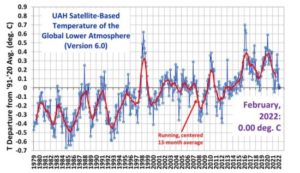
The drop from 0.03 K to 0.00 K from January to February 2022 in the UAH satellite monthly global mean lower-troposphere dataset has proven enough to lengthen the New Pause to 7 years 5 months, not that you will see this interesting fact anywhere in the Marxstream media

….

UAH Global Temperature Update for February 2022 Was 0.00 deg. C

by Roy Spencer, Mar 2, 2022 in ClimateChangeDispatch


The Version 6.0 global average lower tropospheric temperature (LT) anomaly for February 2022 was 0.00 deg. C, down a little from the January 2022 value of +0.03 deg. C.

The linear warming trend since January 1979 still stands at +0.13 C/decade (+0.12 C/decade over the global-averaged oceans, and +0.18 C/decade over global-averaged land).

Pielke Jr. on IPCC AR6 WG2 Release

by Pielke Jr., Feb28, 2022 in WUWT


An initial thread on the IPCC AR6 WG2 report released today

Whereas WG1 received a mixed review in my areas of expertise (specifically: poor on scenarios, solid on extremes), my initial reaction to the WG2 report is that it is an exceedingly poor assessment

The first observation is that the report is more heavily weighted to implausible scenarios than any previous IPCC assessment report

In particular, RCP8.5 represents ~57% of scenario mentions

This alone accounts for the apocalyptic tone and conclusions throughout the report.

How The Green Movement Empowered Putin’s Invasion Of Ukraine

by C. Feldman , Feb 2, 2022 in ClimateChageDispatch


Whatever you think our obligations to defend Ukraine at the moment, you must concede that the green movement in Western Europe and the United States made his actions possible. [bold, links added]

They also made any non-military reaction toothless and unpersuasive. It has been the equivalent of a poker player discarding a royal straight flush and then trying to bluff his opponents with the pair of deuces remaining in his hand.

Only with dumb opponents is he likely to take the pot. And Russian President Putin is definitely not dumb.

Indeed, the weak sanctions proposed by the West to induce the Russians to pull back were so unimpressive the Russian stock market, which has been collapsing, rose 6.5 percent after President Biden announced them.

Mr. Biden did follow Germany in not certifying Nord Stream 2, but that’s just a temporary, paper contract issue. It’s not a long-term or permanent shutdown. He basically hit a couple of banks tied to the Donbas region.

The GDP for the whole of Ukraine is about $160 billion, maybe. The GDP of Donbas is less than $6 billion and the GDP of Lugansk is $1 billion, also maybe. Delaware’s GDP, just to pick a random comparison, is $76 billion. So, to call Mr. Biden’s sanctions small beer is understating it.

And the reason he cannot actually do much more short of war is that he and the leaders of western Europe—bamboozled by the prospect of “climate change”—have made themselves poorer and weaker by eviscerating conventional fuel production.

While they without ample reason were discarding a very good hand, Russian president Putin was improving his by exploiting and selling to us and Europe his nations’ fossil fuels.

….

The green dream goes lethal

by Melanie Phillips, Feb 24, 2022


There are many reasons why the west must bear considerable responsibility for this crisis. As I wrote here, these include the fantasy indulged in until this week by western nations that Putin posed no threat and was instead a person through whom westerners could enrich themselves.

Thus Britain’s capital has been dubbed “Londongrad,” because British governments have allowed so many of Putin’s fellow oligarchs to use its infrastructure to launder stolen Russian funds — contributing in the process so much to Britain’s GDP.

Then there’s the European embrace of pacifism, which has led Britain and other European states to cut their defence spending and rely instead on America’s protective umbrella which they all took for granted.


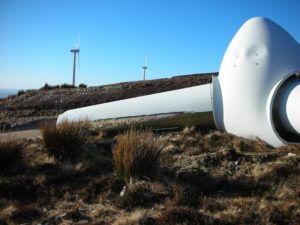
Storm damaged wind turbine, Ireland, 2008

That parasitic illusion went belly-up with the advent of the Biden administration, whose refusal to defend the free world and its preference instead to throw in the towel wherever possible  — as demonstrated most graphically by America’s disorderly scuttle from Afghanistan — has been duly noted by Putin, along with the regimes in China and Iran, as evidence that the Biden administration would take no effective action to counter their own aggression.

But even more shocking that all this is that, through their unhinged obsession with “climate change,” America, Britain and Europe have handed Putin his greatest weapon against them.

In their determination to reduce carbon emissions by turning against fossil fuels, and having put so many of their eggs in the basket of renewables which are desperately unreliable as national sources of energy, they have made themselves overly dependent on gas.

Sinking Sea Level Alarmism: Study By Nevada Scientists Show Surface Motion of Continents “On Average Upward”

by P. Gosselin, Feb 27, 2022 in NoTricksZone


German climate science critical site Die kalte Sonne here reports on a recent study by Hammond et al (2021) titled:  “GPS Imaging of Global Vertical Land Motion for Studies of Sea Level Rise“.

How we have mischaracterized climate risk

by J. Curry, Feb 19, 2022 in ClimateEtc.


“The current thinking and approaches guiding this conceptualization and description have been shown to lack scientific rigour, the consequence being that climate change risk and uncertainties are poorly presented. The climate change field needs to strengthen its risk science basis, to improve the current situation.” – Norwegian risk scientist Terje Aven

For decision-makers, climate change is a problem in risk assessment and management.  Climate change is a risk because it may affect prosperity and security in a negative way, and because its consequences are uncertain.

Global climate change policy has been dominated by a specific strategy of risk management – the Precautionary Principle as a justification for setting specific targets for the elimination of manmade emissions of carbon dioxide.  In the early 1980s, the United Nations Environmental Program (UNEP) became bullish on the idea that fossil fuels would produce dangerous climate change. The prospect of eliminating fossil fuels was congruent with UNEP’s broader interests in environmental quality and world governance. At Villach in 1985 at the beginning of the climate treaty movement, the policy movement to eliminate fossil fuels became detached from any moorings in the science – the rhetoric of precaution argued that we should act anyway to eliminate fossil fuels, just in case. This perspective became codified by the 1992 UN Framework Convention on Climate Change (UNFCCC) Treaty in 1992, the Kyoto Protocol in 1997 and the 2015 Paris Climate Agreement.

Instead of framing the IPCC assessments around risk assessment, the IPCC reports narrowly framed its assessments to support the UNFCCC policies, focusing on dangerous climate change associated with fossil fuel emissions.  The torquing of climate science and the manufacture of a consensus around dangerous human-caused climate change not only oversimplified the scientific and social challenges, but led to the adoption of a “predict then act” strategy to manage and control, supporting decisions about elimination of fossil fuel emissions that were begun in the 1980’s.  The congruence of the IPCC assessments and UNFCCC policies enforces the belief that climate change is a simple or tame problem, with science trumping all practical questions and conflicting values and purposes.

Evaluation of the Homogenization Adjustments Applied to European Temperature Records in the Global Historical Climatology Network Dataset

by P. O’Neill et al., Feb 24, 2022 in MPDI


The widely used Global Historical Climatology Network (GHCN) monthly temperature dataset is available in two formats—non-homogenized and homogenized. Since 2011, this homogenized dataset has been updated almost daily by applying the “Pairwise Homogenization Algorithm” (PHA) to the non-homogenized datasets. Previous studies found that the PHA can perform well at correcting synthetic time series when certain artificial biases are introduced. However, its performance with real world data has been less well studied. Therefore, the homogenized GHCN datasets (Version 3 and 4) were downloaded almost daily over a 10-year period (2011–2021) yielding 3689 different updates to the datasets. The different breakpoints identified were analyzed for a set of stations from 24 European countries for which station history metadata were available. A remarkable inconsistency in the identified breakpoints (and hence adjustments applied) was revealed. Of the adjustments applied for GHCN Version 4, 64% (61% for Version 3) were identified on less than 25% of runs, while only 16% of the adjustments (21% for Version 3) were identified consistently for more than 75% of the runs. The consistency of PHA adjustments improved when the breakpoints corresponded to documented station history metadata events. However, only 19% of the breakpoints (18% for Version 3) were associated with a documented event within 1 year, and 67% (69% for Version 3) were not associated with any documented event. Therefore, while the PHA remains a useful tool in the community’s homogenization toolbox, many of the PHA adjustments applied to the homogenized GHCN dataset may have been spurious. Using station metadata to assess the reliability of PHA adjustments might potentially help to identify some of these spurious adjustments. View Full-Text
SEE ALSO HERE : WUWT
SEE ALSO HERE : CERES

Marshall Islands Growing, Not Shrinking. World Bank’s Embarrassing Error In Alarmist 2021 Report

by C. Rotter, Feb 21, 2022 in WUWT


Last October, just before Glasgow Climate Conference, the World Bank issued a report with a dire warning for the Marshall Islands. It claimed: “Rising sea levels in the atoll nation of Marshall Islands are projected to endanger 40 percent of existing buildings in the capital, Majuro, with 96 percent of the city at risk of frequent flooding induced by climate change.”

The startling claims were based on “new visual models” and that the rising sea levels were due to co2-induced warming.

But now we learn that the model inputs were garbage, and so the model outputs were garbage as well. Nothing of the sort is going to happen to the Marshall Islands anytime soon.

Analysis shows 4% growth from 1945 to 2010!

German climate site Die kalte Sonne here took a closer look at the dramatic claims and found the World Bank report had a grave error: they failed to account for the role that coral reefs play in island building.

2015 paper published by Ford et al indeed found that the opposite is happening: the islands are expanding and not sinking and shrinking. The paper’s abstract:

British colonisation of Australia 250 years ago to blame for recent wildfires

by P. Homewood, Feb 18, 2022 in NotaLotofPeopleKnowThat


Britain’s colonisation of Australia in the late 18th century is partly to blame for the nation’s recent ravaging by bushfires, a new study claims.

Before British ships carrying convicted criminals landed in New South Wales in January 1788, aboriginal people tended the landscape and were in charge of bushfire prevention.

But after the penal colony was established, and indigenous people were forced off their land and away from territories they had tended for centuries, the settlers took a new approach.

Suppression is now the primary focus. Instead of proactively and gradually reducing the risk of fire, authorities try to extinguish a fire as soon as possible after ignition.

Researchers from around the world, including Australia, have published a paper saying this change in tack has left Australia more vulnerable to wildfires now than it was 250 years ago.

“Indigenous people managed Australia’s flammable vegetation with “cultural burning” practices,” the study authors write in an article for The Conversation.

“These involved frequent, low-intensity fires which led to a fine-grained vegetation mosaic comprising grassy areas and scattered trees.

“Landscapes managed in this way were less prone to destructive fires. But under colonial rule, Aboriginal people were dispossessed of their lands and often prevented from carrying out many important practices.”

The change in wildfire prevention due to colonisation has left Australia more vulnerable to wildfires now than it was 250 years ago

….


Dire Warnings Of A Climate Collapse By 2020 Made By Media In 2007 Get Postponed Again

by P. Gosselin, Feb 18, 2022 in NoTrickZone


In 2007, in the wake of the 4th IPCC report and Al Gore’s An Inconvenient Truth, Germany’s most widely circulated daily, Bild, reported:

There are only 13 years left to save our earth! Can the climate catastrophe still be prevented? There is only little time left to save our planet!” According to the World Climate Report, mankind has at most until 2020 to prevent the worst by introducing efficient technologies.

As reported by the Financial Times Deutschland, UN climate researchers predict: “If greenhouse gas emissions do not decrease substantially by 2020, global warming will set in motion irreversible processes such as the melting of the ice sheets in Greenland and the acidification of the oceans.”

See original article (in German) here at Bild.

Since then, the horror scenarios obviously have not come to pass. Moreover, instead of greenhouse gases “substantially decreasing” globally, they’ve actually increased substantially.

New Study: In Northern Poland The Medieval Warm Period Was 3°C Warmer Than Today

by K. Richard, Feb 17,2022 in NoTricksZone


The temperature record for this region also shows today’s temperatures are not much different than they were during the Little Ice Age.

Another chart contained in the study (Pleskot et al., 2022) shows North America’s and Europe’s mean annual temperatures are nearly the lowest of the last 4,500 years.

Methane Spikes !

by Kip Hansen, Feb 10, 2022 in WUWT


Scientists raise alarm over ‘dangerously fast’ growth in atmospheric methane

Our ever benevolent and protective scientist class has come to our rescue by raising the alarm – if they didn’t, we might not be adequately alarmed by this dangerous situation.

Seriously, the Nature punchline is, as you may have already guessed:  “some researchers fear that global warming itself is behind the rapid rise.” 

Yes, that’s right.  Global Warming (itself!) may be behind the rapid rise.

The author of the Nature article, Jeff Tollefson, calls this a “grim milestone” (however, no reason for this being either grim or a milestone is given).

Those interested in this trivial issue should read the Nature article.  There are some interesting points in it concerning suspected and hypothesized sources of the methane and the reason for the rather odd pattern of rise and fall seen in multi-year data.

However, here is:

The Bottom Line

1.  Always look at the units attached to any numerical data.

1900 ppb (parts per billion) is 1.9 ppm (parts per million)

Or, in percentage of the atmosphere:

0.000 19 Percent [%]

2.  What that means in the Real World™ is that the amount of methane in the atmosphere is so small — there is more neon and helium in the atmosphere than methane — that if you searched for a molecule of methane, and individually sorted through a BILLION molecules, you might find one or two.  You might find none in your first billion, but if you sorted enough billions, your find would average out at just under 2 per billion. (Good Luck!)

3. As the Earth continues to warm and green as it comes out of the Little Ice Age, we see more life which means more methane.  More life is a Good Thing.

4.  Atmospheric Methane has spiked! — to almost zero.

# # # # #h

Author’s Comment:

Almost Zero is an important issue.  Many of the most popular dangers and harms touted in the popular press are about the crisis of “things” being discovered at levels which are best described as “Almost Zero”.  This is the nutty misapplication of the precautionary principle, where the mere existence —  the mere detection —  of a thing is automatically equated with harm.

The IPCC CO2 Climate Narrative: A “Behemoth On Clay Feet” …Ready To Collapse

by P. Gosselin, Fab, 6, 2022 in NoTricksZone


The earth’s history provides the solid proof that acquits CO2. The IPCC’s claim of CO2 being the dominant climate factor is a behemoth on clay feet. 

By Fred F. Mueller

Have you ever had an uneasy feeling when watching the aggressive, intolerant stance of the apologists of “man-made climate catastrophe” against all critics?

The overwhelming majority of our elites blame CO2 emitted by mankind to be responsible for “a runaway overheating” of our atmosphere. “The science” spearheaded by the Intergovernmental Panel on Climate Change (IPCC) calls for us to renounce fossil fuels and return to the frugal lifestyle of the 18th or 19th century.

You might well find you’re not alone with that unease, which is proliferating rapidly since social media giants have started to censor people daring to question the IPCC’s “science is settled” attitude.

Another dot on the graphs (Part II)

by Gavin, Feb 2, 2020 in RealClimate


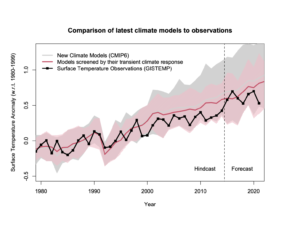
We have now updated the model-observations comparison page for the 2021 SAT and MSU TMT datasets. Mostly this is just ‘another dot on the graphs’ but we have made a couple of updates of note. First, we have updated the observational products to their latest versions (i.e. HadCRUT5, NOAA-STAR 4.1 etc.), though we are still using NOAA’s GlobalTemp v5 – the Interim version will be available later this year. Secondly, we have added a comparison of the observations to the new CMIP6 model ensemble.

As we’ve discussed previously, the CMIP6 ensemble contains a dozen models (out of ~50) with climate sensitivities that are outside the CMIP5 range, and beyond the very likely constraints from the observations. This suggests that comparisons to the observations should be weighted in some way. One reasonable option is to follow the work of Tokarska et al (2020) and others, and restrict the comparison to those models that have a transient climate response (TCR) that is consistent with observations. The likely range of TCR is 1.4ºC to 2.2ºC according to IPCC AR6, and so we plot both the mean and 95% spread over all all models (1 ensemble member per model) (grey) and the TCR-screened subset (pink).

CMIP6 model means and spreads since 1979 (reader friendly version).

….

Germany January Mean Temperatures Falling Since 1988, Contradicting Claims Of Warming

by NoTricksZone, Feb 2, 2022 in WUWT


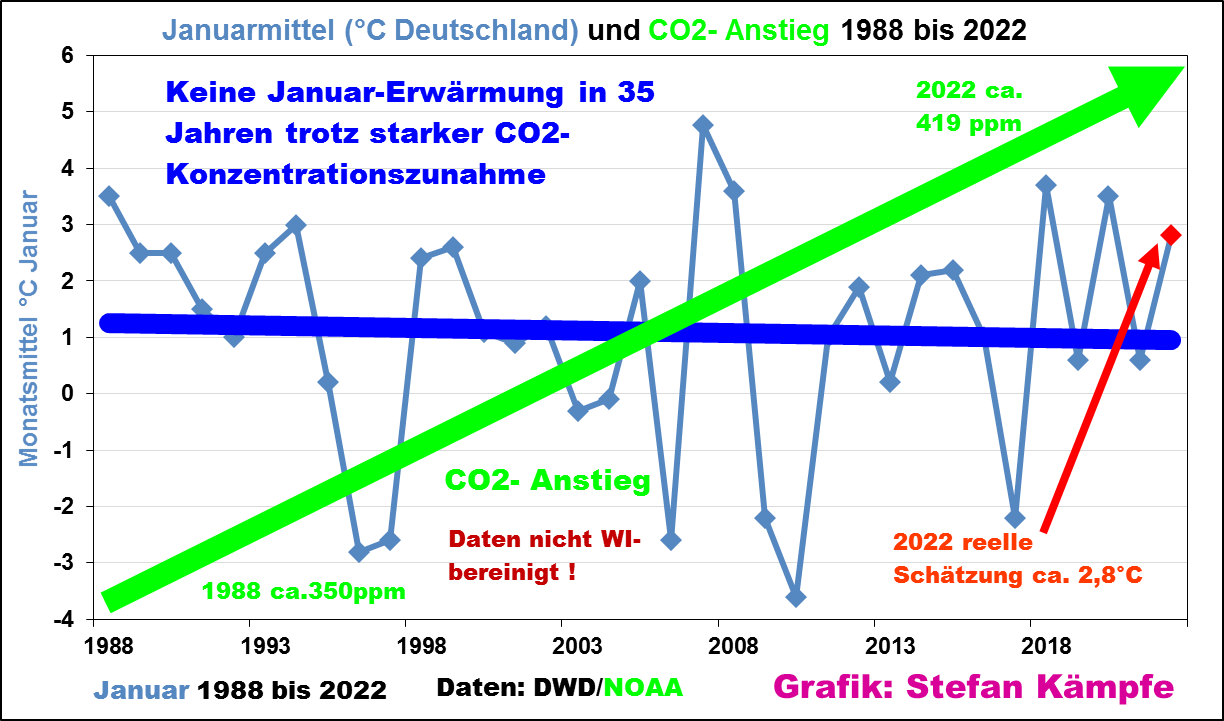
According to the media and climate alarmists, winters like we used to have in the global cooling days of the 1970s were supposed to be disappearing due to increasing warming from rising CO2.

But that hasn’t really been happening. For example, Stefan Kämpfe at the European Institute for Climate and Energy (EIKE) plotted Germany’s mean January temperature going back to 1988:

105 More Non-Global Warming/Non-Hockey Stick Temperature Records Added To The Database In 2021

by K. Richard, Jan 31, 2022 in NoTricksZone


Since 2019,there have been over 350 peer-reviewed scientific papers published showing no warming in the modern era and/or much warmer temperatures than today when CO2 levels ranged from 180 to 280 ppm (Holocene, Pleistocene).

Below is the link to the updated (now including 2021) database of non-hockey temperature records from locations across the world.

These hundreds of papers suggest a) Earth was multiple degrees warmer than today throughout much of the last 11,700 years (Holocene), and b) there has been nothing unusual about temperature changes in the modern era.

The first 8 papers on the 2021 list are shown below as samples.

Over 350 Non-Hockey Sticks (2019-2021)

Zhou et al., 2021  South China Sea ~4°C warmer SST during the Middle Holocene…1994-2004 coldest temperatures of the last 6000 years.