Archives par mot-clé : Non-Global Warming

No, ScienceDaily, Data Show No ‘Sharp Acceleration’ in Warming

by A. Watts, 7 aug, 2026 in WUWT


ScienceDaily’s article, “Scientists detect a sharp acceleration in global warming,” promotes a new Geophysical Research Letters paper claiming that global warming has entered “a faster gear” since about 2015. This is false.  The authors argue that after statistically removing the effects of El Niño, volcanic eruptions, and solar variability from five global surface temperature datasets, they detect a statistically significant acceleration in warming of about 0.35°C per decade over the past 10 years. But historical temperature data show a much different picture.

There is no convincing evidence that Earth’s warming has suddenly accelerated. Instead, this appears to be an exercise in statistical manipulation built upon climate modeling assumptions, presented as though it were an observational discovery.

And there’s advocacy behind the paper too, as evidenced by this quote from the paper’s co-author, climate science blogger Stefan Rahmstorf:

If the warming rate of the past 10 years continues, it would lead to a long-term exceedance of the 1.5°C limit of the Paris Agreement before 2030. How quickly the Earth continues to warm ultimately depends on how rapidly we reduce global CO2 emissions from fossil fuels to zero.

Science and advocacy are not a convincing combination.

The paper does not report the discovery of a new measurement. It takes existing surface temperature records, applies a statistical procedure designed to subtract what the authors consider “noise” from El Niño, volcanic aerosols, and solar variability, and then analyzes the adjusted temperatures for an acceleration signal.

In other words, the claimed acceleration appears only after the authors modify the observations. ScienceDaily presents this as though scientists have discovered a new physical phenomenon. They haven’t. They have created a new statistical product.

Tokyo Sees Coldest February In 34 Years…Mean February Temperature Trend Has Not Risen Since 1987!

by P. Gosselin, Mar 4, 2022 in NoTricksZone


The February and winter 2021/22, untampered JMA mean temperature data are in for Tokyo and its Hachijojima island

Tokyo

Here’s the latest plot of February mean temperatures for Tokyo, since 1987

Over the past 34 years, February mean temperatures in Tokyo have been steady, i.e. no warming. After the past 2 Februarys came in rather balmy, this most recent February has been the coldest since 1988!

Hachijojima

Moving away from the urban Tokyo and over to the city’s rural Pacific island of Hachijojima, some 275 km off the Japan mainland, we plot the latest February data going back to 1987


Here as well there’s been no warming in February since 1987. In contradiction to the predictions of warming, the island has in fact cooled off bit, according to the data from the Japan Meteorological Agency (JMA).

The past February has been among the coolest since 1987.


The Pause Lengthens Again: No Global Warming for 7 Years 5 Months

by C. Monckton of Brenchley, Mar 4, 2022 in WUWT


The drop from 0.03 K to 0.00 K from January to February 2022 in the UAH satellite monthly global mean lower-troposphere dataset has proven enough to lengthen the New Pause to 7 years 5 months, not that you will see this interesting fact anywhere in the Marxstream media

….

17 More Studies Show No Unusual Warming Trend In Recent Centuries…And A Warmer Holocene

by K. Richard, Nov 11, 2021 in NoTricksZone


Cruz et al., 2021 (Argentina)

Argentina’s (Tixi Cave) present annual temperature is 13.8°C. It was 3.5°C (17.3°C), 1.7°C (15.5°C), 3°C (16.8°C), and 4.5°C (18.3°C) warmer than today 3496, 1656, 656, and 160 years before present, respectively. So ~1860 was 4.5°C warmer.


Peer-Reviewed Study Confirms Antarctica Has Not Warmed in Last Seven Decades

by P. Homewood, Jan 16, 2021 in NotaLotofPeopleKnowThat


Cancel all the claims by climate activists that global warming is decimating Antarctica. A peer-reviewed study recently published in one of the most prominent science journals destroys one of the most frequently asserted claims by climate activists – that climate change is warming Antarctica and melting the Antarctic ice sheet. The recent study confirms Antarctica has not warmed in the past 70 years and Antarctic ice cover is expanding rather than shrinking.

Writing in the journal Nature, scientists at Columbia University and the University of Victoria, British Columbia report, “The Antarctic continent has not warmed in the last seven decades, despite a monotonic increase in the atmospheric concentration of greenhouse gases.”


….

Ces villes qui ne se réchauffent pas

by Jean N., 6 décembre 2019 in ScienceClimatEnergie


Non, le réchauffement de la planète n’est pas global comme l’affirment les médias. Selon la dernière version des données officielles de température fournies par le Goddard Institute for Space Studies (GISS) de la NASA (les séries thermométriques terrestres GHCNv4), il existe dans le monde toute une série de villes, villages et régions où aucun réchauffement de la troposphère n’est observé au niveau du sol en fonction du temps. Ceci est d’ailleurs confirmé par la récente étude de Lansner & Pedersen publiée en 2018 (et qui avait fait l’objet d’un article ici-même), mais aussi par d’autres publications qui analysent par exemple le “warming hole” des Etats-Unis (Partridge et al. 2018). Et pourtant, dans ces régions qui ne se réchauffent pas, le taux atmosphérique de CO2 a bel et bien augmenté de manière significative (voir ici). Le but du présent article est d’abord de vous présenter 12 de ces villes et régions. Nous verrons ensuite que le rôle attribué au CO2 est exagéré et que de nombreux facteurs, méconnus, entrent en jeu et jouent probablement un rôle dominant.

1. Présentation de quelques villes et régions qui ne se réchauffent pas.

Dans les lignes qui suivent, les données officielles de température seront utilisées. La qualité de ces données a bien entendu été contrôlée par les gestionnaires locaux des stations météorologiques, et puis par le GISS lui-même. Ne seront présentées que les séries de températures moyennes annuelles. Les données ont ensuite été ajustées pour tenir compte des effets non climatiques, des changements géographiques éventuels de stations de mesure, ainsi que de l’effet de chaleur urbain qui a été déduit. Il s’agit donc de données nettoyées, appelées “GHCN-adj-homogenized”. Chacun peut se les procurer librement sur le site web du GISS (il suffit de cliquer sur un endroit du monde sur la carte ici).

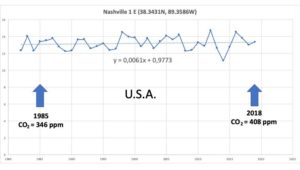
1.1. Commençons par Nashville aux Etats-Unis (Figure 1). Il s’agit de la capitale de l’État du Tennessee qui comptait 668 347 habitants en 2014. Nashville possède un climat subtropical humide (dans la Classification de Köppen) avec des hivers doux qui peuvent être modérément froids et des étés chauds et humides. Les moyennes mensuelles varient entre 3,4 °C pour le mois le plus froid (janvier) et 26,6 °C pour le mois le plus chaud (juillet). On peut voir sur la Figure 1 la relative stabilité de la température moyenne annuelle oscillant autour de 13°C, et ce depuis 1982 (la droite de régression possède une pente très faible, proche de zéro, et valant +0,0061).


Figure 1. Température moyenne annuelle de Nashville (Tennessee, USA) entre 1982 et 2018.


Busted Hockey Sticks: 35 Non-Global Warming Papers Have Been Published In 2019

by Kenneth Richard, March 22, 2019 in NoTricksZone


Could a transition in paleoclimate reconstruction be underway? More and more, scientists aren’t hiding statements or graphical depictions of the lack of modern warming or the much-warmer Holocene past.


A compilation of 35 papers from across the globe indicate that modern climate is not unusual, remarkable or unprecedented, and that large regions of the Earth were as warm or warmer than now when CO2 concentrations were much lower (260 to 350 ppm).

This development continues apace with the trends from the last two years, when 253 non-hockey stick papers were published.