New Scientist: “We could get most metals for clean energy without opening new mines”

by  E. Worrall, Aug 25, 2025 in WUWT


Read more: https://www.newscientist.com/article/2493449-we-could-get-most-metals-for-clean-energy-without-opening-new-mines/

This seems a strange claim, or at least an odd take on the issue. Most mining engineers I’ve met could recite from memory exactly what is in the waste product of the last mine they worked on. And reprocessing waste from past mining operations is big business, in cases where the waste is valuable.

Those minerals will be extracted when the time is right. But until the value of extraction makes it profitable, a significant strategic need arises, or technological advances bring down the cost, why would anyone bother?

As for the claim such extraction could cover the entire needs of battery, solar panel, wind turbine manufacture, most of the estimates for the required minerals I’ve seen are so gigantic, lets just say expert or not, I’d like to see Elizabeth Holley’s calculations.

Graph of the Week – Temperature of ocean air-sheltered stations

by A. Watts, Aug 26, 2025 in WUWT


I somehow missed this, but I find it very interesting. From the 2018 paper: “Temperature trends with reduced impact of ocean air temperature” by Frank Lansner*Jens Olaf Pepke Pedersen

Abstract

Temperature data 1900–2010 from meteorological stations across the world have been analyzed and it has been found that all land areas generally have two different valid temperature trends. Coastal stations and hill stations facing ocean winds are normally more warm-trended than the valley stations that are sheltered from dominant oceans winds.

Thus, we found that in any area with variation in the topography, we can divide the stations into the more warm trended ocean air-affected stations, and the more cold-trended ocean air-sheltered stations. We find that the distinction between ocean air-affected and ocean air-sheltered stations can be used to identify the influence of the oceans on land surface. We can then use this knowledge as a tool to better study climate variability on the land surface without the moderating effects of the ocean.

We find a lack of warming in the ocean air sheltered temperature data – with less impact of ocean temperature trends – after 1950. The lack of warming in the ocean air sheltered temperature trends after 1950 should be considered when evaluating the climatic effects of changes in the Earth’s atmospheric trace amounts of greenhouse gasses as well as variations in solar conditions.

Another New Study Suggests Most – 80% – Of The Modern CO2 Increase Has Been Natural

by K. Richard, Aug 29, 2025 in NoTricksZone 


An independent researcher (Robbins, 2025) has reviewed recent research that suggests at least “80% or more of the [modern CO2] increase is of natural origin.”

This is because “changes in atmospheric temperature are an ‘effect’ of changes in SSTs and not a ’cause’ as some might advocate.”

Similar conclusions are found in a paper published in the same peer-reviewed journal last year (Ato, 2024).

“SST [sea surface temperature] has been the determinant of the annual changes in atmospheric CO2 concentrations and […] anthropogenic emissions have been irrelevant in this process…”

Media Falsely Claim Antarctica On Brink Of Climate Doom, Ignore Contrary Data

by A. Watts, Aug 29, 2025 in ClimateChangeDispatch 


Why abrupt Antarctic ‘climate shifts’ aren’t new or necessarily catastrophic.


Emperor Penguins
A recent CBS News article, “Abrupt Antarctic climate shifts could lead to ‘catastrophic consequences for generations,’ experts warn,” claims that Antarctica is on the brink of irreversible collapse due to climate change, warning that sea levels could rise by meters and that “catastrophic consequences for generations” are looming. [emphasis, links added]

This is false or, at best, deeply misleading.

The actual data and history of Antarctic ice show that “abrupt changes” are neither unprecedented nor a reason to panic. Natural variability and cyclical shifts are being ignored in favor of sensational headlines pushing the increasingly untenable climate crisis narrative.

CBS was not alone in pushing the Antarctic climate crisis narrative.

On August 21, 2025, the Australian Broadcasting Corporation (ABC) joined the chorus of media outlets with alarming headlines warning of a pending ice collapse, publishing a report claiming Antarctica is undergoing “rapid, self-perpetuating changes” that are “potentially irreversible.”

Each of the reports cited a new Nature review led by Professor Nerilie Abram as the source of the information for their alarming articles.

ABC’s article presents Antarctica as being in a state of runaway decline, with imminent threats to emperor penguins and global sea levels, parroting language from the Abram paper as if it were an observed fact, rather than the speculative synthesis of research papers that the Nature study cites.

CBS, ABC, and other media outlets are covering this story as if a tipping point is upon us—but a closer look at the evidence reveals otherwise.

NYT Falsely Blames Climate Change For Hurricane Erin Despite No Evidence

by L. Lueken, Aug 28, 2025 in ClimateChangeDispatch


Rapid intensification of Hurricane Erin isn’t unusual, and attribution studies don’t prove climate change caused it.

The New York Times (NYT) published an article titled “How Climate Change Affects Hurricanes Like Erin,” in which they rely on rapid attribution analysis to claim that climate change is making rapidly intensifying hurricanes more likely, implying that the storm was worsened by global warming. This is false. [emphasis, links added]

Attribution studies are generally not based on solid scientific evidence and, therefore, not provable. Plus, there is a lack of evidence to support the notion that rapid intensification is becoming more common.

At the outset, the NYT claimed that hurricane Erin’s effects, such as they are, “are made worse by global warming,” even though the storm stayed offshore. The storm intensified quickly from a Category 1 to a Category 5 hurricane, and NYT claims that “[a]s the planet warms, scientists say that rapidly intensifying hurricanes are becoming ever more likely.”

First, it is important to note that just because a storm is among the most rapidly intensifying on record, it does not mean that there were not similar storms that went unrecorded.

As mentioned in a previous Climate Realism post about hurricane Erin, hurricane measurement technology is far advanced today than it was even a few decades ago.

Before the widespread use of Hurricane Hunter flights starting in the 70s where offshore storms were first closely monitored and directly measured throughout their lifespan, other rapidly intensifying storms would not have made the record.

So there is uncertainty about the record there.

Beyond that, attribution researchers and the NYT would like to blame hurricane intensification all on warm sea surface temperatures, but rapid intensification occurs in response to a variety of factors lining up just right.

Similar claims were made two years ago concerning Hurricane Otis. That storm also intensified rapidly over a single day, turning into a Category 5 before hitting the west coast of Mexico.

Otis did not intensify under expected conditions; thunderstorm bursts that forecasters were unable to predict are now believed to have been responsible for its rapid intensification.

Just as some scientists say more intense storms are more likely with warming, other scientists say that they will become less likely to form or less likely to strike land.

The NYT neglected to mention these perspectives, focusing its story on the scarier opinions that support the narrative that climate change is responsible for worsening extreme weather events.

In fact, as Climate at A Glance: Hurricanes details, there is no data suggesting hurricanes are becoming more frequent or more intense.

Study Finds Extreme Weather Database Exaggerates Global Disaster Trends

by Climate Discussion Nexus, Aug 28, 2025 in ClimateChangeDispatch 


Disasters don’t count if you don’t count them.

City flood aftermath
According to its publishers, a dataset called EM-DAT, which stands for Emergency Events Database, so it’s not even an acronym, lists “data on the occurrence and impacts of over 26,000 mass disasters worldwide from 1900 to the present day.” [emphasis, links added]

Which makes it perfect for studying long-term trends. And what’s even better, for the climate change crowd anyway, is that, as the authors of a 2024 study noted, “There are very strong upward trends in the number of reported disasters.”

But as the same authors noted in the very next sentence, “However, we show that these trends are strongly biased by progressively improving reporting.” Simply put, before 2000, reporting of small disasters that caused fewer than 100 deaths was hit-and-miss.

So, historically, the record of giant disasters that killed hundreds or more persons is reasonably complete, but not the record of small ones.

And the authors of the recent study argue that once they adjust for the effect of underreporting, the trends in disaster-related mortality go away.

The paper, “Incompleteness of natural disaster data and its implications on the interpretation of trends,” by a group of scientists in Sweden, began by noting that they are not the first to point out the problem.

The weird thing is that many authors who have pointed out this massive flaw have then gone ahead and used the data anyway, as though it did not exist, or at least they had not noticed it:

“Various authors (Field et al., 2012; Gall et al., 2009; Hoeppe, 2016; Pielke, 2021) have noted that there are reporting deficiencies in the EM-DAT data that may affect trends then proceeded to present trend analyses based on it without correction. Even the EM-DAT operators themselves discourage using EM-DAT data from before 2000 for trend analysis (Guha-Sapir (2023)). Yet recently, Jones et al. (2022) investigated the 20 most cited empirical studies utilising EM-DAT as the primary or secondary data source, and found that with only one exception the mention of data incompleteness was limited to a couple of sentences, if mentioned at all.”

Having made that point, their study then digs into the records and shows that in the post-2000 period, there is a steady pattern relating the frequency of events to the number of fatalities (F) per event.

It follows something that statisticians call “power-law behaviour” in which the more extreme an outcome, the rarer it is, not in a straight line but in an inverse exponential relationship, where extreme things, [like] large numbers of fatalities in a disaster, are a lot rarer than small numbers on a logarithmic curve. (For instance, in boating accidents, there are tens of thousands of individuals falling out and drowning for every Titanic.)

Hydrological, meteorological, and geophysical disasters all follow power-law behaviour in recent decades. But in earlier decades, the relationship doesn’t appear to hold because of a deficiency of low-fatality disasters in the data, rather than because it wasn’t still true then..

Finally, an Unbiased and Objective Climate Science Report

by T. Gallaudet, Aug 26, 2025 in TheEpochTimes


The recent report released by Energy Secretary Chris Wright on the climate impacts of greenhouse gas (GHG) emissions in the U.S. has caused quite a stir in the climate science arena. “Outrage,” “pushback,” and “criticized” are the words used in many of the headlines about it.
To better gauge the overall opinion of the report, two journalists from the Associated Press asked members of the climate science committee if they believed that it accurately portrayed the current “mainstream view of climate science.”

The Medieval Warm Period: A Global Phenomenon?

by M. Wielicki, Mar 06, 2025 in IrrationalFear

The debate over the characteristics and impact of the Medieval Warm Period (MWP), roughly dated from 950 to 1250 AD, lies at the heart of discussions on historical climate variability and its implications for understanding current climate change.

Following the publication of the Intergovernmental Panel on Climate Change (IPCC)Third Assessment Report in 2001, the MWP was essentially erased from the paleoclimatological record in favor of the ‘hockey stick’ graph. This disappearance remains a point of contention that has been particularly prominent in public and scientific debate.

The ‘hockey stick’ graph, first published by Michael Mann, Raymond Bradley, and Malcolm Hughes in 1999, depicted temperature anomalies over the past millennium. It showed relatively minor temperature fluctuations for most of the last millennium (the “shaft” of the hockey stick) and a sharp rise in temperatures in the 20th century (the “blade” of the hockey stick). This presentation suggested that the modern warming period has been unprecedented over the last millennium. This finding has been at the core of calls for robust measures aimed at addressing climate change.

A warming pulse in the Antarctic continent changed the landscape during the Middle Ages

by E. Forte et al., Apr 11, 2025 in Nature (OPEN ACCESS)


Abstract

The Antarctic landscape is one of the most stable environments on the Earth, at least since approximately 14 million years ago when most glaciers in continental Antarctica changed from temperate to cold-based, and previous extensive fluvial activity disappeared. Here, we detected a large landscape change on a coastal glacier in continental Antarctica (Boulder Clay Glacier) that occurred in the Medieval Warm Period. Such change consists in a glacial unconformity marked by a continuous sediment layer and an erosion channel on the past glacier surface. This channel, more than 4 kilometers long, represents a local deepening of a glacial unconformity that cuts the underlying glacial strata and was clearly imaged and mapped by Ground Penetrating Radar data. Four boreholes were allowed to calibrate the sediment layer so identified because it was observed in all boreholes at depths between 1.85 and 3.07 m. Moreover, the occurrence at a depth of 11.11 meters of mosses suitable for the dating through radiocarbon dating provided the age of 1050 calibrated years before the present, implying that the erosion event occurred during the Medieval Warm Period between 900 and 989 before the present.

Trump Unsettles Supposedly Settled Climate Science

by H.S. Burnett, Aug 26, 2025 in ClimateChangeDispatch 


DOE climate report shows rising CO2 has limited impact on temperatures and isn’t catastrophic as alarmists claim.


Donald Trump’s presidency has seemingly unsettled the supposedly settled science of climate change, disrupting 40 years of “climate change is killing us” dogma in seven short months. [emphasis, links added]

For nearly four decades, scientists with a reputational and financial stake in the game, and compliant, uninquisitive mainstream media, have told the public one thing consistently concerning climate change: there is a consensus, there is no debate, human greenhouse gas emissions are causing dangerous climate change. The end, roll credits, The Science is settled.

The Consensus Climate Cabal (CCC) of scientists, activists, and politicians attempted to enforce the settled climate science orthodoxy because they profited from it in one way or another, in part by shutting down continued debate and discussion about the causes and consequences of climate change.

For example, the Climategate emails showed scientists suppressing or lying about inconvenient data, undermining climate concerns, having open-minded journal editors removed from their positions or reined in by journal publishers (nefarious activity that continues to this day, unfortunately).

In Climategate’s aftermath, climate skeptics were increasingly shut out of the peer review process, and papers openly skeptical of the anthropogenic climate disaster narrative were nearly impossible to get published in top journals.

The mainstream media then piled on. It began to shut dissenting voices out of climate change stories.

The media concluded that since “the science was settled,” the debate was over, and publishing the views of climate skeptics/climate realists was tantamount to allowing Holocaust deniers a voice in stories about Nazi death camps.

Those not in the consensus group were labeled as climate deniers and disenfranchised in polite company.

A recent article in Nature acknowledged that the DOE’s report has at least a modicum of validity.

“Predictions of global warming are uncertain,” writes Tim Plamer, D.Phil., in a recent article in Nature. “That’s why we need to keep finding out how the climate system works.”

Palmer admits, for example, that climate change is not catastrophic, and “its authors are correct in one respect: the most important uncertainty in our ability to predict how much global temperatures will increase as carbon emissions continue is related to how cloud coverage will change over time.”

The response of global temperatures to rising CO2 is the most critical question in the climate debate. If that question is unsettled, then we can’t really know how the climate will respond to rising temperatures and whether it endangers humans or the environment. Score one for the DOE report.

The science is not “settled,” after all. It never was!

INTERVIEW. Dr. Judith Curry on Global Warming: Where Is the Danger?

by Clintel Foundation, Aug 24, 2025


“People used to call the warm periods the optimums, the climate optimums, because ecosystems and people thrived in these warmer climate optimums,” says Dr. Judith Curry, professor emeritus at the Georgia Institute of Technology. “We talk about two degrees of warming, things like that, but the part that they don’t tell you is that the baseline is the period between 1850 and 1900. Since that period, we’ve already seen 1.3 degrees of warming,” she says. And each of us can see for ourselves if human life on planet Earth has gotten better or worse during that time, while the population has been increasing along with agricultural productivity. “The lives lost per 100,000 people from weather and climate extremes have dropped by two orders of magnitude. So, you know, we’ve managed to do quite well during the first 1.3 degrees of warming. So if we were to see another 1.3 degrees of warming, which is the current best estimate from the UN climate negotiators by 2100, is there any reason to think that would be any worse than the first 1.3 degrees of warming?” Curry asks a simple question.

Many widely held beliefs, such as the notion that a climate crisis or global warming is causing more extreme weather, are simply false. The sea level rise is insignificant. “So where is the danger?” Curry asks.

Curry also points out that until we better understand natural climate variability, we can’t be very confident about stating how much of the warming is human-caused. According to her we don’t have a good enough understanding of a number of issues, e.g. how big is the Sun’s influence on climate, or what is the effect of ocean circulations etc. Therefore the widely used narrative of 97% of scientists agreeing that we are facing a man-made climate crisis is, according to Curry, simply a joke. “Scientists do not agree on the most consequential issues,” she explains.

There is a popular claim. It is still alive, pretty much. I think that there is a scientific consensus that 97% of scientists agree that human-caused climate change exists. Many interpret this to mean there’s no room for any discussion. But where does this claim actually come from?

Well, where it comes from is that there was an activist scientist who had a blog, and he had some of his blogger buddies do a search of scientific abstracts, and they classified the abstracts as either for or against human-caused global warming. Most of them didn’t directly confront the issue. And they counted papers that included cook stove technology being used in India, for example. And they counted that as in favor of the global warming narrative. So, it’s actually a big joke.

What climate scientists actually agree on is very little. Everyone agrees that it’s been warming since about the middle 19th century. Everyone agrees that we’re adding carbon dioxide to the atmosphere. And everyone agrees that carbon dioxide has an infrared emission spectra that, all other things being equal, acts to warm the planet.

But scientists do not agree on the most consequential issues, such as how much of the recent warming has been caused by humans. How much warming can we expect for the remainder of the 21st century? Is warming dangerous? Will humanity and human welfare overall be improved by a rapid transition away from fossil fuels? There’s a huge debate, scientific and political debate on these issues, and pretending that we shouldn’t have this debate and pretending that there’s some sort of agreement by all scientists on these issues where there’s a lot of disagreement is not only bad for science, but it misleads policymakers. So it’s not good for anybody other than for the activist scientists who want attention, fame, fortune, whatever – who knows what drives them.

In your book Climate Uncertainty and Risk: Rethinking Our Response (2023), you write that in 2017, you resigned from your faculty position at the Georgia Institute of Technology because academia increasingly felt like “wrong trousers” due to climate consensus enforcement and free speech issues. Could you please elaborate on this? What did you mean?

Germany’s Green Economy Collapse… Q2 Economy Shrinks 0.3% …AI Stalls

by P. Gosselin, Aug 24, 2025 in NoTricksZone


Germany is not just falling behind – it risks collapsing. 

Germany’s energy woes, brought on by its failed attempt at transitioning to green energies, continue to mount. Blackout News here reports on how the expansion of AI data centers is facing a significant slowdown due to a global lack of sufficient power supply.

In Frankfurt, Germany, industry experts report a critical shortage of grid capacity, leading to stalled projects. The massive energy needs of AI are outpacing the development of power grids and severely hindering growth. In the second quarter of 2025, the German economy shrank 0.3%, worse than expectations.

In contrast, China appears to have a competitive advantage due to its long-term, strategic energy planning and decades of extensive investment in all sectors of power supply. This centralized control has created massive energy reserves, positioning the country favorably for AI expansion. However, this advantage is not rooted in sustainable practices.

China’s energy mix still heavily relies on coal, with renewables making up a much smaller percentage.

German industry continues eroding

Blackout News also reports, “DAX companies are cutting jobs on a massive scale – 30,000 lost within a year”, thus confirming the country’s industrial decline.

“DAX companies are under enormous pressure. Within a year, the largest listed companies lost around 30,000 jobs,” writes Blackout News. “This corresponds to a decrease of 0.9 percent. ‘The demand for employees is likely to continue to decline,’ industry experts emphasize.”

Pielke Jr. –A Takeover of the IPCC

by C. Rotter, Aug 24, 2025 in WUWT


Roger Pielke Jr.’s “A Takeover of the IPCC” offers a timely post-mortem on what’s left of scientific rigor in the world’s most influential climate assessment body, of which Pielke Jr. has long been a supporter. The article chronicles not just a change in personnel at the IPCC, but a seismic shift in methodology and purpose—a transformation best described as a hostile takeover by advocates of “Extreme Event Attribution” (EEA). The implications for public policy, scientific integrity, and even the basic credibility of climate science are staggering, and long overdue for public scrutiny.

Pielke’s article, in short, is a wakeup call. The so-called “settled science” is more unsettled than ever, and the very structures meant to provide honest assessment are being repurposed for advocacy. The cost, inevitably, will be paid in public trust, misallocated resources, and a continued failure to address the real drivers of disaster risk.

There’s an old saying in science: extraordinary claims require extraordinary evidence. The new IPCC, sadly, seems content to settle for extraordinary press releases. The public deserves better. It’s time to ask, loudly, whose interests are really being served by this shift—and to demand a return to genuine scientific skepticism before the last shreds of credibility are gone for good.

Michael Mann’s Social Media Rants Turn Anger Into Alienation

by R. Bradley Jr.,  Aug 23, 2025 in ClimateChangeDispatch 


Michael “ClimateGate” Mann cannot get out of his own way.

His arrogant, condescending social tweets speak for themselves—just as the words, sentences, and paragraphs of the East Anglia emails did. [some emphasis, links added]

“And yes, there is empirical, peer-reviewed support for the conclusion that climate deniers, in general, are truly awful human beings.” (–Michael Mann, via X)

He is not the kind of person you would want in just about any endeavor, much less as a climate scientist trying to present a case.

This post traces Mann’s angst on X and then at BlueSky, his successor to X:

Final Comment

This is enough to keep a psychologist busy. Mann stepped into his own manhole, and he kept digging down.

Like Al Gore, he hurts his cause more than he helps it, as 97 percent of his colleagues (just an estimate) are more rational and quieter than he is on the same subject.

Another Study Affirms Anthropogenic CO2 Does Not Drive Climate Change

by K. Richard, Aug 22, 2025 in NoTricksZone 


Utilizing AI’s evidence-streamlining capabilities, a new study (with “Grok” literally positioned as the lead author) summarizes a few of the key counterpoints undermining the CO2-drives-climate narrative.

For example, consider that humans contribute just 10 GtC per year to the carbon cycle, whereas nature’s sources (ocean outgassing and soil respiration, primarily) contribute 220 GtC annually. The combined total (230 GtC/year) does not distinguish between sources, and thus natural sinks that remove carbon from the atmosphere proportionately absorb human as well as natural emissions, with the human percentage (4%) insignificant and the natural predominant (96%).

But even if the last century of rising CO2 was 100% anthropogenic, the empirical data indicate the residence time for atmospheric CO2 is just 3-7 years. This necessarily precludes the possibility for anthropogenic CO2 in particular to be the driver of presumed radiation imbalances, or radiative forcing. This is because the tiny anthropogenic component is too quickly removed from the cycle to have more than a negligible impact. Nearly 90% of CO2 derived from human emissions sources since 1750 has already been removed, absolving humans of the alleged responsibility for (allegedly CO2-induced) climate change.

The atmospheric CO2 residence time would need to last centuries for the presumed effects of anthropogenic CO2 to have the dominant impact the UN’s Intergovernmental Panel on Climate Change (IPCC) claims it has. So what has the IPCC decided to do? Of course, the IPCC (and those hoping to blame humans for climate change) rely on modeled assumptions that the atmospheric CO2 residence time is, yes, over 100 years. There is no empirical basis validating these assumptions. To put it crudely, the IPCC’s 100-year CO2 residence time model is made up. Fake.

The study also addresses the causality problem that the CO2-drives-temperature narrative has, as there are many studies affirming CO2 changes follow, rather than lead, temperature changes. This T→CO2 directionality is not only observed in the short-term (months), but in paleoclimate studies (an 800-year CO2 lag) as well.

In sum, there is ample evidence available to support the conclusion anthropogenic CO2 does not drive climate change.

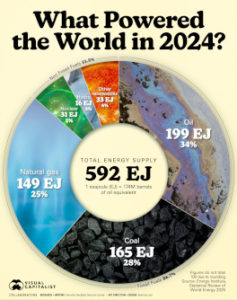
Chart: What Powered the World in 2024?

by D. Neufeld, Aug 22, 2025 in VisualCapitalist


The Global Energy Mix in 2024

This was originally posted on our Voronoi app. Download the app for free on iOS or Android and discover incredible data-driven charts from a variety of trusted sources.


Key Takeaways

  • Global energy demand increased 2% to reach an all-time high of 592 exajoules (EJ) in 2024.
  • Non-fossil fuels grew 7% year-over-year, bringing their share of the global energy mix to 13.5%.

Global energy use rose to 592 EJ in 2024, marking a new record in demand.

While cleaner technologies continue to expand, traditional energy sources still form the backbone of the global energy system. At the same time, the Asia Pacific region drove 68% of demand growth, reflecting the region’s rapid economic momentum and industrialization.

This chart shows the global energy mix in 2024, based on data from the Energy Institute.

Fossil Fuels Underpin the Global Energy Mix

Last year, oil, coal, and natural gas together supplied 86.7% of global energy needs.

Oil remained the dominant energy source, accounting for 199 EJ, or 33.6% of global supply. In 2024, average oil prices declined by 3%, though they were still 27% higher than in 2019. The U.S. held its position as the world’s largest producer, contributing roughly one-fifth of total output.

Coal followed at 27.9%, supported by increased consumption in emerging economies. Natural gas, though cleaner than coal, supplied 25.2%, rounding out the fossil fuel trio.

Energy Source 2024 Total Energy Supply (EJ) Share
Oil 199 33.6%
Coal 165 27.9%
Natural gas 149 25.2%
Nuclear energy 31 5.2%
Hydroelectricity 16 2.7%
Other renewables 33 5.6%
Total 592

It’s also worth noting that low-carbon energy sources are growing at a meaningful pace.

In 2024, their combined share rose to 13.5%, supported by a 7% annual increase. Wind and solar stood out in particular, growing by 16% to remain the fastest-rising energy sources worldwide.

Moreover, nuclear energy accounted for 5.2% of supply, with France and Japan responsible for nearly two-thirds of its growth as long-idled plants were brought back online.

Trump DOE Gives Coal Plant Lifeline Despite Seething Enviro Rage

by A. Streb, Aug 22, 2025 in ClimateChangeDispatch 


Activists warn the move will raise costs and pollute while officials cite grid reliability and energy security.

Campbell coal plant
The Department of Energy (DOE) on Thursday issued an emergency order that will keep a Michigan coal plant [pictured above] running to reduce the risk of blackouts while summer heat strains the power grid and despite environmental protests fighting to shutter the plant. [emphasis, links added]

DOE’s order directs the major grid operator for the central U.S. — the Midcontinent Independent System Operator (MISO) — to continue running a coal-fired plant in Michigan to stave off power shortages, which has sparked ire from some environmental activists who claim the plant will pollute the area.

The order follows a similar May emergency directive to keep the same Michigan J.H. Campbell plant running, which was soon followed by a major blackout in New Orleans, an event that DOE Secretary Chris Wright hailed as proof of why the Trump administration prioritizes energy abundance.

“The United States continues to face an energy emergency, with some regions experiencing more capacity constraints than others. With electricity demand increasing, we must put an end to the dangerous energy-subtraction policies embraced by politicians for too long,” Wright said Thursday.

“This order will help ensure millions of Americans can continue to access affordable, reliable, and secure baseload power regardless of whether the wind is blowing or the sun is shining.”

DOE noted that the May order to keep the coal plant open has allowed it to function as a critical power generator on the grid during periods of high energy demand.

The J.H. Campbell plant was set to close on May 31, a full 15 years before reaching the end of its design life, the agency said.

Dramatic slowdown in melting of Arctic sea ice surprises scientists

by D. Carrington, Aug 20, 2025 in TheGuardian


The surprising reason timber plantations explode into megafires

by University of Utah, Aug 21, 2025 in ScienceDaily


The odds of high-severity wildfire are nearly one-and-a-half times higher on industrial private land than in publicly owned forests. Reducing tree density mitigates megafire risk, even in extreme weather conditions.

The odds of high-severity wildfire were nearly one-and-a-half times higher on industrial private land than on publicly owned forests, a new study found. Forests managed by timber companies were more likely to exhibit the conditions that megafires love — dense stands of regularly spaced trees with continuous vegetation connecting the understory to the canopy.

Are surface temperature records reliable?

by Sue Bin Park, Aug 22, 2025 in SkepticalScience


Surface temperature records are consistent and have been confirmed by multiple independent analyses.

Measurements come from over 30,000 stations worldwide, with around 7,000 having long, continuous monthly records. Scientists adjust for known local anomalies such as urban heat islands by comparing urban and rural trends and accounting for differences.

Allegations in 2009 that poorly located U.S. stations skewed data were tested by NOAA, which found those sites actually read slightly cooler on average.

The independent Berkeley Earth Surface Temperature (BEST) study, led by a former climate skeptic, merged global datasets and concluded that the warming trend is unaffected by stations’ local conditions and nearly identical to NASA and NOAA records.

Temperature measurements are corroborated by satellites, ocean data, melting ice, and shifting ecosystems, all showing the same warming trend. No credible analysis has found that site issues or adjustments undermine the global record.

Go to full rebuttal on Skeptical Science or to the fact brief on Gigafact


This fact brief is responsive to quotes such as this one.


Sources

Skeptical Science Understanding adjustments to temperature data

NASA GISS Surface Temperature Analysis (v4)

Geoscience Data Journal The international surface temperature initiative global land surface databank: monthly temperature data release description and methods

Skeptical Science Berkeley Earth Surface Temperature Study: “The effect of urban heatingon the global trends is nearly negligible”

NOAA On the reliability of the U.S. surface temperature record

Carbon Brief Explainer: How data adjustments affect global temperature records

New Study: Corals Thrived In Warmer-Than-Today Temps And When Sea Levels Were Meters Higher

by K. Richard, Aug 19, 2025 in NoTricksZone 


hen the ocean was warmer than today, coral reef growth was rapid, averaging ~6 mm per year.

Sea levels rose rapidly from the Early to Mid Holocene in this region, as they were up to 2 m higher than today 6000 years ago. The higher sea levels meant there was more room for coral reef growth.

As the ocean cooled and sea levels fell ~2 meters from the Mid-Holocene highstand, coral growth slowed to ~2-3 mm per year.

Today corals are only growing at rates of ~1 mm per year, as the water depths are too low to accommodate reef expansion. In fact, coral coverage “has declined on the flats over the last few decades,” as the “accommodation space is less than a meter at points.”

Research from the Great Barrier Reef region (e.g., Leonard et al., 2020) also indicates coral growth experienced “turn-off” periods during cold centuries (such as the Little Ice Age) with falling sea levels. When the ocean was “~1-2°C warmer than present” and sea levels were “~1.0 m higher than present,” this “allowed reefs to accrete uninhibited.”

UN: Renewables are So Cheap They Need Lots of Subsidies

by E. Worrall, Aug 21, 2025 in WUWT


Inflexion Point: Renewable Energy Is Cheaper Than Fossil Fuels

PRABIR PURKAYASTHA

The tipping point between renewable energy and fossil fuels has been reached, says a new United Nations (UN) report. The UN Secretary-General Antônio Guterres said that we are entering a renewable era and leaving the era of fossil fuels. According to the report, ‘In 2024, renewables made up 92.5% of all new electricity capacity additions and 74% of electricity generation growth’. While almost the entire world has increasingly switched to renewables, the United States stands out as the sole ‘dissident’, with the Trump administration denying climate change and still backing fossil fuels.

The long-talked-about renewable transition is finally here! The question is, do we have the political will to do what is not only necessary in climate terms but also economically a better option for all of us? Or will the old fossil lobby, particularly in the US, sabotage humanity’s transition to a low-carbon future?

Not surprisingly, an analysis—Li, M., Trencher, G., & Asuka, J., Feb 16, 2022, PLOS ONE —of their business activities shows, ‘a continuing business model dependence on fossil fuels…We thus conclude that the transition to clean energy business models is not occurring, since the magnitude of investments and actions does not match discourse’. In other words, oil companies are continuing with their business as usual under the cloak of carbon capture, grey hydrogen, etc., along with a lot of hot air. Incidentally, these four companies alone are responsible for 10% of all global warming in the world since 1965.

The only country acting as the spoiler is the United States, which, though it is no longer competitive in manufacturing, believes that it can extract ‘rent’ from others. This is the new G1’s ‘Trump-based world order’, instead of the G7’s so-called ‘rule-based world order’.

Read more: https://www.counterpunch.org/2025/08/20/inflexion-point-renewable-energy-is-cheaper-than-fossil-fuels/

What about that cited UN report?

The New York Times Publishes False Energy and Climate Information and Refuses to Correct Its Errors

by H. Greuenspecht, Aug 22, 2025 in WUWT


les addressing energy and climate topics in The New York Times (NYT) increasingly include Inaccurate data and false information. The problem is compounded by the paper’s failure to follow its own corrections policy when errors are called to its attention.

Readers look to the NYT to deliver well-reasoned and fact-checked information and analysis in areas where they are not themselves experts. However, based on my professional focus on data and analysis of energy and related environmental issues over the past 45 years, which includes White House and Department of Energy senior positions in the Carter, Bush 41, Clinton, Bush 43, Obama, and Trump 45 administrations as well as work at leading universities and think tanks, NYT coverage of these subjects too often fails to live up to its own standards for accuracy and journalistic integrity.

As a lifetime reader of the NYT, the frequency of errors and a refusal to fix them raises doubts regarding the accuracy of information presented on other topics. Whether or not the problem extends beyond energy and climate, the NYT readership clearly deserves better.

Three recent NYT articles illustrate the problem: a July 22 article by Max Bearak, ostensibly reporting on remarks by UN Secretary-General Guterres’ on renewable energy; a May 26 article by Ivan Penn on competition between electric vehicles (EVs) and vehicles powered by internal combustion engine (ICEVs); and an April 23 column by David Wallace-Wells on the loss of cultural and political momentum for action to reduce greenhouse gas emissions. These are considered in turn below, followed by some summary conclusions.

  1. Max Bearak’s July 22 2025 article “U.S. Is Missing the Century’s ‘Greatest Economic Opportunity,’ U.N. Chief Says” (July 23 print edition).

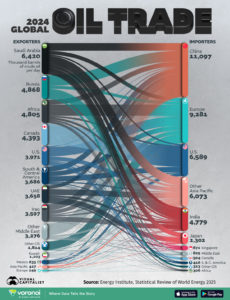
Charted: Global Crude Oil Trade Flows in 2024

by D. Neufeld, Aug 20, 2025 in VisualCapitalist


Global Crude Oil Trade Flows in 2024

This was originally posted on our Voronoi app. Download the app for free on iOS or Android and discover incredible data-driven charts from a variety of trusted sources.

Key Takeaways

  • China imported 11.1 million barrels of crude oil per day in 2024, with Russia standing as its largest supplier of oil.
  • Meanwhile, the U.S. imported 6.6 million barrels per day (mb/d), with Canada accounting for 62% of the total.

In 2024, global oil trade patterns continued to evolve, shaped by geopolitics and changing regional demand.

From Asia to the Middle East and the Americas, oil remains a cornerstone of the global economy. The vast scale of daily trade underscores not only the world’s reliance on energy but also intricate, global alliances.

This infographic shows the largest crude oil importers and exporters by daily volume, based on data from the Energy Institute.

China Leads in Global Oil Imports

Below, we show daily oil import and export volumes for major global players:

“Wake-Up Call” For Europe… German Professor, Fritz Vahrenholt, On U.S. Climate Report

by F. Vahrenholt, Aug 20, 2025 in NoTricksZone


A recent report from the U.S. Department of Energy, commissioned by the Trump administration and authored by five scientists, is making waves.

German energy expert Prof. Fritz Vahrenholt has weighed in, suggesting its findings could be a crucial “wake-up call” for Europe, especially Germany, to rethink its current climate policies.

The report, titled “A Critical Review on Impacts of Greenhouse Gas Emissions on the US Climate” challenges a core assumption of mainstream climate science. It argues that the negative impacts of CO2 have been exaggerated, while its benefits are often overlooked.

According to Vahrenholt, the report highlights that CO2 isn’t just a pollutant; it’s essential for life and photosynthesis. It’s a key ingredient for a “greener earth” and has contributed to a reported 15% increase in global crop yields for staples like rice and wheat. This perspective directly contradicts the idea of CO2 as solely a harmful substance.

Another major point raised by Vahrenholt is the report’s finding that climate models “run too hot.”

The report suggests these models primarily focus on CO2 as the sole driver of warming, neglecting other significant natural factors. Vahrenholt points to measurements that show a substantial portion of recent warming can be attributed to cloud thinning and increased solar radiation, a topic he and Nobel laureate John Clauser have researched.