Archives de catégorie : climate-debate

Hump day hilarity – the progression of climate narrative names

by Anthony Watts, January 16, 2019 in WUWT


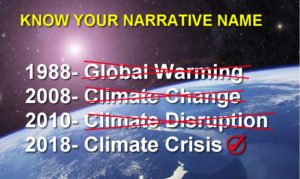
I had a predictable and laughable Twitter dialog today with the editor of the bought and paid for climate activist site known as “The Carbon Brief”. He was bent out of shape because I pointed out that while he thought the reason for the stepping down of Lord Lawson at The Global Warming Policy Foundation in the UK was due to the lack of traffic and interest in the organization, it [the lowered traffic] really is because of two reasons:

  1. The public is getting bored with it, possibly due to all the fear-mongering promoted by irresponsible journalists.

  2. There’s been a shift from the use of the term “global warming” to other terms, perhaps in a desperate bid to “keep it fresh”. …
    .

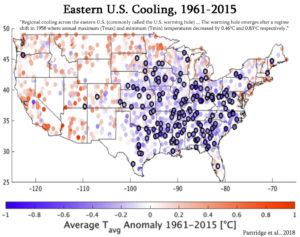
Regional Models: 3-10°C Warming In The Next 80 Years. Observations: No Warming In The Last 40-100 Years.

by K. Richard, January 14, 2019 in NoTricksZone


There are large regions of the globe where observations indicate there has been no warming (even cooling) during the last decades to century. Climate models rooted in the assumption that fossil fuel emissions drive dangerous warming dismiss these modeling failures and project temperature increases of 3° – 10°C by 2100 for these same regions anyway.

Image Source: Partridge et al., 2018

Antarctic Losing Tiny Amounts Of Ice (Or Maybe It’s Gaining Ice, NASA Is Not Sure!)

by P. Homewood, January 15, 2019 in NotaLotofPeopleKnowThat


Antarctica is shedding ice at a staggering rate.

Scientists have discovered global warming has caused the melting of the ice on the continent to increase sixfold since 1979.

This phenomenal rate of melting has seen global sea levels rise by more than half an inch – and experts predict it will get worse. 

Scientists have predicted a ‘multi-meter sea level rise from Antarctica in the coming centuries’ as a result of the vast loss of ice.

Researchers discovered that, between 1970 and 1990, the continent was shedding an average of 40 gigatons of ice mass annually.

This jumped to an average of 252 gigatons a year between 2009 and 2017.

https://www.dailymail.co.uk/sciencetech/article-6590841/Antarctica-losing-SIX-TIMES-ice-year-1970s.html#newcomment


You may of course recall that it was only three years ago that the same NASA, who are behind this latest scare story, were telling us that the ice cap was actually growing in Antarctica. But more of that in a minute.

There are several aspects to this latest story that need closer examination.

New GWPF Paper Shows Hurricanes Are Not Getting Worse

by P. Homewood, January 14, 2019 in NotaLotofPeopleKnowThat


https://www.thegwpf.org/content/uploads/2019/01/Homewood-Hurricanes.pdf

I am pleased to report that the GWPF have now published my latest paper on hurricane trends.

It demonstrates that, contrary to popular myth, hurricanes are not getting more frequent or more powerful.

The paper is based throughout on official data, scientific papers and IPCC reports.

Here is the Executive Summary:

HEAVIES SNOWFALLS IN 100 YEARS BRING CHAOS TO ALPINE SKI RESORTS

by The Times, January 12, 2019 in GWPF


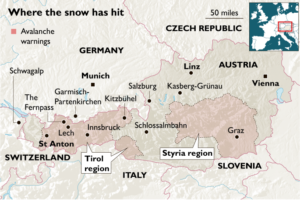
Thousands of British holidaymakers face travel chaos in Austria today after the country experienced the heaviest snowfalls in a century and was bracing for another round of storms.

Three metres of snow fell in the space of 48 hours in some parts of the country and more than a metre is forecast to fall today and tomorrow. Yesterday the army was drafted in to help with the clear-up and to deliver supplies to towns and villages that were cut off.

According to Dr David Viner, a senior research scientist at the climatic research unit (CRU) of the University of East Anglia, within a few years winter snowfall will become “a very rare and exciting event”. “Children just aren’t going to know what snow is,” he said.The Independent, 20 March 2000

Veteran Meteorologists Warn Of “Bitter Cold” …”Areas Under The Gun” As Models Project Cold Polar Blasts!

by P. Gosselin, January 12, 2019 in NoTricksZone


Yesterday we wrote about a study that told us the data do not support that weather blockings are occurring more often than they used to. Some alarmist media and scientists have claimed that the heavy snowfalls in the Alps are happening due to manmade global warming.

Swiss meteorologist: Such snowfalls “nothing unique” for Alps

Yesterday one of Europe’s most high profile meteorologists, Jörg Kachelmann, penned an opinion piece at t-online.de reminding the public that heavy snow events in the Alps, such as the one we are now experiencing, are in fact nothing unique and that it is not a catastrophe.

In the days ahead, many parts of the Alps are expecting up to another meter of new snow, yet, according to Kachelmann, this should not pose any problems to buildings and structures – if their construction indeed adhered to the applicable building codes.

“Nothing to do with climate change”

Kachelmann adds later in his t-online piece: “1. The snowfalls are nothing unique so far for the Alps. 2. They have nothing to do with climate change.”

Does the IPCC say we have until 2030 to avoid catastrophic global warming?

by Patrick T. Brown, January 12, 2019 in WUWT


In late 2018 the Intergovernmental Panel on Climate Change (IPCC) released a report on the impacts associated with global warming of 1.5°C (2.7°F) above preindustrial levels (as of 2019 we are at about 1.0°C above pre-industrial levels) as well as the technical feasibility of limiting global warming to such a level. The media coverage of the report immediately produced a meme that continues to persist. The meme is some kind of variation of the following:

The IPCC concluded that we have until 2030 (or 12 years) to avoid catastrophic global warming

However, these headlines are essentially purveying a myth. I think it is necessary to push back against this meme for two main reasons:

1) It is false.

2) I believe that spreading this messaging will ultimately undermine the credibility of the IPCC and climate science more generally.

Taking these two points in turn:

1) The IPCC did not conclude that society has until 2030 to avoid catastrophic global warming.

The ‘Little Ice Age’ hundreds of years ago is STILL cooling the bottom of Pacific, researchers find

by Charles the moderator, January 9, 2019 in WUWT


  • The Little Ice Age brought colder-than-average temps around the 17th century

  • Researchers say temperatures in deep Pacific lag behind those at the surface

  • As a result, parts of the deep Pacific is now cooling from long ago Little Ice Age

A Harvard study has found that parts of the deep Pacific may be getting cooler as the result of a climate phenomenon that occurred hundreds of years ago. The models suggest In the deep temperatures are dropping at a depth of around 2 kilometers (1.2 miles)

The credibility gap between predicted and observed global warming

by Christopher Monckton of Brenchley, January 10, 2019 in WUWT


The prolonged el Niño of 2016-2017, not followed by a la Niña, has put paid to the great Pause of 18 years 9 months in global warming that gave us all such entertainment while it lasted. However, as this annual review of global temperature change will show, the credibility gap between predicted and observed warming remains wide, even after some increasingly desperate and more or less openly prejudiced ever-upward revisions of recent temperatures and ever-downward depressions in the temperatures of the early 20th century in most datasets with the effect of increasing the apparent rate of global warming. For the Pause continues to exert its influence by keeping down the long-run rate of global warming.

Greenland Is Way Cool

by Willis Eschenbach, January 8, 2019


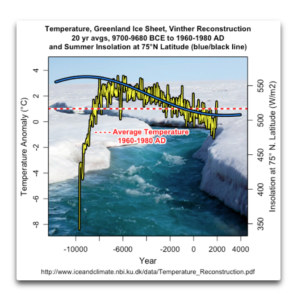
As a result of a tweet by Steve McIntyre, I was made aware of an interesting dataset. This is a look by Vinther et al. at the last ~12,000 years of temperatures on the Greenland ice cap. The dataset is available here.

Figure 1 shows the full length of the data, along with the change in summer insolation at 75°N, the general location of the ice cores used to create the temperature dataset.

Figure 1. Temperature anomalies of the Greenland ice sheet (left scale, yellow/black line), and the summer insolation in watts per square metre at 75°N (right scale, blue/black line). The red horizontal dashed line shows the average ice sheet temperature 1960-1980.

I’ll only say a few things about each of the graphs in this post. Regarding Figure 1, the insolation swing shown above is about fifty watts per square metre. Over the period in question, the temperature dropped about two and a half degrees from the peak in about 5800 BCE. That would mean the change is on the order of 0.05°C for each watt per square metre change in insolation …

Is the forecasted El Niño for this year fading away? It sure looks that way.

by Anthony Watts, January 8, 2019 in WUWT


In late 2018, there were some predictions that there would be a significant El Niño event in 2019. There were strong hints of an El Niño event in both SST data and forecasts. In an April 6th 2018 essay, Bob Tisdale suggested  “Looks like one may be forming right now.”

But if we look at the animation provided by NOAA’s Climate prediction center, it sure looks like it has been fading:

Arctic Sea Ice Extent Higher Than 2006 Last Month

by P. Homewood, January 9, 2019 in NotaLotofPeopleKnowThat


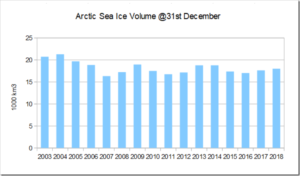
Just last March, the Guardian was trying to panic us about record lows in Arctic sea ice during last winter.

Back in the real world, DMI confirm that average Arctic sea ice extent in December was higher last month than in 2006. In reality, there has been very little change at all since 2005.

http://ocean.dmi.dk/arctic/icethickness/txt/IceVol.txt


U.S. Carbon Emissions Skyrocketed in 2018!

by David Middleton, January 8, 2009 in WUWT


Why did carbon emissions increase in 2018?

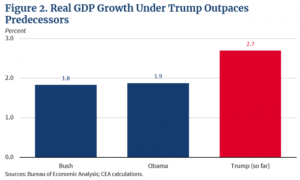
  • A booming economy.  GDP growth during the first 2 years of the Trump administration has been about 50% higher than that of Obama’s eight-year maladministration.

  • Our manufacturing sector is booming.

  • A cold winter.

  • A booming economy drove up trucking and air travel.

  • Electricity demand increased and most of the increasing was powered by natural gas because renewables couldn’t even keep up with no growth.

https://www.whitehouse.gov/articles/economy-firing-cylinders/

Another Climate Propaganda Story Promoting the Normal as Abnormal

by Dr Tim Ball, January 8, 2019 in WUWT


Other stories focus on a pattern or change in a pattern again with the idea that it is new or abnormal. Headlines like this one from 2012, “Why have there been more tornadoes than usual this year?” Often, they are suggestive such as this 2017 New York Times story. “The 2017 Hurricane Season Really Is More Intense Than Normal.” When you read the story, you find, as is usually the case, that the caveats at the end indicate it is not unusual. The problem is the headline already set the pattern in the public mind.

Study reconstructing ocean warming finds ocean circulation changes may account for significant portion of sea level rise

by Anthony Watts, January 7, 2019 in WUWT


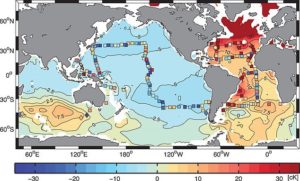
Study suggests that in the last 60 years up to half the observed warming and associated sea level rise in low- and mid- latitudes of the Atlantic Ocean is due to changes in ocean circulation.

Over the past century, increased greenhouse gas emissions have given rise to an excess of energy in the Earth system. More than 90% of this excess energy has been absorbed by the ocean, leading to increased ocean temperatures and associated sea level rise, while moderating surface warming.

The multi-disciplinary team of scientists have published estimates in PNAS, that global warming of the oceans of 436 x 1021 Joules has occurred from 1871 to present (roughly 1000 times annual worldwide human primary energy consumption) and that comparable warming happened over the periods 1920-1945 and 1990-2015.

U.S. Media Bans Scientific Dissent – Claim Wildfires, Floods, Droughts, Hurricanes Are Human-Controlled

by K. Richard, January 7, 2019 in NoTricksZone


NBC News’ Chuck Todd recently asserted that we humans can control the climate and the frequency or intensity of extreme weather events (hurricanes, floods, droughts) and disasters (wildfires) with our CO2 emissions. He has declared the science is “settled” on this point and therefore no “denier” is allowed on his Meet the Press program. But Todd and the members of his panel have recited claims that are contravened by observational evidence and scientific publications.

Forget El Nino, StormFest is about to Hit the West Coast

by Charles the moderator, January 6, 2019 in WUWT


Things often calm down after January 1 during El Nino years….but not this year…with the U.S. West Coast from central California to Washington State about to be pummeled by a series of storms.   Rain, snow, wind?  Plenty for everyone.

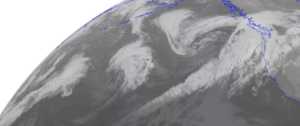
A view of the latest infrared satellite imagery shows an amazing line-up of one storm after another stretching way into the Pacific.  A traffic jam of storms.


Let’s examine our stormy future, using a series of sea level pressure forecasts from the UW WRF weather forecast models (solid lines are sea level pressure, shading in lower atmosphere temperature).


Kerala Floods “Likely Due To Climate Variability, Not AGW”–New Study

by P. Homewood, January 5, 2019 in NotaLotofPeopleKnowThat


Since there is no increase in mean and extreme precipitation in Kerala over the last six decades, the extreme event during August 2018 is likely to be driven by anomalous atmospheric conditions due to climate variability rather anthropogenic climate warming. The severity of the Kerala flood of 2018 and the damage caused might be affected by several factors including land use/ land cover change, antecedent hydrologic conditions, reservoir storage and operations, encroachment of flood plains, and other natural factors. The impacts of key drivers (anthropogenic and natural) on flood severity need to be established to improve our understanding of floods and associated damage.

http://www.geosocindia.org/index.php/jgsi/article/view/137443

Storage wars

by Charles the moderator, January 5, 2019 in WUWT


UC Santa Barbara researcher conducts first-ever global-scale evaluation of the role of soil minerals in carbon storage

University of California – Santa Barbara

One answer to our greenhouse gas challenges may be right under our feet: Soil scientists Oliver Chadwick of UC Santa Barbara and Marc Kramer of Washington State University have found that minerals in soil can hold on to a significant amount of carbon pulled from the atmosphere. It’s a mechanism that could potentially be exploited as the world tries to shift its carbon economy.

“We’ve known for quite a long time that the carbon stored on minerals is the carbon that sticks around for a long time,” said Chadwick, co-author of the paper, “Climate-driven thresholds in reactive mineral retention of soil carbon at the global scale,” published in the journal Nature Climate Change. How much carbon the soil can take and how much it can keep, he said, are dependent on factors including temperature and moisture.

“Terrifying Sea-Level Prediction Now Looks Far Less Likely”… But “marine ice-cliff instability” is “just common sense”

by David Middleton, January 5, 2019 in WUWT


Marine ice cliff instability (MICI) “has not been observed, not at such a scale,” “might simply be a product of running a computer model of ice physics at a too-low resolution,” ignores post glacial rebound, couldn’t occur before ” until 2250 or 2300″… Yet “the idea is cinematic,” “it’s just common sense that Antarctic glaciers will develop problematic ice cliffs” and something we should plan for…

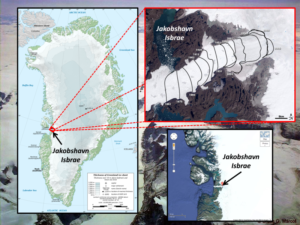
“Our results support growing evidence that calving glaciers are particularly sensitive to climate change.”  Greenland’s climate is always changing… Always has and always will change… And the climate changes observed over the last few decades are not unprecedented. The Greenland ice sheet is no more disappearing this year than it was last year and it is physically impossible for the ice sheet to “collapse” into the ocean.

Figure 6. Jakobshavn Isbrae. (Wikipedia and Google Earth)

Consensus? 500+ Scientific Papers Published In 2018 Support A Skeptical Position On Climate Alarm

by K. Richard, January 3, 2019 in NoTricksZone


In 2018,  over 500 scientific papers were published that cast doubt on the position that anthropogenic CO2 emissions function as the climate’s fundamental control knob…or that otherwise serve to question the efficacy of climate models or the related “consensus” positions commonly endorsed by policymakers and mainstream media sources.

UK Climate Trends – 2018

by P. Homewood, January 4, 2019 in NotaLotofPeopleKnowThat


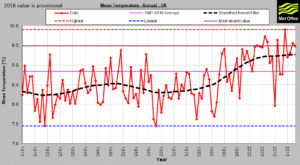
The Met Office has now published its data for 2018. We can expect plenty of claims about last year being the 7th warmest in the UK since records began (in 1910). Or that all of the ten warmest years have occurred this century.

The real significance of these latest numbers, however, is that they continue to confirm that UK temperatures stopped rising more than a decade ago, after a step up during the 1990s.


https://www.metoffice.gov.uk/climate/uk/summaries/actualmonthly…


Sea level oscillations in Japan and China since the start of the 20th century and consequences for coastal management – Part 1: Japan Author links open overlay panel

by Albert Parker, March 1, 2019 in Ocean&CoastalManagement


Highlights
• Japan has strong quasi-20 and quasi-60 years low frequencies sea level fluctuations.
• These periodicities translate in specific length requirements of tide gauge records.
• 1894/1906 to present, there is no sea level acceleration in the 5 long-term stations.
• Those not affected by crustal movement (4 of 5) do not even show a rising trend.
Proper consideration of the natural oscillations should inform coastal planning.

See also here