Archives de catégorie : better to know…?

ANTARCTICA SUFFERING COLDEST JANUARY SINCE 1978 + GLOBAL SEA ICE GROWING EXPONENTIALLY

by Cap Allon, Jan 20, 2021 in Electroverse


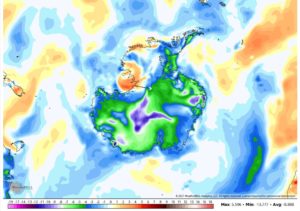
The start of 2021 in Antarctica has been an unusually chilly one. In fact, the first half of January has been the coldest since 1978, according to data compiled by @LpdlcRamirez and @peikko763 on Twitter.

As of Jan. 19, the month-to-date temperature anomaly across Antarctic is approx. -0.5C, making this the continents coldest first 3-or-so-weeks of Jan. since 1978 (solar minimum of cycle 20), according to research conducted by @peikko163 on Twitter, who also notes that the Southern Hemisphere as a whole is suffering anomalous January chills not seen since 2012.

But this chill of solar minimum isn’t just confined to the Southern Hemisphere either, the mercury ACROSS the planet is tumbling. In one month global temperatures dropped by a whopping 0.26C: from 0.53C above the 1981-2010 avg. in Nov. 2020 to just 0.27C above the avg. in Dec. 2020 (UAH). This drop was in spite of a warming Arctic–a region expected to “heat” during times of otherwise “global” cooling (more on that below).

The Sun appears to be sliding into its next Grand Solar Minimum cycle–a multidecadal spell of reduced solar output where the solar disc can be devoid of sunspots for months or even years at a time. The result on Earth’s climate will be one of violent swings between extremes due to a weakening of the jet streams: intense bursts of heat will linger in one area, while a teeth-chattering chill will dominate nearby, and then the regions will “switch” — it is this unpredictable chopping and changing that will hasten the failure of our modern food production systems: crops will fail, on a large scale, and famine could quickly ensue.

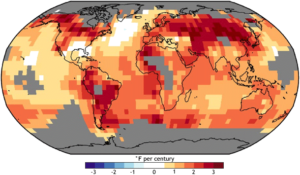
Overall, Earth’s temperature trends colder during a Grand Solar Minimum, as the Sun’s output sinks lower and lower (increased cloud nucleation being one likely forcing). However, not ALL regions experience the chill: as with the previous GSM (the Maunder Minimum 1645-1715), areas such as the Arctic, Alaska, and S. Greenland/N. Atlantic actually warmed while the rest of the planet cooled — NASA reveals the phenomenon in their Maunder Minimum temperature reconstruction map:

AT LEAST 13 DEAD, HUNDREDS HOSPITALIZED AS RECORD SNOWSTORMS SWEEP JAPAN

by Cap Allon, Jan 23, 2021 in Electroverse


Following the historic snowstorms of the past few weeks, Japan has been hit again: at least 13 people died and more than 250 were injured as record snowfall blanketed regions along the Sea of Japan coast, according to the latest report by the nation’s Disaster Management Agency.

Among those to have lost their lives were three people in Fukui Prefecture, and four in Niigata Prefecture, all reportedly while trying to remove the snow which topped a whopping 3.13 meters (10.3 feet) in some areas.

According to Japan’s Meteorological Agency (JMA), at least 10 monitoring stations along the Sea of Japan set new all-time 72-hour snowfall records late on Jan. 10, and many more busted all-time low temperature records, including in Furue, Kamigoori, and Kuzakai–with the latter logging a bone-chilling -24C (-11F).


Distorting the view of our climate future: The misuse and abuse of climate pathways and scenarios

by R. Pielke & J. Richtie, 2020 in EnergyRes&SocScience


Abstract

Climate science research and assessments under the umbrella of the Intergovernmental Panel on Climate Change (IPCC) have misused scenarios for more than a decade. Symptoms of misuse have included the treatment of an unrealistic, extreme scenario as the world’s most likely future in the absence of climate policy and the illogical comparison of climate projections across inconsistent global development trajectories. Reasons why such misuse arose include (a) competing demands for scenarios from users in diverse academic disciplines that ultimately conflated exploratory and policy relevant pathways, (b) the evolving role of the IPCC – which extended its mandate in a way that creates an inter-relationship between literature assessment and literature coordination, (c) unforeseen consequences of employing a temporary approach to scenario development, (d) maintaining research practices that normalize careless use of scenarios, and (e) the inherent complexity and technicality of scenarios in model-based research and in support of policy. Consequently, much of the climate research community is presently off-track from scientific coherence and policy-relevance. Attempts to address scenario misuse within the community have thus far not worked. The result has been the widespread production of myopic or misleading perspectives on future climate change and climate policy. Until reform is implemented, we can expect the production of such perspectives to continue, threatening the overall credibility of the IPCC and associated climate research. However, because many aspects of climate change discourse are contingent on scenarios, there is considerable momentum that will make such a course correction difficult and contested – even as efforts to improve scenarios have informed research that will be included in the IPCC 6th Assessment.

Record Low Temperature In Spain Today

by P. Homewood, Jan 6, 2021 in NotaLotofPeopleKnowThat


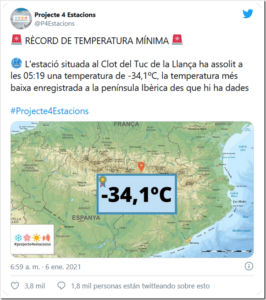
The storm ‘Filomena’ leaves the lowest temperature ever recorded in the Iberian Peninsula: –34.1C

Temperatures in Spain this winter are reaching maximum levels. This week has been very cold, with frosts in much of Spain even in areas very close to the coast. The early morning of this Wednesday was marked by intense cold and snowfall. The thermometers show such low figures that the temperature at the Clot de la Llança (Alto Aneu) weather station stands out: – 34.1 degrees.

It is the lowest temperature in the Iberian Peninsula since there are records. Information provided by the Parc Natural de l’Alt Pirineu (managed by Meteo Pirineo and Meteo Valls d’Àneu). And it has also been confirmed by AEMET. This temperature, 34.1 degrees below zero, is a record since the last time something similar was recorded was on February 2, 1956 with -32.0ºC in Estany-Gento, in the province of Lleida,

https://www.20minutos.es/noticia/4533488/0/borrasca-filomena-record-temperatura-minima-34-1-grados/


See also here

Just How Accurate Are Weather And Climate Measurements?

by Dr J. Lehr & T. Ciccone, Jan 5, 2021 in ClimateChangeDispatch


The accuracy and integrity of weather and climate measurements have always been a concern. However, errors and omissions were not as consequential in the past as they are now.

A hundred or even fifty years ago, our major weather concerns were more limited to local weather. When we have a flight from NYC to LAX, we need to know more detailed and reliable weather information, like is it snowing in St. Louis where we have a layover?

Or the farmer in Nebraska who needs to see the spring wheat production forecast in Ukraine. He needs the best possible information to better estimate the number of acres of winter wheat he should plant for today’s global markets.

We especially need better and more reliable information to decide what actions we should consider preparing for climate changes.

While scientists, engineers, and software programmers know the importance and the need for this data accuracy, the general public is not aware of how challenging these tasks can be.

When looking at long term climate data, we may have to use multiple proxies (indirect measures that we hope vary directly with weather), which add an extra layer of complexities, costs, and sources of error.

One of the most commonly used proxies is the ancient temperature and CO2 levels from ice core samples. Also, for the last few hundred years, tree-ring data was a primary source of annual temperatures.

Climate Change Causation: Was The Medieval Warm Period ‘Regional?’

by F. Menton, Jan 5, 2021 in ClimateChangeDispatch


Some commenters yesterday noted that the climate establishment has not just completely ignored the threat to their orthodoxy posed by the Medieval Warm Period and other similarly-warm pre-human-emissions eras.

Initially, there was a recognition that this issue could be important, and there was definitely some attempt to deal with it.

However, over time, the accumulation of evidence, particularly as to the existence Medieval Warm Period as a global phenomenon, gradually became overwhelming.

So — in the face of evidence that, under the normal precepts of the scientific method, would be deemed to invalidate the hypothesis that only human CO2 emissions could be causing current warming — how can the orthodoxy be kept alive?

The answer, almost entirely, has been to resort to the hand-waving of “detection and attribution” studies, and hope nobody notices. And, to a remarkable extent, nobody notices.

Readers may be interested in a short history of this issue.

See also  A prequel to the Dantean Anomaly: the precipitation seesaw and droughts of 1302 to 1307 in Europe

The Dark Side of Clean Energy and Digital Technologies by Guillaume Pitron, review — our dirty future

by P. Homewood, Jan 6, 2021 in NotaLotofPeopleKnowThat


When Donald Trump offered to buy Greenland from Denmark in 2019 it was dismissed as illegal and absurd. However, the president’s expression of interest was far from absurd, says Guillaume Pitron. Under its soil Greenland boasts one of the largest concentrations of the rare metals that the world will need to power electric cars, computers, mobile phones, robots, solar power plants, artificial intelligence and many high-tech “green” innovations that have not been dreamt up yet. If Trump were after those minerals, buying Greenland would have been a smart move.

The global production and sales of rare metals are dominated by China. It mines so much of them on home soil and controls so much of their extraction in Africa and elsewhere that it oversees up to 95 per cent of the global production of certain minerals. This puts Beijing in charge of “the oil of the 21st century”, writes Pitron, which is a problem for western nations because it means China can restrict supply and drive prices up or down at will, as Opec does with oil. We have “entrusted a precious monopoly of mineral sovereignty to potential rivals”, he notes.

Discarded devices waiting to have their precious metals extracted

CHARLY TRIBALLEAU/GETTY IMAGES

Rare earth minerals production is very energy intensive. Extracting a single kilogram of some requires mining as much as 1,200 tonnes of rock. “Clean energy is a dirty affair,” Pitron writes. He drives home his point by touring villages near polluted lakes in China that are known locally as “cancer villages”.

La fin du réchauffement… Pas du changement climatique!

by B. Van Vliet-Lanoë, Jan 1, 2021 in ScienceClimatEnergie


Un hiver froid s’annonce : le premier d’une série qui devrait durer au moins jusqu’en 2053 (Youssef et al., 2009 ; Zharkova et al.  2015 ; Van Vliet, 2019), période où les médias nous assènent une disparition de la banquise estivale, des ours polaires et des phoques ! Ceci est favorisé par l’activité solaire réduite depuis et le minimum solaire actuel (Fig.1). Le cycle solaire suivant (n°25) devrait aussi être faible. Nous y sommes entrés sans un Minimum d’activité aussi profond que celui Dalton (1790-1830) qui a présidé à la « Bérézina ».


Fig. 1: Intensité des cycles solaires depuis 1975 et la prédiction du cycle 25 (calculés avec le nombre de taches solaires  2018 * ANRPFD ).  B) évolution de l’extension en km2 des banquises arctique et antarctique depuis 1978 par rapport à la déviation standard 1981-2010 (NSDIC).

10 Failed Predictions: Video

by C. Rotter, Jan 2, 2021 in WUWT


From Climate Resistance

Many climate alarmist’s failed predictions were centered around 2020. This video examines just ten, and argues that they were produced not by science, but by ideology. This is proved by the fact that rather than suffering any consequences to their careers or public standing, fearmongering individuals and institutions enjoy continued and undeserved success. The analysis of the ten predictions was produced by Steve Milloy and can be read at his website:

Number Of Global Wild Fires Trending Down Since 2003. Northern Ocean Heat Content Drops Since 2010


In his latest video the veteran geologist looks at wild fires worldwide and the CO2 they emit. He reports that both have been decreasing.

Citing the results of the European Copernicus satellite atmosphere monitoring service (CAMS), total wildfires globally have fallen steadily, along with their corresponding CO2 emissions:

A New Year’s Look At WUWT

by  W. Essenbach, Dec 31, 2020 in WUWT


Today, as the result of a series of wrong turns and bad choices, I ended up at the Wikipedia entry for Watts Up With That. It says:

Watts Up With That? (WUWT) is a blog promoting climate change denial that was created by Anthony Watts in 2006.  

The blog predominantly discusses climate issues with a focus on anthropogenic climate change, generally accommodating beliefs that are in opposition to the scientific consensus on climate change. 

Appalled by the misrepresentations in that, I thought I might comment on them.

First, the blog doesn’t “promote climate change denial”. I always laugh when I read about “denial” because none of the authors of such nonsense ever get around to telling us exactly what we’re supposed to be “denying”. Me, I deny nothing. I disagree with some of the revealed wisdom of those who believe in “consensus science” but that’s a very different thing. And for those who would like a full explanation of why “consensus” has nothing to do with science, let me recommend a wonderful paper entitled AliensCause Global Warming.

The real misunderstanding, however, is that WUWT doesn’t “promote” anything. Instead, it serves a very different purpose. Let me explain what WUWT really is, which will require a bit of a digression. But then if you know me, you’ll know that I’m susceptible to being sidetractored …

ELEVEN YEARS AGO TODAY AL GORE PREDICTED THE NORTH POLE WOULD BE COMPLETELY ICE FREE IN FIVE YEARSp

by Cap Allon, Dec 13, 2020 in Electroverse


On December 13 & 14, 2009, professor, prophet, and soothsayer Al Gore predicted the North Polar Ice Cap could be completely ice free within the next five to seven years.


Gore made his prediction at COP15 Copenhagen which ran from Dec 7 – Dec 18, 2009, where he repeatedly referenced “state-of-the-art” computer modeling to suggest that the north polar ice cap may lose all of its ice by 2014.

“Some of the models suggest that there is a 75 percent chance that the entire north polar ice cap, during some of the summer months, could be completely ice-free within the next five to seven years,” Gore claimed.

“Join me in asking president Obama and the US Senate to set a deadline of 22 April for final action in the US Senate,” he said. “I do not believe we can wait till next November or December.”

The Guardian wrote on Dec 16, 2009 in an article entitled “Al Gore rallies the troops in Copenhagen“:

[Gore] kept up the pace by calling for the international community to sign up to a fully fledged climate change treaty by July 2010 – and then announcing that Mexico was prepared to host a deal-making summit.

He scolded rich countries for demanding the developing world offer evidence of emissions cuts while at the same time trying to inflate the funds they were prepared to offer poor countries to deal with climate change. And he was just as tough on activists who have embraced him as a hero, demanding they set aside their pride and their principles and embrace a deal – no matter how imperfect. He said he recognized their frustration with the glacial pace of negotiations. He agreed that cap-and-trade schemes to cut carbon emissions were an imperfect solution – Gore confessed to favoring a carbon tax – but the current efforts for a deal were the best prospect of avoiding catastrophic climate change.

And there was no trace of sympathy for opponents of action on climate change. Gore began with a brief run-through of the latest science on melting of the Arctic ice cap, evidence he said “only reckless fools would ignore.”

Newly Discovered Greenland Plume Drives Thermal Activities in the Arctic

by C. Rotter, Dec 29, 2020  in WUWT


A team of researchers understands more about the melting of the Greenland ice sheet. They discovered a flow of hot rocks, known as a mantle plume, rising from the core-mantle boundary beneath central Greenland that melts the ice from below.

The results of their two-part study were published in the Journal of Geophysical Research.

“Knowledge about the Greenland plume will bolster our understanding of volcanic activities in these regions and the problematic issue of global sea-level rising caused by the melting of the Greenland ice sheet,” said Dr. Genti Toyokuni, co-author of the studies.

The North Atlantic region is awash with geothermal activity. Iceland and Jan Mayen contain active volcanoes with their own distinct mantle plumes, whilst Svalbard – a Norwegian archipelago in the Arctic Ocean – is a geothermal area. However, the origin of these activities and their interconnectedness has largely been unexplored.

The research team discovered that the Greenland plume rose from the core-mantle boundary to the mantle transition zone beneath Greenland. The plume also has two branches in the lower mantle that feed into other plumes in the region


Alarmism Dies In The Maldives: 97% Of 186 Island Coasts Have Grown (59%) Or Not Changed (38%) Since 2005

by C. Rotter, Dec 22, 2020 in WUWT


Reposted from NoTricksZone

By Kenneth Richard on 21. December 2020

Despite sea level rise, a 2019 global analysis (Duvat, 2019) found 89% of 709 island coasts have been either stable or growing in size in recent decades. A new Maldives-only study (Duvat, 2020) finds rapid (>3 to >50%) coastal growth in 110 of 186 Maldives islands from 2005 to 2016. Just 5 islands – 2.7% – actually contracted in size during this period.

Last year Dr. Virginie Duvat published a global assessment of how the Earth’s islands and atolls are faring against the ongoing challenge of sea level rise since satellite monitoring began in the 1980s.

Fortunately she found “no widespread sign of physical destabilization in the face of sea-level rise.” In fact, a) none of the 30 atolls analyzed lost land area, b) 88.6% of the 709 islands studied were either stable or increased in area, c) no island larger than 10 hectare (ha) decreased in size, and d) only 4 of 334 islands (1.2%) larger than 5 ha had decreased in size.

The World’s Greatest Climate Hypocrite

by GWPF, 2019


Competition is fierce for this year’s Climate Hypocrite of the Year Awards; no more so than in the Luvvie Section. Past winner Leonardo DiCaprio is, as ever, one of the frontrunners. When he’s not lecturing us on climate change, our Leo (`Climate change is real, it is happening right now. It is the most urgent threat facing our entire species’) is cruising on his private yacht or flying between his four luxury homes in New York and California.

Even by Hollywood luvvie standards, DiCap-
rio’s appetite for private jet travel is legendary.
Yet despite his ostentatious lifestyle, he has, for some strange reason, been a board member
of WWF and the National Resources Defense Council, and a UN representative on climate change

NYT: “What happened to Global Warming?”

by E. Worrall, Dec 17, 2020 in WUWT


NYT rolling out the tired global warming makes winter storms more extreme narrative.

How climate change is affecting winter storms.


By John Schwartz

The major winter storm that hit the Eastern United States on Wednesday and Thursday probably prompted some people to ask, “What happened to global warming?”

But although it’s becoming increasingly clear that climate change does have an effect on storms, the relationship can be complex and, yes, counterintuitive. “There were these expectations that winter was basically going to disappear on us,” said Judah Cohen, director of seasonal forecasting at AER, a company that provides information to clients about weather and climate-related risk.

Although winters are becoming warmer and somewhat milder over all, extreme weather events have also been on the increase, and especially in the Northeastern United States, as Dr. Cohen pointed out in a recent paper in the journal Nature Climate Change. From the winter of 2008-9 until 2017-18, there were 27 major Northeast winter storms, three to four times the totals for each of the previous five decades.

Read more: https://www.nytimes.com/2020/12/17/climate/climate-change-winter.html

If global warming to date has caused a three to four fold increase in severe winter storms, imagine the bitterly cold weather the next few decades of global warming will bring.

We must act now, before global warming causes us all to freeze to death!

Eastern Alps may have been ice-free in the time of Ötzi the Iceman

by C. Rotter, Dec 21, 2020 in WUWT


From The New Scientist

Glaciers in the Ötztal Alps in Austria are currently melting and may be lost within two decades, but this might not be the first time humans have seen this kind of change. A new analysis reveals that glaciers in this region formed just before or perhaps even within the lifetime of Ötzi the Iceman, a mummified body found just 12 kilometres away in 1991.

Pascal Bohleber at the Austrian Academy of Sciences in Vienna and his colleagues drilled 11 metres into the Weißseespitze summit glacier, down to the bedrock, at 3500 metres altitude and collected two ice cores. They then used radiocarbon dating to  analyse microscopic bits of organic material extracted from the ice cores and found that the glacier is 5200 to 6600 years old. Ötzi is thought to have lived between 5100 and 5300 years ago, and his body was found preserved in ice.

The glacier’s age means it formed during a time called the mid-Holocene warm period, when Earth’s climate was warmer than it is now. It is also dome-shaped, which Bohleber says is rare in the Alps and means that the ice has seen very little movement over time, meaning we can use it to study the climate when it formed.

Read more: Ötzi the Iceman’s last journey revealed by moss found in his stomach

“More information on the mid-Holocene warm period, when the glaciers were smaller than today, is direly needed so that we can better predict how the glaciers will respond to the anticipated future climate over the next 50 years,” says Bethan Davies at Royal Holloway, University of London.

Comparing ice cores from different sites tells us quite a bit about the past climate in that region, says Bohleber, but that gets harder as the glaciers thaw. Meltwater makes it more difficult to drill for ice cores and causes the glaciers to slide downhill, exposing the ancient ice to modern contaminants.

Read more: https://www.newscientist.com/article/2263399-eastern-alps-may-have-been-ice-free-in-the-time-of-otzi-the-iceman/#ixzz6hDkuLfkW

See also  in GWPF

Polar bears again attracted to Russian town by dead walrus Attenborough blames on no sea ice

by Polar Bear Science, Dec 20, 2020


In the news again: Cape Schmidt (on the Chukchi Sea) made famous by Sir David Attenborough’s false claim that walrus fell to their deaths because of lack of sea ice due to climate change when a clever polar bear hunting strategy was actually to blame.

Last year in December (above), some bears were feeding at Ryrkaypiy’s garbage dump and wandering around town after being displaced from feeding on walrus carcasses by bigger, stronger bears on the nearby point.

This year, the town has managed to keep the bears out of town, so while the residents are having no real problems, more than 30 bears have been spotted near town, almost certainly feeding on natural-death carcasses of walrus along the shore (see photo below from 2017 where Ryrkaypiy can be seen in the background).


Today’s Iceland Colder, Icier Than In Last 8,000 Years (Except the 1800s)

by K. Richard, Dec 15, 2020 in ClimateChange Dispatch


A wealth of new research in glacier and sea ice extent shows modern Iceland is 2-4°C colder than all of the last 8,000 years except for a slightly colder late 19th century.

Even the 1700s were warmer with less ice than today in and around Iceland.

A new study (Geirsdóttir et al., 2020) now affirms peak Holocene warmth at least “∼3–4 °C above modern in Iceland” prevailed throughout much of the last 8,000 years.

Data from tree growth, glacier-induced soil erosion, algae productivity, sea ice biomarker proxies (IP25), and other climate indices affirm these conclusions.

Harning et al., 2020 report an overall 7°C Holocene cooling trend In Iceland’s surrounding sea surface temperatures (SST).

“In terms of foraminifera-reconstructed SST, there is an overall trend of cooling throughout the last 8 ka from ~10 °C to ~3 °C.”


It is only in the last few centuries of the modern era that temperatures sharply plummeted to their lowest values of the last 10,000 years (Geirsdóttir et al., 2020).

“The coolest climate of the last 10 ka occurred in the late 1800s CE.”

Consequent to the peak cooling, glaciers and sea ice reached their maximum extents of the Holocene just 150 years ago.

While Iceland’s glaciers and North Shelf sea ice extent did partially recover in the first half of the 20th century, the ice extents are still beyond what they were in the 1700s and earlier.

There is nothing to indicate modern warmth or ice recession in and around Iceland is unprecedented or even unusual.

Read more at No Tricks Zone

New sunspot cycle could be one of the strongest on record, new research predicts

by National Center for Atmospheric Research/University Corporation for Atmospheric Research, Dec 7, 2020 in ScienceDaily


In direct contradiction to the official forecast, a team of scientists led by the National Center for Atmospheric Research (NCAR) is predicting that the Sunspot Cycle that started this fall could be one of the strongest since record-keeping began.

In a new article published in Solar Physics, the research team predicts that Sunspot Cycle 25 will peak with a maximum sunspot number somewhere between approximately 210 and 260, which would put the new cycle in the company of the top few ever observed.

The cycle that just ended, Sunspot Cycle 24, peaked with a sunspot number of 116, and the consensus forecast from a panel of experts convened by the National Aeronautics and Space Administration (NASA) and the National Oceanic and Atmospheric Administration (NOAA) is predicting that Sunspot Cycle 25 will be similarly weak. The panel predicts a peak sunspot number of 115.

Newly discovered Greenland plume drives thermal activities in the Arctic

by Tohoku University, Dec 7, 2020 in ScienceDaily


A team of researchers understands more about the melting of the Greenland ice sheet. They discovered a flow of hot rocks, known as a mantle plume, rising from the core-mantle boundary beneath central Greenland that melts the ice from below.

The results of their two-part study were published in the Journal of Geophysical Research.

“Knowledge about the Greenland plume will bolster our understanding of volcanic activities in these regions and the problematic issue of global sea-level rising caused by the melting of the Greenland ice sheet,” said Dr. Genti Toyokuni, co-author of the studies.

The North Atlantic region is awash with geothermal activity. Iceland and Jan Mayen contain active volcanoes with their own distinct mantle plumes, whilst Svalbard — a Norwegian archipelago in the Arctic Ocean — is a geothermal area. However, the origin of these activities and their interconnectedness has largely been unexplored


The Guardian: Children Won’t Know what Snow Is – AGAIN

by E. Worall, Dec 8, 2020 in WUWT


h/t James Delingpole / Breitbart; One of the most widely mocked alarmist predictions ever :- In the year 2000, Dr. David Viner beclowned himself by announcing that thanks to Global Warming, “children just aren’t going to know what snow is” (see the web archive – the original was deleted). Now Dr Lizzie Kendon of the UK MET office has followed Viner’s footsteps, by suggesting “much of the snow will have disappeared entirely” by the end of the century.


CAGW failed ‘Predictions’

by R. Istvan, Dec 4, 2020 in WUWT


My last ruminating climate guest post compared ‘big’ climate science issues to ‘weeds’. This is a follow on big picture post, from a different perspective, albeit partly overlapping the first. (First perspective was basic science claims, this is resulting predictions.) I am tired of whack-a-mole minutia, and think that detailed rebuttals to garbage climate alarm papers no longer matter in our politicized ‘GND’ environment.

This post incorporates by reference (not by links [lazy me], just by key WUWT search words or other occasional generic mentions) many previous WUWT guest posts plus other writings that relative newbies can review for your selves. All the previous referenced posts and other writings have many linked reference footnotes for your personal follow up. Trolls, beware.

Since the Charney and Hanson 1988 climate alarm proceedings, there have been many dire climate prognostications. NONE have come true.  Lets review some of the most salient. (We skip trivial stuff like Dr. Viner’s since disappeared 1990 prediction that ‘UK children will not know snow’—since they soon did.)

  1. Temperatures have recently suddenly risen. This was the essence of MBH’s 1999 hockey stick, and later 2013’s Marcott’s equivalent. Both ‘observations’ have been fully discredited. (I personally proved Marcott’s academic misconduct in essay ‘High Stick Foul’ in ebook Blowing Smoke in late 2014.)  True, temperatures have risen since the last Thames Ice Fair in 1814, as the world warmed out of the Little Ice Age (LIA). Climate changes… How much, we dunno for three reasons:
    • In the US, early data is sparse, and later data is contaminated by multiple surface station siting issues. The latter issue proven here at WUWT by 2009.
    • Outside the US and Europe, land temp data is worse than just sparse, it often does not exist at all, or only recently.
    • Over oceans comprising 71% of the Earth surface, data is worse than just sparse. It is mostly non-existent (SH). Where it does exist (until ARGO) it is contaminated by trade routes and ladings.
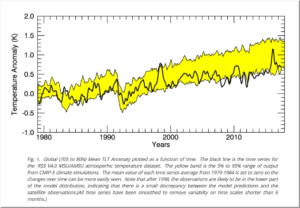
  2. Temperatures will increase unsustainably. This is based on the IPCC nominal ECS of about 3, recently goosed up by forthcoming CMIP6. Except, temps have NOT. As just one example of predictive model falsification, the CMIP4/5 models predicted tropical troposphere hotspot simply does NOT exist. There are several reasons why these models have abjectly failed, explained in several previous posts.
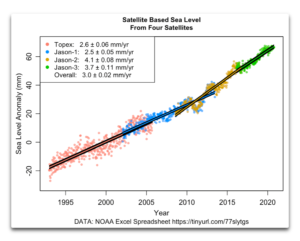
  3. Sea level rise accelerates. Except it hasn’t. And the most accurate SLR dGPS corrected tide gauges not only show no acceleration, they show it with ~closure (thermosteric rise plus ice sheet melt). And, the present rise rate is no different from the peak of the previous interglacial, the Eemian. (Details are in previous WUWT posts and in essay PseudoPrecision in eBook Blowing Smoke)
  4. Polar bears will go extinct from lack of summer sea ice. Except as Dr. Crockford has amply explained, this is an alarmist misconception at two levels. First, polar bears do not depend on summer sea ice. They depend on spring ice during the seal welping season, their main feeding cycle. No one suggests that is diminishing. Second, Arctic sea ice is cyclical, and the notion that it is spiraling ever down (Wadham’s alarm) is just factually wrong. (Essay Northwest Passage in ebook Blowing Smoke covers the Arctic Ice cycle issue in historical detail.)
  5. Extreme weather increases. Except per IPCC SRES (2012) it has NOT, anywhere, in any form. (Climate is rigorously defined as the envelope of weather [like temp, rainfall] over at least 30 years.) All the annual recent climate ‘extremes’ in the press are just weather (like this year’s accurately predicted overactive Atlantic hurricane season). As an example, landfalling US hurricane ACE over 30 years has NOT increased as a recent paper claimed—by falsely including hurricanes that touched land but then went back out to sea and re-intensified.

There are also a lot of unworkable ‘Green New Deal solutions’ to this non-problem. The most prominent are ‘renewable electric generation’ and EV’s.