Archives de catégorie : better to know…?

BBC’s Coral Propaganda

by P. Homewood, Apr 16, 2024 in NotALotOfPeopleKnowThat


The BBC is corrupt, and this report is fraudulent:

It has triggered the fourth global mass coral bleaching event, according to the US National Oceanic and Atmospheric Administration (NOAA).

Bleaching happens when coral gets stressed and turns white because the water it lives in is too hot.

Coral sustains ocean life, fishing, and creates trillions of dollars of revenue annually.

https://www.bbc.com/news/science-environment-68814016

For a start, there has been no “devastating toll”, as the BBC pretends, from the possibility that the world is slightly warmer than a few years ago. (Given margins of error, there is no certainty about this.)

But more importantly, Rannard grossly misrepresents the science. Coral does not “turn white” because the water is too hot. Nor is this is a rare occurrence, as the “fourth global mass coral bleaching event” implies.

On the contrary, bleaching is a common event, which can take place for all sorts of reasons, including when the water gets too cold.

As the leading coral reef expert Dr Peter Ridd has explained, “bleaching” is merely part of a natural process, when coral expels algae in order to switch to a different type which is more suitable adapted to new conditions.

According to Ridd, coral cover on the Great Barrier Reef last year reached record levels, despite four supposedly catastrophic bleaching events in the six years prior to 2022. Neither has there been any significant change in corals worldwide.

Rannard’s article has nothing to do with science; it is just more scaremongering propaganda.

This interview with Peter Ridd which followed his annual review on corals last year is worth watching:

What Heatwave?

by P. Homewood, Apr 14, 2024 in NotaLotOfPeopleKnowThat


I hope you did not blink, otherwise you may have missed it!

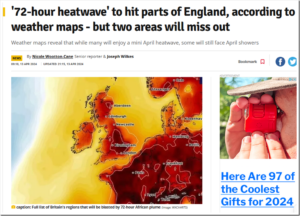
Brits are set to bask in a ’72 hour’ heatwave, according to some forecasters, but not everyone will be feeling the heat as two parts of England are expected to miss out on the sizzling temperatures.

Weather maps reveal that while many will enjoy a mini April heatwave, some will still face April showers. According to WX Charts, which uses Met Desk data for its predictions, temperatures could soar to a balmy 21C at times this month.

The charts indicate that Londoners can expect to enjoy highs of 20C from today until Saturday, with East Anglia and the East Midlands not far behind at 19C. Cities like Birmingham, Nottingham, Manchester, and Sheffield are also set to experience a warm 18C.

https://www.manchestereveningnews.co.uk/news/uk-news/72-hour-heatwave-hit-parts-28989573

Sure enough temperatures reached 21C in Essex, but I don’t know anyone who would actually describe this as a heatwave:

Don’t Be Alarmed About Unusually Warm Temperatures

by A. Epstein, Appt 13, 2024 in ClimateChangeDispatch


Myth: Recent, unusually warm temperatures show that fossil fuels are making our climate more and more dangerous.

Truth: Even with recent temperatures, which are a temporary anomaly, not the new normal, cold is a bigger problem than heat and fossil fuels keep us safer from both. [emphasis, links added]

Leading outlets are portraying the recent streak of warmer-than-expected months as ominous and deadly, and offering anti-fossil-fuel policies as a solution.

In reality, cold is a far bigger problem than heat—and anti-fossil-fuel policies will make us more endangered by both.

Three More New Temperature Reconstructions Document A Warmer Medieval Period

by K. Richard, Apr 11, 2024 in NoTricksZone


he North Atlantic, the Pacific Northwest (USA), and northern Finland were all warmer than today between 1000 and 2000 years ago.

Today’s (2000 CE) July air temperatures in the Azores – archipelago islands in the middle North Atlantic, ~1400 km west of Portugal – are visually shown to average about 10 to 11°C in a newly published reconstruction (Raposeiro et al., 2024).

This average air temperature is about 1 to 2°C warmer than this location’s Little Ice Age climate, or the coldest period (~9.1°C from 1750-1800) of the last 2000 years. However, the Medieval Climate Anomaly (MCA) had temperatures reaching into the 13-15°C range, which is 3-4°C warmer than modern.


A temperature reconstruction from a lake in the USA’s Pacific Northwest (Baig, 2024) indicates glacial temperatures were only 1.0 to 1.6°C colder than the modern temperature, 12.2°C. Temperatures reached 13.7°C, or 1.5°C warmer than today, ~2500 years ago, and then fluctuated between 12.6 and 12.2°C from 1900 years ago until today, a period encompassing both the Medieval Warm Period and Little Ice Age.

Another lake sediment temperature reconstruction using branched glycerol dialkyl glycerol tetraethers (brGDGTs) from northern Finland (Otiniano et al., 2024) suggests the modern temperature (represented as the blue diamond) is among the coldest of the last ~8000 years. Temperatures were much warmer than modern about 1200 to 1500 years ago, and throughout the period from 7000 to 3000 years ago.

The Anthropocene is not an official stratigraphic unit

by A. Préat and B. Van Vliet-Lanoë, Apr 12,2024 in SCE


Main theme: Ever since the idea of a new geological unit, the Anthropocene, waslaunched in 2000 by Paul Crutzen, an atmospheric chemist and Nobel Prize winner, the scientific community has been inflamed by the current global warming situation, and passionate debates have raged between those in favor of this new anthropogenic unit and those opposed to it. The discussion has spread well beyond the geological community, yet it is geologists, and geologists alone, who are able to formally define geological units, in this case stratigraphic units. Our article will reviewthe rules of stratigraphy and show that the introduction of the Anthropocene as a stratigraphic unit does not comply with these rules. After 15 years of debate, the ICS (International Commission on Stratigraphy) has just officially rejected the Anthropocene as a stratigraphic unit. In conclusion, the Anthropocene must be
considered as a ‘Geo-ethical’ unit and not as a ‘Geological’ unit.

Example of the GSSP stratotype from the Thanetian geological stage (Paleocene, see Figure 1). Note the golden spike (see text below). Photography : Pierre Thomas.

3 New Studies Confirm Sea Levels Were 5 to 9 Meters Higher 7,000-5,000 Years Ago Than Today

by K. Richard,  Apr 1, 2024 in ClimateChangeDispatch


Modern relative sea levels are near the lowest in the last 7,000 years.

Two studies, independently published, identified Mid-Holocene sea levels in northern Norway (north of the Arctic Circle) as being 7 to 9 meters higher than today before declining to the present (Balascio et al., 2024, Nielsen et al., 2024). [emphasis, links added]

This region of the Arctic was warm enough to support human settlements and boat harbors during the Medieval Warm Period.

As the climate deteriorated into the Little Ice Age cooling centuries after the Medieval warmth, the accompanying sea level fall led to abandoned residences, ships, and harbors.

The seas had become too shallow to sail in.

EXCLUSIVE: A Third of U.K. Met Office Temperature Stations May Be Wrong by Up to 5°C, FOI Reveals

by C. Morrison, March 1, 2024 in TheDailySceptic


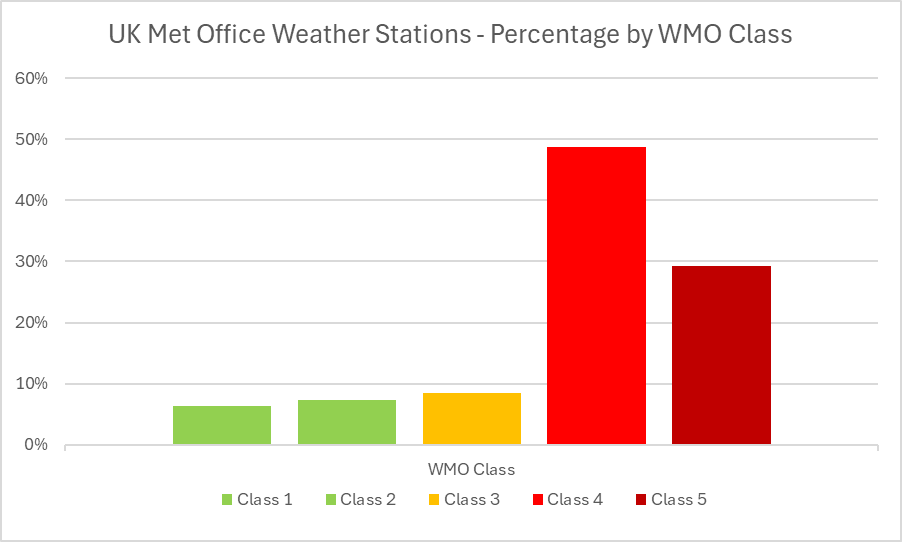
Nearly one in three (29.2%) U.K. Met Office temperature measuring stations have an internationally-defined margin of error of up to 5°C. Another 48.7% of the total 380 stations could produce errors up to 2°C, meaning nearly eight out of ten stations (77.9%) are producing ‘junk’ or ‘near junk’ readings of surface air temperatures. Arguably, on no scientific basis should these figures be used for the Met Office’s constant promotion of the collectivist Net Zero project. Nevertheless, the state-funded operation frequently uses them to report and often catastrophic rises in temperature of as little as 0.01°C.

Under a freedom of information request, the Daily Sceptic has obtained a full list of the Met Office’s U.K. weather stations, along with an individual class rating defined by the World Meteorological Office. These CIMO ratings range from pristine class 1 and near pristine class 2, to an ‘anything goes’ or ‘junk’ class 5. The CIMO ratings penalise sites that are near any artificial heat sources such as buildings and concrete surfaces. According to the WMO, a class 5 site is one where nearby obstacles “create an inappropriate environment  for a meteorological measurement that is intended to be representative of a wide area”. Even the Met Office refers to sites next to buildings and vegetation as “undesirable”. It seems class 5 sites can be placed anywhere, and they come with a WMO warning of “additional estimated uncertainties added by siting up to 5°C”; class 4 notes “uncertainties” up to 2°C, while class 3 states 1°C. Only 13.7%, or 52 of the Met Office’s temperature and humidity stations come with no such ‘uncertainty’ warnings attached.

The above graph shows the percentage totals of each class. Class 1 and 2, identified in green, account for just 6.3% and 7.4% of the total respectively. Class 3 identified as orange comes in at 8.4%. The graph shows the huge majorities enjoyed by the darkening shades of red showing classes 4 and 5. It is possible that the margins of error identified for classes 3, 4 and 5 could be a minus amount – if for instance the measuring device was sited in a frost hollow – but the vast majority are certain to be pushed upwards by heat corruptions.


Meteorologist Debunks TIME Mag’s Claim That Jan 2024 Was Hottest On Record

by A. Watts, Feb 19, 2024 in ClimateChangeDispatch


An article in TIME Magazine (TIME) claims that January 2024 was the hottest ever on record for the planet. Titled, 2024 Had the Hottest January on Record Following 2023’s Hottest Year on Record the article is based on a single source of temperature data.

Data from multiple other sources of temperature measurements refute this claim. [emphasis, links added]

TIME refers to the Copernicus EU climate service as the source for its alarming claim. Copernicus EU issued a press release claiming:

January 2024 was the warmest January on record globally, with an average ERA5 surface air temperature of 13.14°C, 0.70°C above the 1991-2020 average for January and 0.12°C above the temperature of the previous warmest January, in 2020.

The month was 1.66°C warmer than an estimate of the January average for 1850-1900, the designated pre-industrial reference period.

The problem with that is that they are using a reference period of 1850 to 1900 that no other climate data source uses; a period, not coincidentally, more than 100 years of global warming ago when the Earth was cooler than today.

For example, NASA Goddard Institute for Space Studies (GISS) produced a map of the globe that shows a significantly lower global temperature for January 2024.

The GISS global value was just 1.20°C compared to the 1.66°C claimed by Copernicus is different because NASA GISS is using a base period of 1951 to 1980.

Copernicus seemingly cherry-picked the reference period to fit the climate crisis narrative, and TIME was too uninterested in seeking and presenting the truth to investigate the extraordinary claim, instead reporting it as an unchallenged fact.

Green Billionaires Press Hollywood to Promote Armageddon Climate Messages in Movies

by C. Morrison, Feb27, 2024 in TheDailySceptic


Green billionaires are pouring money into discreet campaigns to persuade Hollywood writers to catastrophise the climate in future film and television scripts. One of their main vehicles is Good Energy, which tells writers that showing anger, depression, grief or other emotion in relation to the climate crisis, “can only make characters more relatable”. Los Angeles-based Good Energy is funded by numerous billionaire foundations including Bloomberg Philanthropies, the Sierra Club and the Climate Emergency Fund; the latter operation is part-funded by Aileen Getty and is one of the paymasters of the Just Stop Oil pests.

Good Energy aims to weave climate alarm into all types of film-making, “especially” if it is not about climate. With the support of Bloomberg, it recently published ‘Good Energy – A Playbook for Screenwriting in the Age of Climate Change’. It claims the Playbook is “now the industry’s go-to guide to incorporating climate into any storyline or genre”. As with almost all green campaigning groups, Good Energy would not exist without the support of billionaire funding. These operations seek a supra-national collectivist Net Zero solution to a claimed climate emergency. Good Energy acknowledges it would not exist without this funding, adding, “as collaborators and champions, each has provided a unique contribution for which we are endlessly grateful”.

Susan Crockford: State of the Polar Bear Report 2023 (pdf)

by S. Crockford, 2023


Key Findings
* There were no reports from the Arctic in 2023 indicating polar bears were being harmed due to lack of summer sea ice habitat, in part because Arctic sea ice in summer has not declined since 2007. 
 
* Contrary to expectations, a study in Svalbard found a decrease in polar bears killed in defense of life or property over the last 40 years, despite profound declines in sea ice over the last two decades. 
 
* A survey of Southern Hudson Bay polar bears in 2021 showed an astonishing 30% increase over five years, which adds another 223 bears to the global total. 
 
* A concurrent survey of Western Hudson Bay polar bears in 2021 showed that numbers had not declined since 2011, which also means they have not declined since 2004. Movement of bears across boundaries with neighbouring subpopulations may account for the appearance of a decline, when none actually occurred. 
 
* The IUCN Polar Bear Specialist Group has ignored a 2016 recommendation that the boundaries of three Hudson Bay subpopulations (Western HB, Southern HB, and Foxe Basin) be adjusted to account for genetic distinctiveness of bears inhabiting the Hudson Bay region; a similar boundary issue in the western Arctic between the Chukchi Sea, and the Southern and Northern Beaufort subpopulations, based on known movements of bears between regions, has been acknowledged since 2014 but has not yet been resolved. 
 
* The US Fish and Wildlife Service and the IUCN Polar Bear Specialist Group, in their 2023 reports, failed to officially acknowledge the new-found South-East Greenland population as the 20th subpopulation, despite undisputed evidence this is a genetically distinct and geographically isolated group. Numbers are estimated at 234 individuals.

A Curious Paleo Puzzle

by W. Eschenbach, Feb 23, 2024 in WUWT


A final possibility, of course, is that the warming has little to do with CO2 and that the CO2 levels are a function of temperature and not the other way around …

I titled this post “A Curious Paleo Puzzle”. That’s the puzzle. How can an increase of 13 W/m2 in CO2 forcing cause an increase of 115 W/m2 of upwelling surface longwave radiation?

All suggestions welcome.


….

Reviewing Elon Musk and His Position on the Climate ‘Crisis’

by Climate Change and Music, Feb 19, 2024 OPEN LETTER


GREAT SYNTHESIS

With respect to “Climate Change”, this website and my contribution to the discussion focuses on the data. I have a standing request/challenge to anyone (scientist or not) to provide an empirical Temperature/CO2 data set that shows CO2 driving the climate on any statistically significant historical time scale. Scientific proof requires empirical data. The Catastrophic Anthropogenic Global Warming (CAGW) theory does not have that empirical data (because that data does not exist).

Wrong Again: 50 Years of Failed Eco-pocalyptic Predictions

by M. Ebell & S.J. Milloy, 18 Sep 2019 in CompetitiveEnterpriseInstitute


Thanks go to Tony Heller, who first collected many of these news clips and posted them on RealClimateScience

SUMMARY

Modern doomsayers have been predicting climate and environmental disaster since the 1960s. They continue to do so today.

None of the apocalyptic predictions with due dates as of today have come true.

What follows is a collection of notably wild predictions from notable people in government and science.

More than merely spotlighting the failed predictions, this collection shows that the makers of failed apocalyptic predictions often are individuals holding respected positions in government and science.

While such predictions have been and continue to be enthusiastically reported by a media eager for sensational headlines, the failures are typically not revisited.

New Study Finds No Evidence Of A CO2-Driven Warming Signal In 60 Years Of IR Flux Data

by K. Richard, Jan 11, 2024 in NoTricksZone


“The real atmosphere does not follow the GHG [greenhouse gas] GE [greenhouse effect] hypothesis of the IPCC.” – Miskolczi, 2023

CO2 increased from 310 ppm to 385 ppm (24%) during the 60 years from 1948 to 2008. Observations indicate this led to a negative radiative imbalance of -0.75 W/m². In other words, increasing CO2 delivered a net cooling effect – the opposite of what the IPCC has claimed should happen (Miskolczi, 2023).

Also, there is “no correlation with time and the strong signal of increasing atmospheric CO2 content in any time series,” which affirms “the atmospheric CO2 increase cannot be the reason for global warming.”

“The Arrhenius type greenhouse effect of the CO2 and other non-condensing GHGs is an incorrect hypothesis and the CO2 greenhouse effect based global warming hypothesis is also an artifact without any theoretical or empirical footing.”

Rising Maximum Temperatures

by K. Hansen, Jan5, 2024 in WUWT


Roger Pielke Jr. recently posted a piece at The Honest Broker titled:  “U.S. Climate Extremes: 2023 Year in Review   – A Very Normal Year” – which was subsequently reposted at WUWT.

In that post, he uses this graphic:

(I have increased the size of the titles for clarity – kh)

It is easy to see that the trends of both the Maximum January temperatures and the Maximum July temperatures have been rising — more so for January temperatures than July — though this is somewhat obscured by the different scales of the two graphs.   [Caveat:  The temperature record on which this graph is based is not scientifically reliable before about 1940.] Also, one has to be careful to note what exactly they are really measuring.

CET Daily Temperatures

by P. Homewood, Jan 4, 2023 in NotaLotofPeople KnowThat


https://www.metoffice.gov.uk/hadobs/hadcet/cet_info_max2023.html

I want to focus on the end of year CET graph, which gives the lie to the extreme temperature myth often bandied around.

The graph plots daily max CET temperatures, against the background of the percentiles of the 1961-90 climatology. The Met Office should of course be using 1991-2020 as the baseline, so the climatology should be shifted upwards by a half a degree or so. But we’ll leave that aside.

We can legitimately regard anything between the 5% and 95% bands as being “weather”. Only days outside this might be regarded as “extreme”. (I would actually argue anything outside 1% and 99%).

We see that apart from a handful of days, every day was within that “normal weather” band.

In a year there will be 36 days outside of that band on average. The Met Office do not supply the data for these percentiles to enable the number of days to be calculated, but this year it does not look to be excessive in terms of that average.

Moreover, although there were a few days in September which set record highs for that particularly day, none were records for the month as a whole. The highest temperature last September was 28.9C, but the record for September stands at 31.5C in 1906:


Of course most of the year had temperatures above the average. But we have a wide range of weather in Britain. We can have mild, wet winters, and cold, snowy ones; we can have cool, wet summers and sunny hot ones. But these are weather events, not climate, and they are dependent on weather patterns, the jet stream and so on.

A predominance of warmer weather is not climate change.

No Trends In Extratropical Cyclones – IPCC

by  P. Homewood, Jan 2, 2024 in NotaLotofPeopleKnowThat


image

We constantly hear that storms are getting worse because of global warming. These claims are not referring to hurricanes and tropical storms, but the sort of storm which hits the UK several times every winter.

These are known as Extratropical Storms. The clown Jim Dale made this very claim again this week after Strom Gerrit. According to him, it is all to do with warm oceans, which pep up these storms. If this was correct, there would never be any storms in the Arctic. But claims such as this show a basic misunderstanding of meteorology; astonishing for somebody who claims to be a meteorologist!

NOAA explain the difference between tropical and extratropical cyclones (ETCs):

Climate Science Double-Speak

by K. Hansen, 2017 in WUWT


A quick note for the amusement of the bored but curious.

While in search of something else, I ran across this enlightening page from the folks at UCAR/NCAR [The University Corporation for Atmospheric Research/The National Center for Atmospheric Research — see pdf here for more information]:

What is the average global temperature now?

We are first reminded that “Climate scientists prefer to combine short-term weather records into long-term periods (typically 30 years) when they analyze climate, including global averages.”  As we know,  these 30-year periods are referred to as “base periods” and different climate groups producing data sets and graphics of Global Average Temperatures often use differing base periods, something that has to be carefully watched for when comparing results between groups.

Then things get more interesting, in that we get an actual number for Global Average Surface Temperature:

“Today’s global temperature is typically measured by how it compares to one of these past long-term periods. For example, the average annual temperature for the globe between 1951 and 1980 was around 57.2 degrees Fahrenheit (14 degrees Celsius). In 2015, the hottest year on record, the temperature was about 1.8 degrees F (1 degree C) warmer than the 1951–1980 base period.

Quick minds see immediately that 1.8°F warmer than 57.2°F is actually 59°F [or 15° C]  which they simply could have said.

UCAR/NCAR goes on to “clarify”:

“Since there is no universally accepted definition for Earth’s average temperature, several different groups around the world use slightly different methods for tracking the global average over time, including:

NASA Goddard Institute for Space Studies

    NOAA National Climatic Data Center

    UK Met Office Hadley Centre”

We are told, in plain language, that there is no accepted definition for Earth’s average temperature, but assured that it is scientifically tracked by the several groups listed.

2 More New Studies Undermine Alarmist Claims That Corals Are Harmed By Warming

by K. Richard, Dec 21, 2023 in NotricksZone


Warmer sea surface temperatures are associated with coral growth, not decline.

According to a new study, coral growth was slow during the ~1°C colder Little Ice Age (LIA), but grew rapidly as sea surface temperatures (SSTs) warmed after 1850. Warmth is associated with coral growth, whereas colder SSTs are linked to growth rate decline.

“The average growth rate of four colonies living in the LIA is 0.87 ± 0.11 cm/yr, which is significantly (t-test, p < 0.0001) lower than the colonies in the 20th century [1.23 ± 0.22 cm/yr].”

“The observed low average growth rates during the LIA can be explained by the ~1°C lower temperature.”

Ocean pH levels were as low or lower (more “acidified”) than recent decades during the LIA (e.g., 1500s to 1700s CE), suggesting that the atmospheric CO2 levels are not an ocean pH variability determinant. In fact, the authors point out that anthropogenic CO2 can only ever affect pH variability by 0.05 of a unit over centuries, whereas natural variations in pH units can reach 0.1 to 0.3 within a decade or less.

Antarctic Sea Ice Volume Greater Than The Early 1980s

by P. Homewood, Dec 21, 2023 in NotaLotof PeopleKnowThat


There was much scaremongering from the alarmist community when Antarctic sea ice extent fell earlier in the year. As the Antarctic summer begins, the melt has slowed down, to the extent that extent is not even the lowest since 1979, and it is higher than in 2017:


https://zacklabe.files.wordpress.com/2023/12/nsidc_sie_ant_lines-5.png

https://zacklabe.com/antarctic-sea-ice-extentconcentration/

But much more important is the fact that sea ice volume remains higher than the early 1980s, thanks to the fact that it is much thicker than normal around the peninsula:

More coal burned on Earth in 2023 than ever before in human history

by Jo Nova, Dec19, 2023 in JoNova


The best kept secret in the world is that humans are using more coal than ever

So much for the “stranded dead asset”. In 2022 the world set a new all-time record for coal use — reaching 8.4 billion tons. In 2023, despite all the Net Zero billions in spending, despite the boom in windmills and solar panels, global demand for coal will top 8.54 billion tons.

The IEA is the “International Energy Agency” — supposedly, the impartial servant of 31 nations worth of taxpayers. Yet they decided to ignore the world record and instead tell us how coal is set to decline. It’s what they think the taxpayers need to hear.  Their press release:

Global coal demand expected to decline in coming years

New Study Now Claims We Humans Heat The Atmosphere Just By Exhaling

by K. Richard, Dec 18, 2023 in NoTricksZone


“Where hydrocarbon chains (food types) are consumed by humans and turned into CH4 [methane] … global warming potential is no longer neutral, and human respiration has a net warming effect on the atmosphere.”  – Prada et al., 2023

Image Source pexels.com (stock photo)

According to a new study, humans “contribute to global warming” by exhaling greenhouse gases like methane and carbon dioxide 16 times per minute.

“Exhaled human breath can contain small, elevated concentrations of methane (CH4) and nitrous oxide (N2O), both of which contribute to global warming. These emissions from humans are not well understood and are rarely quantified in global greenhouse gas inventories.”

Like bovine populations, humans are referred to as “methane producers” (MPs), respiring and burping this potent greenhouse gas simply by existing. (Concerns about methane’s global warming potential are so significant that New Zealand is imposing a “methane tax” on the nation’s cows, as these MP animals are heating up the planet with their burps.)

Measurements of methane and nitrous oxide in human breath and the development of UK scale emissions

by C. Rotter, Dec 16, 2023 in WUWT/PlosOne


In a recent study published in PLOS ONE, titled “Measurements of methane and nitrous oxide in human breath and the development of UK scale emissions,” researchers have embarked on a quest that epitomizes the absurdity of current climate change discourse. This study, focusing on the emissions of methane (CH4) and nitrous oxide (N2O) from human breath, is not only a glaring example of scientific overreach but also a worrying indicator of the lengths to which climate alarmism is willing to go.

The study’s objective to investigate emissions from human breath in the UK population is fundamentally flawed. It operates under the assumption that these emissions are significant enough to warrant detailed analysis and inclusion in national greenhouse gas inventories. This premise is laughable at best, considering the minuscule percentage these emissions contribute to the overall greenhouse gas emissions.

The methodology employed in the study is questionable. Collecting 328 breath samples from 104 volunteers hardly constitutes a representative sample of the UK population. Furthermore, the study’s reliance on such a small sample size to draw conclusions about national-scale emissions is a classic case of over-extrapolation.

The study’s findings that 31% of participants were methane producers and that all participants emitted nitrous oxide are presented without adequate context. These results are portrayed as significant, yet they fail to consider the broader environmental impact. The fact that these emissions are stated contribute a mere 0.05% and 0.1% to the UK’s total emissions of CH4 and N2O, respectively, well below any margin of error in “national inventories” renders these findings insignificant.

Claim: Global Warming is Reducing Maximum Temperatures in the Himalayas

by E. Worrall, Dec 15, 2023 in WUWT


Nature Geoscience volume 16, pages 1120–1127 (2023)Cite this article

Abstract

Understanding the response of Himalayan glaciers to global warming is vital because of their role as a water source for the Asian subcontinent. However, great uncertainties still exist on the climate drivers of past and present glacier changes across scales. Here, we analyse continuous hourly climate station data from a glacierized elevation (Pyramid station, Mount Everest) since 1994 together with other ground observations and climate reanalysis. We show that a decrease in maximum air temperature and precipitation occurred during the last three decades at Pyramid in response to global warming. Reanalysis data suggest a broader occurrence of this effect in the glacierized areas of the Himalaya. We hypothesize that the counterintuitive cooling is caused by enhanced sensible heat exchange and the associated increase in glacier katabatic wind, which draws cool air downward from higher elevations. The stronger katabatic winds have also lowered the elevation of local wind convergence, thereby diminishing precipitation in glacial areas and negatively affecting glacier mass balance. This local cooling may have partially preserved glaciers from melting and could help protect the periglacial environment.

Read more: https://www.nature.com/articles/s41561-023-01331-y

The maximum temperature trend may be cooling at -0.26C per decade at some stations, according to the study.

Evolution of the world fuel intensities

by S. Furfari, Dec 15, 2023 in ScienceClimatEnergie


A benchmark that explains why green NGOs want to promote energy sobriety

The fashion for saving energy, which assumes that human behaviour can compensate for the inelasticity of energy demand, is not new. Only the name is. In 1924, when US President Calvin Coolidge proposed saving oil because he had been told that reserves would soon be exhausted, he devised a strategy called energy conservation. Though compassionate and generous, these methods failed to reverse the continuing growth in energy demand. Energy consumption, and oil consumption in particular, continues to rise as the world’s population grows and more people need to eat and work, i.e. consume energy. It is the task of industry and engineers to make processes and products more efficient. It has always been an ongoing quest. The Romans used massive stones to build their bridges, creating amazing monuments. Today, a similar function is performed with much lighter materials. Efficiency is normal behaviour in human activities, including the production, conversion and consumption of energy.