
Archives par mot-clé : IPCC

Rainfall, Cyclone Data Show No Clear Upward Trend, Contradict IPCC Claims

by P. Gosselin, Mar 19, 2023, in NoTricksZone


Feel helpless when trying to assess the veracity of “climate doom is looming” claims? Don’t give up trying to understand the relevant basics because you don’t need to be a scientist to do so.

There is a rather simple way to get an idea about what this is all about. Even without a scientific background, most people have at least a good common sense. And that’s all it takes to get a grasp of how energy flows back and forth between earth’s surface and the skies.

Today in Part 5, we look at the linkage between the allegedly CO2-driven rise of air and sea surface temperatures on the one side and the disconnect between these increases and their strangely weak to insignificant impact on rainfall and hurricane intensity”.

Preceding chapters see Part 1 1), Part 2 2), Part 3 3), Part 4 4).

Variability of cloud effects vs “greenhouse gas” effects

In the last chapter, we have seen that there are some discrepancies between the global warming trend as claimed by the official climate science and the local evolution of rainfall, which should be a direct consequence of higher temperatures since this causes more evaporation. This seems not to be the case e.g. for Germany, see Fig. 1:

Science Yields Surprises! Island Nations Growing… “Atoll, Island Stability Is Global Trend”!

by P. Gosselin, Mar 8, 2023 in WUWT


IPCC high-end sea level predictions for 2100 are “highly erroneous”. 

Global warming alarmists like to claim that Pacific island nations are on the verge of disappearing – due to rising sea levels caused by polar ice melting due to global warming, which in turn supposedly is caused by rising concentrations of “heat-trapping” trace gas CO2 from the burning of fossil fuels.

These coral reef island nations risk going under real soon, unless we wean ourselves from fossil fuels soon, they say.

Coral reef island nations are emerging, not disappearing

But yesterday Kenneth here presented a new paper appearing in Nature, (Kench et al., 2023), which looks at whether the coral reef islands are in fact seeing unprecedented and undergoing accelerating physical changes that risk outrunning human adaptation measures. The authors analyzed the dynamics of a Maldivian reef island at millennial to decadal timescales.

Recent changes not unprecedented

The researchers found that “island change over the past half-century (±40 m movement) is not unprecedented compared with paleo-dynamic evidence”.

Nothing unusual is happening. The global data suggest that almost all islands are in fact growing, and not  disappearing under water like climate alarmists mistakenly believe.

“Recent shoreline changes (±40 m/50 years) are ‘dwarfed’ by the shoreline changes (±200 m/100 years) that occurred throughout previous centuries,” the study’s authors write.

 89% of all the globe’s islands are stable, or growing!

Moreover, just 4 years ago, another peer-reviewed publication appearing in a renowned journal found similar results: 89% of the globe’s islands and 100% of large islands have stable or growing coasts! According to Duvat, 2019:

“88.6% of islands were either stable or increased in area, while only 11.4% contracted. It is noteworthy that no island larger than 10 ha decreased in size. These results show that atoll and island areal stability is a global trend, whatever the rate of sea-level rise.”

Moreover, Khan et al (2018) found: “Prediction of 4–6.6 ft sea level rise in the next 91 years between 2009 and 2100 is highly erroneous.”

How IPCC’s 1990 Predictions Expensively Failed

by C. Monckton of Brenchley, Nov 8, 2022 in WUWT


It is now almost a third of a century since 1990, when IPCC made its first predictions about the weather. Since IPCC (2021) continues to predict the same 3 C° midrange long-term warming (equilibrium doubled-CO2 sensitivity, or ECS, broadly equivalent to 20th-century anthropogenic warming from all sources) as in 1990, it is high time someone examined IPCC’s medium-term predictions to shed light on the plausibility of its long-term predictions.

IPCC’s key medium-term prediction in 1990 was as follows –

“Based on current model results, we predict:

  • “under the IPCC Business-as-Usual (Scenario A) emissions of greenhouse gases, a rate of increase of global mean temperature during the next century of about 0.3 C° per decade (with an uncertainty range of 0.2 C° to 0.5 C° per decade). This is greater than that seen over the past 10,000 years. This will result in a likely increase in global mean temperature of about 1 C° above the present value by 2025 and 3 C° before the end of the next century. The rise will not be steady because of the influence of other factors.”

IPCC also predicted as follows –

This second business-as-usual prediction was that there would be 1.8 C° warming from preindustrial times to 2030. Deducting the 0.45 C° warming up to 1990, the prediction amounted to 1.35 C° or about 0.34 C°/decade. Thus, IPCC predicted 0.3-0.34 C°/decade medium-term warming. However, only 0.14 C°/decade has occurred since 1990
he IPCC’s Climate Math Doesn’t Add Up. Will Anyone Notice?

by R. McKitrick, Oct 14, 2022 in ClimateChangeDispatch


The high and rising costs of climate policy — now including the inability of jurisdictions that bet big on renewables to guarantee enough energy for their citizens to survive the coming winter — don’t just entitle us to question the basis for it: they demand we do so.

Ultimately, the justification for renewables is the view that carbon dioxide emissions have a big effect on the climate that will cause devastating harm at some point in the future. [bold, links added]

Scientists measure the effect using a concept called “Equilibrium Climate Sensitivity” or ECS, which estimates how much long-run average warming will occur as a result of doubling the amount of carbon dioxide in the atmosphere.

Some important new evidence pointing to a low ECS value just emerged in the scientific literature.

ECS has long been uncertain. In 1979 the U.S. National Academy of Sciences estimated it to be between 1.5 and 4.5 degrees Celsius, with a best estimate of 3.0 degrees C.

That range, which runs from “no big deal” to “very bad outcomes,” was accepted by the UN Intergovernmental Panel on Climate Change (IPCC) in its first report in 1990 and thereafter until 2007 when, citing greater warming projections in newer models, it raised the bottom end to 2.0 degrees C.

But over the next few years, literature developed using, not model simulations, but observed warming rates since the late-1800s to estimate ECS.

Its results typically centered around 2.0 C or less. So in 2013, the IPCC reduced the bottom end of the range back to 1.5 C and declined to offer a best estimate. In other words, after three decades climate science hadn’t narrowed the uncertainty at all.

The economic implications of ECS being 2 C rather than 3 C are enormous.

Regime Pseudoscientists Enforce Climate Change Narrative

by M. Rectenwald, Oct 12, 2022 in ClimateChangeDispatch


It does this by pathologizing said subjects and their views.

For example, the field has been mobilized to discredit so-called conspiracy theorists by attempting to identify the mistaken mental processes that conspiracy theorists exhibit. [bold, links added]

The methods and results of such studies have proven to be less than stellar, to say the least.

Now, the field is also being wielded to discredit “climate change deniers.”1 By pathologizing the thinking processes of these stubbornly mistaken subjects, the views of said subjects can be safely dismissed.

After all, the theory of anthropogenic climate change (ACC) is obviously true, or so says the Intergovernmental Panel on Climate Change (IPCC), the planetary authority on the matter.

Likewise, those who doubt or deny ACC must be crazy. The point of psychological studies is to discover just what is wrong with these people and how, if possible, to change their minds.

Of course, such studies focus exclusively on the “deniers,” without ever considering climate change believers and whether something is wrong with them. The field lacks even a semblance of symmetry.

Never mind that “the science” is dubious or that climate change is ludicrously being blamed for heart attacks, obesity in children, increased violence, and terrorism, among other medical and social maladies.

Believing in a causal connection between a questionable climate change theory and these phenomena must be perfectly rational, according to this kind of research.

Such is the thrust of a recent study of Australian climate change skeptics conducted by a lecturer in psychology and a professor of geology at the University of the Sunshine Coast.

Entitled “Associations of Locus of Control, Information Processing Style and Anti-reflexivity with Climate Change Scepticism in an Australian Sample,” the study examines climate change skeptics in terms of thinking styles rather than “values” and “sociodemographic” factors.

Since past research has found values and sociodemographic factors to be intractable, the researchers in this study seek to identify factors that presumably can be changed and that should likewise prove useful for the study.

Satellite Temperature Data Show Almost All Climate Model Forecasts Over the Last 40 Years Were Wrong

by C. Morrison, Oct 8, 2022 in DailySceptic


A major survey into the accuracy of climate models has found that almost all the past temperature forecasts between 1980-2021 were excessive compared with accurate satellite measurements. The findings were recently published by Professor Nicola Scafetta, a physicist from the University of Naples. He attributes the inaccuracies to a limited understanding of Equilibrium Climate Sensitivity (ECS), the number of degrees centigrade the Earth’s temperature will rise with a doubling of carbon dioxide.

Scientists have spent decades trying to find an accurate ECS number, to no avail. Current estimates range from 0.5°C to around 6-7°C. Without knowing this vital figure, the so-called ‘settled’ science narrative around human-caused climate change remains a largely political invention, not a credible scientific proposition. Professor Scafetta has conducted extensive work into climate models and is a long-time critic of their results and forecasts. In a previous work, he said many of the climate models should be “dismissed and not used by policymakers”. Along with around 250 professors, he is a signatory to the World Climate Declaration which states there is no climate emergency and also notes climate models are “not remotely plausible as global tools”.

Scafetta’s latest work grouped 38 major climate models into low, medium and high ECS values, ranging between 1.8°C and 5.7°C. He found that models in the medium and high category “ran hot” in over 95% and 97% of cases respectively. The lower models were said to have done better when compared to global warming calculated for the period by the major surface datasets of 0.52-0.58°C. But the UAH satellite data showed warming up to 30% less during this period, suggesting even the low warming models produced “excessive warming” from 1980-2021.

According to Scafetta, these results are showed that the ECS figure could be as low as 1.2-2°C. Particular concern is expressed about surface temperature records that “appear to be severely affected by non-climatic warming biases”. Scafetta concludes that surface-based temperature records are likely to be affected by warming biases, such as the urban heat island effect due to expanding urban development, and subject to natural oscillations that are not reproduced by climate models. He concludes: “The global warming expected for the next few decades may be even more moderate than predicted by the low ECS-GCMs [Global Circulation Models], and could easily fall within a safe temperature range where climate adaptation policies will suffice.”


See also : Satellite Temperature Data Show Almost All Climate Model Forecasts Over the Last 40 Years Were Wrong

Press Release: Important new paper challenges IPCC’s claims about climate sensitivity

by P. Homewood, Sep 20, 2022 in NotaLotofPeopleKnowThat


London, 20 September – A new paper reduces the estimate of climate sensitivity – the amount of warming expected for a doubling of carbon dioxide concentrations – by one third. The results therefore suggest that future global warming will be much less than expected.
The paper, by independent scientist Nic Lewis, has just appeared in the journal Climate Dynamics. It is an important challenge to the official view of the Intergovernmental Panel on Climate Change (IPCC).
Lewis has critiqued a 2020 assessment of climate sensitivity by Sherwood et al., which strongly influenced the IPCC’s Sixth Assessment Report, in 2021. Lewis commented:
“It is unfortunate that Sherwood et al.’s assessment of climate sensitivity, which underpinned the UN Framework Convention on Climate Change, contained such serious errors, inconsistencies and deficiencies in its methods”.
After correcting the Sherwood et al. methods and revising key input data to reflect, primarily, more recent evidence, the central estimate for climate sensitivity comes down from 3.1°C per doubling of CO2 concentration in the original study to 2.16°C in the new paper.
This large reduction shows how sensitive climate sensitivity estimates still are to input assumptions, and that values between 1.5°C and 2°C remain quite plausible.

  • Climate sensitivity represents the long-term global temperature increase caused by a doubling of atmospheric CO2 concentration. There are different measures of climate sensitivity. Both the Sherwood and Lewis papers estimate the so-called ‘effective’ climate sensitivity, which reflects a new equilibrium state projected from centennial changes after a doubling of the CO2 concentration. This measure is considered the most relevant one for predicting climate change in the coming two centuries.
  • Climate sensitivity has always been a very important, but also highly uncertain, parameter in the climate change discourse. Earlier IPCC reports assessed its value as likely to be somewhere between 1.5°C and 4.5°C, with a best estimate of 3°C. However, prompted by the Sherwood paper, the 2021 Sixth Assessment Report moved that range upwards, to 2.5 to 4°C. Although for outsiders this might sound boring, for insiders it was a revolutionary change.
  • Lewis’s corrections and revisions lead to a likely range of 1.75 to 2.7°C, which is not only lower but is also much less uncertain than either the 2021 official IPCC assessment or the very similar Sherwood et al. estimate (2.6 to 3.9°C).
  • Nic Lewis is the lead or sole author of ten peer-reviewed papers on climate sensitivity. He was a participant in the 2015 workshop that kicked off the World Climate Research Programme project that led to the Sherwood et al. 2020 paper, but he was not a co-author of that paper.

Lewis commented:
“The substantial reduction in assessed climate sensitivity upon updating key input data suggests that the increase in the bottom of the climate sensitivity range in the IPCC Sixth Assessment Report was unjustified”.
Lewis’s paper is entitled ‘Objectively combining climate sensitivity evidence’. It can be freely downloaded here. A detailed explanatory article about the paper is available here.

DEBUNKED: Europe’s claimed ‘worst drought in 500 years’

by P. Homewood,  Aug 20, 2022  , in NotaLotofPeopleKnowThat


Roger Pielke Jr debunks Europe’s “Worst Drought in 500 Years Claim”:


Conclusion

In Western and Central Europe — basically Atlantic France all the way to Moscow, north of the Mediterranean region and south of the North Sea region — the IPCC and the underlying peer reviewed research on which it assesses has concluded that drought has not increased and, logically, that increased drought cannot be attributed to human-caused climate change. The only exception here is that the IPCC has medium confidence in an increasing trend of soil moisture deficits in some subregions, however the IPCC has low confidence that this trend can be attributed to human-caused climate change. Looking to future, at temperature changes of 2C and more, at present the IPCC does not expect the current state of scientific understandings to change. But stay tuned — that’s why we do science.

The full post is here.

See also : DEBUNKED: Europe’s claimed ‘worst drought in 500 years’ – Peer-reviewed studies, data & IPCC reveal ‘drought has not increased’ & ‘cannot be attributed to human-caused climate change’

Is Global Warming The Greatest Scientific Fraud In History?

by G.K. Mitchell, Aug 19, 202 in ClimateChangeDispatch


In its seminal report in 1990, the U.N. IPCC stated that “at the then current rate of world emissions of CO2, the global mean temperature would likely increase by 1°C by 2025.

This statement formed the basis for the hypothesis that anthropogenic (man-made) global warmingresulted from the increased concentration of CO2 in the Earth’s lower atmosphere resulting from man-made activities.

Central to the hypothesis was that the temperature of the lower troposphere would increase as the concentration of CO2 in the troposphere increased.

Therefore, in its 1990 report, the U.N. IPCC established a direct linkage between the concentration of CO2 in the atmosphere and the temperature of the lower troposphere.

The scientific method of inquiry has guided scientific research and investigation for over 400 years. In summary, the scientific method requires that a researcher observe a phenomenon, postulate a hypothesis for the cause of the phenomenon, and then conduct experiments or scientific investigations to falsify the hypothesis.

In adherence to the scientific method, a climate scientist who thinks that man has caused global warming should develop a complex hypothesis as follows:

  1. Global warming has occurred; that is, the temperature of the world’s oceans, landmass, and relevant atmosphere has risen during the period under investigation by a statistically significant amount.

  2. Man’s activities are responsible for the global warming that has occurred.

  3. The extent to which global warming has occurred, or is reasonably projected to occur in the future, will adversely affect life on Earth.

If any of the conjectures in the complex hypothesis above are found to be invalid, the complex hypothesis is determined to be falsified and either discarded or modified.

Tim Ball: The Evidence Proves That CO2 is Not a Greenhouse Gas

by T. Ball, Sept 13, 2018 in Technocracy


The Intergovernmental Panel on Climate Change (IPCC) claim of human-caused global warming (AGW) is built on the assumption that an increase in atmospheric CO2 causes an increase in global temperature. The IPCC claim is what science calls a theory, a hypothesis, or in simple English, a speculation.  Every theory is based on a set of assumptions. The standard scientific method is to challenge the theory by trying to disprove it. Karl Popper wrote about this approach in a 1963 article, Science as Falsification. Douglas Yates said,

“No scientific theory achieves public acceptance until it has been thoroughly discredited.”

Thomas Huxley made a similar observation.

“The improver of natural knowledge absolutely refuses to acknowledge authority, as such. For him, skepticism is the highest of duties; blind faith the one unpardonable sin.”

In other words, all scientists must be skeptics, which makes a mockery out of the charge that those who questioned AGW, were global warming skeptics. Michael Shermer provides a likely explanation for the effectiveness of the charge.

“Scientists are skeptics. It’s unfortunate that the word ‘skeptic’ has taken on other connotations in the culture involving nihilism and cynicism. Really, in its pure and original meaning, it’s just thoughtful inquiry.”

The scientific method was not used with the AGW theory. In fact, the exact opposite occurred, they tried to prove the theory. It is a treadmill guaranteed to make you misread, misrepresent, misuse and selectively choose data and evidence. This is precisely what the IPCC did and continued to do.

A theory is used to produce results. The results are not wrong, they are only as right as the assumptions on which they are based. For example, Einstein used his theory of relativity to produce the most famous formula in the world; e = mc2. You cannot prove it wrong mathematically because it is the end product of the assumptions he made. To test it and disprove it, you challenge one or all of the assumptions. One of these is represented by the letter “c” in the formula, which assumes nothing can travel faster than the speed of light. Scientists challenging the theory are looking for something moving faster than the speed of light.

Biden falsely links Kentucky floods to ‘climate change’ – Reality Check: Floods ‘have not increased in frequency or intensity’ – White House ignores peer-reviewed studies & IPCC & data

by M. Morano, Aug 11, 2022 in WUWT


Study in the Journal of Hydrology finds no increase in floods – ‘Compelling evidence for increased flooding at a global’ scale is lacking’

Extreme Weather expert Dr. Roger Pielke Jr. comments on new study: ‘New empirical study: Are floods increasing in North America and Europe? No (and consistent with IPCC.)’

Study published in the Journal of Hydrology, Volume 552, September 2017, Pages 704-717. The study found:

‘The number of significant trends was about the number expected due to chance alone.’

‘Changes in the frequency of major floods are dominated by multidecadal variability.’

‘The Intergovernmental Panel on Climate Change (IPCC) concluded (Hartmann et al., 2013) that globally there is no clear and widespread evidence of changes in flood magnitude or frequency in observed flood records.’

‘The results of this study, for North America and Europe, provide a firmer foundation and support the conclusion of the IPCC (Hartmann et al., 2013) that compelling evidence for increased flooding at a global scale is lacking.’

Little evidence of changes in extreme weather trends

by P. Homewood, July 27, 2022 in NotaLotofPeopleKnowThat


New IPCC attribution statistics are distorting observational evidence

London, 27 July – A new paper from the Global Warming Policy Foundation finds that the IPCC’s recent shift in methodology has led to misleading claims about changes in weather extremes.

The review, from physicist Dr Ralph Alexander, finds that IPCC claims that many of these weather extremes are increasing significantly are largely unsupported by observational evidence.

Ralph Alexander: Extreme Weather: The IPCC’s Changing Tune (pdf)

According to Dr Alexander:
“On almost every kind of extreme weather, with the possible exemption of heatwaves, the evidence for significant changes is scant. But the latest IPCC report has introduced novel ‘attribution’ statistics and now insists that things are getting worse. It’s yet another case of scientists trying to scare the public into compliance.”

Dr Alexander’s paper looks at:
– droughts
– floods
– hurricanes
– tornadoes
– wildfires
– hot and cold extremes
– coral bleaching.

He concludes that:
“The mistaken belief that weather extremes are worsening because of climate change is more a perception, fostered by media coverage, than reality. The IPCC’s new statistical method is playing an unworthy part in bringing this sorry state of affairs to pass.”

GWPF invited the Royal Society and the Met Office to review this paper, and to submit a response to be published as an appendix to it. No reply was received.

The IPCC And The Infamous Hockey Stick Graph

by CCD Editor, July 25,2022 in ClimateChangeDispatch


Ron Barmby, author of  “Sunlight on Climate Change: A Heretic’s Guide to Global Climate Hysteria” (AmazonBarnes & Noble) spoke with Mike Ryan of TNT Radio (TNT Radio (podbean.com) about what he uncovered in the recent IPCC report, Climate Change 2021: The Physical Sciences Basis.

Ron’s findings: after being made famous by Al Gore and adopted by the IPCC, then being made infamous by its historical and statistical failings and subsequently dropped by the IPCC, the hockey stick temperature graph is back!

And a new narrative is being introduced that carbon dioxide has been demoted to causing only half of human global warming to date.

Mike discusses with Ron the four things wrong, and often in conflict with, the report itself with the latest doomsday science from the IPCC. LISTEN:

…IPCC Summary Report, Part 2…

by D. Dears, July 2022 in PowerForUsa


Conclusion

The politicians changed the report written by the scientists so that it would be consistent with the SPM written by the politicians.

The report now reads:

“The body of statistical evidence in chapter 8 … now points towards a discernible human influence on global climate.”

Whereas it originally read:

“No study to date has positively attributed all or part (of the climate warming observed) to (manmade) causes.”

As a result, the pubic was told there is a discernible human influence on global climate when the scientists said none had been positively identified.

A legitimate scientific organization wouldn’t allow politicians to overrule scientists.

Why would our country rely on such an organization?

Link to Amicus Curiae https://bit.ly/3QSuyCn

Use this link in an email to let others know about this article https://bit.ly/3AqFm53 

Climate Change Weekly #439: Hurricanes Not Increasing, Despite Warming

by H.S. Burnett, Jul 1, 2022 in WUWT


Pielke notes five points of fact about hurricanes:

  1. The Intergovernmental Panel on Climate Change (IPCC) finds “no consensus” on the relative role of human influences on Atlantic hurricane activity, quoting the IPCC as follows: “there is still no consensus on the relative magnitude of human and natural influences on past changes in Atlantic hurricane activity, … and it remains uncertain whether past changes in Atlantic TC activity are outside the range of natural variability.”
  2. “The IPCC has concluded that since 1900 there is ‘no trend in the frequency of USA landfall events.’ This goes for all hurricanes and also for the strongest hurricanes, called major hurricanes.”
  3. “Since at least 1980, there are no clear trends in overall global hurricane and major hurricane activity.”
  4. “There are many characteristics of tropical cyclones that are under study and hypothesized to be potentially affected by human influences, … but at present there is not a unified community consensus on these hypotheses, as summarized by the World Meteorological Organization,” as to whether any of the factors are affected by human greenhouse gas emissions.
  5. “Hurricanes are common, incredibly destructive and will always be with us. Even so, we have learned a lot about how to prepare and recover.”

Pielke points out that some of the costliest hurricanes occurred in the early part of the twentieth century when average global temperatures were cooler than at present.

Code Red For Sanity – The Credibility Crisis At The IPCC

by R. Barmby, Jun23, 2022 in ClimateChangeDispatch


When speaking about the Intergovernmental Panel on Climate Change (IPCC) report Climate Change 2021: The Physical Sciences Basis, UN Secretary-General António Guterres declared it a “code red for humanity.”

He further stressed, “The alarm bells are deafening, and the evidence is irrefutable.” [bold, links added]

But a person who reads the report dispassionately and thoroughly will recognize that there is no code red for humanity and that the evidence is indeed refutable. It would be more accurate to say the report is a code red for sanity.

Classical science observes what is; that’s the evidence. A political agenda persuades what should be done; that’s the alarm bells.

Let’s turn off the alarm the IPCC pulled by examining Climate Change 2021: The Physical Science Basis (referred to from this point as “the report”).

You’ll discover that while the report contains some scientific evidence, much of it is hidden, manipulated, or contradicted.

Because of this, we’ll refute the so-called evidence in the report by explaining how the science has been misrepresented.

Let’s bring sanity back to science.

The report has four major themes where the political agenda has overrun classical science.

Theme 1: Climate history was altered.

The IPCC would like you to believe that the Earth’s temperature has been constant for thousands of years and that the approximate 1°C of warming is unprecedented.

The report offers this figure to support that view:

Why IPCC Climate Forecasts Are So Dodgy

by R. Barmy, May 5, 2022 in ClimateChangeDispatch


This is the fourth in a series of articles on the IPCC’s AR6 WG1 report. –CCD ed.

Margaret Thatcher helped create the United Nations Intergovernmental Panel on Climate Change (IPCC) in 1988. As an Oxford-trained chemist, she understood scientific principles and was concerned that we “… do not live at the expense of future generations.”

By 2002, the Iron Lady turned against global warming extremism by stating in her book Statecraft: Strategies for a Changing World, “What is far more apparent is that the usual suspects on the left have been exaggerating the dangers and simplifying solutions in order to press their agenda…” [bold, links added]

Thatcher’s comments of exaggeration and simplification were a prescient critique of the IPCC report Climate Change 2021: The Physical Sciences Basis.

The IPCC uses computer simulations to predict climate dangers and test solutions. An important step in the computer simulation of a real-world physical process is making sure the simulator can replicate the known history of that physical process.

If a computer model can accurately replicate a significant history of a known process, called hindcasting, it lends credibility that the correct equations are being used and will be able to predict future events.

AR6 Model Failure Affirmed: ‘No Model Group Succeeds Reproducing Observed Surface Warming Patterns’

by K. Richard, Apr 25, 2022 in NoTricksZone


A new study published in Geophysical Research Lettershighlights the abysmal model performance manifested in the latest Intergovernmental Panel on Climate Change report (AR6). The 38 CMIP6 general circulation models (GCMs) fail to adequately simulate even the most recent (1980-2021) warming patterns over 60 to 81% of the Earth’s surface.

Dr. Scafetta places particular emphasis on the poor performance of the highly uncertain estimates (somewhere between 1.83 and 5.67°C) of equilibrium climate sensitivity (ECS) and their data-model agreement relative to 1980-2021 global warming patterns.

The worst-performing ECS estimates are the ones projecting 3-4.5°C and 4.5-6°C warming in response to doubled CO2 concentrations (to 560 ppm) plus feedbacks, as the 1980-2021 temperature trends are nowhere close to aligning with these trajectories.

Instead, the projected global warming by 2050 (~2°C relative to 1750) associated with the lowest ECS estimates and implied by the warming observed over the last 40+ years is characterized as “unalarming” even with the most extreme greenhouse gas emissions (no mitigation efforts undertaken) growth rate.

In addition to the conclusion that “no model group succeeds reproducing observed surface warming patterns,” poor modeling of heat transfer physics, ocean and atmospheric circulation patterns, polar sea ice processes…is also evident in the latest IPCC report.

“Accurately reproducing regional temperature differences over the past 40+ years is beyond the capability of climate model simulations, and even fails for major ocean basins and continents.”

The fundamental modeling failures in simulating responses to sharply rising greenhouse gas emissions over the last 40+ years “calls into question model-based attribution of climate responses to anthropogenic forcing.”

Climate Past Far From Settled: 7 Major Temperature Reconstructions Find No Agreement

by P. Gosselin, Mar 29, 2022 in WUWT    


new paper published in open access publishing MDPI looks at seven prominent hemispheric and global temperature reconstructions for the past 2000 years (T2k).

The analysis conducted by the authors found that some reconstructions “differed from each other in some segments by more than 0.5 °C” whilst some show negligible pre-industrial climate variability (“hockey sticks”).

Those showing variability would suggest natural factors playing a greater role than those that claim climate had been rather constant over the past 2000 years.

Abstract: Global mean annual temperature has increased by more than 1 °C during the past 150 years, as documented by thermometer measurements. Such observational data are, unfortunately, not available for the pre-industrial period of the Common Era (CE), for which the climate development is reconstructed using various types of palaeoclimatological proxies. In this analysis, we compared seven prominent hemispheric and global temperature reconstructions for the past 2000 years (T2k) which differed from each other in some segments by more than 0.5 °C. Whilst some T2k show negligible pre-industrial climate variability (“hockey sticks”), others suggest significant temperature fluctuations. We discuss possible sources of error and highlight three criteria that need to be considered to increase the quality and stability of future T2k reconstructions. Temperature proxy series are to be thoroughly validated with regards to (1) reproducibility, (2) seasonal stability, and (3) areal representativeness. The T2k represents key calibration data for climate models. The models need to first reproduce the reconstructed pre-industrial climate history before being validated and cleared for climate projections of the future. Precise attribution of modern warming to anthropogenic and natural causes will not be possible until T2k composites stabilize and are truly representative for a well-defined region and season. The discrepancies between the different T2k reconstructions directly translate into a major challenge with regards to the political interpretation of the climate change risk profile. As a rule of thumb, the larger/smaller the pre-industrial temperature changes, the higher/lower the natural contribution to the current warm period (CWP) will likely be, thus, reducing/increasing the CO2 climate sensitivity and the expected warming until 2100.

A Brief Summary Of How ‘Global Warming’ Science Has Changed Since 1998

by K. Richard, Mar 31, 2022 in NoTricksZone


Two weeks before Dr. Michael E. Mann and colleagues published their 23 April 1998 “hockey stick” chart in Nature, a peer-reviewed journal published a paper asserting “an overwhelming majority of climate scientists” (50 out of 60) view catastrophic human-caused global warming – and even global warming itself – as an “unsupported assumption”.

At the time, satellite data indicated the lower troposphere had cooled by 0.13°C between 1979 and 1994. The Arctic had cooled by -0.88°C since the 1940s.

It was thought the IPCC had just (1995) perpetrated a “disturbing corruption of the peer-review process” in manipulating the conclusions of scientists to support favored government policies.

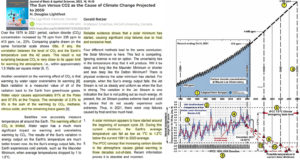
New Study: The CO2-Drives-Global-Warming ‘Concept’ Is ‘Obsolete And Incorrect’

by Lightfoot & Ratzer,  Mar 14, 2022 in NoTricksZone/JBasicApplSci


In analyzing UAH global temperature and Mauna Loa CO2 records from 1979 to 2021, climate researchers Lightfoot and Ratzer (2022) report there has been “little, if any” correlation between these two variables during this period.

They assert that between 91 and 98% of Earth’s greenhouse gas effect is from water vapor, as CO2 and other trace gases contribute less than 5% to greenhouse gas forcing.

A solar minimum has just began in the current solar cycle 25. The declining solar output is projected to eventually lead to a ~1 to 1.2°C cooling over the next 30 to 40 years. Solar minimum periods are also accompanied by crop failures due to frost and weather extremes delivering excessive heat.

The authors conclude by suggesting the popularized conceptualization of CO2 as a driver of global warming has proven to be “obsolete and incorrect”.

New Study: The CO2-Drives-Global-Warming ‘Concept’ Is ‘Obsolete And Incorrect’

by K. Richard, Mar 14, 2022 in NoTricksZone


“The IPCC concept that increasing carbon dioxide in the atmosphere causes global warming is three decades out-of-date.”  − Lightfoot and Ratzer (2022), Journal of Basic & Applied Sciences

In analyzing UAH global temperature and Mauna Loa CO2 records from 1979 to 2021, climate researchers Lightfoot and Ratzer (2022) report there has been “little, if any” correlation between these two variables during this period.

They assert that between 91 and 98% of Earth’s greenhouse gas effect is from water vapor, as CO2 and other trace gases contribute less than 5% to greenhouse gas forcing.

A solar minimum has just began in the current solar cycle 25. The declining solar output is projected to eventually lead to a ~1 to 1.2°C cooling over the next 30 to 40 years. Solar minimum periods are also accompanied by crop failures due to frost and weather extremes delivering excessive heat.

The authors conclude by suggesting the popularized conceptualization of CO2 as a driver of global warming has proven to be “obsolete and incorrect”.

Image Source: Lightfoot and Ratzer, 2022

Pielke Jr. on IPCC AR6 WG2 Release

by Pielke Jr., Feb28, 2022 in WUWT


An initial thread on the IPCC AR6 WG2 report released today

Whereas WG1 received a mixed review in my areas of expertise (specifically: poor on scenarios, solid on extremes), my initial reaction to the WG2 report is that it is an exceedingly poor assessment

The first observation is that the report is more heavily weighted to implausible scenarios than any previous IPCC assessment report

In particular, RCP8.5 represents ~57% of scenario mentions

This alone accounts for the apocalyptic tone and conclusions throughout the report.

IPCC WGII AR6, More Insanity: Small Islands

by K. Hansen, March 1, 2022 in WUWT


A Shocking Lack of Evidence for Shocking Claims

The IPCC has rushed out a new portion of the IPCC WGII Sixth Assessment Report: Climate Change 2022: Impacts, Adaptation and Vulnerability.  The report itself and all of its summaries and chapters are available from the IPCC web site.  I say rushed out because when I downloaded Chapter 15: Small Islandsat 5:00 pm EST on February 28th, the copy I received was still marked “Accepted Version Subject to Final Edits” and “Do Not Cite, Quote or Distribute”.

They are quite right to mark it “Do Not Cite, Quote or Distribute”  —  I would have suggested expanding that to “Do Not Cite, Quote, Distribute, or Read”.   But, that would be a personal opinion.  I am afraid I failed to follow my own best advice and have made the mistake of reading Chapter 15:  Small Islands.  So, having failed to “not read” I will follow up by failing to not cite, quote or distribute potions in this Opinion essay.

The IPCC CO2 Climate Narrative: A “Behemoth On Clay Feet” …Ready To Collapse

by P. Gosselin, Fab, 6, 2022 in NoTricksZone


The earth’s history provides the solid proof that acquits CO2. The IPCC’s claim of CO2 being the dominant climate factor is a behemoth on clay feet. 

By Fred F. Mueller

Have you ever had an uneasy feeling when watching the aggressive, intolerant stance of the apologists of “man-made climate catastrophe” against all critics?

The overwhelming majority of our elites blame CO2 emitted by mankind to be responsible for “a runaway overheating” of our atmosphere. “The science” spearheaded by the Intergovernmental Panel on Climate Change (IPCC) calls for us to renounce fossil fuels and return to the frugal lifestyle of the 18th or 19th century.

You might well find you’re not alone with that unease, which is proliferating rapidly since social media giants have started to censor people daring to question the IPCC’s “science is settled” attitude.