Archives de catégorie : better to know…?

Willie Soon on the Tom Nelson Podcast

by C. Rotter, Oct 20, 2022 in WUWT


This CO2 stuff is…pure delusion. You cannot find any signature of that.

Dr. Soon was an astrophysicist at the Solar, Stellar and Planetary Sciences Division of the Harvard-Smithsonian Center for Astrophysics, from 1991-2022. He served as receiving editor for New Astronomy from 2002-2016, astronomer at the Mount Wilson Observatory from 1992-2009. He is also on the editorial board of Geoscience, an MDPI publication since 2020 as well as serving as Review Editor of Frontiers in Earth Science starting 2022. Dr. Soon has also held the role of visiting professors at various institutions including University of Putra, Malaysia, Institute of Earth Environment of Xian, China and State Key Laboratory of Marine Environmental Science at Xiamen University. Since September 2021, Dr. Soon is also affiliated with Hungary’s Institute of Earth Physics and Space Science.
Dr. Soon earned bachelor’s and master’s degrees in science and a Ph.D. in aerospace engineering from the University of Southern California.

“The whole point of science is to question accepted dogmas. For that reason, I respect Willie Soon as a good scientist and a courageous citizen.’’ — Freeman Dyson in the Boston Globe, November 5, 2013

About Willie Soon: https://www.ceres-science.com/willie-soon
103 of his peer-reviewed papers: https://lweb.cfa.harvard.edu/~wsoon/
“How much has the Sun influenced Northern Hemisphere temperature trends? An ongoing debate”: https://iopscience.iop.org/article/10.1088/1674-4527/21/6/131
CERES news: https://www.ceres-science.com/news
Please help support independent science by donating to CERES-science.com:
https://www.ceres-science.com/support-us
——
Tom Nelson’s Twitter: https://twitter.com/tan123
Substack: https://tomn.substack.com/
About Tom: https://tomnelson.blogspot.com/2022/03/about-me-tom-nelson.html
Notes for climate skeptics:
https://tomnelson.blogspot.com/2019/06/useful-notes-for-climate-skeptics.html

Everything you need to know about COP

by Global Witness, Oct 11, 2022 in Blog


COP stands for ‘Conference of the Parties’, which is a generic phrase in International Relations-speak meaning a committee created after an international treaty is signed, tasked with making decisions about how that treaty is implemented.

There are all kinds of COPs for various international agreements, from chemical weapons to combating desertification. But the term COP has come to be associated with the meetings of one particular committee: that created after the signing of the United Nations Framework Convention on Climate Change (UNFCCC).


154 countries signed the UNFCCC in June 1992, agreeing to combat harmful human impacts on the climate. Since then, COP meetings have been held (almost) annually to discuss how exactly that should be achieved, and monitor what progress has been made. Each COP is usually referred to by its number in the series, e.g. COP26 was the 26th COP meeting.

Each year a different country becomes the COP president, in charge of organising and running that year’s meeting. Usually this means that the host city moves each year, too. Any new agreements which are made at COP tend to be named after the host city, e.g. the 2015 Paris Agreement or the 2021 Glasgow Climate Pact.

Who is involved in COP?


Greta Thunberg Fractures German Greens With Her Call To Continue Operation Of Hated Nuclear Power Plants

by P. Gosselin, Oct 16, 2022 in NoTricksZone


German talk show host Sandra Maischberger interviewed climate activist Greta Thunberg in her native Sweden. The interview aired on Wednesday.

Many climate policy critics see Greta Thunberg (19) as a puppet of interest groups who can’t possibly have any motivation of her own due to her young age and lack of education. It is noticeable, however, that she occasionally makes recommendations that can generate downright hatred, especially in Germany, among Green and Fridays for Future circles.

In 2019, Greta already classified nuclear power as a “small part of a big new carbon-free energy solution” – even citing publications from the Intergovernmental Panel on Climate Change.

She was harshly criticized for this and avoided the topic for three years. Since the Greens began in the mid-1970s as scattered citizens’ initiatives against nuclear power plants – which only later also turned to various aspects of nature conservation – energy generation from nuclear fission has become considered as a high-risk technology, and not only in left-wing educated bourgeois circles.

The fact that the civilian use of nuclear power has resulted in far fewer deaths and injuries than, for example, modern traffic or conventional power generation, is often overlooked or deliberately not communicated. The factual situation therefore no longer plays a role here, but only its political usability.

Nevertheless, Thunberg has ventured forth once again with the topic of nuclear power – albeit cautiously – and compares it to coal power, which is also maligned. In words: “If they [the German nuclear plants] are already running, I think it would be a mistake to shut them down and turn to coal.”

In FfF circles, this can already be called courageous because Greta’s popularity is especially large in the rich and populous German-speaking countries where a green-loaded media landscape made Thunberg’s idol figure possible in the first place. Next to Stockholm, Berlin is her main field of activity and here she is always received effusively and with much attention.

From the point of view of the inclined EIKE reader, the above quote is of course at best  pragmatic over the short-term, yet it does not show an attitude favorable to a sustainable economic and social welfare development. However, since Brussels redefined nuclear power as a “green” technology months ago, it can be assumed that increasingly parts of the FfF movement are also losing interest in the German government’s misguided energy policy. Perhaps in the near future Greta will already recommend the inherently safe new breeder and DFR reactor types, which already theoretically can no longer be called risky.

The fact that Greta got anointed as an expert without any objective reason is now being questioned from the point of view of nuclear power despisers.

Some in Berlin are trying to denigrate her view. The taz points to approval of Greta’s remark by the CDU conservatives and the FDP free democrats. In addition, lobbyists such as the brother of Eckart von Hirschhausen or Armin Simon are quoted:

“Greta Thunberg is mistaken when she implies that nuclear power plants could help in dealing with the current gas crisis.” (Simon)

“Nuclear power cannot be an instrument of climate policy”, (Hirschhausen, Scientists for Future).

Completely wrong – the more nuclear power plants are on the grid, the more electricity there is, and the cheaper the energy is, which is old familiar market logic. And if there is more electric power, less gas has to be burned to generate it, which benefits the bankruptcy-threatened metal and food industries. Hirschhausen is an economist and thus, in contrast to Greta, an expert. How can it be that the activist without a degree knows more about economics than the economics professor?

LITHIUM mining for electric vehicles is incredibly destructive to the environment and about as far from “green” as you can imagine

by P. Homewood, Oct 13, 2022 in NotaLotofPeopleKnowThat


There’s nothing new here, but it acts as a good reminder of just bad lithium mining is for the environment:

Electric vehicles are promoted as the solution for combating “climate change.” Governments are currently incentivizing the production of electric vehicles, while punishing the fossil fuel industry. However, lithium mining for electric vehicles is incredibly destructive to the environment, and is about as far from “green” as one could imagine. Not to mention, most of the lithium-ion batteries produced today come from China and require water-intensive mining operations that ravage natural environments throughout Australia, Argentina and Chile. The process depletes ground water, and leaves behind toxic wastewater that contaminates fields and harms wildlife. The mining process is not carbon dioxide free, either. The mining process releases 15,000 kilograms of carbon dioxide emissions for every ton of lithium that is extracted.

There are serious environmental risks to extracting lithium for the production of lithium-ion batteries

When lithium is extracted from salt mines, the miners must drill into the salt flats and pump out a salty, mineral-rich brine. The brine is placed in large pools, so the water can evaporate out. When the brine evaporates, it leaves behind a sludge of potassium, manganese, borax and lithium salts that must be filtered out further. The process pollutes nearby aquifers and lowers the water table, interfering with water sources in the local environment.

The lithium extraction process takes several months, displaces valuable water resources, and leaves behind a toxic trail of wastewater in the local environment. It takes approximately 500,000 gallons of water to produce one ton of lithium. When mining companies head into countries like Chile, they use up a majority of the region’s water, unjustly affecting small communities.

According to the Institute of Energy Research, Chile’s Salar de Atacama is one of the driest places on Earth, yet the mining companies are allowed to use up 65% of the region’s water. After the brine is removed from the salt flats, the water table automatically falls, disrupting the natural flow of water that is needed for wells and agriculture. These large-scale disruptions can always be blamed on “climate change” as the lithium mining industry plunges ahead, with no regard for the environmental damage wrought in its wake.

Water quality, wildlife populations, and crops all adversely affected by lithium mining

UN Declares: ‘We own the science’ & ‘the world should know it’ so ‘we partnered with Google’ to ensure only UN climate results appear

by Marc Morano, Oct 2, 2022 i


Climate Depot Special Report

The United Nations revealed that they “own the science” of climate change and they have manipulated Google search results to suppress any climate view that deviates from UN claims. Melissa Fleming, the Under-Secretary for Global Communications at the United Nations made the remarks at a World Economic Forum ‘Tackling Disinformation’ event on September 29, 2022 titled “Sustainable Development Impact Meetings 2022.”

Melissa Fleming:  (Full Video) “We partnered with Google. For example, if you Google ‘climate change,’ you will, at the top of your search, you will get all kinds of UN resources. We started this partnership when we were shocked to see that when we Googled ‘climate change,’ we were getting incredibly distorted information right at the top. So we’re becoming much more proactive. We own the science, and we think that the world should know it, and the platforms themselves also do. But again, it’s a huge, huge challenge that I think all sectors of society need to be very active in.” (Full transcript here)

As I wrote in my book, The Great Reset, “the public health bureaucracy and the ‘climate community’ have become political lobbying organizations, and they are using ‘The Science’ to support their preferred policies—policies that dovetail with the Great Reset and advance the power of the administrative state.”

September Arctic Sea Ice Trends

by P. Homewood, Oct 8, 2022 in NotaLotofPeopleKnowThat


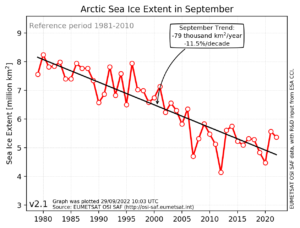
We looked at the Arctic sea ice minimum for this year a couple of weeks ago. But the average for September as a whole is much more relevant.

In fact it shows very similar results this year, with average September extent slightly below last year, but otherwise the highest since 2014, and also much greater than in 2007:

https://ocean.dmi.dk/arctic/icecover_30y.uk.php

Note the grossly misleading trend line, loved by all Arctic alarmists! Their trend cannot conceal the fact that the ice extent stopped declining in 2007.

The ice could remain stable for the next century, but DMI’s overall trend line would still show a long term decline decline.

The New Pause Lengthens to 8 Years

by C. Monckton of Brenchley,  Oct 6, 2022 in WUWT


The New Pause, having paused a month ago, has now lengthened again: this time to exactly eight years. As always, the Pause is calculated as the longest period for which the least-squares linear-regression trend up to the most recent month for which the UAH global mean surface temperature anomaly is available is zero.


The trend on the entire dataset during the 526 months from December 1978 to September 2022 is 0.95 C°, equivalent to only 1.34 C°/century. So slow a rate of warming is well within the natural variability of the climate, and is proving net-beneficial.

The New Pause has grown to fully eight years in length at a most embarrassing point for true-believers: for the cost to the West of the economically suicidal policies that they have long advocated is now becoming all too painfully apparent, just as it is also ever more evident that the warming since 1990 is well below half the midrange prediction made by IPCC that year.


Weather Disasters Wrongly Linked To Global Warming By Two International Agencies

by P. Homewood, Oct 4, 2022 in NotaLotofPeopleKnowThat


Because the data is compiled from the same EM-DAT da­tabase, the annual number of deaths shows an uptick from the 1990s to the 2000s. It is clear though that disaster-related deaths from extreme weather have been falling since the 1920s and are now approaching zero. This is due as much to improved planning, more robust structures and early warning systems, as it is to diminishing numbers of natural disasters. And, as can be seen from the figure, it is earthquakes – entirely natural events – that have been the deadliest disasters over the last two decades.

Ignoring all the evidence, however, the press release accompanying the latest WMO report proclaims that “Climate science is clear: we are heading in the wrong direction,” the UN Secretary-General adding, with characteristic hype, that the report “shows climate impacts heading into uncharted territory of destruction.”

A more detailed discussion of the erroneous claims of both CRED and the WMO can be found in my two most recent reports on weather extremes (here and here).

New Study Affirms Anthropogenic CO2 Emissions Play No Role In Larsen Ice Shelf Melt

by K. Richard, Oct 3, 2022 in NoTricksZone


There are four main reasons why Antarctica’s Larsen C Ice Shelf may be melting. None of them involve human forcing or CO2 concentration changes.

Scientists have recently completed an exhaustive 20-year study of the “most significant causes of melting” of the Larsen C Ice Shelf in the Antarctic Peninsula. They have concluded the 4 main surface melt drivers are:

1. Shortwave solar radiation.

2. Foehn wind variations.

3. Cloud cover changes.

4. Natural circulation variations (SAM, ENSO).

Neither anthropogenic forcing nor CO2 emissions are listed as causal factors in Antarctic ice melt processes.


In other words, there is nothing even remotely unusual about any Antarctic ice melt or climate trends that cannot be explained by or attributed to natural, non-anthropogenic processes.

Notable US Hurricanes In History

by P. Homewood, Oct 1, 2022 in NotaLotofPeopleKnowThat


Graphs only tell part of the story when it comes to hurricanes. They give the numbers, but don’t give much idea of the devastation they bring.

The National Hurricane Center has produced a list of some of the most notable hurricanes to hit the US:

https://www.nhc.noaa.gov/outreach/history/#camille

I won’t reprint the whole  list, but it’s worth a read.

The list certainly is not all-inclusive. There are many more which could have been added, such as the 150 mph Indianola hurricane in 1886,  and Carla in 1961, the 8th and 9th most intense hurricanes on record.

But the list gives a good impression of how catastrophic US hurricanes have always been.

The timeline I have prepared below just covers the period 1900 to 1969 and summarises just how frequent these disastrous hurricanes actually are.

India, China Emissions Make Mockery of Western Policies

by  V. Jayaraj, Sep 23, 2022 in CO2Coalition


Amidst the European energy crisis, it’s easy to miss other events that are of significance to the discussion about the climate-change movement.

Among them are a series of setbacks to green policies in China and India.

These countries — representing three billion people — have delayed implementation of renewable energy commitments and aggressively increased the production and consumption of fossil fuels.

At the Shanghai Cooperation Organization summit, Chinese and Indian leaders — along with their counterparts from Russia and Turkey — explicitly declared that they cannot be coerced into reducing fossil fuel consumption, calling for an “increased investment in oil and gas production and exploration.”

As usual, the mainstream media neither published this news in headlines nor discussed how the proliferation of fossil fuels in these countries make the so-called net zero measures in the West irrelevant to the objectives of climate alarmists.

As the world’s second biggest coal user and home to 1.3 billion people, India has deemphasized its commitment to transitioning to renewable energy.

According to reports, the country fell significantly short of its solar-installation targets, jeopardizing its overall transition goals.

India’s Economic Times reported that at least 25 gigawatts (GW) of solar power projects that were expected to be operational or nearly complete faced delays or uncertainties.

The deferrals of solar installations now make it impossible to attain the planned addition of 450 GW in renewable capacity by 2030.

The Times says India “added 10 GW of solar capacity in 2021, while it needs to add close to 30 GW every year to be able to meet the target.”

The National Solar Mission — India’s internationally renowned solar energy strategy — is in disarray, with only half its promised capacity in place.

India considers coal plants an integral part of its energy sector.

Environmentalism Is A Fundamentalist Religion Steeped In Green Dogma

by J. Kotkin, Sep 21, 2022 in ClimateChangeDispatch


Today’s climate activists resemble nothing so much as a religious movement, with carbon the new devil’s spawn.

The green movement is increasingly wedded to a kind of carbon fundamentalism that is not only not realistic but will reduce living standards in the West and around the world.

And as with other kinds of religious fundamentalism, the climate hysteria is often overwrought and obviously so; a decade ago, the same activists predicted a planetary disaster by 2020 if the U.S. and China did not reduce their emissions by 80 percent—which of course never happened. [bold, links added]

This approach is a losing one that reduces the effectiveness of the green lobby. What’s needed to combat climate change is a pragmatic approach based on adapting to real and verifiable dangers.

And this starts with environmentalists acknowledging the limits of our ability to curb emissions in the short run. This is not to cede the fight. The reality is what we do in the West means increasingly little.

Today’s biggest emitters come from China, which already emits more GHG than the U.S. and the EU combined, while the fast growth in emissions comes increasingly from developing countries like India, now the world’s third-largest emitter.

Ronald Stein on the Huge Advantages of Fossil Fuels Over Wind/Solar Power, Tom Nelson Podcast

by C. Rotter, Sep 20, 2022 in WUWT


Ronald Stein, P.E. is an engineer and Founder of PTS Advance, drawing upon decades of project management and business development experiences. He is an internationally published columnist, energy expert, and Pulitzer Prize nominated author who writes frequently about all aspects of energy and economics and is a Policy Advisor for The Heartland Institute.

More about Stein: https://www.heartland.org/about-us/wh…
Stein’s website: https://energyliteracy.net/
Twitter: https://twitter.com/PTSFounder

Tom Nelson’s Twitter: https://twitter.com/tan123
Substack: https://tomn.substack.com/
About Tom: https://tomnelson.blogspot.com/2022/0…
Notes for climate skeptics:
https://tomnelson.blogspot.com/2019/0…
ClimateGate emails:
https://tomnelson.blogspot.com/p/clim…

Press Release: Important new paper challenges IPCC’s claims about climate sensitivity

by P. Homewood, Sep 20, 2022 in NotaLotofPeopleKnowThat


London, 20 September – A new paper reduces the estimate of climate sensitivity – the amount of warming expected for a doubling of carbon dioxide concentrations – by one third. The results therefore suggest that future global warming will be much less than expected.
The paper, by independent scientist Nic Lewis, has just appeared in the journal Climate Dynamics. It is an important challenge to the official view of the Intergovernmental Panel on Climate Change (IPCC).
Lewis has critiqued a 2020 assessment of climate sensitivity by Sherwood et al., which strongly influenced the IPCC’s Sixth Assessment Report, in 2021. Lewis commented:
“It is unfortunate that Sherwood et al.’s assessment of climate sensitivity, which underpinned the UN Framework Convention on Climate Change, contained such serious errors, inconsistencies and deficiencies in its methods”.
After correcting the Sherwood et al. methods and revising key input data to reflect, primarily, more recent evidence, the central estimate for climate sensitivity comes down from 3.1°C per doubling of CO2 concentration in the original study to 2.16°C in the new paper.
This large reduction shows how sensitive climate sensitivity estimates still are to input assumptions, and that values between 1.5°C and 2°C remain quite plausible.

  • Climate sensitivity represents the long-term global temperature increase caused by a doubling of atmospheric CO2 concentration. There are different measures of climate sensitivity. Both the Sherwood and Lewis papers estimate the so-called ‘effective’ climate sensitivity, which reflects a new equilibrium state projected from centennial changes after a doubling of the CO2 concentration. This measure is considered the most relevant one for predicting climate change in the coming two centuries.
  • Climate sensitivity has always been a very important, but also highly uncertain, parameter in the climate change discourse. Earlier IPCC reports assessed its value as likely to be somewhere between 1.5°C and 4.5°C, with a best estimate of 3°C. However, prompted by the Sherwood paper, the 2021 Sixth Assessment Report moved that range upwards, to 2.5 to 4°C. Although for outsiders this might sound boring, for insiders it was a revolutionary change.
  • Lewis’s corrections and revisions lead to a likely range of 1.75 to 2.7°C, which is not only lower but is also much less uncertain than either the 2021 official IPCC assessment or the very similar Sherwood et al. estimate (2.6 to 3.9°C).
  • Nic Lewis is the lead or sole author of ten peer-reviewed papers on climate sensitivity. He was a participant in the 2015 workshop that kicked off the World Climate Research Programme project that led to the Sherwood et al. 2020 paper, but he was not a co-author of that paper.

Lewis commented:
“The substantial reduction in assessed climate sensitivity upon updating key input data suggests that the increase in the bottom of the climate sensitivity range in the IPCC Sixth Assessment Report was unjustified”.
Lewis’s paper is entitled ‘Objectively combining climate sensitivity evidence’. It can be freely downloaded here. A detailed explanatory article about the paper is available here.

Air conditioning has a climate problem. New technology could help.

by S. Osaka, Sep 12, 2022 in TheWashingtonPost


Last week, Californians got a reminder of one of the most vexing paradoxes of global warming. With temperatures well over 110 degrees Fahrenheit in some regions on Tuesday night, hundreds of thousands of the state’s residents received beeping text alerts to notify them that the power grid, straining under the weight of millions of air-conditioning units, was about to collapse. Save power now, the text warned, or face rolling blackouts.

Consumers conserved, and the state’s electricity grid made it out of a record-breaking hot day relatively unscathed. Still, as temperatures rise worldwide, more people are going to need to install air conditioners. Butas currently sold, AC units can actually make global warming worse: On hot days, they suck tons of electricity from the grid, and their chemical refrigerants can accelerate global warming.

This is why researchers and start-ups are hoping to create new, cutting-edge AC units. AC technology has seen only “incremental improvements over the past 100 years,” said Ankit Kalanki, a manager at Third Derivative, a climate tech accelerator co-founded by the energy think tank RMI. “There has not been a step change in innovation.”

Rethinking The Greenhouse Effect

by P. Homewood, Sep 16, 2022 in NotaLotofPeopleKnowThat


London, 16 September – A former head of Australia’s National Climate Centre is arguing that the Intergovernmental Panel on Climate Change (IPCC) has adopted an overly simplistic approach to global warming and has ended up exaggerating the human contribution to recent climate change.
William Kininmonth argues that the warming of the planet is fastest in winter and in high latitudes near the poles. He argues that this is mostly due to increased heat transport from the tropical oceans.
However, the recent warming of the tropical oceans can’t be explained by the greenhouse effect due to carbon dioxide, because that effect is small in the humid tropical atmosphere. The most probable explanation is natural changes in ocean currents.
William Kininmonth says:
“The IPCC’s radiation balance approach is very simplistic, ignoring the fact that nowhere on the Earth’s surface is in radiation balance. Mainstream climate science may have led us all up a blind alley”.
GWPF invited the Royal Society and the Met Office to review this paper, and to submit a response to be published as an appendix to it. No reply was received.


William Kininmonth: Rethinking the Greenhouse Effect (pdf)

Exposing The ‘97% Of Scientists Agree With Man-made Global Warming’ Lie

by D. Craig, Sep 15, 2022 in ClimateChangeDispatch


The main author of the paper who came up with the figure was John Cook, an Australian former web programmer and blogger who later gained a Ph.D. in philosophy at the University of Western Australia and founded what could be seen as a climate alarmist website.

He assembled a group of volunteers recruited via the website as part of a ‘citizen science’ project and tasked them with examining the abstracts of 11,944 climate papers from 1991-2011 matching the topics ‘global climate change’ or ‘global warming’.

Note that the volunteers didn’t speak to any scientists and didn’t read the scientific papers. They just looked at the abstracts – a summary paragraph or two.

The volunteers classified the abstracts into one of seven categories according to their opinions of Anthropogenic Global Warming (AGW):

  1. Explicit endorsement of AGW with quantification
  2. Explicit endorsement of AGW without quantification
  3. Implicit endorsement of AGW
  4. No position or Uncertain
  5. Implicit rejection of AGW
  6. Explicit rejection of AGW without quantification
  7. Explicit rejection of AGW with quantification

The reviewers then ‘simplified’ results into four main categories as follows:

Climate Scaremongers Take Note: It Was Hotter In 1976!

by P. Homewood, Sep 13, 022 in ClimateChange Dispatch


For weeks we have been told that this year’s warm summer is due to climate change.

The BBC’s Justin Rowlatt was quite clear: ‘We know what is behind this – greenhouse gas emissions caused by our burning of fossil fuels like coal and gas,’ a message amplified across the media and stoked by the Met Office, who delighted in their red warnings and public health alerts. [bold, links added]

It was not only the heat. The Met Office claimed that this summer’s drought is a harbinger of the future we could expect, ably assisted by fraudulently misleading images of ‘dried up reservoirs’ on BBC News.

As many of us suspected all along, the summer of 2022 was not a record breaker at all, as it was much hotter in 1976, as the Central England Temperature Series makes clear:

https://www.metoffice.gov.uk/hadobs/hadcet/data/meantemp_seasonal_totals.txt


Indeed it was hotter in 1826 and 2018, and this summer was no hotter than in 1995 and 2006.

A breakthrough discovery in carbon capture conversion for ethylene production

by University of Illinois Chicago, Sep 9, 2022 in ScienceDaily


A team of researchers led by Meenesh Singh at University of Illinois Chicago has discovered a way to convert 100% of carbon dioxide captured from industrial exhaust into ethylene, a key building block for plastic products.

Their findings are published in Cell Reports Physical Science.

While researchers have been exploring the possibility of converting carbon dioxide to ethylene for more than a decade, the UIC team’s approach is the first to achieve nearly 100% utilization of carbon dioxide to produce hydrocarbons. Their system uses electrolysis to transform captured carbon dioxide gas into high purity ethylene, with other carbon-based fuels and oxygen as byproducts.

The process can convert up to 6 metric tons of carbon dioxide into 1 metric ton of ethylene, recycling almost all carbon dioxide captured. Because the system runs on electricity, the use of renewable energy can make the process carbon negative.

Reasons to avoid false balance and fake debates

by W. Baerbel and J. Cook, Sep 9, 2022 in SkepticalScience


False balance media reporting

One of the most insidious, albeit often inadvertent forms of climate misinformation is false-balance media  coverage, where contrarian voices are given equal coverage with climatescientists. This stems from the journalistic norm assuming there are always two sides to an issue, thus giving mainstream and contrarian voices equal representation. As a result, a few dissenting scientists are given similar attention to the 97% of scientists who are convinced that humans are causing global warming.

debate

Analysis of media coverage from 1988 to 2002 showed that newspapers often presented false balance media coverage of climate change [18]. While the situation has improved in prestige-press coverage [19], the tabloid press has shown no signs of improvement [20]. Similarly, 70% of U.S. TV coverage of climate change presents a false balance [21]. In short, much of what people learn about climate change from the media involves well-established scientific truth presented alongside groundless assertions.

To debate or not to debate

Debate is crucially important to climate science and in the case of human-caused climate change has already occurred over decades. The process of scientific debate is open to anyone—although it does require that participants subject their ideas to the scrutiny of the peer-review process, which is fundamental for the advancement of scientific knowledge [31]. However, contrarians refuse to participate in scientific debates: they do not present their views at scientific conferences, and have a negligible presence in the peer-reviewed literature. Instead, they demand special treatment by bypassing the usual scientific process and presenting unvetted ideas to the public.

How should one respond if invited to publicly debate mainstream climate science? Requests to “debate” climate science or the timing of climate impacts are for propaganda purposes and should be avoided.  Agreeing to participate in such debates run the risk of misinforming the public by conveying the false impression that the scientific community is undecided on basic facts like human-caused global warming.

In contrast, debates over solutions to climate change are worthwhile. One response to an invitation to debate is to inform the organisers of the danger of misinforming the public by debating established science, and that a more appropriate and constructive debate topic is climate solutions. If the organisers persist in hosting a problematic debate, a further option is to issue a public statement explaining that you had advised the organisers not to go ahead due to the problematic nature of the event, but they went ahead regardless.

Meet Climate Skeptic Jacob Rees-Mogg, New UK Energy Secretary

by A. Macaskill and P. Sandle, Sep 8, 2022 in ClimateChangeDispatch


Britain appointed lawmaker Jacob Rees-Mogg, who has expressed skepticism about the need to fight ‘climate change’ as the new business secretary, raising concerns that he could delay the target of reducing net zero emissions by 2050.

Rees-Mogg, nicknamed “the honorable gentleman from the 18th century” because of his poshness and trademark double-breasted suit, was on Tuesday put in charge of the Department for Business, Energy and Industrial Strategy, which is responsible for the government’s strategy on ‘climate change’. [bold, links added]

In the past, Rees-Mogg has expressed concerns about “climate alarmism“, said humanity should adapt to, rather than mitigate, ‘climate change’, and warned that the drive to getting to net zero emissions is responsible for high energy prices.

After his appointment, Rees Mogg said his priority would be to provide help for people dealing with sharply higher energy bills and that the government will soon bring forward a package to help the public.

New Prime Minister Liz Truss has backed the legally binding target of reducing net zero ‘greenhouse gas’ emissions by the middle of this century, but has supported scrapping green levies and bringing back fracking if there is local support.

One contentious issue facing Rees-Mogg is providing a clear and settled policy environment for business after successive Conservative governments have produced energy and industrial strategies that were abandoned just a few years later.

Greenpeace Cofounder Says Climate Change Based On False Narratives

by L. Yun-Jeong, Sep 9,  2022 in ClimateChangeDispatch


Patrick Moore [pictured], one of the founders of Greenpeace, said in an email obtained by The Epoch Times that his reasons for leaving Greenpeace were very clear: “Greenpeace was ‘hijacked’ by the political left when they realized there was money and power in the environmental movement.

[Left-leaning] political activists in North America and Europe changed Greenpeace from a science-based organization to a political fundraising organization,” Moore said. [bold, links added]

Moore left Greenpeace in 1986, 15 years after he co-founded the organization.

“The ‘environmental’ movement has become more of a political movement than an environmental movement,” he said. “They are primarily focused on creating narratives, stories, that are designed to instill fear and guilt into the public so the public will send them money.

He said they mainly operate behind closed doors with other political operatives at the U.N., World Economic Forum, and so on, all of which are primarily political in nature.

The Intergovernmental Panel on Climate Change [IPCC] is “not a science organization,” he said. “It is a political organization composed of the World Meteorological Organization and the United Nations Environment Program.”

“The IPCC hires ‘scientists’ to provide them with ‘information’ that supports the ‘climate emergency’ narrative.”

Their campaigns against fossil fuels, nuclear energy, CO2, plastic, etc., are misguided and designed to make people think the world will come to an end unless we cripple our civilization and destroy our economy. They are now a negative influence on the future of both the environment and human civilization.”

“Today, the left has adopted many policies that would be very destructive to civilization as they are not technically achievable. Only look at the looming energy crisis in Europe and the UK, which Putin is taking advantage of. But it is of their own making in refusing to develop their own natural gas resources, opposing nuclear energy, and adopting an impossible position on fossil fuels in general,” Moore wrote.

The Left ‘Hijacked’ Greenpeace

When German Environmentalists and Putin’s Government Had a Burning Love Affair

by D. Godefridi, Sept 8, 2022 in GatestoneInstitue


  • In 2011, the German Baltic Sea Nature Conservation Foundation was established as a result of an agreement between three of Germany’s leading environmental organizations – WWF, BUND and NABU – and the company Nord Stream, which is a subsidiary of the government of Vladimir Putin.
  • These environmental organizations were, moreover, at the same time fiercely opposed to German civil nuclear power, to the exploitation of shale gas in Europe and to the import of American gas via the construction of liquefied petroleum gas terminals in Germany.
  • Those were three issues where the views of the environmental organizations were totally congruent with those of the Russian Federation. This meant betting everything on “red” — as in a casino — but in this instance, on Russian gas.
  • Right after these contractual commitments by Nord Stream AG, the environmental organizations withdrew the lawsuit they had initiated against Nord Stream…
  • The German press reported last month that, inspired by the success of the first foundation, the same State of Mecklenberg-Western Pomerania was setting up a new foundation as recently as January 2021, the Mecklenberg-Western Pomerania Foundation for Climate and Environmental Protection, this time endowed with 192 million euros from the Russian government.
Those were… issues where the views of the environmental organizations were totally congruent with those of the Russian Federation. This meant betting everything on ‘red’ — as in a casino – but in this instance, on Russian gas. Pictured: The corporate headquarters of Gazprom Germania, the German unit of Russian natural gas company Gazprom, photographed on March 30, 2022 in Berlin, Germany. (Photo by Sean Gallup/Getty Images)

La géologie, une science plus que passionnante … et diverse