Tous les articles par Alain Préat

Full-time professor at the Free University of Brussels, Belgium apreat@gmail.com apreat@ulb.ac.be • Department of Earth Sciences and Environment Res. Grp. - Biogeochemistry & Modeling of the Earth System Sedimentology & Basin Analysis • Alumnus, Collège des Alumni, Académie Royale de Sciences, des Lettres et des Beaux Arts de Belgique (mars 2013). http://www.academieroyale.be/cgi?usr=2a8crwkksq&lg=fr&pag=858&rec=0&frm=0&par=aybabtu&id=4471&flux=8365323 • Prof. Invited, Université de Mons-Hainaut (2010-present-day) • Prof. Coordinator and invited to the Royal Academy of Sciences of Belgium (Belgian College) (2009- present day) • Prof. partim to the DEA (third cycle) led by the University of Lille (9 universities from 1999 to 2004) - Prof. partim at the University of Paris-Sud/Orsay, European-Socrates Agreement (1995-1998) • Prof. partim at the University of Louvain, Convention ULB-UCL (1993-2000) • Since 2015 : Member of Comité éditorial de la Revue Géologie de la France http://geolfrance.brgm.fr • Since 2014 : Regular author of texts for ‘la Revue Science et Pseudosciences’ http://www.pseudo-sciences.org/ • Many field works (several weeks to 2 months) (Meso- and Paleozoic carbonates, Paleo- to Neoproterozoic carbonates) in Europe, USA (Nevada), Papouasia (Holocene), North Africa (Algeria, Morrocco, Tunisia), West Africa (Gabon, DRC, Congo-Brazzaville, South Africa, Angola), Iraq... Recently : field works (3 to 5 weeks) Congo- Brazzaville 2012, 2015, 2016 (carbonate Neoproterozoic). Degree in geological sciences at the Free University of Brussels (ULB) in 1974, I went to Algeria for two years teaching mining geology at the University of Constantine. Back in Belgium I worked for two years as an expert for the EEC (European Commission), first on the prospecting of Pb and Zn in carbonate environments, then the uranium exploration in Belgium. Then Assistant at ULB, Department of Geology I got the degree of Doctor of Sciences (Geology) in 1985. My thesis, devoted to the study of the Devonian carbonate sedimentology of northern France and southern Belgium, comprised a significant portion of field work whose interpretation and synthesis conducted to the establishment of model of carbonate platforms and ramps with reefal constructions. I then worked for Petrofina SA and shared a little more than two years in Angola as Director of the Research Laboratory of this oil company. The lab included 22 people (micropaleontology, sedimentology, petrophysics). My main activity was to interpret facies reservoirs from drillings in the Cretaceous, sometimes in the Tertiary. I carried out many studies for oil companies operating in this country. I returned to the ULB in 1988 as First Assistant and was appointed Professor in 1990. I carried out various missions for mining companies in Belgium and oil companies abroad and continued research, particularly through projects of the Scientific Research National Funds (FNRS). My research still concerns sedimentology, geochemistry and diagenesis of carbonate rocks which leads me to travel many countries in Europe or outside Europe, North Africa, Papua New Guinea and the USA, to conduct field missions. Since the late 90's, I expanded my field of research in addressing the problem of mass extinctions of organisms from the Upper Devonian series across Euramerica (from North America to Poland) and I also specialized in microbiological and geochemical analyses of ancient carbonate series developing a sustained collaboration with biologists of my university. We are at the origin of a paleoecological model based on the presence of iron-bacterial microfossils, which led me to travel many countries in Europe and North Africa. This model accounts for the red pigmentation of many marble and ornamental stones used in the world. This research also has implications on the emergence of Life from the earliest stages of formation of Earth, as well as in the field of exobiology or extraterrestrial life ... More recently I invested in the study from the Precambrian series of Gabon and Congo. These works with colleagues from BRGM (Orléans) are as much about the academic side (consequences of the appearance of oxygen in the Paleoproterozoic and study of Neoproterozoic glaciations) that the potential applications in reservoir rocks and source rocks of oil (in collaboration with oil companies). Finally I recently established a close collaboration with the Royal Institute of Natural Sciences of Belgium to study the susceptibility magnetic signal from various European Paleozoic series. All these works allowed me to gain a thorough understanding of carbonate rocks (petrology, micropaleontology, geobiology, geochemistry, sequence stratigraphy, diagenesis) as well in Precambrian (2.2 Ga and 0.6 Ga), Paleozoic (from Silurian to Carboniferous) and Mesozoic (Jurassic and Cretaceous) rocks. Recently (2010) I have established a collaboration with Iraqi Kurdistan as part of a government program to boost scientific research in this country. My research led me to publish about 180 papers in international and national journals and presented more than 170 conference papers. I am a holder of eight courses at the ULB (5 mandatory and 3 optional), excursions and field stages, I taught at the third cycle in several French universities and led or co-managed a score of 20 Doctoral (PhD) and Post-doctoral theses and has been the promotor of more than 50 Masters theses.

Michael Mann’s Social Media Rants Turn Anger Into Alienation

by R. Bradley Jr.,  Aug 23, 2025 in ClimateChangeDispatch 


Michael “ClimateGate” Mann cannot get out of his own way.

His arrogant, condescending social tweets speak for themselves—just as the words, sentences, and paragraphs of the East Anglia emails did. [some emphasis, links added]

“And yes, there is empirical, peer-reviewed support for the conclusion that climate deniers, in general, are truly awful human beings.” (–Michael Mann, via X)

He is not the kind of person you would want in just about any endeavor, much less as a climate scientist trying to present a case.

This post traces Mann’s angst on X and then at BlueSky, his successor to X:

Final Comment

This is enough to keep a psychologist busy. Mann stepped into his own manhole, and he kept digging down.

Like Al Gore, he hurts his cause more than he helps it, as 97 percent of his colleagues (just an estimate) are more rational and quieter than he is on the same subject.

Another Study Affirms Anthropogenic CO2 Does Not Drive Climate Change

by K. Richard, Aug 22, 2025 in NoTricksZone 


Utilizing AI’s evidence-streamlining capabilities, a new study (with “Grok” literally positioned as the lead author) summarizes a few of the key counterpoints undermining the CO2-drives-climate narrative.

For example, consider that humans contribute just 10 GtC per year to the carbon cycle, whereas nature’s sources (ocean outgassing and soil respiration, primarily) contribute 220 GtC annually. The combined total (230 GtC/year) does not distinguish between sources, and thus natural sinks that remove carbon from the atmosphere proportionately absorb human as well as natural emissions, with the human percentage (4%) insignificant and the natural predominant (96%).

But even if the last century of rising CO2 was 100% anthropogenic, the empirical data indicate the residence time for atmospheric CO2 is just 3-7 years. This necessarily precludes the possibility for anthropogenic CO2 in particular to be the driver of presumed radiation imbalances, or radiative forcing. This is because the tiny anthropogenic component is too quickly removed from the cycle to have more than a negligible impact. Nearly 90% of CO2 derived from human emissions sources since 1750 has already been removed, absolving humans of the alleged responsibility for (allegedly CO2-induced) climate change.

The atmospheric CO2 residence time would need to last centuries for the presumed effects of anthropogenic CO2 to have the dominant impact the UN’s Intergovernmental Panel on Climate Change (IPCC) claims it has. So what has the IPCC decided to do? Of course, the IPCC (and those hoping to blame humans for climate change) rely on modeled assumptions that the atmospheric CO2 residence time is, yes, over 100 years. There is no empirical basis validating these assumptions. To put it crudely, the IPCC’s 100-year CO2 residence time model is made up. Fake.

The study also addresses the causality problem that the CO2-drives-temperature narrative has, as there are many studies affirming CO2 changes follow, rather than lead, temperature changes. This T→CO2 directionality is not only observed in the short-term (months), but in paleoclimate studies (an 800-year CO2 lag) as well.

In sum, there is ample evidence available to support the conclusion anthropogenic CO2 does not drive climate change.

Chart: What Powered the World in 2024?

by D. Neufeld, Aug 22, 2025 in VisualCapitalist


The Global Energy Mix in 2024

This was originally posted on our Voronoi app. Download the app for free on iOS or Android and discover incredible data-driven charts from a variety of trusted sources.


Key Takeaways

  • Global energy demand increased 2% to reach an all-time high of 592 exajoules (EJ) in 2024.
  • Non-fossil fuels grew 7% year-over-year, bringing their share of the global energy mix to 13.5%.

Global energy use rose to 592 EJ in 2024, marking a new record in demand.

While cleaner technologies continue to expand, traditional energy sources still form the backbone of the global energy system. At the same time, the Asia Pacific region drove 68% of demand growth, reflecting the region’s rapid economic momentum and industrialization.

This chart shows the global energy mix in 2024, based on data from the Energy Institute.

Fossil Fuels Underpin the Global Energy Mix

Last year, oil, coal, and natural gas together supplied 86.7% of global energy needs.

Oil remained the dominant energy source, accounting for 199 EJ, or 33.6% of global supply. In 2024, average oil prices declined by 3%, though they were still 27% higher than in 2019. The U.S. held its position as the world’s largest producer, contributing roughly one-fifth of total output.

Coal followed at 27.9%, supported by increased consumption in emerging economies. Natural gas, though cleaner than coal, supplied 25.2%, rounding out the fossil fuel trio.

Energy Source 2024 Total Energy Supply (EJ) Share
Oil 199 33.6%
Coal 165 27.9%
Natural gas 149 25.2%
Nuclear energy 31 5.2%
Hydroelectricity 16 2.7%
Other renewables 33 5.6%
Total 592

It’s also worth noting that low-carbon energy sources are growing at a meaningful pace.

In 2024, their combined share rose to 13.5%, supported by a 7% annual increase. Wind and solar stood out in particular, growing by 16% to remain the fastest-rising energy sources worldwide.

Moreover, nuclear energy accounted for 5.2% of supply, with France and Japan responsible for nearly two-thirds of its growth as long-idled plants were brought back online.

Trump DOE Gives Coal Plant Lifeline Despite Seething Enviro Rage

by A. Streb, Aug 22, 2025 in ClimateChangeDispatch 


Activists warn the move will raise costs and pollute while officials cite grid reliability and energy security.

Campbell coal plant
The Department of Energy (DOE) on Thursday issued an emergency order that will keep a Michigan coal plant [pictured above] running to reduce the risk of blackouts while summer heat strains the power grid and despite environmental protests fighting to shutter the plant. [emphasis, links added]

DOE’s order directs the major grid operator for the central U.S. — the Midcontinent Independent System Operator (MISO) — to continue running a coal-fired plant in Michigan to stave off power shortages, which has sparked ire from some environmental activists who claim the plant will pollute the area.

The order follows a similar May emergency directive to keep the same Michigan J.H. Campbell plant running, which was soon followed by a major blackout in New Orleans, an event that DOE Secretary Chris Wright hailed as proof of why the Trump administration prioritizes energy abundance.

“The United States continues to face an energy emergency, with some regions experiencing more capacity constraints than others. With electricity demand increasing, we must put an end to the dangerous energy-subtraction policies embraced by politicians for too long,” Wright said Thursday.

“This order will help ensure millions of Americans can continue to access affordable, reliable, and secure baseload power regardless of whether the wind is blowing or the sun is shining.”

DOE noted that the May order to keep the coal plant open has allowed it to function as a critical power generator on the grid during periods of high energy demand.

The J.H. Campbell plant was set to close on May 31, a full 15 years before reaching the end of its design life, the agency said.

Dramatic slowdown in melting of Arctic sea ice surprises scientists

by D. Carrington, Aug 20, 2025 in TheGuardian


The surprising reason timber plantations explode into megafires

by University of Utah, Aug 21, 2025 in ScienceDaily


The odds of high-severity wildfire are nearly one-and-a-half times higher on industrial private land than in publicly owned forests. Reducing tree density mitigates megafire risk, even in extreme weather conditions.

The odds of high-severity wildfire were nearly one-and-a-half times higher on industrial private land than on publicly owned forests, a new study found. Forests managed by timber companies were more likely to exhibit the conditions that megafires love — dense stands of regularly spaced trees with continuous vegetation connecting the understory to the canopy.

Are surface temperature records reliable?

by Sue Bin Park, Aug 22, 2025 in SkepticalScience


Surface temperature records are consistent and have been confirmed by multiple independent analyses.

Measurements come from over 30,000 stations worldwide, with around 7,000 having long, continuous monthly records. Scientists adjust for known local anomalies such as urban heat islands by comparing urban and rural trends and accounting for differences.

Allegations in 2009 that poorly located U.S. stations skewed data were tested by NOAA, which found those sites actually read slightly cooler on average.

The independent Berkeley Earth Surface Temperature (BEST) study, led by a former climate skeptic, merged global datasets and concluded that the warming trend is unaffected by stations’ local conditions and nearly identical to NASA and NOAA records.

Temperature measurements are corroborated by satellites, ocean data, melting ice, and shifting ecosystems, all showing the same warming trend. No credible analysis has found that site issues or adjustments undermine the global record.

Go to full rebuttal on Skeptical Science or to the fact brief on Gigafact


This fact brief is responsive to quotes such as this one.


Sources

Skeptical Science Understanding adjustments to temperature data

NASA GISS Surface Temperature Analysis (v4)

Geoscience Data Journal The international surface temperature initiative global land surface databank: monthly temperature data release description and methods

Skeptical Science Berkeley Earth Surface Temperature Study: “The effect of urban heatingon the global trends is nearly negligible”

NOAA On the reliability of the U.S. surface temperature record

Carbon Brief Explainer: How data adjustments affect global temperature records

New Study: Corals Thrived In Warmer-Than-Today Temps And When Sea Levels Were Meters Higher

by K. Richard, Aug 19, 2025 in NoTricksZone 


hen the ocean was warmer than today, coral reef growth was rapid, averaging ~6 mm per year.

Sea levels rose rapidly from the Early to Mid Holocene in this region, as they were up to 2 m higher than today 6000 years ago. The higher sea levels meant there was more room for coral reef growth.

As the ocean cooled and sea levels fell ~2 meters from the Mid-Holocene highstand, coral growth slowed to ~2-3 mm per year.

Today corals are only growing at rates of ~1 mm per year, as the water depths are too low to accommodate reef expansion. In fact, coral coverage “has declined on the flats over the last few decades,” as the “accommodation space is less than a meter at points.”

Research from the Great Barrier Reef region (e.g., Leonard et al., 2020) also indicates coral growth experienced “turn-off” periods during cold centuries (such as the Little Ice Age) with falling sea levels. When the ocean was “~1-2°C warmer than present” and sea levels were “~1.0 m higher than present,” this “allowed reefs to accrete uninhibited.”

UN: Renewables are So Cheap They Need Lots of Subsidies

by E. Worrall, Aug 21, 2025 in WUWT


Inflexion Point: Renewable Energy Is Cheaper Than Fossil Fuels

PRABIR PURKAYASTHA

The tipping point between renewable energy and fossil fuels has been reached, says a new United Nations (UN) report. The UN Secretary-General Antônio Guterres said that we are entering a renewable era and leaving the era of fossil fuels. According to the report, ‘In 2024, renewables made up 92.5% of all new electricity capacity additions and 74% of electricity generation growth’. While almost the entire world has increasingly switched to renewables, the United States stands out as the sole ‘dissident’, with the Trump administration denying climate change and still backing fossil fuels.

The long-talked-about renewable transition is finally here! The question is, do we have the political will to do what is not only necessary in climate terms but also economically a better option for all of us? Or will the old fossil lobby, particularly in the US, sabotage humanity’s transition to a low-carbon future?

Not surprisingly, an analysis—Li, M., Trencher, G., & Asuka, J., Feb 16, 2022, PLOS ONE —of their business activities shows, ‘a continuing business model dependence on fossil fuels…We thus conclude that the transition to clean energy business models is not occurring, since the magnitude of investments and actions does not match discourse’. In other words, oil companies are continuing with their business as usual under the cloak of carbon capture, grey hydrogen, etc., along with a lot of hot air. Incidentally, these four companies alone are responsible for 10% of all global warming in the world since 1965.

The only country acting as the spoiler is the United States, which, though it is no longer competitive in manufacturing, believes that it can extract ‘rent’ from others. This is the new G1’s ‘Trump-based world order’, instead of the G7’s so-called ‘rule-based world order’.

Read more: https://www.counterpunch.org/2025/08/20/inflexion-point-renewable-energy-is-cheaper-than-fossil-fuels/

What about that cited UN report?

The New York Times Publishes False Energy and Climate Information and Refuses to Correct Its Errors

by H. Greuenspecht, Aug 22, 2025 in WUWT


les addressing energy and climate topics in The New York Times (NYT) increasingly include Inaccurate data and false information. The problem is compounded by the paper’s failure to follow its own corrections policy when errors are called to its attention.

Readers look to the NYT to deliver well-reasoned and fact-checked information and analysis in areas where they are not themselves experts. However, based on my professional focus on data and analysis of energy and related environmental issues over the past 45 years, which includes White House and Department of Energy senior positions in the Carter, Bush 41, Clinton, Bush 43, Obama, and Trump 45 administrations as well as work at leading universities and think tanks, NYT coverage of these subjects too often fails to live up to its own standards for accuracy and journalistic integrity.

As a lifetime reader of the NYT, the frequency of errors and a refusal to fix them raises doubts regarding the accuracy of information presented on other topics. Whether or not the problem extends beyond energy and climate, the NYT readership clearly deserves better.

Three recent NYT articles illustrate the problem: a July 22 article by Max Bearak, ostensibly reporting on remarks by UN Secretary-General Guterres’ on renewable energy; a May 26 article by Ivan Penn on competition between electric vehicles (EVs) and vehicles powered by internal combustion engine (ICEVs); and an April 23 column by David Wallace-Wells on the loss of cultural and political momentum for action to reduce greenhouse gas emissions. These are considered in turn below, followed by some summary conclusions.

  1. Max Bearak’s July 22 2025 article “U.S. Is Missing the Century’s ‘Greatest Economic Opportunity,’ U.N. Chief Says” (July 23 print edition).

Charted: Global Crude Oil Trade Flows in 2024

by D. Neufeld, Aug 20, 2025 in VisualCapitalist


Global Crude Oil Trade Flows in 2024

This was originally posted on our Voronoi app. Download the app for free on iOS or Android and discover incredible data-driven charts from a variety of trusted sources.

Key Takeaways

  • China imported 11.1 million barrels of crude oil per day in 2024, with Russia standing as its largest supplier of oil.
  • Meanwhile, the U.S. imported 6.6 million barrels per day (mb/d), with Canada accounting for 62% of the total.

In 2024, global oil trade patterns continued to evolve, shaped by geopolitics and changing regional demand.

From Asia to the Middle East and the Americas, oil remains a cornerstone of the global economy. The vast scale of daily trade underscores not only the world’s reliance on energy but also intricate, global alliances.

This infographic shows the largest crude oil importers and exporters by daily volume, based on data from the Energy Institute.

China Leads in Global Oil Imports

Below, we show daily oil import and export volumes for major global players:

“Wake-Up Call” For Europe… German Professor, Fritz Vahrenholt, On U.S. Climate Report

by F. Vahrenholt, Aug 20, 2025 in NoTricksZone


A recent report from the U.S. Department of Energy, commissioned by the Trump administration and authored by five scientists, is making waves.

German energy expert Prof. Fritz Vahrenholt has weighed in, suggesting its findings could be a crucial “wake-up call” for Europe, especially Germany, to rethink its current climate policies.

The report, titled “A Critical Review on Impacts of Greenhouse Gas Emissions on the US Climate” challenges a core assumption of mainstream climate science. It argues that the negative impacts of CO2 have been exaggerated, while its benefits are often overlooked.

According to Vahrenholt, the report highlights that CO2 isn’t just a pollutant; it’s essential for life and photosynthesis. It’s a key ingredient for a “greener earth” and has contributed to a reported 15% increase in global crop yields for staples like rice and wheat. This perspective directly contradicts the idea of CO2 as solely a harmful substance.

Another major point raised by Vahrenholt is the report’s finding that climate models “run too hot.”

The report suggests these models primarily focus on CO2 as the sole driver of warming, neglecting other significant natural factors. Vahrenholt points to measurements that show a substantial portion of recent warming can be attributed to cloud thinning and increased solar radiation, a topic he and Nobel laureate John Clauser have researched.

The Battery Storage Delusion.. what 35 million tons of industrial effort buys you

by Dr L. Schernikau, Aug 21, 2025 in WUWT


Details inc Blog at www.unpopular-truth.com

As someone who has spent most my professional life in the global energy and commodities space both as an economist and as a trader, I have grown increasingly concerned about the way grid-scale battery storage is portrayed in public discourse. If you have paid any attention to the headlines, you would have heard that battery technology is “on the verge of solving” the intermittency problem of wind and solar energy. According to this narrative, all we need to do is build more battery storage, and the path to “net zero” will unfold automatically… magically.

If only it were that simple…

In my latest blog post Pros and Cons of Utility-Scale Battery Storage I unpack the many assumptions behind this belief. The facts I present may be unpopular, but they are grounded in physics, not politics.

Here a couple of key points that I feel might spark some interest.

35 million tons of raw materials for a couple of hours…

To build a 50 GWh utility-scale lithium-ion battery system (approx. annual output of a Gigafactory), which has the ability to store electricity, for a city like New York, for only a few hours, you need ~ 35 million tons of raw materials (~ 700,000 t per GWh). That roughly covers the mining, upgrading, transport, and processing of ores like lithium, cobalt, nickel, graphite, iron ore, bauxite, and others.

Think about it like this…a 1-ton utility-scale battery has a storage capacity of around 100 kWh and requires ~ 70 tons of mined, processed, and manufactured raw materials to be manufactured. This is the energy equivalent of about ~40 kg of coal or ~20 litres of oil.

Let that sink in: 70 tons of mining and industrial processing to store what coal already provides in a (40kg) bag, small enough to be carried by hand.

Media Championed Study Overstating Climate Damages, Went Radio Silent As Major Flaws Emerged

by K. Killough, Aug 20, 2025 in ClimateChangeDispatch


Typhoon flooding aftermath
When a study published last year in the peer-reviewed journal Nature found that climate change would cost the globe $38 trillion per year by 2050 — ultimately reducing GDP by 19% over the next 24 years — many media outlets were quick to jump on it. [emphasis, links added]

“Climate change will make you poorer,” CNN warned. The Guardian reported on the study under the headline, “Climate crisis: average world incomes to diminish by nearly a fifth by 2050.”

Reuters and Forbes also carried articles on the study, and the Associated Press reported that “New study calculates climate change’s economic bite will hit about $38 trillion a year by 2049.”

According to the activist publication Carbon Brief, only one other study received more mentions in the media in 2024.

However, the study — referred to as “the Potsdam study” — has since been found to have serious flaws.

When these are corrected, according to the researchers who uncovered the problems, it reduces the study’s estimate of climate “damages” through 2100 by two-thirds. This means the estimates aren’t statistically different from zero.

The study has been cited by organizations influencing policy across the globe, including the World Bank, the Organization for Economic Co-operation and Development, and the U.S. Congressional Budget Office. Sen. Sheldon Whitehouse, D-R.I., cited the study last yearand again in July — both times entering the study into the Congressional Record.

While The Washington Post reported on the errors, none of the other outlets have so far revisited the story.

Flaws called “devastating” to the paper’s conclusions


The DOE climate report: a scientific milestone that Europe does not want to see

by Clintel Foundation, Aug 13, 2025


In July, the U.S. Department of Energy (DOE) published a groundbreaking document: A Critical Review of Impacts of Greenhouse Gas Emissions on the U.S. Climate. At the request of Energy Secretary Chris Wright, five leading scientists provided a clear and well-founded overview of climate science, finally paying explicit attention to uncertainties, alternative insights, and factual observations. The authors are not bloggers or activists, but internationally recognized researchers with decades of expertise in climate science, meteorology, economics, and physics. [See the box at the bottom of this article for their credentials].

Sober, well-founded, and without alarmism

Energy Secretary Chris Wright gave the researchers complete freedom in writing this report: “I exerted no control over their conclusions.” The report stands out for its clarity, objectivity, and scientific integrity.

Some key points of the report are:

  • CO₂ should no longer be seen as ‘pollution’: the report advocates a scientific review of this US position (since 2009), including recognition of the positive effect of CO₂ on crop growth.
  • Global greening: satellite images show greening of the Earth due to higher CO₂ levels.
  • Models vs. observations: the discrepancies between model results and actual observations are shown. There is also more emphasis on natural climate variability.
  • Weather extremes: there is no alarming increase in extreme weather conditions in the US.
  • Economic consequences: interventions on CO₂ emissions have little climate impact in the short term, but can entail high economic costs.

Reactions from Europe

The report has certainly been noticed within the US. Among others, researcher Roger Pielke Jr. devoted a widely read article to it on his Substack channels. Pielke describes the DOE report as a serious scientific text that has carefully processed sources.

This report should also have shaken Europe awake, but what happened? Complete silence. No news bulletins, no parliamentary questions, no editorial commentary. While alarmist reports are spreading like wildfire across Europe, this report is being ignored. This is not only remarkable, it is downright shocking. It casts a shadow over the intellectual honesty of the European climate debate.

Two articles on the Dutch blog Klimaatgek.nl endorse this. On August 8, DoE report and media silence (in the Netherlands) was published, noting that the report was widely discussed in US circles, but remained unseen in the Netherlands, despite its importance for the automotive, energy, and agricultural sectors, among others. Earlier, on July 30, Klimaatgek headlined: Breakthrough: revision of CO₂ vision in the US. The report is called a potential turning point in the American climate vision, something that Europe cannot ignore.

Why this is so essential for Europe

Europe is guided by a single narrative: the climate crisis is urgent and catastrophic. Those who think differently are ignored or denounced. This report does the opposite: it acknowledges human influence, puts it in context, highlights uncertainties, identifies the benefits of CO2, and advocates for balanced policy considerations. As mentioned, the European silence is distressing. It is not only journalistically inappropriate; it is a democratic and scientific shortcoming. The consequences are:

  • A limited public debate – the public only hears one side.
  • Democratic deficit – policy-making based on incomplete information.
  • Scientific impoverishment – essential uncertainties and alternatives disappear from view.

Time to wake up

The DOE report deserves open debate, not silence. Europe should be proud of space for scientific diversity. Anyone who truly trusts science cannot ignore this report. Clintel remains committed to increasing the visibility of this and similar contributions – not to prove itself right, but to make the conversation complete. Only with all the facts, uncertainties, and perspectives can sensible choices be made.

The Weather Stations We Never Had

by Dr M. Wielicki, Aug 11, 2025 in Clintel


A central pillar of the climate-crisis narrative is simple enough to fit on a bumper sticker… today is the hottest in human history. That line only works if you accept, without question, that we have reliable, global temperature data before satellites. We do not. What we have is a patchwork of land stations concentrated in a few developed regions, a lot of ocean guesses from ship tracks, and then, later, generous statistical infilling.

Everyone agrees the 1930s were brutally hot across the United States… the Dust Bowl was a humanitarian and ecological disaster. Crops failed, soils blew away, and heat waves killed thousands. NOAA’s own retrospectives still call out 1936 as a benchmark summer, and July 1936 remains a singular month in the U.S. record.

https://www.weather.gov/arx/heat_jul36?utm

The global map we never measured

Before 1950, most thermometers were in the United States, Europe, and parts of the British Commonwealth. Large parts of Africa, South America, the Arctic, and the Southern Ocean had little to no routine coverage. Even the NOAA-led overview of GHCN-Daily notes how the core database is a collage of many sources with varying periods of record… that is the raw material modern analyses inherit.

Now the uncomfortable part. When there are no thermometers, you either leave grid boxes blank, or you paint numbers in from far away. HadCRUT historically left many boxes blank, explicitly avoiding interpolation, which means the “global” mean depends on where you have observations. NASA’s GISTEMP goes the other direction and spreads anomalies up to twelve hundred kilometers from a station, filling the gaps with 1200 km smoothing. Those are not trivial choices, they are the ballgame.

If you overlay the 1930s anomaly map with the station density maps, you see something obvious… warm where the thermometers were numerous, cool or neutral where coverage was threadbare. A compilation of historical station distribution between 1921 and 1950 makes the same basic point… the network was sparse and badly unbalanced.

Meteorologist Debunks False Stories On Climate Change Fueling Western Washington Megafires

by C. Mass, Aug 14, 2025 in ClimateChangeDispatch 


NY Times and Seattle Times falsely claim Western Washington megafires are rising; history shows only one since 1902.

Western Washington State fire
[Last week], The New York Times ran a blatantly false story, with The Seattle Times featuring it as well.
 [some emphasis, links added]

The claim: that Western Washington will experience more “megafires” due to human-caused global warming (climate change).

Unfortunately, the writer of this story (a Washington State stringer for the NY Times) failed to examine the historical record or the best science, getting the essential facts wrong.

How do I know the writer got it wrong?

Because for the past two years, I have researched this very issue and just published a paper on this topic in the peer-reviewed literature (here). I have read every paper and report on this issue.

So exactly what did the NY Times (and the Seattle Times) get wrong?

The article defines megafires as ones that involve hundreds of thousands of acres.

How many such fires have occurred since 1900 in western Washington?

Die Welt’ Journalist Axel Bojanowski: Apocalypticism Is “A Code Of Belonging” Among Journalists

by P. Gosselin, Aug 13, 2025 in NoTricksZone 


The world is better than what the media think.

‘Die Welt’ science journalist Axel Bojanowski was recently interviewed by the online “BauerWilli” (BW) and discussed his recently released book

33 Amazing Glimmers of Hope – Why the world is better than we think,”


Bojanowski argues there is an overly negative and apocalyptic style of reporting in the media, particularly concerning climate and environmental issues.

Cult-like behavior

According to Bojanowski, predicting the end of the world has become a sign of belonging among journalists. He sees this as a counter-movement to the post-war prosperity.

Scientists Warn About Scientists’ Warnings

by W. Eschenbach, Aug 19 2025, in WUWT


Only a journalist truly committed to the ancient art of panic-clickbait could squeeze all the world’s existential dread into a headline like, “A Giant, Destructive Volcanic Eruption Is Set to Shake the World in the Coming Months, Bringing About the End of Mankind, Scientists Warn.” They’ve accompanied it with the following graphic, in case you weren’t adequately terrified.

The dead giveaway? “Scientists Warn.” Whenever you see those two words sandwiched together above the fold, you know you’re about to step into a wonderland of wild extrapolation, qualified maybes, and models run so far into the future they boomerang back with “robots take over” as the y-axis.

They start out as follows:

Study: Corals Thrived 6,000–10,000 Years Ago Amid Much Higher Seas And Warmer Temps

by K. Richard, Aug 19, 2025 in ClimateChangeDispatch 


coral reef
New research from Indonesia indicates that from about 6,000 to 10,000 years ago, when the ocean was warmer than today, coral reef growth was rapid, averaging ~6 mm per year. [emphasis, links added]

Sea levels rose rapidly from the Early to Mid-Holocene in this region, as they were up to two meters higher than today 6,000 years ago. The higher sea levels meant there was more room for coral reef growth.

As the ocean cooled and sea levels fell ~2 meters from the Mid-Holocene highstand, coral growth slowed to ~2-3 mm per year.

Today, corals are only growing at rates of ~1 mm per year, as the water depths are too low to accommodate reef expansion.

In fact, coral coverage “has declined on the flats over the last few decades,” as the “accommodation space is less than a meter at points.”

Research from the Great Barrier Reef region (e.g., Leonard et al., 2020) also indicates coral growth experienced “turn-off” periods during cold centuries (such as the Little Ice Age) with falling sea levels.

When the ocean was “~1-2°C warmer than present” and sea levels were “~1.0 meter higher than present,” this “allowed reefs to accrete uninhibited.”

Study: Ocean sediments support theory that comet impact triggered Younger Dryas cool-off

by A. Watts, Aug 13, 2025 in WUWT


Northern Hemisphere cooling 12,800 years ago generally thought to be caused by glacial meltwater; new geochemical evidence might support comet impact.

Analysis of ocean sediments has surfaced geochemical clues in line with the possibility that an encounter with a disintegrating comet 12,800 years ago in the Northern Hemisphere triggered rapid cooling of Earth’s air and ocean. Christopher Moore of the University of South Carolina, U.S., and colleagues present these findings in the open-access journal PLOS One on August 6, 2025.

During the abrupt cool-off—the Younger Dryas event—temperatures dropped about 10 degrees Celsius in a year or less, with cooler temperatures lasting about 1,200 years. Many researchers believe that no comet was involved, and that glacial meltwater caused freshening of the Atlantic Ocean, significantly weakening currents that transport warm, tropical water northward. In contrast, the Younger Dryas Impact Hypothesis posits that Earth passed through debris from a disintegrating comet, with numerous impacts and shockwaves destabilizing ice sheets and causing massive meltwater flooding that shut down key ocean currents.

However, the impact hypothesis has been less well supported, lacking any evidence from ocean sediments. To address that gap, Moore and colleagues analyzed the geochemistry of four seafloor cores from Baffin Bay, near Greenland. Radiocarbon dating suggests the cores include sediments deposited when the Younger Dryas event began. To study them, the researchers used several techniques, including scanning electron microscopy, single-particle inductively coupled plasma time-of-flight mass spectrometry, energy dispersive spectroscopy, and laser ablation inductively coupled plasma mass spectrometry.

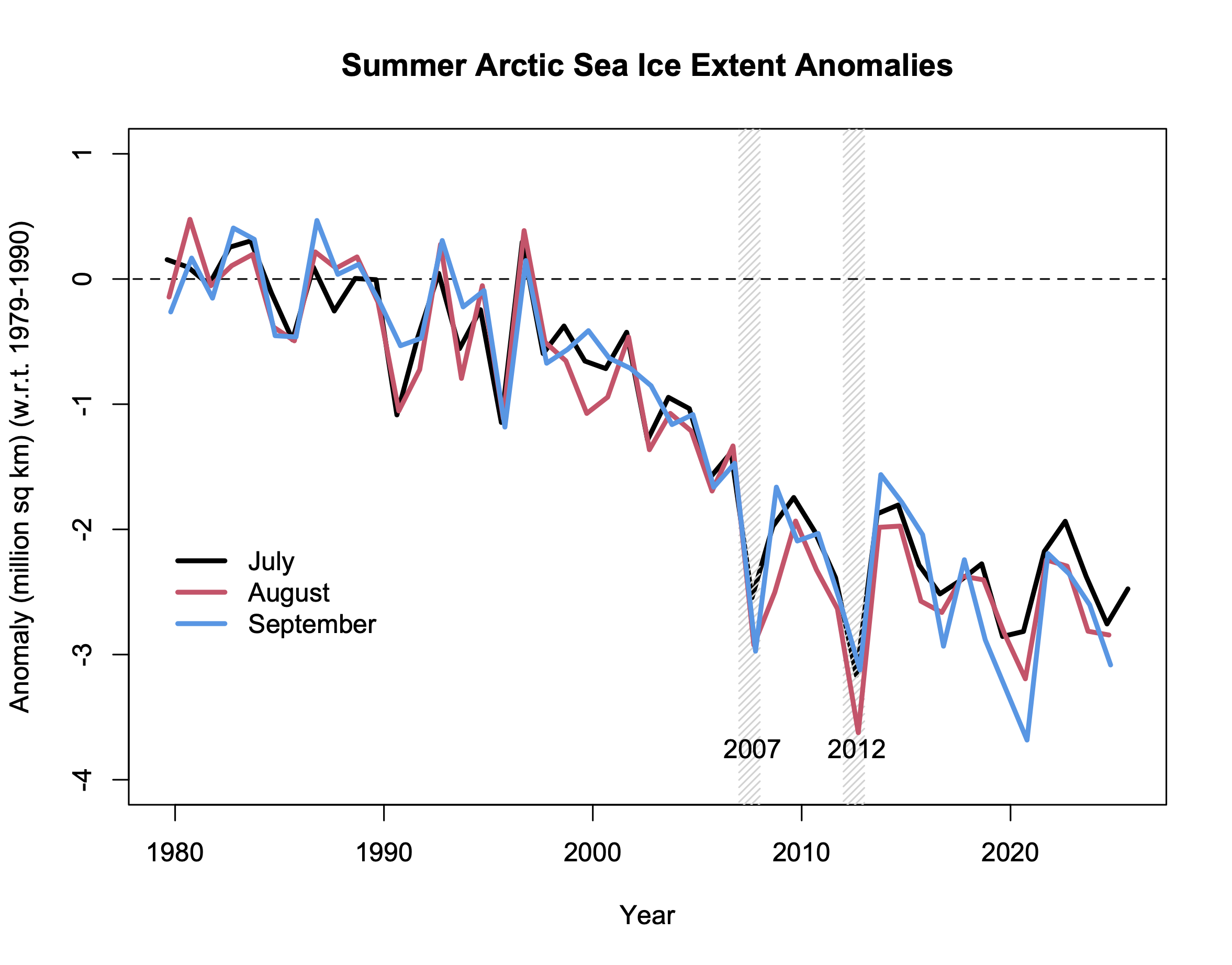
New Study: No Decline In Arctic Sea Ice Extent – ‘No Long-Term Trend’ – Since 2007

by K. Richard, Aug 11, 2025 in NoTricksZone 


In 2007 Al Gore won a Nobel Peace prize for predicting summer (September) Arctic sea ice would “vanish” in the next 5 to 7 years, or by 2014.

Since 2007 Arctic sea ice extent (SIE) losses have ceased. Instead, the SIE trend has been stable for nearly two decades (Stern, 2025).

“Before 2007, September SIE was declining approximately linearly. In September 2007, SIE had its largest year‐to‐year drop in the entire 46‐year satellite record (1979–2024). Since 2007, September SIE has fluctuated but exhibits no long‐term trend.”


New Study Thoroughly Disassembles The CO2-Drives-Climate Assumption In One Fell Swoop

by K. Richard, Aug 15, 2025 in NoTricksZone 


Not only does CO2 have no discernible effect on climate, but any alleged anthropogenic role within the hypothetical greenhouse effect is not detectable either.

In recent decades there has been a concerted effort to assert it is “settled” science to characterize variability in the atmospheric CO2 concentration – assumed to be modulated by human activity – as the predominant factor in both climate change and the so-called greenhouse effect.

Science, however, is never truly settled.

A new Frontiers study succinctly unsettles this prevailing paradigm with surgeon-like precision. In under 20 pages the authors deliver a cogent critique of the CO2-drives-climate presumption. A few of the key points include:

• CO2 only contributes about 4-5% to the greenhouse effect, whereas water vapor and clouds contribute 95%.

• Of that 4-5% greenhouse effect contribution from CO2, just 4% of that can be attributed to human activities (i.e., fossil fuel emissions). Thus, about 96% of the 4% contribution from CO2 can be attributed to natural processes.

“WV [water vapor] and clouds (for which WV is responsible) dominate the ARE [atmospheric radiative effect], while CO2 contributes only 4-5% to it. Also, anthropogenic CO2 emissions are only 4% of the total, with the vast majority (96%) being natural. Additionally, evidence suggests that changes in temperature precede those in CO2 concentration, thus challenging the assumption that CO2 drives temperature.”

• As Fig. 10 in the study indicates, observed changes in the atmospheric CO2 concentration cannot be demonstrated to have exerted any effect in altering longwave radiation measurements, much less the surface temperature. A hypothetical doubling the CO2 concentration [NC-RAGs, or non-condensing radiatively active gases] “results in a temperature increase of zero”.

“[W]hile the role of CO2 in photosynthesis is important in biochemical terms, it becomes negligible in terms of its contribution to the surface energy balance.”

“[T]he observed increase of the atmospheric CO2 [from 300 ppm to 420 ppm] has not altered the ARE [atmospheric radiative effect or greenhouse effect] in any discernible way.”


New Study: Heatwave-Related Deaths Have Been Declining In Recent Decades

by K. Richard, Aug 4, 2025 in NoTricksZone 


Human ingenuity outpaces modern warming. 

A comprehensive new data analysis (Walkowiak et al., 2025) involving European countries finds it takes less than 18 years for humans to adapt to a 1°C increase in mean annual temperature. Consequently, exposure to excessive heat has become less and less deadly.

Supporting this conclusion, a 2018 study involving 305 locations across 10 countries (1985-2012) affirmed “a decrease in heat-mortality impacts over the past decades,” as “heat-related mortality [fractions, AFs] decreased in all countries.”

DOE Climate Report Authors Challenge Climate Consensus, Trigger Fierce Media Backlash

by K. Killough, Aug 4, 2025 in ClimateChangeDispatch 


he Department of Energy has released a climate assessment report that incorporates the conclusions of climate scientists who have long been labeled by Democrats, the media, and climate activists as “climate deniers.” [emphasis, links added]

In a statement announcing the release Tuesday of the report, Energy Secretary Chris Wright said it was part of the EPA’s proposed rule repealing the 2009 endangerment finding, which cites the report.

Wright notes in the report’s foreword that the modern world is one of unprecedented prosperity in human history, but the public is being told that “the very energy systems that enabled this progress now pose an existential threat.”

He said he commissioned the report to “encourage a more thoughtful and science-based conversation” that scrutinizes the view that fossil fuels are threatening humanity’s well-being.

The report’s coauthor, Dr. Judith Curry, president of the Climate Forecast Applications Networkand author of “Climate Uncertainty and Risk,” says on her blog that there wasn’t complete agreement among the authors, and she welcomes a robust discussion on the report’s conclusion.

However, she wrote, she didn’t expect the same kind of openness from the alarmists who have long been the primary source of science informing climate policy for the past couple of decades.

“The Michael Mann wing of the climate debate will hate this report because: the CWG [Climate Working Group] authors are reputable scientists outside of their ‘tribe.’ The Report demonstrates that Mann et al. are losing control of the climate narrative in the U.S., and because of Trump Derangement Syndrome,” Curry wrote, adding that their usual ad hominem attacks won’t be effective against the report.