Archives de catégorie : climate-debate

The Sahara Is Green When Warm, Desert When Cold…And It’s Drier Now Than The Last Glacial Maximum

by K. Richard, Aug 1, 2022 in NoTricksZone


If wetter is warmer and drier is colder, the modern Saharan climate suggests we are not in a warm period.

It is common knowledge that warmer temperatures are associated with wetter, greener climates, and cooler temperatures are linked to droughts, browning, crop failures, etc.

For example, in the continental US there is a “robust association between pan-CONUS drought events and cold tropical Pacific conditions” (Baek et al., 2019). Again, cooling sea surface temperatures are the “principal driver” of drought across the US.

Why the Sun, Not CO2, Heats the Oceans Revisiting the Debate: Does Greenhouse Back-radiation Warm the Oceans?

by J. Steele, Aug 1, 2022 in WUWT


About a decade ago there was a heated and unresolved debate on whether infrared back radiation from greenhouse gases is heating the oceans. Because infrared penetrates less than a millimeter into the ocean’s surface, many skeptics argued it is impossible to blame rising CO2 for ocean warming. However, several prominent skeptic scientists, people who I have great respect for, also weighed in arguing it was silly and useless to argue infrared heat can’t warm the ocean.

After analyzing the physics detailed in this video, I’m convinced it is solar energy that drives the observed ocean heating, and any infrared ocean heating is insignificant at best. If this analysis holds, it is another significant strike against the prevailing CO2 driven global warming theory

To ensure lay people are brought up to speed, here’s a quick summary of where consensus climate science stands today.

STUDY: 96% OF U.S. CLIMATE DATA IS CORRUPTED

by Heartland Institute, July 27, 2022


Official NOAA temperature stations produce corrupted data due to purposeful placement in man-made hot spots

Nationwide study follows up widespread corruption and heat biases found at NOAA stations in 2009, and the heat-bias distortion problem is even worse now

ARLINGTON HEIGHTS, IL (July 27, 2022) – A new study, Corrupted Climate Stations: The Official U.S. Surface Temperature Record Remains Fatally Flawed, finds approximately 96 percent of U.S. temperature stations used to measure climate change fail to meet what the National Oceanic and Atmospheric Administration (NOAA) considers to be “acceptable” and  uncorrupted placement by its own published standards.

The report, published by The Heartland Institute, was compiled via satellite and in-person survey visits to NOAA weather stations that contribute to the “official” land temperature data in the United States. The research shows that 96% of these stations are corrupted by localized effects of urbanization – producing heat-bias because of their close proximity to asphalt, machinery, and other heat-producing, heat-trapping, or heat-accentuating objects. Placing temperature stations in such locations violates NOAA’s own published standards (see section 3.1 at this link), and strongly undermines the legitimacy and the magnitude of the official consensus on long-term climate warming trends in the United States.

“With a 96 percent warm-bias in U.S. temperature measurements, it is impossible to use any statistical methods to derive an accurate climate trend for the U.S.” said Heartland Institute Senior Fellow Anthony Watts, the director of the study. “Data from the stations that have not been corrupted by faulty placement show a rate of warming in the United States reduced by almost half compared to all stations.”

NOAA’s “Requirements and Standards for [National Weather Service] Climate Observations” instructs that temperature data instruments must be “over level terrain (earth or sod) typical of the area around the station and at least 100 feet from any extensive concrete or paved surface.” And that “all attempts will be made to avoid areas where rough terrain or air drainage are proven to result in non-representative temperature data.” This new report shows that instruction is regularly violated.

READ THE REPORT (PDF).


No, Met Office–A Dry July Does Not Mean Climate Change.

by P. Homewood, July 30, 2022 in NotaLotofPeopleKnowThat


So far July 2022 has been the driest July in England since 1911. Up to 26 July there has been only 15.8mm of rain averaged across England; this is only 24% of the amount we would expect in an average July.

At this stage in the month we would expect to have seen well over three-quarters of the month’s rain to have already fallen in an average July.

The situation for the UK is a little better. As it stands, July 2022 is still the eighth driest July since 1836. With only 37.7mm of rain having fallen so far it is the driest July since 1984. Scotland has been closer to average in the north and west, but drier conditions have prevailed for south and east Scotland. Overall Scotland (71%), Wales (39%) and Northern Ireland (43%) have been dry, but the most extreme conditions are in East Anglia and southeast England.

Mark McCarthy, Head of the Met Office National Climate Information Centre, said: “It is not just July that has been dry. Since the start of the year, all months apart from February have been drier than average in the UK too. The result of this is that the winter, spring and summer of 2022 have all seen less than the UK average seasonal rainfall. 

“England has seen the lowest levels during these periods and, rainfall totals for the first six months of the year are around 25% below their long-term average, with the driest regions in the east and southeast.

Germany’s Alfred Wegener Institute Sees No Extreme Situation With Arctic Sea Ice

by P. Gosselin, July 22, 2022 in NoTricksZone


The Alfred Wegner Institute does not see an extreme situation with sea ice in the Arctic (June 2022). The institute’s page states:

The Alfred Wegener Institute Helmholtz Centre for Polar and Marine Research (AWI) is participating again this year with the AWI Consortium Model, a dynamic coupled sea ice ocean model, and calculated a September sea ice extent of 4.75 million square kilometers in its June forecast. This value is about 4% above the median value of all submitted models but in the middle of the predictions given for dynamic models.

Dr. Frank Kauker, a physicist in the Sea Ice Physics Section at AWI, assesses the first prediction as follows: “The first forecast of a year from the beginning of June is usually still characterized by a rather large uncertainty (this year 0.43 million square kilometers). Nevertheless, at the moment there is nothing to indicate an extreme situation in September.

The ice cover in September will be with a great probability in the range of the last years, i.e. between 4 and 5 million square kilometers. The next forecast in early July will reduce the uncertainty somewhat, as it will become clear in June how many melt ponds will have formed, which will then decisively determine the melt rates of the ice during the rest of the year due to their lower solar irradiance return.”

New Study: 96% Of U.S. Climate Data Is Corrupted

by Heartland Institute, July 28, 2022  in ClimaterChangeDispatch


A new study, Corrupted Climate Stations: The Official U.S. Surface Temperature Record Remains Fatally Flawed, finds approximately 96 percent of U.S. temperature stations used to measure climate change fail to meet what the National Oceanic and Atmospheric Administration (NOAA) considers to be “acceptable” and uncorrupted placement by its own published standards. [bold, links added]

The report, published by The Heartland Institute, was compiled via satellite and in-person survey visits to NOAA weather stations that contribute to the “official” land temperature data in the United States.

The research shows that 96% of these stations are corrupted by localized effects of urbanization – producing heat bias because of their close proximity to asphalt, machinery, and other heat-producing, heat-trapping, or heat-accentuating objects.

Placing temperature stations in such locations violates NOAA’s own published standards (see section 3.1 at this link) and strongly undermines the legitimacy and the magnitude of the official consensus on long-term climate warming trends in the United States.

“With a 96 percent warm bias in U.S. temperature measurements, it is impossible to use any statistical methods to derive an accurate climate trend for the U.S.,” said Heartland Institute Senior Fellow Anthony Watts, the director of the study.

How Eco-Activists And Lawsuits Are Worsening Wildfires

by J. Wood, July 27, 2022 in Climate ChangeDispatch


With more than three million acres already burned or burning, 2022 is shaping up to be another devastating year for wildfires in the U.S.

America’s forests need to be managed more actively, a task the Biden administration took up earlier this year when it announced a 10-year strategy to reduce excess fire fuels, like downed trees and underbrush, on up to 20 million acres of national forest and 30 million acres of other lands. [bold, links added]

This plan is a step in the right direction, but it’s unlikely to come to fruition if the administration doesn’t first tackle two major obstacles to forest restoration: environmental red tape and litigation.

Projects to clear out fire fuel often face substantial delays. New research from the think tank where I work, the Property and Environment Research Center, found that it takes an average of 3.6 years for efforts to clear downed, unhealthy, and too densely grown trees to move from the required environmental review to on-the-ground work.

For prescribed burns, the delay is even longer, 4.7 years. And these are the averages. Many urgently needed projects take much longer.

While many bureaucratic, technical, and fiscal obstacles affect these delays, red tape and lawsuits are substantial contributors.

Little evidence of changes in extreme weather trends

by P. Homewood, July 27, 2022 in NotaLotofPeopleKnowThat


New IPCC attribution statistics are distorting observational evidence

London, 27 July – A new paper from the Global Warming Policy Foundation finds that the IPCC’s recent shift in methodology has led to misleading claims about changes in weather extremes.

The review, from physicist Dr Ralph Alexander, finds that IPCC claims that many of these weather extremes are increasing significantly are largely unsupported by observational evidence.

Ralph Alexander: Extreme Weather: The IPCC’s Changing Tune (pdf)

According to Dr Alexander:
“On almost every kind of extreme weather, with the possible exemption of heatwaves, the evidence for significant changes is scant. But the latest IPCC report has introduced novel ‘attribution’ statistics and now insists that things are getting worse. It’s yet another case of scientists trying to scare the public into compliance.”

Dr Alexander’s paper looks at:
– droughts
– floods
– hurricanes
– tornadoes
– wildfires
– hot and cold extremes
– coral bleaching.

He concludes that:
“The mistaken belief that weather extremes are worsening because of climate change is more a perception, fostered by media coverage, than reality. The IPCC’s new statistical method is playing an unworthy part in bringing this sorry state of affairs to pass.”

GWPF invited the Royal Society and the Met Office to review this paper, and to submit a response to be published as an appendix to it. No reply was received.

The IPCC And The Infamous Hockey Stick Graph

by CCD Editor, July 25,2022 in ClimateChangeDispatch


Ron Barmby, author of  “Sunlight on Climate Change: A Heretic’s Guide to Global Climate Hysteria” (AmazonBarnes & Noble) spoke with Mike Ryan of TNT Radio (TNT Radio (podbean.com) about what he uncovered in the recent IPCC report, Climate Change 2021: The Physical Sciences Basis.

Ron’s findings: after being made famous by Al Gore and adopted by the IPCC, then being made infamous by its historical and statistical failings and subsequently dropped by the IPCC, the hockey stick temperature graph is back!

And a new narrative is being introduced that carbon dioxide has been demoted to causing only half of human global warming to date.

Mike discusses with Ron the four things wrong, and often in conflict with, the report itself with the latest doomsday science from the IPCC. LISTEN:

LARGEST SUMMER SEA ICE EXTENT SINCE 2008 TRAPS ARCTIC SHIPS; + COLDEST JULY AIRMASS IN 70 YEARS BLOWS THROUGH THE BERING STRAIT

by Cap Allon, July 19, 2022 in Electroverse


The mainstream are heat-chasers. They report only on stories that fit the AGW Party agenda. This cherry-picking leads to a painfully misinformed public when it comes to the climate–which is exactly where they want us.

It usually stands, however, that if the MSM goes silent on a particular locale then it’s probably because that particular locale isn’t ‘behaving’ as they would like.

ase in point today: we have the Arctic and Greenland refusing to play ball.

Earth’s most-northern reaches are actually experiencing persistent and long-lasting COOLING, which is far more telling than a brief burst of heat in, for example, Western Europe, which, 1) is forecast to be over before it’s even really begun, and 2) can be tied to entirely natural forcings–namely low solar activity and a violently ‘buckling’ jet stream flow (more on that below).

UK heatwave: How do temperatures compare with 1976?

by P. Homewood, July 24, 2022 in NotaLotofPeopleKnowThat


People on social media have been comparing the high temperatures in much of the UK with the heatwave of 1976, suggesting that the severity of the current hot weather is being exaggerated.

So, what does the evidence show?

How hot was the summer of 1976?

The peak that year was 35.9C. That has been beaten by the current temperatures, with 40.3C recorded so far.

The heatwave of 1976 started in June and lasted for two months. There was a lack of rainfall and a significant drought, with the government enforcing water rationing.

The heatwave was rare for that decade. The average maximum temperature in July in the 1970s was 18.7C. In the 2010s, it was more than 20C.

The European Heat Wave and Global Warming

by Guest Blogger, July 21, 2022 in WUWT


From the Cliff Mass Weather Blog

There is a lot of talk about the short-term European heatwave with some suggesting that the record-breaking warmth is the result of climate change/global warming.

Some of the media and climate advocates have been over the top in their claims (see below), stating that this event was the result of human-caused global warming.

Global Warming Has Stalled Over Much Of The Last 10 Years, Arctic Never Melted Away

by P. Gosselin, July, 22, 2022 in NoTrickZone


The globe hasn’t been warming and the Arctic hasn’t been melting much for almost a decade now.

Recall the climate crisis loonies warned us some 20 years ago the Arctic sea ice would disappear by the summer of 2014. Well it’s still very much there, as Joe Bastardi reminds us at his most recent Saturday Summary:

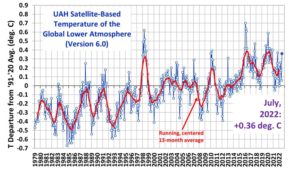
No warming in 8 years

Moreover, UAH global mean temperature anomaly hasn’t risen in eight years as well, Hat-tip Snowfan here:

….

Was It Hotter In 1911?

by P. Homewood, July 23, 2022 in NotaLotofPeopleKnowThat


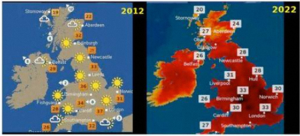
There has inevitably been a lot of apoplectic reporting about this week’s heatwave in Britain. Everybody from the BBC to the Met Office have been blaming it on climate change, with suitably scary colours to ram the message home:

Comparison of TV weather Maps from the BBC in summer 2012, left, and summer 2022 right. Source: BBC

Courtesy of Climate Realism

But so far I have not seen an objective analysis.

So let’s start with a few simple facts:

1) It was extremely hot for a couple of days this week.

2) The heat was the result of an extremely unlikely set of meteorological conditions – a perfect storm, if you like.

We know this because the Met Office told us so. On July 8th, they announced the possibility of a heatwave a week later. The weather model runs produced a wide band of possibilities, with most predicting similar temperatures to the weekend before, and some even forecasting no heatwave at all. At that stage on a couple of models out of the hundreds run predicted 40C temperatures, which were described by the BBC as “a very tiny possibility”.


Climate Monitoring Since The Little Ice Age

by P. Homewood, July 19, 2022 in NotaLotofPeopleKnowThat


Meanwhile the jokers at the Met Office don’t seem to have realised that their temperature records begin at the depth of the Little Ice Age, or appear to have heard about Urban Heat Islands

It is mid July 2022. We are currently experiencing a significant – at the time of writing provisionally record-breaking – heatwave for the UK. Red weather warnings for extreme heat are in force for large parts of England and forecasts indicated a real possibility of temperatures reaching up to 40°C in some areas. Indeed, this temperature has already been exceeded. Whether or not records are broken, a key part of the work that we do at the Met Office is climate monitoring, an important aspect of which is the ability to put current weather into historical context. Climate monitoring serves many functions: It can effectively communicate the relative severity of an event; it can indicate how frequently such extremes are likely to occur; and it can monitor how the character or frequency of extremes are changing over time. In order to properly understand the risks from climate change, a key research question climate monitoring can help us to answer is, ‘What are the current weather and climate hazards, risks and impacts that should be expected in the UK and globally?’. To address this question, we must look to the past, and the scientific effort goes back further than you might think.

Making history

In 1663, Robert Hooke stood before the relatively newly formed Royal Society and proposed ‘A method for making the history of the weather’. Hooke and other notable scientists of the time were actively developing instruments capable of making meteorological measurements of wind, rain, air pressure, humidity and temperature. These were the early anemometers, rain gauges, barometers and thermometers of the time1. In his paper, Hooke recommended what should be measured and how it should be recorded, including ‘a scheme at one view representing to the eye the observations of the weather for a month’ and implored his colleagues to undertake such measurements. From a modern climatologist’s point of view, arguably one of the most important advances by Hooke was his recognition that if systematic and consistent measurements were made across the country, or even across the world, then an international perspective on the weather could be obtained, for the benefit of humankind. 

The Two Degree Limit

by Andy May, July 19, 2022 in WUWT


For decades We have been told that we must not let global warming exceed two degrees Celsius above the “pre-industrial” global average temperature. Recently the IPCC lowered this limit to 1.5°C. In the latest IPCC report, called AR6, pre-industrial is defined as before 1750, but they use global temperatures from 1850-1900 as representative of the period because global average surface temperatures are not available for 1750.[1] The U.S., Europe, and much of Asia were industrialized by 1900, so their numbers are clearly not representative of the period of interest, unless temperatures remained constant from 1750 to 1900, which is unlikely.

Why the focus on 2°? In a 2014 comment in Nature, David Victor and Charles Kennel tell us that there is little scientific basis for the 2°C figure, but it was a simple focal point and it “sounded bold and perhaps feasible.” (Victor & Kennel, 2014). Then they admit the goal is “effectively unachievable.”

What is the “pre-industrial?” Did it have an ideal climate that we wish to return to? The year 1750 was in the coldest and most miserable part of the Little Ice Age (LIA). The LIA was the coldest period in the Holocene Epoch, or since the last glacial period ended about 12,000 years ago, at least in much of the Northern Hemisphere.

Greenhouse gas CO2 , should not be feared.

by Dr ir. F. van den Beemt, March 15, 2022 in ScienceTalks


The 2021 UN Climate Change Conference, COP 26, resulted in several countries making statements that they would aim to reduce their emissions of greenhouse gases, particularly CO2, based on the fear that these gases are warming the Earth dangerously by what they call the greenhouse effect. But fear is a bad counselor. Understanding the matter reduces anxiety. The purpose of this article is to inform a broad audience about the greenhouse gas CO2 without going into scientific detail, for the latter see [1].

The Earth Thermostat: ensuring a livable temperature on Earth.

The sun heats the Earth with mostly visible light. Our water planet, the Earth, cools down by invisible heat radiation to space. The Earth’s surface, the oceans, and the atmosphere store heat to varying degrees. Wind- and water flows distribute heat all over the Earth. The evaporation process of water transmits energy from the surface into the air. Warm air rises until it cools and forms clouds. Clouds reflect incoming sunlight back to space that otherwise would have warmed the Earth’s surface. Clouds emit heat radiation to space and also some back to the Earth’s surface. These and many more heat transport processes act together as a planet-wide thermostat to create the livable temperature on Earth that we enjoy today.

The terrestrial thermostat knows no rest.

If the Earth’s surface warms up for any reason, this thermostat acts until a new equilibrium is reached. This equilibrium is never static, however, it fluctuates because the wind, convection, precipitation, and all the other dynamic natural processes continually adjust. The atmosphere shows dynamic, cyclic and chaotic characteristics.


Figure 1 ( copied from Figure 10 in [2]): Effects of changing concentrations of  CO2 on the filtered spectral flux at the mesopause altitude of 86 km. The smooth blue line is the spectral flux, from a surface at the temperature of 288.7 K for a transparent atmosphere with no greenhouse gases. The green line is with the CO2 removed but with all the other greenhouse gases at their standard concentrations. The black line is with all greenhouse gases at their standard concentrations. The red line is for twice the standard concentration of CO2 but with all the other greenhouse gases at their standard concentrations. Doubling the standard concentration of CO2 (from 400 to 800 ppm) would only cause a forcing increase (the area between the black and red lines) of 3.0 W m−2.

Above clouds, the water vapor concentration decreases where CO2 concentration stays nearly constant. Within the upper troposphere and the stratosphere, the CO2-specific part of the emission by clouds and water vapor will be again absorbed but now mainly by CO2. Within the thin stratosphere, CO2 emits to space as our satellites detect.

Heat emission to space at top of the atmosphere

Think it’s hot now? How Britain roasted in TEN-WEEK heatwave during summer of ’76

by P. Homewood, Jul 15, 2022 in NotaLotofPeopleKnowThat


Wildfires have raged, speed restrictions have been imposed on some railway lines and hospitals have already declared ‘critical incidents’.

The hot weather in Britain this summer is set to peak next week, when the mercury could top 39C (102F) in London.

The current non-stop sunshine has evoked memories of the summer of 1976, when there were 15 consecutive days that saw temperatures of 89.6F (32C) somewhere in the UK.

Overall, there were ten weeks of blazing heat that saw widespread drought, mass standpipe use, and even the pausing of the murder trial of the notorious ‘Black Panther’, after a woman suffering from ‘heat exhaustion’ collapsed.

During a First Division football match between Manchester City and Aston Villa, City player collectively lost four stone in weight, prompting the team’s captain to call for an end to ‘summer soccer’.

At that year’s Wimbledon tennis championships, umpires were allowed to remove their jackets for the first time in living memory, whilst major roads were littered with broken-down cars that had overheated.

The extreme weather also caused an increase in the number of 999 callouts to domestic disturbances, as tempers buckled due to the heat.

The summer of 1976 was caused in part by very hot air that had originated in the Mediterranean. The warm weather and lack of rain began on June 23 and did not abate for more than a month.

The highest temperature recorded in the summer was on July 3, when the mercury hit 96.6F (35.9C) in Cheltenham. The average maximum daily temperature was 67.8F (19.9C).

“97% Consensus” — What Consensus?

by G. Wrightstone, Oct 28, 2021 in CO2Coalition


You have likely heard that 97% of scientists agree on human-driven climate change. You may also have heard that those who don’t buy into the climate-apocalypse mantra are science-deniers. The truth is that a whole lot more than 3% of scientists are skeptical of the party line on climate. A whole lot more.

The many scientists, engineers and energy experts that comprise the CO2 Coalition are often asked something along the lines of: “So you believe in climate change, then?” Our answer? “Yes, of course we do: it has been happening for hundreds of millions of years.” It is important to ask the right questions. The question is not, “Is climate change happening?” The real question of serious importance is, “Is climate change now driven primarily by human actions? That question should be followed up by “is our changing climate beneficial or harmful to ecosystems and humanity?”

There are some scientific truths that are quantifiable and easily proven, and with which, I am confident, at least 97% of scientists agree. Here are two:

  1. Carbon dioxide concentration has been increasing in recent years.

  2. Temperatures, as measured by thermometers and satellites, have been generally increasing in fits and starts for more than 150 years.

What is impossible to quantify is the actual percentage of warming that is attributable to increased anthropogenic (human-caused) CO2. There is no scientific evidence or method that can determine how much of the warming we’ve had since 1900 that was directly caused by us.

We know that temperature has varied greatly over the millennia. We also know that for virtually all of that time, global warming and cooling were driven entirely by natural forces, which did not cease to operate at the beginning of the 20th century.

The claim that most modern warming is attributable to human activities is scientifically insupportable. The truth is that we do not know. We need to be able to separate what we do know from that which is only conjecture.

What is the basis for the “97% consensus” notion? Is it true? 

Hint: You can’t spell consensus without “con.”

If, indeed, 97% of all scientists truly believed that human activities were causing the moderate warming that we have seen in the last 150 years, it would be reasonable for one to consider this when determining what to believe. One would be wrong, however.

Science, unlike religion, is not a belief system. Scientists, just like anyone else, will say that they believe things (whether they believe them or not) for social convenience, political expediency or financial profit. For this and other good reasons, science is not founded upon the beliefs of scientists. It is a disciplined method of inquiry, by which scientists apply pre-existing theory to observation and measurement, so as to develop or to reject a theory, so that they can unravel as clearly and as certainly as possible the distinction between what the Greek philosopher Anaximander called “that which is and that which is not.”

Declining tropical cyclone frequency under global warming

by S. Chand et al., Jun 27, 2022 in Nature


Abstract

Assessing the role of anthropogenic warming from temporally inhomogeneous historical data in the presence of large natural variability is difficult and has caused conflicting conclusions on detection and attribution of tropical cyclone (TC) trends. Here, using a reconstructed long-term proxy of annual TC numbers together with high-resolution climate model experiments, we show robust declining trends in the annual number of TCs at global and regional scales during the twentieth century. The Twentieth Century Reanalysis (20CR) dataset is used for reconstruction because, compared with other reanalyses, it assimilates only sea-level pressure fields rather than utilize all available observations in the troposphere, making it less sensitive to temporal inhomogeneities in the observations. It can also capture TC signatures from the pre-satellite era reasonably well. The declining trends found are consistent with the twentieth century weakening of the Hadley and Walker circulations, which make conditions for TC formation less favourable.

Impact of Changing Climate on Andean Glaciers in Sync with Polar Ice

by University of Florida, Jul 14, 2022 in WUWT


Peer-Reviewed Publication

Glaciers in tropical mountain ranges are experiencing similar impact from the drivers of climate change as those in the polar regions of Antarctica and the Northern Hemisphere, according to a study published today in Nature.

The paper by a team of international scientists, including Robert Hatfield, an assistant professor in the University of Florida Department of Geological Sciences, is the first to show that the effects of greenhouse gases and other drivers of the Earth’s temperature are impacting glaciers in the Southern Hemisphere at the same pacing as ice sheets in the north.  To derive their findings, researchers used sedimentary deposits from Lake Junín, high in the Peruvian Andes, to create a record of glacial changes stretching back 700,000 years.

Hatfield explained that much of what scientists knew about past glacial changes came from records of ice growth and decay that occurred in the Northern Hemisphere.

“As we try to understand how climate works across the globe, we need more than just records that are influenced by and biased toward the Northern Hemisphere,” Hatfield said.

The land-based lake record collected by Hatfield and his colleagues matches the duration of ice core records from Antarctica and spans the longest time frame ever collected from the Southern Hemisphere.

“What makes our findings unique is that we were able to get a continuous and independently dated record of tropical Alpine glaciation for the first time,” he said. “The key takeaway was that the tropics follow the same beat and same rhythm to what’s going on in the Northern Hemisphere.”

Despite variations in solar radiation between the two hemispheres, the study showed glacier changes in both regions occurred at the same time. This suggests that the rise in atmospheric greenhouse gas concentrations associated with changes in the volume of the ice sheets of the north is influencing the entire planet simultaneously.

Arctic Sea Ice Still Quite Abundant for Early Summer

by S. Crockford, Jul 15, 2022 in WUWT/PolarbearScience


Despite rhetoric to the contrary, there is still plenty of sea ice over Arctic regions this summer, supplying feeding platforms for polar bears, ice-dependent seals, and walrus cows nursing their young calves. Forget about whether the numbers are below or above some short-term average, there is no catastrophe in the making for marine mammals in the Arctic at this time.

Remember, by early summer, young seals have left the surface of the ice and are in the water feeding; predator-savvy adults and subadults are hauled out on broken chunks of ice moulting their hair-coat. They may look like sitting ducks but polar bears have a hard time catching them because the seals are vigilant and have many escape routes available (due to all the open water). Most polar bears in Hudson Bay are still on the ice (you’ll see why below): the live cams near Churchill set up to watch polar bears are presently showing images of ravens with sea ice in the background, not bears.

This post is predominantly sea ice charts for mid-July, what we in the science field call observational evidence, aka ‘facts’. Keep in mind that satellites used to produce these images have an especially hard time distinguishing ice topped with melt water from open water, which means much more ice useful to these marine mammals is almost certainly present than is shown in the charts (as much as 20% more in some regions).

Arctic-wide levels, NSIDC Masie


Lennart Bengtsson: Global climate change and its relevance for a global energy policy.

by H. von Storch, March 12, 2013 in DieKlimazwiebel


The relation between temperature and greenhouse gases in its very simplistic form has been known since the second half of the 19thcentury. The effect of the greenhouse gases can be seen as a warm overcoat preventing the surface in radiating away the heat to space. However, the warming is a complex process incorporating the dynamics of atmospheric and ocean flows and interactions of the many components of what is now called the Earth’s system. This includes in addition to the atmosphere, the oceans, the land surfaces and the land ices. Its study requires advanced computer models and other tools for its analysis and understanding.  It also requires accurate observations for validation and monitoring as well as special measurements for the development of many crucial aspects of the models. It is in fact an immensely complex undertaking that is virtually impossible to explain to the public in a readily understandable way. This has lead to a tendency towards oversimplification that has contributed more to confusion than to a thorough understanding. However, because of the strong public interest we are now facing a dilemma as the public and the political community have become too much involved in the climate change debate influencing the actual science and this not necessarily in a positive way as it implies an arbitrary selection of priorities and preferential issues.


Natural processes drive climate and practically all kinds of extreme weather have always been part of the climate and are practically unrelated to the modest warming we so far have had. The effect of increasing greenhouse gases is a slow but relentless process that will have to be dealt with but will require more time and better insight in key processes.Some events are seen as very dramatic as the reduced Arctic summer ice, others, even more puzzling, such as the surprising lack of warming in the tropical troposphere is hardly discussed.

The problem is that the global warming is mainly caused by the emission of carbon dioxide and thus directly related to energy production by fossil fuels that has dominated and still dominates the energy production by more than 80%. To significantly reduce or eliminate fossil fuel is not feasible on a time-scale shorter than several decades, as it requires fundamental technical breakthrough in energy generation or alternatively a major change in our life stile. As the second alternative is hardly possible to achieve in a world with mostly open societies, it is obvious that the world community is facing a gigantic challenge. Additionally many parts of the world are suffering because of a lack of suitable energy and the need is further underpinned by the fact that the world’s population will increase by another two billion humans in the next three decades.

Some comments on the present situation

Mass balance of the Antarctic ice sheet 1992–2016: reconciling results from GRACE gravimetry with ICESat, ERS1/2 and Envisat altimetry

by J. Zwally et al., 2021, March 29, in J.of.Glaciology


Abstract

GRACE and ICESat Antarctic mass-balance differences are resolved utilizing their dependencies on corrections for changes in mass and volume of the same underlying mantle material forced by ice-loading changes. Modeled gravimetry corrections are 5.22 times altimetry corrections over East Antarctica (EA) and 4.51 times over West Antarctica (WA), with inferred mantle densities 4.75 and 4.11 g cm−3. Derived sensitivities (Sg, Sa) to bedrock motion enable calculation of motion (δB0) needed to equalize GRACE and ICESat mass changes during 2003–08. For EA, δB0 is −2.2 mm a−1 subsidence with mass matching at 150 Gt a−1, inland WA is −3.5 mm a−1 at 66 Gt a−1, and coastal WA is only −0.35 mm a−1 at −95 Gt a−1. WA subsidence is attributed to low mantle viscosity with faster responses to post-LGM deglaciation and to ice growth during Holocene grounding-line readvance. EA subsidence is attributed to Holocene dynamic thickening. With Antarctic Peninsula loss of −26 Gt a−1, the Antarctic total gain is 95 ± 25 Gt a−1 during 2003–08, compared to 144 ± 61 Gt a−1 from ERS1/2 during 1992–2001. Beginning in 2009, large increases in coastal WA dynamic losses overcame long-term EA and inland WA gains bringing Antarctica close to balance at −12 ± 64 Gt a−1 by 2012–16.

Global Man-Made CO2 emissions 1965 – 2021: BP Data

by BP, Jul 10, 2022 in WUWT


Introduction

Every summer BP publish their statistical review of world energy.

https://www.bp.com/en/global/corporate/energy-economics/statistical-review-of-world-energy/co2-emissions.html

One element of their comprehensive set of spreadsheets is a table of CO2 emissions country by country since 1965.  For the purposes of this post, the CO2 emissions data provided by BP here is assumed to be valid.  This post reviews the 2022 update to the BP data.

The 2022 dataset accounts for the 2020 effect of the Covid-19 epidemic, the CO2 emissions resulting in the aftermath of the epidemic, its impact on Global economic activity and the outcome for the recovery of Man-made CO2 emissions in 2021.

For an earlier post reporting the status of Man-made CO2 emissions as of 2020, see: